
Photograph: Mark Mistry
Mumbaikars – as Mumbai’s residents are known – spend on average four hours commuting each day, uncharitably cheating those who work a full week of precious time few can afford. Incongruously, the ‘Gateway to India’ is one of the largest conurbations in the world without an underground Metro system. Locals say delays in implementing such vital infrastructure have been fuelled by corruption, a charge that despite the passing decades remains prevalent. True or not, the complexities of completing major infrastructure projects in this megacity have been well documented.

Photograph: Mark Mistry
However, stagnation is not the preserve of big-ticket items, as the building of Mumbai’s new international terminal proves. The absence of bins means that those who wish to dispose of their rubbish responsibly are frustrated at every turn. Coupled with its lack of public toilets, you have a city that ought to be jostling for position with its cousins in China and Malaysia brought low by the most basic of municipal needs, betraying India’s once-vaunted membership of the BRIC group of nations.
Nationally, the Reserve Bank of India introduced an interest rate cut last month in the hope of arresting economic decline. Ominously, on 7 February India’s growth forecast was revised down for the second time in two weeks.
Against this background the beginnings of election fever are perceptibly taking hold. Indian media has been tying itself in knots with the ‘Will he, won’t he?’ question of Gujarat’s First Minister Narendra Modi’s expected tilt at the premiership as the BJP candidate. Meanwhile Rahul Gandhi – scion of the India’s most famous political family – was newly elevated in late January to become Congress party’s vice president, second only to his mother Sonia Gandhi, as the party readies its man.
But while Rahul Gandhi steels himself for the limelight, in Mumbai others in his party present an altogether less appealing face to the electorate. In the last fortnight there was an uncomfortable confrontation between Congress MP Nilesh Rane, son of industries minister Narayan Rane, and a female traffic warden. Anita Lobo, aged 55, pulled up the younger Rane’s convoy for blocking traffic and the two exchanged words, details of which remain in dispute. What is known is that she was detained for three hours at a police station after Rane complained to her superiors. Lobo was warned not to return to the area where the argument arose – an order she has since flouted at the time of writing, according to The Times of India. This episode is a reminder to Mumbaikars, within sight of the election, that family continuity in public life is not always a good idea. Rahul Gandhi might also take note, as there would be little harm in his long-awaited elevation to the party’s high command signalling the need for discipline among Congress candidates if they are to encourage people to vote for the incumbent government.
Law – what is it good for?
As is sadly now known worldwide, India is currently undergoing a period of intense social soul searching as it seeks legal solutions to the issues brought to the fore by the Delhi gang rape case. Implementing new legislation is fraught with uncertainty as debate rages about how any new laws might be used by a police force renowned for its selective approach to enforcement. In Mumbai it is existing laws that are under scrutiny, as the country’s clash between old and new is represented by rich urbanites seeking the same vices as their peers in the Western world.
Barack Obama’s re-election for a second term as US President last year also heralded the relaxation of marijuana laws in California and Washington states. But in Mumbai, where tourists are openly offered hashish at many a corner in Colaba, your correspondent has had to explain to inquisitive police that a rolled-up cigarette does not a joint make. This otherwise unsurprising interaction is turned on its head by goings on at the Kumbh Mela festival taking place almost 900 miles North East of Mumbai, where attendees openly smoke the chillum, a hashish mix, en masse as part of their religious celebrations.
Indeed, some provisions in the Bombay Police Act (1951) would not seem out of place in George Orwell’s 1984. For example, dancing: ‘. . . prior scrutiny of such performances and of the scripts in respect thereof, by the Board approved by the State Government for the purpose . . .’
Venues flouting this rule are still subject to raids by police, who in some cases, as highlighted in Channel 4’s Unreported World in November last year, sought to bring a moral dimension to the supposed crime. Police arrested women present as prostitutes while tipping off the local press, bringing shame upon the individuals and their families.
Nisha Harale Bedi, a former Miss Mumbai now a legislative campaigner for greater personal freedoms across the city, is working tirelessly to encourage authorities to recognise the inherent inequality of local laws, some of which date back to the British Raj.
Nisha said: “This is the country of the Kama Sutra – how can it be that some people’s attitudes are so ancient?”
Bedi is a firm believer not only in sex education, but also informing youths about drugs, ‘to teach them right from wrong’. She added: “We have to remove politics from these (issues) if we want to progress and we cannot let young people’s social education be dominated by Bollywood and MTV alone. If we do, then where will be?”

Photograph: Mark Mistry
Looking ahead
In Mumbai it is important to note that progress is being made. The city’s Police Commissioner, Dr Satyapal Singh, shared a platform on 29 January with Nisha Harale Bedi as part of a panel discussing women’s safety and technology at Mumbai’s World Trade Centre. While he would not be drawn on changes to police training, or his recently reported controversial views on sex education as reported by The Indian Express, he displayed a willingness to work with others. Dr Singh said: “How can the police tackle serious crime when their families protect them? Parents are the best police. If you want to improve society then we must work together.”
That many people spoke in support of the traffic warden involved in the angry exchange with a minister’s son and Congress MP Nilesh Rane demonstrates that ordinary citizens will no longer be cowed by so-called untouchables of the political elite. And millions in Mumbai will have their travelling times drastically diminished with the expected opening of the Metro system later this year.
Only time will tell however if the proposed legislative, social and economic changes at national level can expect the same level of progress, as India seeks to reclaim its economic prowess while soothing international concerns about its treatment of women.
]]>Less than three years after the siege of 26/11, the citizens of Mumbai are facing the consequences of another terror attack. It is hardly a surprise that people are using Twitter to communicate, but its use as a tool for crisis communications is evolving.
Back in 2008, I suggested that an eyewitness tag on Twitter, such as #EW, would help people identify relevant material from the vast torrent of tweets that were being posted about Mumbai.
In 2011, Twitter users have taken things beyond my rather simple idea by organising a number of separate hashtags to relay information.
Rather than only using one hashtag (#Mumbai) as many people did three years ago, today the Twitter users of Mumbai have started posting to:
In addition, as Guardian journalist Laura Oliver has pointed out, Indians are putting together a shared spreadsheet to coordinate useful contact information in real time.
The paper is a case study of the BBC’s adoption of live text commentary to report breaking news. Indeed, Mumbai was the first time the BBC had used a ‘live-blogging’ format to cover a major terror attack.
I’ll be giving the talk at Westminster University’s ‘Global Media and the "War on Terror"’ conference on 14th September.
Abstract
The emergence of instant global communication technology has placed pressure on competing media organisations to publish news information at great speed (Gowing, 2009). In the event of an ongoing breaking news crisis, online journalists have begun to adopt live updates or live blogs as a way of disseminating news information quickly from a variety of sources (Newman, 2009).
The BBC’s use of this format during the Mumbai attacks in 2008 was the first time the organisation had used live updates to cover a major terror attack. The BBC’s coverage won an Online News Association award and appeared popular with the online audience. The live update pages, however, raised a number of editorial questions both within (Herrmann, 2008) and outside the Corporation (Sutcliffe, 2008).
The inclusion of audience material from Twitter was a particular concern. Based on a content analysis of the BBC’s Mumbai live update pages, interviews with journalists who worked on the story and internal documents, this paper considers the impact that ‘live blogging’ a terror attack has on the BBC’s editorial process and journalism.
The paper demonstrates that the imperative of ‘getting news out there’ meant BBC journalists often published news material on the live update pages on the basis of a single source using attribution to distance the BBC from the accuracy of the information.
It also argues that the concept of ‘news as conversation’ is limited by the context of a breaking news security story where a serious tone is expected and careless reporting might jeopardise human life. Although the ‘live blog’ format did facilitate the inclusion of audience comment, the extent to which it should be included was contested both on practical and editorial grounds.
]]>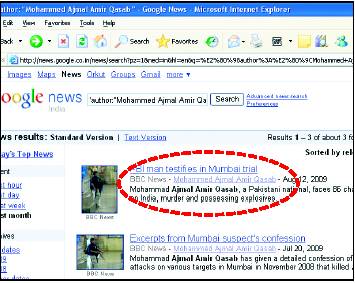
First a labourer in Lahore, followed by a stint at a jihadi camp, then shooting his way into becoming India’s most-reviled terrorist, and now supposedly a journalist. Google News has given Mohammed Ajmal Amir Qasab the status of a BBC correspondent reporting out of Mumbai, albeit mistakenly.
The ubiquitous Internet utility, which is used by millions daily to find and view up-to-the-minute news headlines and related photos, has erroneously attributed three BBC News articles to the Pakistani national — the lone 26/11 gunman alive — who has been charged on 86 counts.
A search given for ‘author:"Mohammed Ajmal Amir Qasab" on Google News on Independence Day-Eve, threw up three stories dated July 20, July 27 and August 12, 2009, attributed to Qasab. The terrorist’s name appears alongside ‘BBC News’ — the same author-line format that Google News places media houses and journalists in. It even adds a link to Qasab’s name, which leads to the three stories.
To add to the irony of the situation, the blunder makes it appear that Qasab is reporting for BBC News about his own trial.
In its functioning, Google News is similar to the Google search engine in that it collects all the web information it can find, creates an index with that information, and serves it to users via a simple web search interface in less than half a second. It continuously ‘crawls’ thousands of English-language news sites and thousands more news sites from around the world to throw up results for a search.
The Google ‘search by author’ feature — which has credited Qasab with his three BBC News stories — allows anyone to find more articles by individual reporters.
"We look at patterns in different articles to identify where author bylines are usually placed. We also do named entity extraction to find names in the articles. By putting those two together, we usually get author names with a high degree of accuracy," a Google spokesperson told TOI.
In this instance, though, Google seems to have picked up Qasab’s name from the caption below his photographs — all three showing the AK-47 wielding terrorist during the bloodbath at Mumbai CST on November 26, 2008.
]]>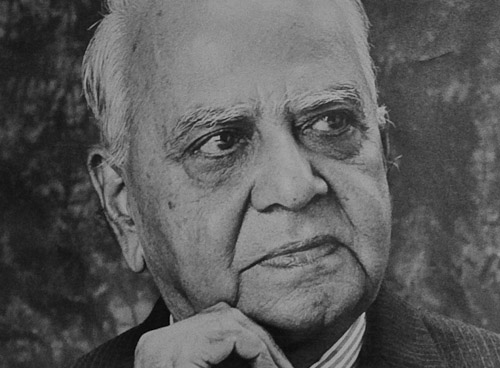
"I have begun to despise politicians and their ways. At my age, I don’t want to photograph any of them unless Barack Obama visits India."
As India goes to the polls at the start of its rather overwhelming general election, the words of TS Satyan, a revered photojournalist who has spent his life chronicling India and Indians, offer a glimpse of how the modern world seems to those who have watched it age with them.
I came across TS Satyan on a recent visit to Mumbai. India’s newspapers were filled with tittle-tattle in the build-up to its election – which begins today, 16 April. The leading paper, The Times of India, placed a modest banner headline at the top of each broadsheet page of coverage, branding the 2009 election a "Dance of Democracy".
Amid low-level election scandal (centring on an anti-Muslim rant by Varun Gandhi, another member of the Nehru-Gandhi dynasty), there was a revealing interview with Satyan in the pages of Time Out Mumbai.
Answering questions as an exhibition of his life’s work opened at the Institute of Contemporary Indian Art in Mumbai, Satyan – now 85 and a veteran of the Deccan Herald, Illustrated Weekly, Time and Life – described the pressures on photojournalists in India in depressingly familiar terms.
Those wanting to take to this profession must consider it carefully. You have to know more and work harder to earn less than in many other professions. You need the strength of a packhorse to carry around all the equipment. You must develop resourcefulness, ingenuity and adaptability to solve assignment logistics. Most important, you must stay healthy, always. You have to be your best self. The expectations of editors and readers are high.
News photography in modern times is not only fatiguing, but also dangerous and calls for alertness and dedication. In India there is not much money for those wanting to work for the print media. No wonder more and more young persons are branching out to other areas like advertising, industrial and fashion photography.

Exhibited in the quiet confines of the ICIA, Satyan’s body of work was impressive. The common theme in the work hung in the gallery was of a quiet, knowing peek inside of India itself. He chronicled rituals, personalities and intimate moments often unseen by outsiders. His images were beautifully composed and lit with a delicate and natural touch.
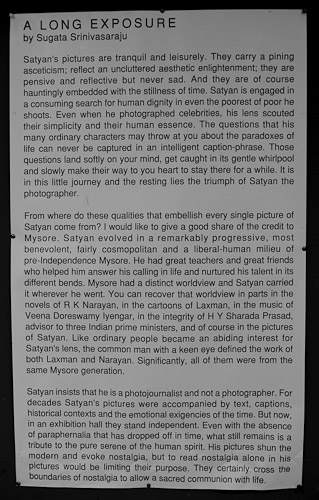
The literature at the ICIA included an introduction to Satyan, highlighting the influence on his work of his home, the educated, literate, princely state of Mysore – home, too, to one of India’s greatest writers, RK Narayan.
And while Satyan in Time Out claimed he was most proud of those of his photographs with an artistic quality, the introduction stresses his roots in news photography. "Satyan insists that he is a photojournalist and not a photographer."

But the photographer himself appears to lament the fast pace of modern journalism, telling Time Out he feels there is now a lack of interest in the work of what he terms "the concerned photographer".
Indian editors are not bothered about him and his work. They are not visually thrilled. They don’t seem to realise that in its own way, a picture can activate the conscience of the reader. They don’t realise that without being preachy the photographer can sensitise, motivate and subtly show us the need to search our own hearts. It is unfortunate that rank commercialisation of the mass media has worsened the situation.
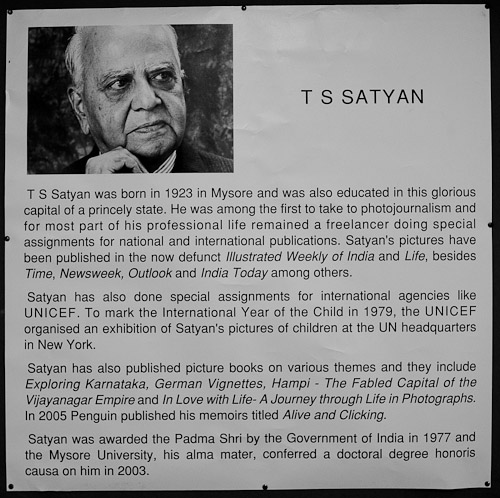
There appears to be no Wikipedia entry for TS Satyan (the best Wikipedia’s search engine can offer is "Satan"), so I have posted below my photographed copy of his biographical details, along with the introduction to the recent Mumbai retrospective.
TS Satyan’s photographs reproduced from Time Out Mumbai
]]>
 Pretty obvious I suppose but there are some interesting bits and pieces in this RAND report into the terrorist attacks on Mumbai back in November 2008. Most of it concerns the implications for security strategy but there’s a few observations about media coverage and its relationship with terrorism.
‘The prolonged nature of the episode, which went on for 60 hours with the steadily mounting death toll, made it a slow-motion shoot-out and siege that mesmerized the world’s news media.’
2. Attacks designed to guarantee foreign news coverage
‘The attacks on foreigners guaranteed international media coverage. The message to India was, “Your government cannot protect you. No place is safe.” And the international publicity would inevitably result in travel to India being cancelled or postponed with consequent damage to India’s economy.’
3. Recruiting through publicity
‘Terrorist attacks are intended not only to cause fear and alarm but also to inspire terrorist constituencies and attract recruits. By succeeding — and here “success” means humiliating the Indian security services, causing large-scale death and destruction, and garnering global media coverage for days — terrorists hope to attract both Pakistani and Indian recruits to their cause.’
4. Misinformation hampers the authorities’ response
‘The multiple attacks at different locations prevented the authorities from developing an overall assessment of the situation. Media reports consistently overestimated what we now know to be the actual size of the attacking force. The security forces probably had similar difficulties, complicated further by the inevitable erroneous reports that accompany the response to any terrorist event.’
5. Attackers call the editors
‘They also talked to the news media via cell phones to make demands in return for
the release of their hostages. This led Indian authorities to think that they were dealing with a hostage situation, which further confounded their tactical response.’
Image: Confusion characterised the initial stages of the security response; Vinu Wikipedia Creative Commons Sharealike 2.0
]]>View in iTunes
Tonight we discuss the recent attacks in Mumbai at the Frontline Club – Tue, 26 Dec at 7pm UK time. We’ll be broadcasting the event on the Frontline Club live channel which you can see above,
What will these attacks mean for the ongoing “war on terror” and will India now be seen as a soft target? Will deteriorating relations between Pakistan and India be brought closer by a new co-operation to work together in the aftermath of the attacks and a joint desire to bring the perpetrators to justice? Or will these attacks simply fuel the existing tensions between these two nuclear powers?
Taking part will be Aamir Ghauri, a London-based journalist/political commentator, David Loyn, the BBC’s International Development correspondent, Vikram Dodd who writes for The Guardian and was in Mumbai shortly before the attacks took place, and returned there the following day to report on them and Edna Fernandes, a British Indian journalist and former foreign correspondent for the Financial Times in New Delhi as well as political and international business correspondent for Reuters and Dow Jones in London. Chairing the discussion will be Owen Bennett-Jones, a presenter and correspondent for the BBC and former Islamabad correspondent.
If you can’t join us at the club in person, do please try and join us online.
The recent attacks on Mumbai marked a
moment when Twitter appeared to reach a critical threshhold. In the UK,
various media outlets made use of the 140 character tool to augment
their reporting.
In fact, a journalist I spoke to today, said: if journalists hadn’t
heard of Twitter, then they probably weren’t doing their job properly.
Thousands of people were using Twitter to talk about Mumbai. Some
twitterers were in the city. Others just commenting from far flung
places around the globe. Some were relaying information they had
watched on television. Others trying to get blood donors down to the
hospital in Mumbai.
But as Twitter use becomes more widespread, so it becomes
increasingly difficult to pinpoint the type of information you are
looking for. A vast of sea of tweets with #Mumbai quickly developed,
and if you were a journalist trying to find eyewitness accounts you
found yourself painstakingly wading through them all. Those who did
probably found it was time well spent, but is there a better way?
I think one possible partial solution would be the development of
more Twitter conventions. After all, Twitter already has some. The ‘#’
is already used as a useful way of sorting information. Other
conventions such as ‘RT’ for retweet have also cropped up.
If you’re a journalist using Twitter it would be really useful, for
example, if people had used ‘EW #Mumbai’ for eyewitness accounts. The
twitterers calling for blood donors, or people offering to help
relatives trying to find out what had happened, might have used ‘SOS
#Mumbai’.
Maybe these could be developed as ‘tags’, rather than having to be
included in the main body of the update, so that twitterers still had
their precious 140 characters of space. Twitter could provide a set of
default tags, but why not just allow people to tag their tweet how they
wish as they would on a blog post.
That way people could search for various angles on a topic, helping
them to access the type of Mumbai updates they were looking for rather
than having to trawl through every single thought on Mumbai.
For those interested, I’m sure they’ll be more posts on Mumbai in
the future – I’m in the process of collecting a lot of information
which I hope to distill at some point.