
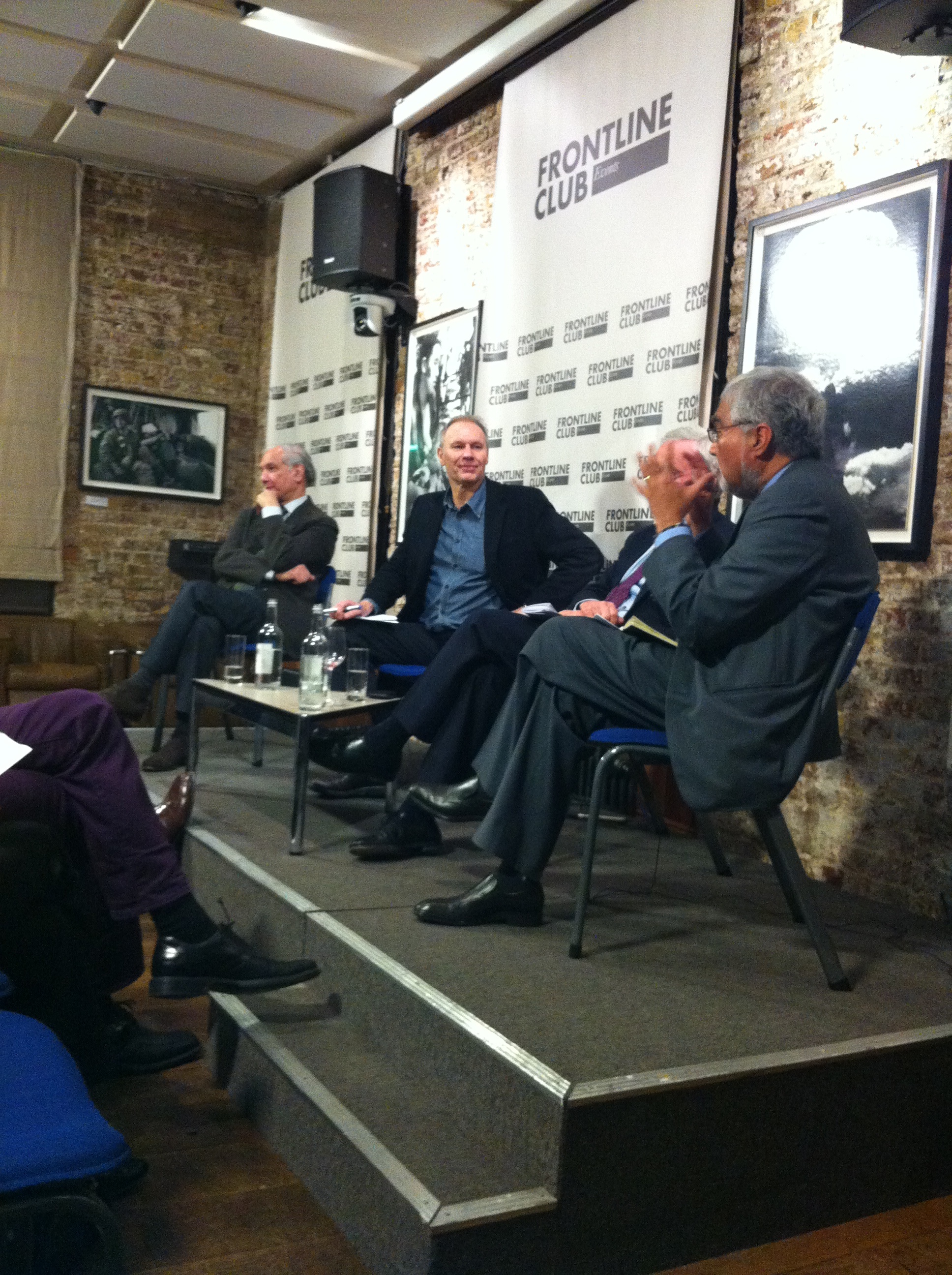
L-R: Mukesh Kapila, James Copnall, Lindsey Hilsum, Heather Pagano and Thomas Mawan Muortat discuss South Sudan.
The audience packed out the Frontline Club for the first event of the year on 8 January, a testament to the subject that has been dominating international headlines for the last few weeks – the crisis in South Sudan. A panel of experts from different fields, chaired by Channel 4 international editor Lindsey Hilsum, discussed the current fighting in the world’s youngest country, each offering valuable opinions on where it came from and where it’s going.
The BBC’s South Sudan and Sudan correspondent, James Copnall, gave some context to the recent fighting and imparted what he has seen on the ground first hand. When Hilsum asked if it was an attempted coup that started the fighting, as President Salva Kiir has claimed, or a mutiny amongst the presidential guard, as alleged by former vice-president Riek Machar, Copnall said it is still too early to tell, but “the key objective is to get both sides to stop fighting and at least start talking.”
Heather Pagano from Medecins Sans Frontieres (MSF) added a humanitarian perspective: “The situation is quite concerning… the speed with which everything changes on the ground, which makes it incredibly difficult to plan a proper aid response, especially in such a big country with very little logistical capacity.”
“I’ll share with you MSF’s main humanitarian concerns at the moment,” Pagano added. “In Juba, we are working in a UN camp where there is 30,000 displaced. It is so cramped that people are taking turns sleeping at night. A physic on the team worked out that the population density there is 10x the population density in Mumbai.”
MSF’s other concerns for those in refugee camps are ethnic based attacks, a lack of water (“wells are running dry by 10am”), and a high risk of disease outbreak.
Hilsum asked Thomas Mawan Mourtat, a South Sudanese political analyst, how South Sudan has come to this so quickly after the jubilation of independence in 2011. He explained that there were many underlying factors that led to this: “The population feels it has be let down and agitated by the ruling party. It was not surprising to many people that it blew up – the extent of the violence was a surprise, but people were feeling something was going to happen.”
Professor of Global Affairs Mukesh Kapila, who prior to teaching at the University of Manchester was the UN Resident and Humanitarian Coordinator for Sudan, pointed out that history suggests new countries go through a level of instability.
“The international community needs to be tolerant. The idea that you could impose a western style democracy, a winner takes all approach, and the rituals of a mature state and expect everything to work is complete nonsense.”
“Peace and society is built from the bottom up, not top down. You need a much more grassroots approach, local democracy and local governance.”
Mourtat agreed with Kapila that a resolution could be best reached through the grassroots, specifically through the strengthening of local councils: “During the war, one of the most successful campaigns was organising grassroots district councils.” He explained, “the SPLA has lost its way since it came into power. This local administration has been lost and that needs to be re-established.”
When an audience member asked if more UN peacekeepers were needed, the former Sudan UN coordinator, Kapila, went as far to call the current peacekeeping response “abominable”.
“If you look at the case of Darfur, the biggest UN peacekeeping operation” said Kapila, “the situation is as bad as ever. Why are [global taxpayers] paying a billion dollars a year, yet there is ongoing violence. How is a UN peacekeeper force going to bring about peace between a sovereign government and an armed insurgency?”
He reasoned: “Spend it on trying to build grassroots to build community reconciliation and community peace building capacities.”
https://soundcloud.com/frontlineclub/first-wednesday-south-sudan
By Nicky Armstrong
Last night’s event at the Frontline Club saw a heated debate between the expert panel and the audience on the UN’s presence in Darfur. Chaired by Patrick Smith, editor of Africa Confidential, the discussion bought up many of the tangled complexities surrounding the conflict in Darfur. With the recent expulsion of the former UN head in Sudan and tensions rising in the Nuba mountains the UN has come under scrutiny, charged with failing the people of Darfur.
The discussion opened with Sir John Holmes, a former British diplomat and UK ambassador for France and Portugal. He claimed the UN had been given an impossible task dealing with a political system that was obstructing the UN, recounting the situation when he first arrived in Sudan:
“There were still regular attacks on villages by the Janjaweed, there was tribal fighting of different kinds, occasional rebel attacks form these forces and a very unstable security situation…the overall security situation was stuck, it wasn’t really moving, it was stagnant, there was no real progress and frankly it stayed that way throughout my time and its pretty much the same way now.”
Dr. Mukesh Kapila CBE went on to discuss the failures of not only the UN but of a collective failure on behalf of the international community:
“My journey did not start in 2003, it began exactly 10 years before in Rwanda…and there I saw for myself what happens when an international response system basically implodes because there are contradictions…if there is a failure it is a collective failure…this is all extremely relevant to why we failed in Darfur…. all the lessons of enquiry on Rwanda which were big enquiries of the system and produced a big report, all of [these] were forgotten.”
The deafening silence from the UN and lack of response to memos was described as an ‘amnesia’ from the very top as they remained seized up on the matter of Darfur.
Dr Ahmed Al-Shahi offered his opinion on why the UN has failed. When asked who was the principal author by an audience member, Al-Shahi went on to describe a number of factors, but it was apparent that a lot of the problems lay with the political system under President Omar Al-Bashir and his regime in Khartoum.
China’s involvement in Darfur and why the UN is not reacting as it has recently in Libya were just some of the issues raised. It seems the issue of Darfur shall remain complex, with the situation not reflecting well on the UN.
Mukesh made a poignant closing statement:
“The UN should honestly admit its failure and its paralysis, for the reasons we have been debating. But it’s a mother bearing child relationship, you can’t make yourself redundant, what it should not do is be false prophet, launch misleading missions, which distract and bring false hope…I think we should be honest, that’s what I am saying and I think the UN is bound to fail…we are talking about the 21st century with twitter and globalisation and we are dealing with an instrument that I think is a relic to the Second World War, and conflict after conflict it has proven that it can’t succeed.”
Click Here to read the Amnesty International 2011 Sudan report.
]]>
Join us at the Frontline Club to discuss the actions of the UN and whether they are still failing Darfur.
]]>https://soundcloud.com/frontlineclub/nine-years-on-is-the-un-still
Since the start of the 2003 conflict in Darfur, questions have been raised about the role played by the United Nations and the viability of its mandate.
With the recent expulsion from Chad of the former UN head in Sudan during the original outbreak of violence in Darfur, and the crisis edging towards its first decade, is there any more that the UN can do? Or has the situation reached a level that is beyond resolution?
After the UN came under fire for not having done enough to help civilians during recent attacks, we will be discussing how the enduring situation in Darfur reflects on the UN.
Join us at the Frontline Club to discuss the actions of the UN and whether they are still failing Darfur. What could be done to reduce the possibility of future failures?
Chaired by Patrick Smith, editor of Africa Confidential.
With:
Dr. Mukesh Kapila CBE, former Under Secretary General, National Society and Knowledge Development for the International Federation of Red Cross and Red Crescent Societies based in Geneva. He has worked extensively in the Sudan where he was previously UN Humanitarian Coordinator and UNDP Resident Representative. He is Special Representative for The Aegis Trust.
Sir John Holmes, a British diplomat for over 30 years, serving as the UK’s Ambassador to France and Portugal, and as Overseas Adviser to both Tony Blair and John Major when Prime Minister. He was Under-Secretary-General for Humanitarian Affairs and Emergency Relief Coordinator at the United Nations in New York from 2007-2010, and visited Sudan five times during that period. He is now the Director of The Ditchley Foundation.
Dr Ahmed Al-Shahi, Research Fellow and Co-founder of the Sudanese Programme at St Antony’s College, Oxford University.
In association with the Aegis Trust.
Image Credit: Babasteve / Flickr
]]>