It’s not easy to hear of how Russian lawyer Sergei Magnitsky was killed.
“You need to be sitting down for this story” said chair, Edward Lucas, foreign correspondent with the Economist. “Could those people at the back find a space?”
William Browder was once the largest foreign portfolio investor in Russia with the Hermitage fund before he was thrown out of the country in 2005.
Sergei Magnitsky
“Twenty-five police officers raided my office in Moscow” Browder said, “and 25 more police officers raided the office of my American law firm. . . . One of the lawyers protested at the seizure of these documents and he was beaten so badly he was hospitalised for three weeks.”
Browder hired seven lawyers to find out more about the mess, one of them was a 36-year-old Sergei Magnitsky. They started an investigation that unearthed a high-level attempt to siphon a high-volume of funds. It was a complicated scheme that lead to a false tax refund of $230m that came – not from Browder‘s company but from the Russian taxpayer.
Six out of seven of Browder’s lawyers left Russia for safety. Sergei Magnitsky decided to stay.
“He testified against the police officers who did the raid used to get the documents . . . and one month later the same police officers came to his home . . . and arrested him and put him in pre-trial detention and then began to torture him.”
He was later sent to the infamous Butyrka prison and got very sick after months of serious mistreatment.
“They did move him to a facility that had an emergency room but instead of treating him in an emergency room they put him in an isolation cell and chained him to a bed and allowed eight riot guards with rubber batons to beat him until he died.”
Browder is now trying to push the Sergei Magnitsky Rule of Law Accountability Act through US congress. If approved, this would allow assets of those responsible for his detention, abuse or death to be seized.
Corruption
Brutal truths about the Russian state unravel through the Magnitsky story. From a citizen’s point of view, bribery is a part of what Masha Gessen, author of a recent book on Putin, says is the “daily humiliation of living in Russia”.
But she said corruption in the country should be concerning from a strategic point of view, too.
“Russia happens to have one of the two largest arsenals of nuclear arms that’s reason enough to pay attention to the fact that . . . it’s extremely corrupt and on the brink of collapse.”
According to Browder the rot runs deep. He cites the beginnings of the investigation that ultimately led to Sergei Magnitsky’s murder.
“I discovered . . . that all the Russian companies I was investing in were basically losing all the money they should have been sharing with the shareholders with a bunch of corrupt officials and corrupt management.”
Putin
Gessen said the Russian president models government on the Russian spy agency – his former employer.
“I think Putin seriously believes that the KGB is the best thing ever invented. And he’s done everything in his power – and that’s a lot – to re-shape Russia in the image of the KGB.
“The KGB’s a closed system, it’s best on personal connections and paranoia, where information comes in and doesn’t go out.”
This is the system that allowed Magnitsky’s death. As Browder said when asked by the audience what happened to his Russian investments, “I didn’t lose any money, I lost something far more precious; the life of a young man.”
]]>Against a backdrop of growing discontent, and widespread allegations of fraud, Russia’s recent elections heralded Vladimir Putin’s re-election to the presidency. The man who many still saw as Russia’s de facto leader will now resume his tenure, four years after ostensibly ceding power to Dmitry Medvedev.
In light of these developments a panel of experienced commentators gathered at the Frontline Club to assess the past, present and future of Putin’s Russia. The evening was chaired by Edward Lucas, The Economist’s Deputy International Editor, in discussion with Masha Gessen, a Russian-American journalist and author, and Bill Browder, an outspoken shareholder activist who was the largest foreign investor in Russia until 2005, when he was banned from the country.
Gessen, author of The Man Without a Face: The Unlikely Rise of Vladimir Putin, described Putin’s Russia as a mafia state in which large-scale corruption at the top relies on small-scale corruption at the bottom. She claimed that Putin “thinks the KGB is the best thing that was ever invented”, adding that she saw him as pleonexic – in that he suffers from the insatiable desire to have what rightfully belongs to others.
Browder agreed, describing his own experience as “the story of how bad things have got in Russia, and emblematic of the bare face of Russia from the beginning to the end.” He began to withdraw his money when he realised that all of his companies were hemorrhaging money to corrupt officials. A saga ensued in which Russian police seized his assets, took control of his companies and – amongst other things – conspired to reclaim $230m that Browder’s companies had paid in tax.
What followed has now become an infamous tale of state corruption and brutality. Sergei Magnitsky, the lawyer investigating matters on Browder’s behalf, was imprisoned and eventually murdered in custody.
His is not the only case of this kind, as Browder and Gessen observed, but the unfailing bureaucracy of all involved led to the publication of an exact account of the events, written by Magnitsky, and a list of those responsible. Lucas described the Magnitsky list as “one of the most effective fires lit under the regime”, and Browder summarised the reasons behind its impact:
“The people who committed these crimes didn’t do it because of religious intolerance, or ideological intolerance. They did this for money.”
Browder suggested that the regime was unsustainable, given the prevalence of events like this, but the panel recognised the inherent difficulty in ensuring a genuine transition of power. Gessen offered her own analysis of the regime’s ability to adapt and protect itself:
“With the whole reset campaign of the last 3 years, there were a lot of people who fell into Medvedev’s trap. The best way to think of Putin and Medvedev is of a president and a first lady: the first lady gets to reach out to people, and perform humanitarian gestures. That humanitarian gesture deceived a lot of people.”
Despite this, Gessen noted that the West is an important influence, even to the most corrupt Russian officials:
“More important than anything else, it’s the place where they keep their money. You can’t keep your money in Russia, there is always somebody better connected than you are.”
And, as the question and answer period drew to a close, Lucas suggested that Putin’s hold on power might begin to loosen if another disaster on the scale of the Kursk or Beslan were to strike:
“He handles these situations very badly. The people who’ve got a huge stake in the survival of the regime may wonder if they can keep it going for a few more years by pushing him downwards or sideways.”
Watch the event here:
]]>By Nicole Hunt
European leaders gather in Brussels on Monday for an informal meeting of the European Council, during which discussions are set to focus on jobs and the new fiscal stabilisation treaty agreed at their controversial meeting last month. Leaders are planning to iron out the details of the treaty at the meeting, in hopes that it’ll be ready to sign by the time they meet again on 1 March.
While all eyes are on Brussels, two big trials are before the courts in South Africa. In Ventersdorp, Chris Mahlangu and an unnamed teenager are back on trial for the April 2010 murder of Afrikaner Weerstandsbeweging (AWB) leader Eugene Terre’Blanche, postponed from October to allow more time for hearings.
Meanwhile, Henry Okah, former Movement for the Emancipation of the Niger Delta (MEND) leader, goes on trial in Johannesburg on terrorism charges in connection with the October 2010 Independence Day bombings in Abuja, Nigeria, which killed 12 people.
Monday is also the 40th anniversary of Bloody Sunday.
Spanish Magistrate Baltasar Garzon’s abuse of power trial resumes on Tuesday, with the judge himself expected to begin testifying if some preliminary matters are cleared up earlier in the day. There is speculation that the verdict for Garzon’s illegal wiretapping case – which was head on 17 January – could be delivered before Tuesday’s hearing.
The annual Herzliya policy conference kicks off in Jerusalem. Speakers throughout the three-day conference include Israeli President Shimon Peres, World Bank President Robert Zoellick, Israeli Defence Minister Ehud Barak, former Greek Prime Minister George Papandreou, and German Foreign Minister Guido Westerwelle.
Wednesday is all about Supreme Courts. Wikileaks founder Julian Assange begins a two-day hearing at the UK Supreme Court in London, appealing a 24 February, 2010 decision to extradite him to Sweden to face questioning on charges of sexual assault. The court is expected to reserve judgement after the hearing wraps up on Thursday, meaning the legal saga won’t quite be over yet.
In Islamabad, Pakistani Prime Minister Yousuf Raza Gilani is back before the Supreme Court, which is looking into his government’s decision not to investigate corruption among politicians after passing a controversial amnesty law in 2007 known as the National Reconciliation Ordinance. Gilani appeared before the court briefly on 19 January.
A North Korean prisoner amnesty begins on Wednesday, as part of celebrations to mark the 70th anniversary of the birth of recently-deceased Kim Jong-Il in February and the 100th anniversary of the birth of Kim Il-Sung in April.
NATO Defence Ministers begin a two-day meeting in Brussels on Thursday. Discussions are expected to focus on Afghanistan and security transition following the 20 January attack on French troops by an Afghan soldier, which killed four.
Kuwaitis go to the polls to elect 50 members to Parliament. Emir Sheikh Sabah al Ahmad al Sabah dissolved Parliament by decree on 6 December, 2011 citing ‘deteriorating conditions in the country’. 50 members are elected for four-year terms. Four women were elected for the first time in the country’s last elections, which took place in 2009.
On Friday, The Extraordinary Chambers in the Courts of Cambodia hears the appeal for Khmer Rouge Special Branch Chief Kaing Guek Eav, aka Duch, who was convicted of crimes against humanity and grave breaches of the Geneva Conventions in July 2010. Duch, who was head of the infamous Tuol Sleng prison camp, was sentenced to 35 years in prison over the deaths of up to two million people during the 1975-79 Khmer Rouge regime.
The three-day Munich Security Conference begins Friday; though there’s no word yet on this year’s attendees, the guest list always features the great and good of international politics and defence (or at least the important). The MSC is often the site of important policy announcements, so is well worth looking out for.
Anti-Kremlin groups are scheduled to hold their latest protest in Moscow on Saturday, this one timed to coincide with the two-month anniversary of disputed parliamentary elections on 4 December, and with one month to go until presidential elections on 4 March almost certainly see Vladimir Putin return to the helm.
The month and a half long Rugby 6 Nations tournament begins, with France, Engand, Ireland, Scotland, Wales and Italy hoping to end up in the 17 March final. England won the tournament in 2011.
The week closes with the runoff for the Finnish presidential race, following a first round vote on 22 January. Former Finance Minister Sauli Niinisto, who won 37 per cent of the first vote, faces off against Green party candidate Pekka Haavisto, who won 19 per cent of the vote.
]]>By Nicole Hunt
The week starts off with a bang as humankind hits a big milestone on Monday – the UN is marking the day as the moment the world’s population surpasses seven billion people.
A deadline set by the Arab League two weeks ago for Syrian President Bashar al Assad to open dialogue with the Syrian opposition council expires. Syria risks expulsion from the regional bloc over concerns at the rising death toll from nine months of action against anti-government protesters, which has already topped 3,000.
With Cannes off-limits to all but world leaders, the traditional anti-G20 rally is being held in Nice on Tuesday. The demonstration kicks off a four-day ‘alternative summit’, with many of the world’s biggest NGOs expected to be in attendance.
The two-day London Conference on Cybersecurity begins in London, with Foreign Secretary William Hague, US Secretary of State Hillary Clinton and Wikipedia founder Jimmy Wales all scheduled to speak.
Turkey hosts the Istanbul Conference for Afghanistan on Wednesday, focusing on security and cooperation in the heart of Asia; Pakistani President Asif Ali Zardari and Afghan President Hamid Karzai are among those attending. While the Conference could have been lost in the build up to the G20, Karzai’s expected announcement of the next areas where Afghan security forces will take control from NATO is bound to keep it in the headlines.
Of course the G20 itself kicks off on Thursday, though it wouldn’t be surprising if many of the European leaders involved are quite sick of seeing each other – for some, this will be their third meeting in 12 days.
While the G20 leaders are discussing the world’s financial problems, the European Central Bank’s Governing Council will be holding the first of its two meetings this month. The meeting is the first chaired by former Italian Central Bank Governor Mario Draghi, who replaces Jean-Claude Trichet as ECB President on 1 November.
The Hajj pilgrimage to Mecca begins on Friday. The five-day festival has in recent years attracted nearly two million foreign pilgrims, making it the largest pilgrimage in the world. Muslims who have the means to make the journey are required to do so at least once during their lifetime.
The Mars500 simulated mission to Mars ‘returns’ to Earth at the Institute of Biomedical Problems in Moscow. The crew members have been in an isolation chamber for 17 months, even performing several simulated spacewalks during their journey.
Italy’s Partido Democratico holds a pro-democracy, anti-Berlusconi rally in Rome on Saturday. The opposition party is using the occasion to launch its proposals for the reconstruction of the world’s economy and an alternative to Silvio Berlusconi’s embattled government.
In Cape Town, the Russell Tribunal on Palestine, an international tribunal investigating Israeli complicity in human rights abuses against Palestinians, opens its South African evidence session, with opening remarks from Archbishop Desmond Tutu and an address from Winnie Madikizela-Mandela.
The week closes with two Central American elections. In Guatemala, Otto Perez Molino of the Partido Patriota faces off against Manuel Baldizon of the Libertad Democratica Renovada party in a presidential run-off. Molina won 13 per cent more of the vote in the 11 September first round election.
Meanwhile, in Nicaragua, incumbent President Daniel Ortega is eligible for a second term following an October 2009 decision by the country’s Supreme Court that removed constitutional obstacles that would have prevented him from standing again. Voters also elect members to the country’s parliament.
]]>Luke Harding will be joined by a panel at the Frontline Club to discuss his experiences as The Guardian's Moscow correspondent and what they tell us about Russia today.
]]>
In 2007 Luke Harding arrived in Moscow to take up a new job as a correspondent for The Guardian. Not long after, mysterious agents from Russia’s Federal Security Service, the successor to the KGB, broke into his flat. He was followed, bugged, and even summoned to Lefortovo, the FSB’s notorious prison.
The break-in was the beginning of a psychological war against the journalist and his family that burst into the open in 2011 when he was expelled from Moscow for reporting allegations that under Vladimir Putin the country had become a “virtual mafia state”.
The first western reporter to be deported from Russia since the days of the Cold War, Luke Harding has written about his run-in with the new Russia in his recently published book, Mafia State. It includes unpublished material from confidential US diplomatic cables, published by WikiLeaks last year, that described Russia as a “virtual mafia state”.
Luke Harding will be joined by a panel at the Frontline Club to discuss his experiences as The Guardian‘s Moscow correspondent and what they tell us about Russia today.
Chaired by James Meek, writer and reporter. He has reported for the Guardian since 1985, between 1991 and 1999 from the former USSR. In 2004 his reporting from Iraq and about Guantanamo Bay won a number of awards, including Britain’s Foreign Reporter of the Year award. He is the author of two collections of short stories and four novels, most recently We Are Now Beginning Our Descent.
With:
Luke Harding, the Guardian’s Moscow correspondent. He was previously the Guardian’s South Asia correspondent in New Delhi, and has reported for the paper from Afghanistan and Iraq. Author of Mafia State: How one reporter became an enemy of the brutal new Russia and the co-author of WikiLeaks: Inside Julian Assange’s war on secrecy.
Angus Roxburgh, author and renowned journalist, he was the Sunday Times Moscow correspondent in the mid-1980s and the BBC’s Moscow correspondent during the Yeltsin years. He is the author of The Second Russian Revolution, Pravda: Inside the Soviet Press Machine and most recently The Strongman: Vladimir Putin and the Struggle for Russia.
Andrei Soldatov, a Russian investigative journalist, co-founder of the secret services watchdog website Agentura.ru and co-author of The New Nobility: The Restoration of Russia’s Security State and the Enduring Legacy of the KGB.
Susan Richards, a non-executive director and founder of Open Democracy and a specialist on Russian affairs. She is the author of two books; Epics of Everyday Life, about the lives of ordinary Russians in the transition from communism and Lost & Found in Russia: Encounters in the Deep Heartland, which covers the period 1992-2008.
]]>Next week we will be discussing the aid operation in Somalia and how effective it can be in a country caught between political instability, conflict and violence.
For In the Picture this week we will be joined by Norwegian photojournalist Espen Rasmussen who, for his project TRANSIT, travelled to 10 different countries recording the lives of refugees. This week’s screening Love Me Please investigates the shooting of journalist Anastasia Baburova in Moscow and reveals the true extent of neo-Nazism in Russia.
For next week’s Reflections we will be joined by veteran war correspondent Martin Bell.
]]>
By Nicole Hunt
The International Atomic Energy Agency (IAEA) Board of Governors meets in Vienna on Monday, with Iran likely to be high on the agenda following last week’s report expressing increased concerns over ‘undisclosed nuclear related activities’ in the country.
Bouthaina Shaaban, political adviser to Syrian President Bashar al Assad, is in Moscow, where she is scheduled to meet with Foreign Minister Sergey Lavrov and hold a press conference for international media. Shaaban was one of three Syrian officials slapped with sanctions by the US Treasury Department at the end of August.
The African National Congress is expected to wrap up disciplinary proceedings against controversial ANC youth leader Julius Malema on Tuesday, having recently moved the hearing from the ANC headquarters at Luthuli House to an undisclosed location in Johannesburg following violent protests last week. Malema is accused of bringing the ANC into disrepute and sowing divisions within ANC ranks after he encouraged the overthrow of Botswana’s government.
In Brussels, the OECD publishes its annual Education at a Glance report, analysing the education systems and performances in member states. For the first time, this year’s report also looks at education in Brazil, China, India, Indonesia, Russia and South Africa.
The European Court of Human Rights in Strasbourg hears a complaint on Wednesday brought by four people who say they were illegally deprived of their liberty without justification while they were held in a police ‘kettle’ during the 2001 May Day protests in London.
In New York, the UN Security Council holds a debate on drought-stricken Somalia, where security issues have compounded problems as aid struggles to get into the country and people struggle to get out.
Parliamentary elections take place in Denmark on Thursday. Recent polls say Helle Thorning-Schmidt could be the country’s next Prime Minister, as her opposition Social Democrat party looks poised to win the most seats.
A court in The Hague is due to rule on Apple’s application to ban sales of Samsung’s Galaxy phones. A temporary injunction banning sales and distribution throughout much of Europe was issued on 11 August, but is not due to come into effect until 13 October.
Following debates this week in several European parliaments on new powers for the European Financial Stability Fund, European finance ministers begin a two-day meeting on Friday.
The International Criminal Court in The Hague holds a confirmation of charges hearing for Callixte Mbarushimana, a former UN employee charged with crimes against humanity and war crimes in the Democratic Republic of Congo in 2009. Mbarushimana is alleged to have been the executive secretary of the Democratic Forces for the Liberation of Rwanda and directly responsible for at least 32 deaths in Rwanda during the 1994 genocide while still employed by the UN, but has never been charged.
Libyan schools are scheduled to re-open on Saturday, with a brand new curriculum devoid of Gaddafi-era subjects such as the Green Book.
At the Dead Sea in Israel, photographer Spencer Turnick stages another mass nude photoshoot, hoping to bring awareness to the fact that the famously salty lake is drying up.
The week wraps up with state elections in Berlin, the sixth in Germany this year. The regional elections have generally proven disastrous for Angela Merkel’s CDU party, which has suffered losses country-wide to the Social Democrats, a trend that many expect to continue into the 2013 federal election.
]]>It has been a while since I wrote here the last time… I apologize for the long silence (not that I really hope that you’ve really noticed – but I have been sort of ashamed that I abandoned my blog here for ages…) well, anyway, I’m back.
Back – and have a question for you. I would really appreciate if you brainstorm on the topic above, what could emergency workers do to help reporters cover tragedies and conflicts? What would you like them to do or not to do so that it would be a tandem not a Pushmi-Pullyu?
I’m giving a seminar for young / future emergency workers and plan to talk with them about trauma and trauma coverage.
***
To fill the gap between my rare posts I’ll report that this summer I conducted a series of seminars on stress and trauma for journalists and editors of the Russian Information Agency "Novosti" (News), one of the largest news agencies in Russia. It was very interesting – for me, and hopefully for my participants. At least we had fun writing down our stressors at work – and finding out that we love our job for the same reasons we hate it (lack of time means fast flow of diverse information – not boring; multitasking causes stress sometimes but also makes you feel important and responsible, etc. etc. etc.)
Here are some pictures:
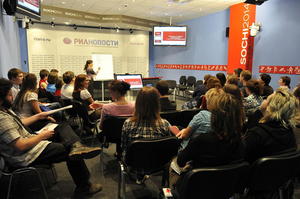
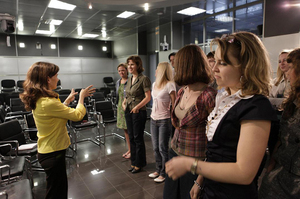
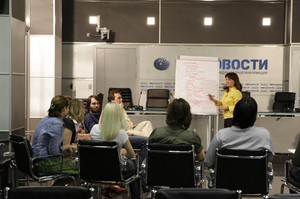
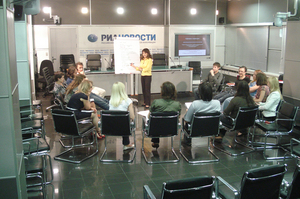
Looking forward to your input, and thanks in advace!
Olga.
]]>The case against those accused of killing Russian journalist Anna Politkovskaya outside her Moscow apartment in October 2006 collapsed this Thursday as the jury aquitted all three suspects. One day later the presiding judge, Yevgeni Zubo, ordered the Russian Investigative Committee reopen the case,
“The fact that no one at all has been held accountable for this murder sends a very clear message to potential perpetrators: You can do it, and you can get away with it,” said Tatyana Lokshina, deputy director of the Human Rights Watch Moscow bureau. “Brazen killings have become almost routine in the Russian Federation.” link
Rustam Makhmudov, the man suspected of pulling the trigger, reportedly offered to turn himself in during the summer of 2008. However, he remains at large. The Guardian newspaper published a timeline of the Anna Politkovskaya murder case beginning from the day before the former Novaya Gazeta investigative journalist was killed,
5 October 2006
Anna Politkovskaya, Russia’s most famous opposition journalist, gives an interview to Radio Liberty. In it, she talks about her ongoing investigation into the Chechen president, Ramzan Kadyrov, expressing the hope that he is tried for numerous human rights abuses.7 October 2006
Politkovskaya is shot dead in the lift of her block of flats in Moscow after returning from a shopping trip. Her killer shoots her in the chest and head, then flees, leaving behind an Izh pistol equipped with a silencer. It is President Vladimir Putin’s birthday.10 October 2006
After three days of silence, Putin dismisses Politkovskaya as "insignificant". He tells the German paper Süddeutsche Zeitung that the journalist and Kremlin critic was "well-known only in the west".Late August 2007
Russia’s prosecutor general, Yury Chaika, announces that 10 people have been arrested in relation to the murder investigation. He blames the killing on a Moscow criminal gang, adding that "unfortunately" officers from the FSB – Russia’s spy agency – and police provided operational support.September 2007
The chief investigator in the case is demoted and several new officers are brought in. The investigation is handed over to a new committee headed by a rival prosecutor, Alexander Bastrykin.June 2008
Prosecutors announce that the case is ready to go to court. Six out of the 10 original suspects are quietly released.July 2008
Bastrykin says Politkovskaya’s alleged killer, Rustam Makhmudov, has escaped from Russia and is now hiding somewhere in western Europe. He fails to explain how he slipped out of the country.19 November 2008
The trial of four men accused of involvement in Politkovskaya’s assassination begins at Moscow’s military district court. The judge announces that the trial will be held in closed session in accordance with the jury’s wishes. He is forced to overturn his decision after a juror reveals that this was not true.19 February 2009
The jury is sent out to consider its verdict after closing speeches by prosecution and defence lawyers. Karina Moskalenko, a lawyer for the Politkovskaya family, suggests the defendants may have been the victims of an elaborate set-up. link
We’ll update this post and the timeline as the investigation continues. For now, I’ll leave the last word to Miklos Haraszti, the Organization for Security and Cooperation in Europe’s representative for media freedom,
]]>“Russia is a country where for years and years now, journalists who cover human rights issues and corruption are being murdered and assaulted… It has to be admitted, at the highest level of the country, that there can be no free speech in a country where the best journalists are afraid for their lives for doing their jobs.” link
A journalist who was shot along with a human rights lawyer on a Moscow street has died in hospital, a newspaper editor has said.
Anastasia Baburova died on the operating table, hours after Monday’s shooting, according to Novaya Gazeta editor Sergei Sokolov.
Ms Baburova, a freelance journalist who worked for the paper, was shot when she reportedly tried to intervene after a gunman fatally shot lawyer Stanislav Markelov.
Mr Markelov was fighting against the early release of a Russian colonel convicted of murdering a Chechen woman in 2000.
He had also represented murdered anti-Putin journalist Anna Politkovskaya as well as Chechens and others who made allegations of abuse at the hands of Russian authorities. link
There a running total of journalists killed in Russia on Wikipedia. Baburova is the first journalist to have been killed in 2009. Arkady Babchenko, a journalist who also works for Novaya Gazeta won the Frontline Club Special Commendation Award for his coverage of the war in South Ossetia and Georgia.
UPDATE: 22 January
]]>Surveillance cameras precorded the murders but investigators could not make out the killer’s identity, Moscow Police Chief Vladimir Pronin told reporters, Russia’s Itar-Tass news agency reported.
“I can only state that it is a young man 180 centimeters (5 feet, 11 inches) high with a slim body build,” Pronin said. “I can also state that there are no witnesses who saw the killer.” link