But rapid urban growth is a challenge for cities everywhere – from the effects of climate change and natural disasters to mass migration, urban sprawl, pollution and lack of affordable housing.
During an evening of film screenings and discussion, we explore these tensions and what solutions can be found to make cities places that leave no one behind and that are a joy to live in for everyone.
The evening will begin with the screening of two recent films made by PLACE, the Thomson Reuters Foundation’s website covering land and property rights stories around the world.
Film 1 – Falling Freetown
“Falling Freetown” looks at Freetown, the capital of Sierra Leone in the wake of last year’s landslide that claimed the lives of about 1,000 people, a disaster many said was waiting to happen due to poor urban planning combined with rapid migration, deforestation, and freak weather events linked to climate change.
Watch the trailer here: https://vimeo.com/266505415/4f76fbd4df
Film 2 – Urban Nomads
“Urban Nomads” looks at the challenges facing Mongolia’s herding community and the mass migration from rural areas into the capital Ulaanbaatar as climate change and socio-economic changes force people into the city.
Watch the trailer here: https://vimeo.com/266537726
A panel discussion with urban experts will explore the themes raised in the films and discuss solutions that turn these challenges into opportunities for cities. The filmmakers will also be available to answer questions.
Chair
Astrid Zweynert is an award-winning journalist, editor of PLACE and social media specialist. Astrid drives coverage and production of Thomson Reuters Foundation’s global news services covering humanitarian crises, human rights and social innovation for the foundation’s website and the Reuters global newswire.
Speakers
Sarah Colenbrander is a Senior Researcher on urban issues at the International Institute for Environment and Development (IIED). Her areas of expertise include financing urban infrastructure, urban governance for inclusion and sustainability, and climate and energy policy in urban areas. She is also Global Programme Lead and Senior Economist at the Coalition for Urban Transitions, a network of research, government and private sector organisations. In addition to academic publications, she has contributed to World Bank, New Climate Economy and UN Environment reports and is Associate Editor for the journal ‘Environment and Urbanization’. She is also a guest lecturer at the University of Oxford, University College London and University of Manchester.
Anna Locke – Head of Programme of Agricultural Development and Policy at ODI (The Overseas Development Institute). Her work focuses on land governance and large-scale investment, biofuels and food security. She has in-depth experience working on market-led agriculture, analysing and advising on how to develop agriculture to promote sustainable growth and reduce poverty, based on principles of competitiveness, market access and inclusiveness.
Euphemia Sydney-Davies is a Sierra Leonean fashion designer and founder of the Sydney-Davies label who is passionate about ethical and sustainable fashion. Instead of outsourcing work to India or China, she set up a small tailoring workshop in Freetown, where she trains local men and women how to make garments for her clothing ranges. After the mudslide Sydney-Davies went home to help her people and raised funds in the UK, where she is based, to assist those most affected. She remains in touch with those who lost everything in the disaster and is critical of the government’s handling of the crisis.
Charles Landry is an author, speaker and international adviser on the future of cities. He is best known for popularising the Creative City concept. Its focus is how cities can create the enabling conditions for people and organisations to think, plan and act with imagination to solve problems and develop opportunities. He has chaired multiple urban innovation juries including The European Capital of Innovation Award – iCapital, New Innovations in the Creative Economy (N.I.C.E.) and Actors for Urban Change. He is a fellow of The Robert Bosch Academy in Berlin.


]]>
By Nicole Hunt
Russian President Vladimir Putin visits Israel on Monday, where he’s scheduled to attend the unveiling of a national memorial to Red Army soldiers killed during World War II. Putin is also due to meet with Prime Minister Benjamin Netanyahu, who is likely to raise concerns over Russia’s relationship with Syria. Putin also visits the West Bank and Jordan on Tuesday.
Meanwhile, EU High Representative for Foreign Affairs Catherine Ashton will be hosting a joint ministerial council of the EU and the Gulf Cooperation Council in Luxembourg, with talks focusing, once again, on Syria and Iran.
Monday may or may not be a momentous day in the US. The Supreme Court is due to sit for the final time this term, which means it should issue judgements on the cases it’s currently considering – namely, the two cases challenging Arizona’s controversial immigration law and President Barack Obama’s health care reform bill. However, if the Court has too many remaining cases to wrap up, it could opt to extend the sitting to later in the week (likely Wednesday or Thursday), with the health care judgement likely to be the last one issued.
The African National Congress opens its National Policy Congress on Tuesday, a conference held every five years ahead of its December electoral conference. Controversial proposals for the nationalisation of mines are due to be discussed, but following the expulsion of ANC Youth Leader Julius Malema, a major proponent of nationalisation, the proposals have lost a bit of their momentum. Of greater interest will be how President Jacob Zuma fares at the conference, with his reception seen as an indicator of whether he’ll be selected to run for a second term at the December conference.
The UN Office on Drugs and Crime (UNODC) publishes its annual World Drug Report, looking at consumption, production and trafficking across the world. The 2011 report found that cannabis remained by far the most widely-consumed drug.
The OECD has several high-profile reports on the agenda this week, beginning with the OECD-FAO Agricultural Outlook 2011-2020, a joint publication with the Food and Agriculture Organization looking at the market forces driving volatility in commodity prices. The Economic Survey of the United States, the OECD’s regular assessment of the US economy, is launched in Washington on Tuesday, followed by the OECD International Migration Outlook in Brussels on Wednesday.
The District Court of Assen in the Netherlands is scheduled to rule on an application by the Public Prosecutor on Wednesday to dissolve and ban the Martijn organisation, which lobbies for the social acceptance of paedophilia and sexual relationships between adults and children.
The UN Human Rights Council receives an update from the Commission of Inquiry on Syria in Geneva. The COI was set up following the Council’s emergency session on 1 June specifically to look into the 25 May Houla massacre.
The report comes the day before US Secretary of State Hillary Clinton begins a three-day visit to Russia on Thursday. While the trip has been scheduled for some time around the APEC Women and The Economy Forum, Clinton also has the opportunity to meet with Russian Foreign Minister Sergei Lavrov to discuss Syria. The meeting will be the first since Clinton publicly accused Syria of sending helicopters to the Assad regime, which Lavrov countered by accusing Washington of arming the opposition rebels.
Mongolians go to the polls to elect members to the State Great Khural, in an election which has been most notable for who’s not running. Former President Mambaryn Enkhabyar had been planning to head up a new party, but he was instead arrested, charged with corruption, and banned from standing for parliament. His 25-year-old son Batshugar Enkhbayar was also ruled inelgibile because he hasn’t yet served his two years of compulsory military service.
US financial sanctions on the Iranian oil trade, which were introduced as part of the National Defense Authorization Act in December, come into effect, meaning that banks in countries which have failed to ‘significantly reduce’ the volume of purchases of crude Iranian oil can be barred from doing business in the US financial market. The US has granted waivers to several countries, including India, Turkey, and South Korea, allowing them to continue imports for another six months because they’ve already reduced the amount of crude they’re importing.
Thursday also marks the deadline for WikiLeaks founder Julian Assange to apply to the European Court of Human Rights for an interim order to halt his extradition from the UK to Sweden to face questioning for alleged sexual assaults. If Assange has not applied by Thursday, his extradition window in the UK opens, giving authorities 10 days to arrange extradition. Of course, the whole matter is further complicated by Assange’s current residency at the Ecuadorian embassy, where he’s asked for asylum.
Keeping with the legal theme, Rwandan opposition leader Victoire Ingabire is expected to find out on Friday whether she’s been found guilty or acquitted on charges of association with a terrorist group, propagating genocide ideology, revisionism, and ethnic division, for which prosecutors have requested a life sentence. Ingabire’s supporters say the charges, which she denies, are politically motivated.
George Zimmerman, the man accused of second degree murder in the 26 February shooting death of Florida teen Trayvon Martin, appears for a bail hearing in Sanford. Zimmerman had his bail revoked earlier this month when it emerged that he was in possession of a passport and had access to more funds than had been established at his initial bond hearing.
World Bank President Robert Zoellick’s five-year term expires on Saturday. Holding with the tradition that usually sees an American head the Bank while a European leads the IMF, Korean-American doctor and former Dartmouth College president Jim Yong Kim assumes the role on Sunday.
Icelandic President Olafur Ragnar Grimsson is looking to win a fifth term in presidential elections, though the vote will not be as comfortable as he’s accustomed to – incumbents traditionally run unopposed, but six other candidates have put their hats in the ring this time around. His toughest competition is journalist Thora Arnorsdottir, whose popularity in the polls slipped after she took some time off from the campaign to give birth to her third child.
Saturday has also been bandied about as the favoured date for a meeting of the Syria Contact Group – if the members of the group can actually agree on its existence. The UN (per its Special Envoy Kofi Annan), the UK, the US, Russia and France have all been generally supportive of the idea of a meeting, but have failed to agree on the sticking point of Iranian participation. Russia insists that Iran must be present and part of any international solution, while the UK and the US have said Iranian involvement is ‘unworkable’ due to Tehran’s support for the Syrian regime.
Traditionally quiet Sunday is anything but this week, with presidential and legislative elections in Mexico, parliamentary polls in Senegal, and the introduction of Australia’s landmark carbon tax just the beginning.
Sunday is the deadline for Israel to demolish five apartment blocks in Givat Ulpana, which the Supreme Court ruled on 7 May had been built illegally on private Palestinian land. While the residents and the government came to an agreement last week that should see them leave voluntarily, reports that some settlers have been barricading the area mean a peaceful departure is not guaranteed.
The EU’s embargo on Iranian oil, which was approved by Foreign Ministers in January, comes into effect. The sanctions prohibit the import, purchase and transport of Iranian crude oil and petroleum products, and come just days before technical teams are due to resume discussions on Iran’s nuclear programme in Istanbul.
]]>Last Thursday Tsakhiagiin Elbegdorj was sworn in as Mongolia’s new President. Along with a military parade in Ulan Bator’s Sukhbaatar Square opposite Parliament, there was a concert staged at the Cultural Palace.
But sports fans in Mongolia were not disappointed. A wrestling competition to mark the occasion was also held on Friday. Yep, Friday Night Wrestling in Ulan Bator.
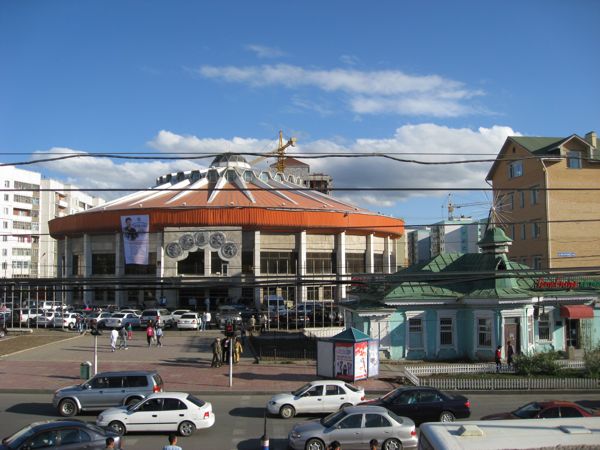
Like many buildings in the capital, the circular exterior of the Wrestling Palace reflects the traditional Mongolian Ger. But, on the inside, its wrestling arena stands beneath a high dome and is surrounded by several tiers of seating.
It’s a sweaty cauldron for warrior wrestlers and spectators alike.
Wrestling competition during 2009 Presidential Inauguration Celebrations in Mongolia from Guy Degen on Vimeo.
My colleagues and I bought tickets for 6000 MNT (tugrug) a piece – around 3 euro each. There’s no allocated seating and we found ourselves looking for seats among wrestlers and their trainers.
You kind of politely step out of the way for these lads. They’re huge. A large arm swept me aside while I was filming on a landing.
I’ve since learnt that many players in Mongolia’s Rugby team are drawn from the ranks of wrestlers. Looking closely at the ear of the wrestler in the opening shot of the video above, you can clearly see he sports the cauliflower ears of a forward. Whether that’s from packing down in a scrum or from wrestling I can’t tell you.
Wrestling is steeped in Mongolian culture and tradition. Along with archery and horse riding it’s one of three so called "manly sports".
Next month these sports will feature at the Naadam Festival in Ulanbaatar – the biggest festival in Mongolia.
]]>
Tsakhiagiin Elbegdorj set the time of his swearing-in ceremony to become the fourth President of Mongolia in a symbolic nod to the year Genghis Khan was proclaimed ruler of the Mongol Empire.
Dressed in a gold-coloured traditional deel, Elbegdorj took the oath of office today at Parliament in the capital Ulan Bator.
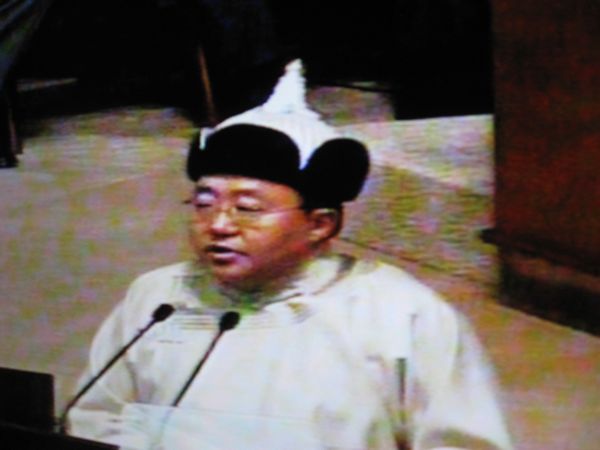
On a fuzzy television set it looked like a fine set of robes fit for a president. However later in the afternoon at the ceremonial military parade in Sukhbataar Square, an onlooker was grinning as she told me that maybe the President’s deel was not such a good cut. Apparently it looked a little too big for him.
Tsakhiagiin Elbegdorj succeeds President Nambaryn Enkhbayar. Elbegdorj is a Harvard grad and has served twice as Prime Minister. He pitched his presidential campaign on fighting corruption and won the elections on May 24 by a slim majority.
Already President Elbegdorj has made headlines over whether Mongolia should join foreign mining companies and invest in a major gold and copper mine.
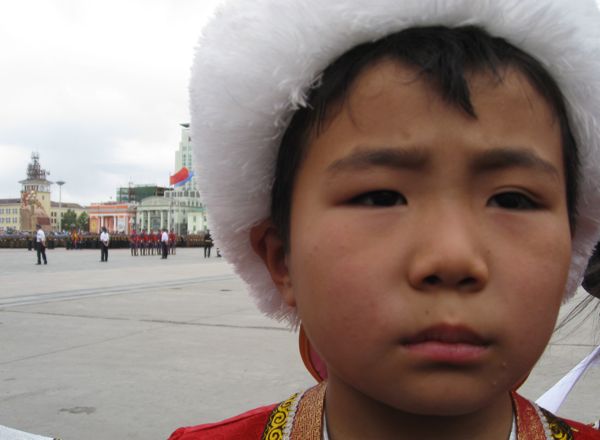
Despite a few technical glitches, namely poor sound during speeches, the military parade was quite a spectacle.
Personally, I’m looking forward to the traditional wrestling competition that will be held on Friday night as part of the inauguration celebrations.
]]>