Over the course of three evenings, an impressive and challenging line up of speakers will debate issues ranging from the current situation in Ukraine to the role of social media in journalism. These first events mark the start of regular discussions and screenings that will take place in Bucharest as part of the Frontline Club’s International Parters programme.
Full line-up of events and speakers:
Screening: Ukraine – From Democracy to Chaos + Q&A with Jill Emery
Tuesday 18 February, 6:30PM
 Ukraine – From Democracy to Chaos explores this complex country, its geopolitical importance in Europe and its unfinished struggle for democracy. The film explores the political divisions between east and west Ukraine that gave rise to the Orange Revolution in 2004 and still have deep roots in dictating today’s political reality.
The screening will be followed by discussion about the recent developments in Ukraine, moderated by Stefan Candea, co-founder and director of the Romanian Centre for Investigative Journalism. He will be joined by: Vlad Mixich, journalist and senior editor of HotNews.ro; multimedia journalist, Laurentiu Diaconu-Colintineanu; and Paul Radu, investigative journalist and director of Rise Project.
Screening: Fortress + Debate
Wednesday 19 February, 6:30PM
 Over 20 years after the collapse of the Soviet Union directors Klára Tasovská and Lukáš Kokeš travel back in time on their visit to the unrecognised Pridnestrovian Moldovian Republic. A separatist region within Moldova, it has its own passports and stamps, an elected president and a legal system.
The screening will be followed by a debate with: Marian Voicu, producer Romanian Public Television; Michael Bird, journalist and editor of The Black Sea; and Lina Vdovîi, online editor at TVR and member of the Romanian Centre for Independent Journalism.
One World Romania Preview Screening: High Tech, Low Life + Debate
Thursday 20 February, 6:30PM
 High Tech, Low Life follows Zola, a smart, tech-savvy and playful youngster, and Tiger Temple, a 50-something citizen reporter, as they each travel the country to report stories that would otherwise remain unknown. A unique peek behind the notorious Great Firewall of China that captures the fearlessness of a new digital generation.
The screening will be followed by a debate moderated by multi media journalist Brăduț Ulmanu. He will be joined by: independent journalist, Radu Ciorniciuc; human rights activist and coordinator of the FreeEx program of ActiveWatch, Liana Ganea; and journalist Ioana Moldoveanu.
]]>On Wednesday 19 June, the Frontline Club audience burst into spontaneous applause to the precision choreography of a Transnistrian military parade. The footage was part of the documentary film Fortress, shown at the preview screening of Open City Docs Fest, supported by the Czech Centre London as part of One World Echoes in London.
Capturing aspects of everyday life in the unrecognised Pridnestrovian Moldovian Republic, from televised propaganda to school graduation ceremonies, the film offered rare insight into the little-known world that is also known as Transnistria. Czech director Lukáš Kokeš explained what his film was about:
“It’s not only about human rights, and not only a travelogue about an exotic country. The main topic for us was the atmosphere of that place, and we called it Fortress because we think that in every country there is a kind of a fortress. It shows us that Transnistria, with its corruption and its absurd regime is not so far away as we thought. So I think sometimes we all live in a small fortress called Transnistria.”

Moderator and Founding Director of Open City Docs Fest Michael Stewart kicked off the Q&A: “As young chap who wasn’t, I’m sure, familiar with the occupation of your country by the great Russian forces, how come you made this particular film?”
“The biggest motivation for us to go there and make a film was that we didn’t know about the existence of this territory, or country,” replied Kokeš. “Often the territory is described as a dangerous place where you should never go; so we wanted to explore it and fill this black gap on the European map. … We felt we were connected to the reality there, as it was similar to the communist past of our country.”
“There are speculations,” responded Kokeš, to a question on arms smuggling:
“They may have been sold in the 90s. The main income for the state comes from smuggling. They are smuggling food, cigarettes, alcohol, everything that comes from Ukraine goes through Transnistria. And there it gets lost. The son of Igor Smirnov, the [former] President, was the head of border control.”
“The fear of the people,” was the main obstacle the team faced in filming:
“This situation is similar to the Czechoslovakian reality during the 70s or 80s,” said Kokeš. “Because people fear they could lose their jobs, they don’t want to criticise the regime.”
He added, “It’s very interesting that nowadays:
“The secret service in Transnistria, at that time when we were shooting it was called MGB, which means Ministry of State Security; after the new President was elected – he was perceived as big hope, as a democratic force – he changed the name from MGB to KGB again.”

On internet access in the territory, Kokeš observed, “there’s only one internet provider, controlled by the state”:
“The internet is there, you can surf, find everything you want, but you are being watched. Last month they started to block all the opposition sites, or the forums where people are discussing political issues. So it’s very easy for them to control.”
Asked about the potential resolution of the territorial conflict with Moldova, Kokeš replied:
“The propaganda is very, very strong. After 20 years they succeeded to make this brainwashed generation, because even the young people, they told us that Moldova is enemy territory to them. Officially there is still war between Moldova and Transnistria. Only they are not fighting. So Moldovans are enemies to them.”
To conclude, Kokeš described how the project changed his own perception:
“I was expecting a Soviet open-air museum. I expected only old cars, but suddenly there were pink Hummers. So I started to think things are more complicated. We started to ask people how could they describe the regime: is it socialist or democratic or dictatorship or something in between? And they said: it’s very complicated. It’s anarchy, it’s oligarchy, it’s democracy but with its own rules, it’s a complex problem.”
Fortress was presented as part of the One World Echoes in London series, supported by the Czech Centre London and in collaboration with One World Prague.
Upcoming films in the series are Black Out and Stone Games, both at Open City Docs Fest on Sunday 23 June.
]]>

One World Echoes in London is a series of human rights film screenings supported by by the Czech Centre London. Celebrating the 15th anniversary of One World, Europe´s largest human rights film festival established in Prague in 1998 by the Czech NGO People in Need. This series offers a selection of extraordinary documentary films exploring societies and individual lives from a human rights perspective. Representing various countries where People in Need, the biggest NGO in Eastern Europe, runs its human rights, relief and development projects.
One World Echoes are co-organised by the Czech Centre London, Open City Docs Fest London 20-23 June 2013 and the Frontline Club.
Thursday 11 April 2013, 7:00 PM Frontline Club – Amazing Azerbaijan!
 Amazing Azerbaijan! is a tale of two countries. A shiny democratic republic the government proudly puts on display for visiting journalists and dignitaries. Alongside a repressive and corrupt state with no respect for freedom of expression, where peaceful protesters are violently beaten and journalists are threatened or even killed. Followed by a Q&A with director Liz Mermin.
Friday 24 May 2013, 7:00 PM Frontline Club – Motherland or Death
 For over fifty years Cuba has been following the battle-cry of the revolution, Patria o Muerte, which translates as Motherland or Death. Veteran Russian documentarian Vitaly Mansky centers on the generation born before the revolution. They are devoted to their motherland with heart and soul, yet curse the circumstances in which they are forced to live.
Wednesday 19 June 2013, 7:00 PM Frontline Club – Fortress BOOK NOW
Over twenty years after the collapse of the Soviet Union directors Klára Tasovská and Lukáš Kokeš travel back in time on their visit to the unrecognised Pridnestrovian Moldovian Republic. A separatist region within Moldova, with its own passports, an elected president and a legal system. This Open City Preview Screening will be followed by a Q&A with director Lukáš Kokeš.
Sunday 23 June 2013 2:30 PM Preview screening Open City Cinema Tent – Black Out BOOK NOW
 Every evening during exam season in Guinea, hundreds of school children begin a nightly pilgrimage to the airport, petrol stations and wealthier parts of the city, searching for light. A literal and metaphorical journey to enlightenment, this evocative documentary tells how children reconcile their lives in one of the world’s poorest countries, with their desire to learn.
Sunday 23 June 2013 5:00 PM UK Premiere Open City Lighbox – Stone Games BOOK NOW
 Do the Sudeten Germans who were tortured and killed during their expulsion at the end of the Second World War deserve a commemorative monument or not? In response to a stone monument in Nový Bor, Czech Republic a group of local inhabitants has unleashed a hate-filled ritual dance of national fervor and moral outrage that also turns out to be a sufficiently strong election issue.


Over 20 years after the collapse of the Soviet Union directors Klára Tasovská and Lukáš Kokeš travel back in time on their visit to the unrecognised Pridnestrovian Moldovian Republic. Also known as Transdniestria, this separatist region within Moldova has its own passports and stamps, organises presidential elections and maintains its own legal system.
In Fortress Tasovská and Kokeš raise what is left of the iron curtain to give a fascinating peak into a country that technically does not exist. They capture everyday life through portraits of ordinary people living in this geo-political gap, stuck between the European Union and Russia, between the present and the past, crime and decency, decadence and hope for change.

For twenty years president Igor Smirnov maintained Soviet-style propaganda and established an authoritative rule. Filmed during the 2011 presidential elections, Fortress is a sharp and darkly funny account, analysing the configuration of this ‘limbo-state’ and the practicalities of a regular life within it.
Directed by Klára Tasovská and Lukáš Kokeš
Duration: 70′
Year: 2012
[vimeo clip_id=”62117691″ width=”400″ height=”225″]
This screening is part of One World Echoes, an international tour celebrating the 15th anniversary of One World, Europe´s largest human rights film festival established in Prague in 1998 by Czech NGO People in Need.
One World Echoes are co-organized by the Czech Centre London, Open City London Documentary Festival (20-23 June) and the Frontline Club.
Women leaving Moldova and crossing the border into Romania and then on to European countries to work illegally has become a mass phenomenon that is tearing families apart.
Bordering Romania and the Ukraine, Moldova is the poorest country in Europe, with an unemployment rate of 80%. Mamma Illegal follows three women between 2004 and 2011 as they work illegally in Europe to earn money to provide their families with a better life.
Vienna 2004 – Auralia is making a living illegally cleaning in Austria. As she watches a video of her family back home the demands of being so far away are made clear. She cries as she sees her children missing their mother.
She has chosen to leave her family and work in Vienna in order to send money home. As the film progresses the strain that this is putting on the women and the families is evident. They start to wish they had never let their loved ones go.
Auralia’s family is not a one off – footage of a Moldovan school shows a classroom of crying children, pleading to the camera for their parents to return home. The teacher speaks to the camera saying, “They leave in order to work and hopefully they will be better off afterwards”. Nearly all of the children present in the class have a mother working abroad, some have both parents working in separate countries. The result is a generation of children left behind, being brought up by their grandparents and remembering their parents only through distant memories.
As the years progress the effects on the women become more noticeable. Natasha, a Moldovan woman living in Italy, is very obviously struggling to cope. “I left because I had to, I couldn’t see any other way out”. She refuses to return home. When he receives a letter stating she has to leave the country; she is visibly distressed, fainting when leaving the immigration office. Her messages to her 10-year-old daughter are of love, yet she insists on staying rather than returning to be with her.
“You mustn’t judge me because I left you at such a young age, I am doing this for you”. This reason for their mothers leaving them is repeatedly drilled into the children. As the children grow up into young adults, though, it is interesting to see that they would not make the same decisions as their parents – “I would not leave if I had children of my own, this is my home”.
It becomes clear that the women see what kind of life they could have and when they do finally return home they view their homes as dirty and poverty stricken, the pressure this puts on their marriages could not be made more heart-rending. When Auralia’s husband commits suicide, she shouts at his coffin “why did you leave us?” The film’s Producer, Arash Riahi, took questions after the screening and explained that Auralia’s husband could not face her leaving for Vienna again and suicide was his last, desperate attempt to force her to stay at home with her children.
The film leaves you reflecting on what you would do if you were in the same situation – it is in the human condition to want to better yourself and your situation, but at what price?
]]>Mama Illegal is a film about the sacrifices made by three Moldovan women who leave their homes and families to work illegally as cleaners in Italy and Austria.
Enduring long separations from their children, and leaving their families to face the hardships of life in Europe’s poorest country, the women hope to pave the way for a better future.
Director Ed Moschitz follows the women from 2004-2007 in an attempt to shed light on the often ignored suffering of economic migrants.
**Official Competion IDFA 2011**
Director: Ed Moschitz
Year: 2011
Length: 102′
]]>As part of an attempt to catch up, I’ve just been reading Jeff Jarvis, Jay Rosen and C.W. Anderson on the renewed argument over "Twitter revolutions". The role of Twitter in revolutions was first debated in 2009 with reference to Moldova and Iran and has been inevitably resurrected in light of the events in Tunisia and Egypt.
The overarching point these authors make is that the debate has become rather futile with various people pointing out that Twitter does not cause revolutions – an argument that nobody has made.
In 2009, I was critical of the use of the term ‘Twitter revolution’ by the news media for the political protests in Moldova. I felt the use of this phrase and some of the specific roles that were attributed to Twitter in news articles did not aid our understanding of what was happening in Moldova.
It also hindered our understanding of what Twitter was actually being used for and lumped together a variety of Internet tools under the term ‘Twitter’ – which I didn’t think was helpful either.
In that spirit, what follows are a few notes on what we might have learnt from events in Moldova, Iran, Tunisia, and Egypt about the specific role of Twitter and other social media sites. Hopefully, it provides a starting point for understanding some of the implications of social media for politics.
The role of social media tools
1. Spreading ideas and initial organisation
Twitter, Facebook, etc play an important role prior to a revolution (or protest/uprising etc) in spreading ideas and information. They help connect organisers, activists and opposition groups and link these people to others who may be sympathetic to the cause or might even support direct action.
In Egypt, it appears that where previously Egyptians were fearful of rising up against Mubarak’s repressive regime, social media played a role in making people aware that there were others who would join them if they made a stand. Facebook, Twitter (Moldova – Odnoklassniki too) are very useful organisational tools at this stage enabling initial action to take place in a coordinated fashion.
2. Attracting the attention of the international news media
Tweeting about your revolution attracts attention from news media. There is something of a Twitter revolution in breaking news occurring. News organisations are increasingly aware of news and information mediated on Twitter, which they are using as a primary global news wire.
As a consequence, protests that might not have gained media attention or the same amount of media attention in the past now do so. (In Iran, Twitter users pressurised CNN to cover the story using the hashtag CNNfail).
Given the news media’s attention to Twitter, there do not need to be huge numbers of people tweeting. It is sufficient to have a relatively small number of people tweeting your revolution who will inevitably be picked up by the media.
The combination of satellite television and the Internet thus drastically reduces the time it takes for news and information of your revolution to spread to all parts of the world.
3. Facilitating an international support network
Skype, Facebook, email, Twitter etc allows diaspora in other countries to communicate easily with those protesting in homeland. This also helps create more media coverage particularly in situations where the diaspora can mediate the message of the revolution to news organisations in English rather than the local language. It also provides an international support network for protesters.
4. The importance of YouTube in providing imagery
Rather obviously, YouTube is useful for documenting video of demonstrations. It enables "ordinary citizens" to provide potentially iconic images from the revolution (E.g. Neda Soltan, in Iran). Journalists can use videos shot by protesters to refute state-media imagery and the government version of events.
The use of YouTube, and other video-sharing websites, encourages TV broadcasters to keep running the story because they have access to pictures. Government initiatives to stop the story being covered by blocking journalists’ access are significantly undermined and arguably counterproductive, as the news media rely increasingly on the protesters media content rather than producing their own.
5. A shift in power?
The ability of protesters to publish their own media content immediately to a potentially global audience is emerging as a powerful weapon to combat more traditional applications of power and control such as state violence and censorship.
Limitations and problems
1. How useful is social media at the site of a protest?
In Moldova, at least, Twitter was not used as an organisational tool at the site of demonstrations where mobile phone access and Internet connections were blocked and organisation was generally choatic or nearly non-existent. But according to this BBC infographic it appears bloggers were updating from Tahrir square’s much more organised camp. Further comments on differences between Moldova and Egypt welcomed.
2. The clampdown on Internet access
All social media tools are inevitably less useful when the Internet or individual websites are blocked by a government. This triggers a subsequent struggle over the control and distribution of information online. Opposition groups can attempt to circumvent lockdowns by using proxy servers or relaying information by other means to people who subsequently post their material online.
In Egypt, sustaining the protests and media coverage of them required other forms of communication – word of mouth, landlines, international broadcast media, etc.
3. Representative of the situation ground?
Social media is not necessarily representative. In Moldova, there was more sympathy for the Communist party away from the capital among people who were not using social media. But in the case of Egypt, what was being said on social media sites appeared to reflect a much broader swathe of public opinion.
4. A government can deploy the same tools against the protesters
A government can use the same Internet tools to target protesters, organise crackdowns, spread their own message, and disinformation (See Iran in particular). Perhaps there is currently a window of opportunity whereby governments are less tech-savvy and more heirarchical compared to opposition groups.
That might change as governments necessarily adapt their structures and practices to the new information environment, but for some its already too late. Censorship of Internet tools is more likely to be successful for governments if established over a longer period of time (e.g. China) rather than in a desperate response to a crisis (e.g Egypt).
5. Can loose leadership structures consolidate gains?
It could be argued that the loose leadership structure of protests organised through social media (althou
gh I’m not convinced it will always hold true) leaves questions over whether initial gains can be followed up. Will a movement that was united behind Mubarak being forced from power be able to maintain that unity moving forward? It will certainly be interesting to see how the revolutions in Tunisia and Egypt develop.
Download this episode
View in iTunes
“Popa’s photographs are a powerful enquiry into a pervasive form of violence against women. They are a tragic reminder of just how vulnerable and powerless women are globally, and expose the futility of universal declarations”. So declares Mark Sealy, director of Autograph-ABP, who will be moderating this event featuring Romanian photographer Dana Popa.
By photographically documenting the experiences of sex-trafficked Moldovan women, Popa has drawn attention to an issue of slavery, immorality and shocking exploitation. Moldova is one of the main source countries for trafficking women and children, up to 10% of the female population are sold into prostitution abroad.
Popa worked with International Organisation for Migration and Winrock International in Moldova, where she documented the disturbing experiences of these women. Finally, she captured the spaces where trafficked women are forced into prostitution in the brothels of Soho, London. Her project and book entitled not Natasha, after the nickname Eastern European prostitutes are often labelled with, takes an in-depth look at the hopes, fears and sorrows of the women and families she met. With the help of her poignant pictures, Popa will speak at the Frontline Club about how not Natasha came about, the issues it involves and her experiences as a photographer.
For more information about the project, follow this link, or read a Frontline Forum Blog post about Popa‘s work.
]]>Download this episode
View in iTunes
Romanian photographer Dana Popa will be giving an In the Picture talk at the Frontline Club on Friday about her project not Natasha.
not Natasha documents the lives of Moldovan women who have been trafficked out of their country and forced to work in the sex trade abroad. Their destinations sound exotic and varied, including, according to Popa: Turkey, Russia, Romania, the Czech Republic, Albania, Italy, Spain, Israel, Saudi Arabia and Great Britain, but the plight of women in all these places is the same.
Beaten, drugged and threatened into letting strangers have sex with them, the traffickers reap the financial rewards of the trafficked women’s dangerous work. They are left psychologically damaged and, in most cases, suffering from STDs. Popa’s photographs encapsulate the despair of these women and their loved ones who have been left behind.
Popa worked in collaboration with two charities, IOM Moldova and Winrock International, to produce a body of work which is both beautiful and shocking. Her pictures use vivid colours to bring their stories to life, while deftly handling the sensitive subject with a profound subtlety.
The next issue of Frontline a Broadsheet will feature a photo-essay by Popa. In it she declares:
Slavery is not a ‘thing of the past’. It is a very real problem which can no longer be ignored. With Romania having joined the European Union, borders to Western Europe are easier to cross. Human cattle is still sold on Europe’s Black Market.
Read more about the event and book here for Friday’s In the Picture. In the mean time here is a taster of some of Dana Popa’s images:
I don’t usually crosspost, so if you’ve seen this post (which also a couple of interesting comments now) on the Media140 blog there’ll be nothing new below, but I hope you’ll forgive me for doing so on this occasion.
The intro in italics was written by Dee Jackson, the Editor of the Media140 blog. I’m grateful to her for inviting me to post on the blog and her editing skills (a rare luxury!)
The rest is me picking up where I left off for the Frontline Club in April here and here.
The Iranian Elections in June saw Twitter jump into public consciousness as the government jammed mobile phones and blocked access to many other social networks. Twitter users changed their locations en masse to “Tehran” to protect those really tweeting from the Iranian capital while avatars acquired green ribbons and washes, in yet another sign of solidarity.
However, you might have well have missed the very first “Twitter Revolution” – which took place a couple of months earlier in April, in Moldova. Or did it? Below Daniel Bennett reflects on whether or not students really used Twitter to storm the Moldovan presidency or whether the picture, now distinctly clearer in retrospect, is rather more complex than the headline writers might have wanted it to be.
Background
In April, Natalia Morari, investigative journalist and civil rights activist, sat down with a handful of friends in a cafe in Moldova. They had met to discuss the re-election of the ruling Communist Party and more specifically what should be done about it. Natalia Morari and her friends were convinced the election was fraudulent and believed another four years of Communist rule would be a disaster for Moldova. They decided to organise a peaceful protest: a candle-lit vigil of national mourning in the capital Chisinau.
Denied access to the Communist-controlled media, they spread the word using a variety of social media tools. Expecting several hundred to attend their ad hoc protest they were more than a little surprised to find that thousands had turned up to demonstrate their anger at fraud and government policy. Perhaps even more astonishingly the media world was watching because Moldova’s Twitterati had managed to get #pman (the acronym of the main square in the Moldovan capital Chisinau) to trend on Twitter.
‘Twitter Revolution’?
After all, it was a great story and media organisations around the globe gobbled it up – Twitter used to organise mass demonstration and bring down Communist government. My favourite headline from the time was the Telegraph’s, ‘Students use Twitter to storm presidency in Moldova’, which sounded rather surreal to me.
It was clear that Twitter was having a massive impact on the media coverage of this event – far more than it would have received otherwise – and that in terms of disseminating information to a much wider audience, Twitter was proving its worth. But personally, I wasn’t convinced that Twitter was playing a ‘key role in organising the protests’ as much media coverage reported at the time.
So, I took something of a gamble and went against the general Internet torrent, to suggest that Twitter was playing a far less significant role than was being suggested – at least in terms of prior organisation and at the scene of the demonstration.
I pointed out that cell phone networks were blocked at the square itself, website connections were down and that the total number of Twitterers in Moldova was probably no more than a few hundred. Perhaps most compellingly, I found a blog post by Natalia Morari in which she described the organisation of the protest – without even mentioning Twitter by name. Moldovan commenters both agreed and disagreed with my analysis. It seems that Twitter was used by some, but that this was a much broader social media campaign.
Political change in Moldova
 That was April. Fast forward to July and you might well have missed the news about the re-run of Moldova’s elections in which the Communist majority was overturned. In September, a new pro-western coalition government was formed and Parliament approved Vlad Filat as Prime Minister.
Don’t kick yourself for missing the updated headlines. After all, ‘people using cool Internet tool to storm the presidency’ is far more newsworthy than any eventual, wrangled, drawn out, and almost-complete triumph of a pro-western political movement in a small Communist state.
But we can now at least say that here was significant political change in one country – you might even call it a revolution. In the light of these events and the use of Twitter in Iran in June, it’s perhaps more important to re-assess Twitter’s role in the initial protest.
Natalia Morari on Twitter in Moldova
Last week, Natalia Morari spoke on a panel about Twitter’s role in the April protests at an Alliance of Youth Movements summit in Mexico City. She has been quoted in media outlets in the past, but the panel offered her an extended opportunity to discuss the role of Twitter (although it’s worth mentioning at this juncture that Natalia was sitting next to Twitter creator, Jack Dorsey.)
Morari gave us a better idea of how Twitter was used. She made it plain that “Twitter wasn’t used as a main source of mobilising people”. During the initial organisation of the protests, far more emphasis was placed
on blogs, text messages, Facebook and other social networks. Morari describes these spaces as “the most important free zone for people who want to make their own views [heard]” in Moldova, given that the Communist Party controlled the mainstream media.
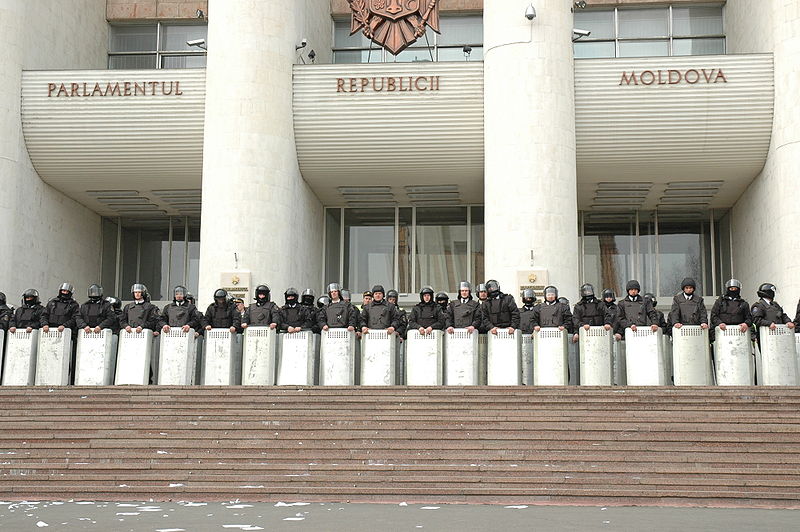
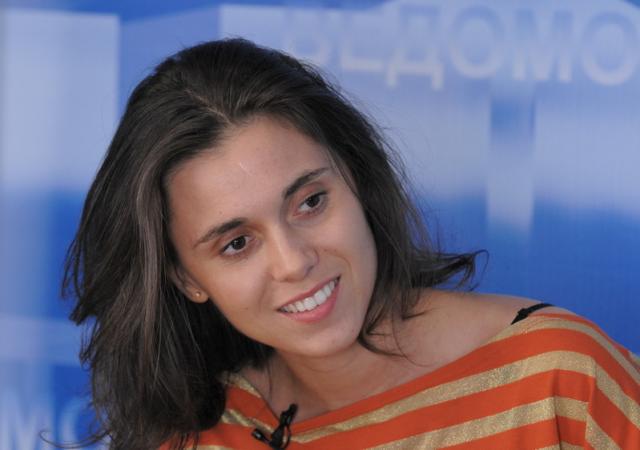 But once the demonstration started, she said Twitter became more important because the government shut down websites. She said the only source of information available was through Twitter on mobile phones. Even that was limited. Morari said at times only one mobile phone network was available and “many people couldn’t keep in touch with those who were in the street”.
While Twitter was not the main mobilisation tool, Morari says more and more people began using it as the only way to keep up with what was happening in their country. In particular, she noted that it was vital for informing the significant Moldavian diaspora about what was happening.
In Morari’s words, Twitter was used as a way of “informing and keeping in touch with people who were interested and cared about what was happening in Moldova”. #pman then was more important as a way of organising information than it was for organising the protest (which, in retrospect, clearly wasn’t very ‘organised’ at all).
Evaluating Twitter’s role
The names we give to events never tell the full story. But in April the ‘Twitter Revolution’ tag meant that many people misunderstood what was happening in Moldova. It misses the key roles which other social media tools played in the initial mobilisation and, perhaps more importantly, the phrase disconnected the narrative from political reality.
Sitting next to Morari on the panel in Mexico City, Jack Dorsey said (I believe, misleadingly) that the events in Moldova proved the “concept of creating a temporary flash movement out of nothing” – as if general political dissatisfaction with Communist rule and the election process among Moldova’s younger, urban population were both irrelevant to the demonstration.
Nevertheless, the power of the few to disseminate information to the many – in the context of a country with state-controlled media and in the face of government attempts to silence opposition – had profound implications. Twitter’s ability to continue to provide people with access to information in these circumstances was a vital component in the process of the protests.
And while it might be a far more complicated picture, calling what happened in Moldova “a Twitter Revolution” certainly got us talking. Personally, I believe we need more debate, we need to be examining this sort of research and furnishing some comparisons with the Iranian election in June in order to understand what impact Twitter has on 21st Century politics.
