Freelance/Student £140
Members £115
*Tickets include lunch

A day long workshop that covers some of the basic production skills that can help you create high quality original content for your podcast that will make you stand out in the crowd. Deborah Dudgeon and David Prest, of award winning audio producers, Whistledown, will dissect what makes a successful podcast, how to plan it and put it together, and explain some of the simple marketing tools that can ensure your podcast reaches its audience.
Over the course of the day you will:
– listen to some great podcasts and work out what makes them successful, as well as what doesn’t work so well
– script an introduction to your own podcast
– learn how to plan your podcast, work out a format and running order
– get advice on selecting the right presenter(s) and guests
– experiment with microphone use and how to capture good quality sound
– understand rights issues and financing
– learn how to reach your audience
– and ultimately make your own 5-minute podcast to take home.
About the trainers:
David Prest and Deborah Dudgeon of Whistledown Productions will teach the course. Whistledown is the largest provider of speech programmes to BBC Radio, providing landmark series such as Radio 4’s The Reunion, and Feedback, as well as a wide range of features and documentaries. Whistledown also works with universities and commercial clients to make podcasts and audio guides.
Image: via Shutterstock / MAFord
]]>Freelance/Student £140
Members £115
*The tickets include a light lunch

In an increasingly competitive media marketplace, gaining maximum coverage for the issues that matter is key to making sure your stories make a difference. Learn why editors reject or select humanitarian and NGO stories and how to avoid the classic pitfalls. This course will show you how to produce fantastic visually led pitches using the right platforms to ensure maximum coverage and compliments the storytelling courses held in January and March.
What you will cover:
- How to tell visual stories that sell in well,
- Pitching photo stories to the media,
- The relationship between media and photography,
- Understanding what the media wants,
- Understanding what the media doesn’t want (what not to do),
- The role of wire services like AP, Reuters, AFP, and EPA,
- How to file photographs as press handouts to the wires,
- Using web platforms and social media effectively for dissemination photography.
What to bring:
- Laptop to take notes,
- At least two story ideas.
About the trainer – Nadene Ghouri
 Arete is the expert humanitarian storytelling agency for non-profits and NGOs, working with award-winning journalists and content specialists to help tell stories that make a difference. Nadene Ghouri is an award-winning investigative journalist and a key member of the Arete team, with two decades of global experience producing news, current affairs, documentary investigations and features. She has been a staff reporter/producer for the BBC and Al Jazeera English. She is a two-time finalist for Broadcast Journalist of the Year, Popular Features and Best Television Documentary at the One World Media Awards and a former winner of the Amnesty Media Awards (Best Radio Investigation). Ghouri is also a winner of the Human Trafficking Foundation Media Awards (Best National Newspaper Investigation) and the Ethnic Minority Media Awards (Best Broadcast Journalist and Best Documentary). Ghouri is a highly experienced international media trainer and consultant, with a particular focus on storytelling training and strategic communications.
Location: Room 9 Bargehouse/ OXO Tower.
Address: Oxo Tower Wharf, Bargehouse Street South Bank London SE1 9PH

There has never been a better time to be a filmmaker. Broadcast quality cameras are now more affordable than ever before and edit software will run on a laptop or home computer. In this short taster session, film-maker Dean Arnett gives us a quick over view of three of Canon’s frontline cameras, clearly aimed at three different film-making markets. Dean gives us a quick tour of what we need to shoot for the edit, how to use the camera and how to visualise the story.
The workshop is led by Dean Arnett who is a self-shoot documentary producer. He has worked internationally but most notably for the BBC and Discovery. He is also a media trainer, designing and delivering film and editing courses for video-journalists and self-shoot producers. In 2014 he was awarded the coveted, ’Rising Star award’ at the 2014 Canadian International Film Festival for his BBC documentary ‘Burying the Past. He continues to shoot documentaries and deliver training for broadcast and commercial organisations all over the world, with a handful of projects currently in production.
*Please note this is a taster workshop for the two-day filmmaking course coming up at The Frontline Club.
ArchFilmFest is a 6-day biennial festival that will celebrate architectural film through screenings, installations, symposia, workshops and an international film competition. Frontline Club has partnered with ArchFilmFest by bringing a selection of films and workshops.
]]>Freelance/Student £125
Members £100

Got a documentary idea but not sure how to: move it forwards, get some interest, get it funded, commissioned and broadcast? This one day course is for anyone, from complete beginners to experienced producers, who have a documentary idea but don’t know how to move it forwards, develop it and get it made. This workshop applies to online documentaries, broadcast TV documentaries and one-off theatrical release documentaries. During the day we break down the development process, working through what’s needed to create a compelling pitch, then a fully rounded proposal, a treatment, shooting schedule, budget and sizzle teaser.
The workshop will cover the following:
1. PITCH
– What is a story?
– What is a documentary?
– Where’s the access?
– The title
– The pitch
2. PROPOSAL
– Planning the proposal
– Tag line
– Identifying the critical information for each section
– Writing and rewriting the proposal
– Sizzle teasers
3. TREATMENT
– Point of view
– Treatment and execution styles
– Presenters, narration
– Re-versioning, added value and interactive options
– The opening sequence and how to start
– Narrative reveal, arc, structure
– Script
– Empathy, pace and audience engagement
– HEC test
– The importance of themes
4. PRODUCTION
– Rights, release forms
– Shooting schedule
– Budget
– Production managing and workflow
Dean Arnett is an award-winning, self-shooting producer, with 23 years’ experience. After many years working for the BBC, he is now freelance, shooting documentaries, corporates and TV features with a variety of cameras, all around the world. He also provides training for the BBC, PA, Archant and other media groups.
Freelance/Student £125
Members £100
In an increasingly competitive media marketplace, gaining maximum coverage for the issues that matter is key to making sure your stories make a difference. Learn why editors reject or select humanitarian and NGO stories and how to avoid the classic pitfalls. This course will show you how to produce fantastic visually led pitches using the right platforms to ensure maximum coverage and compliments the storytelling courses held in January and March.
What you will cover:
- How to tell visual stories that sell in well,
- Pitching photo stories to the media,
- The relationship between media and photography,
- Understanding what the media wants,
- Understanding what the media doesn’t want (what not to do),
- The role of wire services like AP, Reuters, AFP, and EPA,
- How to file photographs as press handouts to the wires,
- Using web platforms and social media effectively for dissemination photography.
What to bring:
- Laptop to take notes,
- At least two story ideas.
About the trainer – Nadene Ghouri
Arete is the expert humanitarian storytelling agency for non-profits and NGOs, working with award-winning journalists and content specialists to help tell stories that make a difference. Nadene Ghouri is an award-winning investigative journalist and a key member of the Arete team, with two decades of global experience producing news, current affairs, documentary investigations and features. She has been a staff reporter/producer for the BBC and Al Jazeera English. She is a two-time finalist for Broadcast Journalist of the Year, Popular Features and Best Television Documentary at the One World Media Awards and a former winner of the Amnesty Media Awards (Best Radio Investigation). Ghouri is also a winner of the Human Trafficking Foundation Media Awards (Best National Newspaper Investigation) and the Ethnic Minority Media Awards (Best Broadcast Journalist and Best Documentary). Ghouri is a highly experienced international media trainer and consultant, with a particular focus on storytelling training and strategic communications.
As guest speakers we’ll have Zing Tsjeng Editor at VICE and Jonathan Paterson Digital Editor at BBC who will be sharing their experience on pitching and what they expect from a good story.
This workshop is part of a series being run in partnership with Arete. To find out more about their other workshops, click here.
]]>Freelance/Student £125
Members £100
In an increasingly competitive media marketplace, gaining maximum coverage for the issues that matter is key to making sure your stories make a difference. Learn why editors reject or select humanitarian and NGO stories and how to avoid the classic pitfalls. This course will show you how to produce fantastic visually led pitches using the right platforms to ensure maximum coverage and compliments the storytelling courses held in March and April.
What you will cover:
- How to tell visual stories that sell in well,
- Pitching photo stories to the media,
- The relationship between media and photography,
- Understanding what the media wants,
- Understanding what the media doesn’t want (what not to do),
- The role of wire services like AP, Reuters, AFP, and EPA,
- How to file photographs as press handouts to the wires,
- Using web platforms and social media effectively for dissemination photography.
What to bring:
- Laptop to take notes,
- At least two story ideas.
About the trainer – Nadene Ghouri
Arete Stories is the expert humanitarian storytelling agency for non-profits and NGOs, working with award-winning journalists and content specialists to help tell stories that make a difference. Nadene Ghouri is an award-winning investigative journalist and a key member of the Arete Stories team, with two decades of global experience producing news, current affairs, documentary investigations and features. She has been a staff reporter/producer for the BBC and Al Jazeera English. She is a two-time finalist for Broadcast Journalist of the Year, Popular Features and Best Television Documentary at the One World Media Awards and a former winner of the Amnesty Media Awards (Best Radio Investigation). Ghouri is also a winner of the Human Trafficking Foundation Media Awards (Best National Newspaper Investigation) and the Ethnic Minority Media Awards (Best Broadcast Journalist and Best Documentary). Ghouri is a highly experienced international media trainer and consultant, with a particular focus on storytelling training and strategic communications.
As a guest speaker, The Guardian’s global development editor Lucy Lamble, will talk about what Guardian Development team are looking for when it comes to a strong pitch.
This workshop is part of a series being run in partnership with Arete Stories. To find out more about their other workshops, click here.
]]>
I never thought about making money when I set up Kigali Wire. From the beginning it has always been an experiment and it remains so. I never thought about making money when I shot my first photojournalism essay – which is in dire need of an editor’s hand… forgive me, it is my first bash at the medium. And I never think about money when people use my stuff. So, why am I thinking about money now?
Because, I reckon I stand to make more money on by-products than I (probably) ever could from straight journalism. Since doing the photojournalism essay, I’ve received the following enquiries:
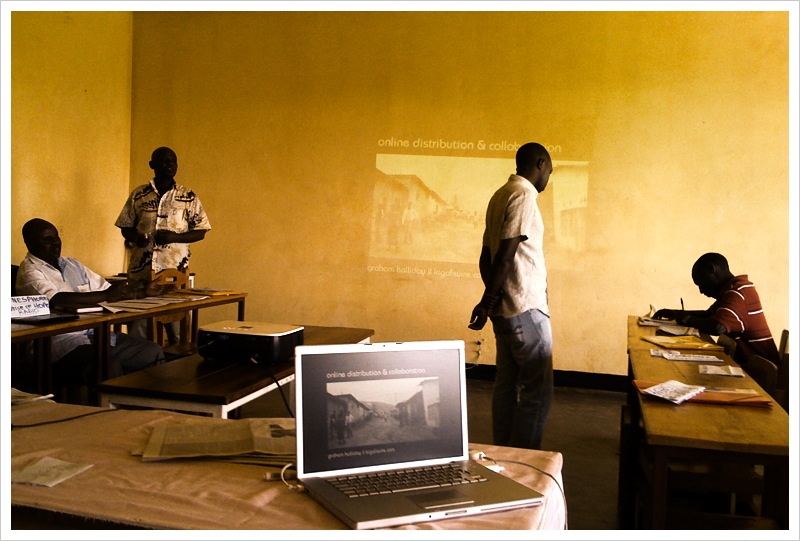
– 5 invites to give paid talks – that’s me above, about to give one of them in Kigali.
– interest from a major newspaper in commissioning an edit of the piece.
– interest from a couple of NGO’s about doing similar photojournalism pieces on a commission basis.
That’s almost $2,000, even if the latter two don’t come off. All the tools I use are cheap. All the digital tools I use are free or low cost.
I’m beginning to hope think it might be sustainable to do the stories I want to do, in the way I want to do them, if I keep in mind that by-products are the only earner. And if I get more creative in what by-products I come up with.
This is something Vaughan and I have talked about loads over the years – maybe one day we’ll unveil our world-beating chip van model for the future of journalism... And I’d say this kind of thinking is at the core of what the Frontline Club stands for.
Of course, this isn’t new, but – in these utterly grim times for old media – thinking along these lines might offer a glimmer of hope for any would-be freelance journalists out there. And it deffo plays into the whole how to be a foreign correspondent thinking some of us talked about recently. To make this work best, I reckon you still need to…
go somewhere cheap. And odd. The odder the better. link
Photo taken from my personal Flickr account
]]>Former foreign correspondent Thomas Crampton talks to Eric Weiner, another former foreign correspondent, about his thoughts on the 10 career options left for foreign correspondents. As media giants crumble and budgets for "the old way of doing things" no longer exist it’s a timely (and funny) 10 minute chat. I’m guessing option number 5 – "Public Relations" is proving to be the most popular for all journalists, not just foreign correspondents, purely for economic reasons, but…
"Deep down, in your heart of hearts, you know, you’re just a flack" link
However, after several years of media training for the Frontline Club, the BBC, Al Jazeera and others, it looks as if I’m heading yet deeper towards two of the other options. Firstly, option number 4 – "The Professor".
I won’t quite be a professor, but I will be training Rwandan journalists here in Kigali, where I moved with my family one month ago. I’ll be trying to impart a little of what I know and hopefully learn a fair bit of what they know about journalism.
I’ll be working part-time on a USAID funded programme in association with the Rwanda Initiative, a Canadian media NGO based in the Rwandan capital. I’ll have around 5-8 journalists per month, from radio, newspaper and TV, and I hope to learn a bit about what they do, how they work and where they work.
This shouldn’t take up more than a day or two per week, which leaves me plenty of time to desk-based research work, schedule training overseas with a little left over for option number 10 – "Digital".
I’ve handed over the bulk of the online end of Frontlineclub.com to the very able Charlotte Cook. And finally, instead of writing about journalists working on the frontline, I get to be one. Almost. I’ll be blogging for Frontline about life in Rwanda and I’ll be launching my Kigali Wire news/blog site in a week or so
You can follow me on Twitter @kigaliwire and if you’re really keen (and you’ve read this far) you can learn about the process behind building Kigali Wire which will possibly form part of the training I’ll be doing here in Rwanda.
Press accreditation in Rwanda currently costs $1,000 per year for foreign journalists, but it looks like the fee might come down to a more freelance friendly $300 in the near future. As and when it does, I’ll look at getting accredited and adding a bit of Eric Weiner’s option number 1 – "The Journeyman" – to my portfolio of jobs.
So, please stay tuned. And, if you’re passing through Kigail – do let me know.
]]>