It’s been nearly 2 months since the Grenfell Tower fire. In this time 9 survivors, local residents and volunteers have felt compelled to make a film to dispel the public’s fear from the Lancaster West community and reveal the deep impact this has had on them as people.
‘The survivors are not statistics they are humans beings’, says Adrianne McKenzie, one of the film-makers who has been struck by the way the survivors are seen in terms of ‘what they can be given … not as people’. Film-maker and youth worker Nendie Pinto-Duschinsky supported the team of young film-makers and describes the film as ‘harrowing to make’ but the ‘articulacy, dignity and insight of the young people will change perceptions’. Young people lost their lives on the night running into the building to save people. We hope the film will transform the way the community are seen from ‘angry and un-relatable’ to the truth that they are ‘coping with their suffering by trying to help other people’. Their humanity and morality is the clear message.
The media has covered the story in ways that the local community are not satisfied with, the evening will touch in the disparity between eye witness accounts and the reporting of events as they unfold on national media as well as the dangerous spread of misinformation.
There will be a discussion after the film with the survivors of the tragedy and the film-makers to share their personal accounts of the fire, and how disasters like this are reported in the UK.
Joining the discussion will be the journalist Ed Vulliamy. Growing up in Notting Hill, Vulliamy has written regularly on the ruthless development of the area that has divided those living in West London. He regularly writes for the Guardian.
Watch Channel 4’s excerpt of the film here
Interviews with some of the young people in the film here
Speakers
Zoe Dainton and David Benjamin lived on the 4th Floor of Grenfell Tower where the fire started. ‘ We’re two of the lucky ones we survived, we got out. People feel lost right now, everyone’s walking round like zombies[…] Here round Latimer where Grenfell is everyone knew each other, was friendly with each other there wasn’t much trouble. It was nice, as a community we were quite close…Some kids are lucky that they won’t remember this apart from in pictures and videos. There was a girl who went to school the next day and done her GCSEs in her pyjamas, she’s going to remember that forever’.
Shona Harvey lives 5 minutes from Grenfell Tower and went to primary school with Zoe. ‘Ladbroke Grove was a special area for me to grow up in because it’s culturally diverse, and it’s home to one of the biggest street carnivals in the world, The Notting Hill Carnival’, Shoana says. ‘Even myself, I was sitting down with some friends in a cafe, we were talking about what’s going on but then you do pause and think, am I laughing too much? I do think to myself maybe I feel a little better… but then you watch more footage on the news and it hits me again and I can feel my emotions building up and you realise it’s still quite fresh’.
Adrianne McKenzie is a freelance film-maker who spent much of her youth in West London. She was making a film about the closure of Stowe Youth Club near to Grenfell Tower when the fire happened. She picked up her camera and began to record events from the first night. Struck by the de-humanisation of the survivors, spending time on the ground has revealed that ‘…no-one’s really talking much about the people apart from what they can be given. So these luxury apartments or £5,000 from the government… No ones really thought about them as people they are just statistics. I feel like the survivors have been forgotten about. People are fighting a lot for the deceased but not as hard for the people who are still here’.
Reece Yeboah lives underneath Grenfell Tower and sees it every morning. He is a fashion designer and young creative pursuing his dreams. He feels if Princess Diana was alive she would have come and helped the people of Grenfell. ‘My niece goes to nursery in Grenfell Tower so on the morning of the fire I took her to nursery.’ ‘We’re doing this because we’re a community and we’re doing it from our hearts but we shouldn’t have to, the council should be doing this’. I lost 4 or 5 friends in the tower, but it’s probably more, most people in the tower, I used to see them everyday.’
Pilgrim Tucker is a community organiser and campaigner. She has many years experience of working on projects aimed at amplifying the voices of local residents, service users and community members, supporting them to organise to influence decisions that affect them. She worked with Grenfell residents in 2015 to help them campaign against the refurbishment undertaken KCTMO and Rydon. Since the fire she has continued to work with residents on the Lancaster west estate that surrounds the tower.
There will be an optional donation (£5 + standard ticket) when you book. You can also donate optionally via paypal:
We will be accepting donations for the survivors of the fire who will be attending the evening. 20 million pounds was donated by the public to meet the emergency needs of the survivors, many of whom are still ill from the fire without regular food and basic clothing. The Royal Borough of Kensington and Chelsea Council have imposed eligibility criteria which prevent or delay survivors claiming money in many cases. For example to receive the ‘Fresh Start’ grant of £10,000, survivors must be in permanent accommodation, which they are not.
Nearly all of the 250 families are in temporary accommodation as the permanent accommodation offered is unsuitable or not ready. The small percentage of donations that have been given out for the most part have been awarded to community organisations.
We would encourage you to donate to the fund at the screening to help them get on their feet during this uncertain period of their lives.
The Frontline Charitable Trust is a not-for-profit organisation.
]]>
It was perhaps twenty minutes after the call to prayer had sounded and we were breaking the fast, sitting on the floor around a plastic sheet with plates of rice and meat, when I was knocked sideways to the ground.
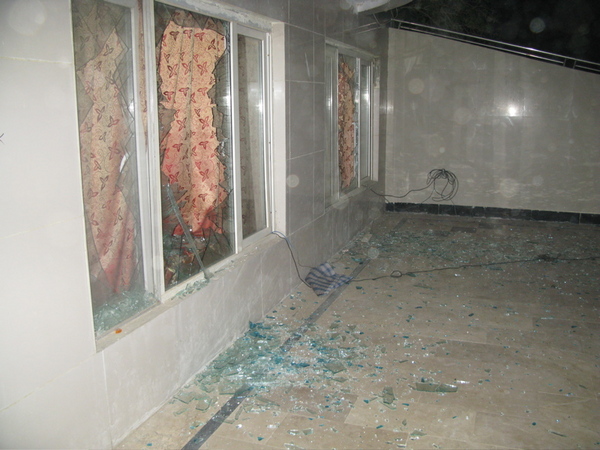
It takes a split second till you realize what happened; the shock-wave had blown out the windows, sending the glass flying like shrapnel into the room. It was a miracle that no one was injured.
Our glass is double glazing, and glass kept on raining down the facade landing on our terrace, shattering into thousands of tiny pieces. There have been bomb blasts before that shook the ground, but nothing like this. I heard gunfire on the streets for several minutes, and I moved to the back rooms of the apartment with my friends. No pretty pictures this time, but I doubt I could have held the camera steady those first few minutes anyway.
Soon after the gunshots stopped, we walked out onto the terrace, glass crunching under our sandals and watched as police cars and ambulances rushed past towards the blast side. The air was filled with dust and a few blocks down I could the flashing lights and cars gathering. Quite soon after, a fire burst out, with flames and black smoke billowing into the sky – firefighters passed by.
The blast site was near to Sharjah Bakery, a shop I visit most days for soda and sweets. Just across the street is a wedding salon, and the NDS/intelligence services office is close by along with a private security company and a construction company. A friend called and said it might have been a bomb factory that blew up. Some 40 minutes later reports came in that it was a car bomb. Casualties kept arriving at Mirwais hospital for hours after the explosion. People were being dug out of the collapsed building. This morning the toll had risen to 43 dead and 65 injured.
My desk is littered with pieces of plaster that have fallen off from the ceiling and the window frames sit next to the wall.
30 minutes after the blast a convoy of foreign troops drove by, the unmistakable sound of their heavy vehicles roaring through the streets, followed by more ambulances.
Smoke kept on rising into the sky hours later, even though the firefighters seemed to have managed to put out the fires. Helicopters were flying overhead through the night sky.
Sitting in the now windowless living room last night talking with my Afghan friends, one turns to me and says: “There are those Afghans who migrated to the west who say they miss Afghanistan!” He bursts out into laughter. “This is what they are missing!” Another shakes his head: “Fuck Kandahar. Fuck Afghanistan.”
Around 11:00pm people were being evacuated from the Continental guesthouse. The police chief was talking about another 4 possible suicide bombers who were still at large in the city and heated discussion broke out in my apartment as to whether or not we should stay or move to another building further away from the Continental guesthouse and the main roads.
In the end we stayed. The idea that a truck bomb would drive into our building and explode seemed unrealistic at the time.
Now the next morning, the air is filled with the sound of people cleaning up broken glass on the street. The shopkeepers just opposite our building have all lost their glass windowfronts. I can see the blast sight; some buildings are missing, and the ones adjacent to the center of the explosion seem derelict, without windows or frames, just the empty carcasses left standing.
The area around the Shah Jahan Restaurant is a popular area, with many people spending their evenings on the little green grass strip in the middle of the road. Half an hour ago I drove to the blast site, and the destruction leaves little doubt that this has been Kandahar’s biggest bomb so far: entire buildings were annihilated and squares of mud huts flattened.
Sharjah Bakery is gone, the construction company reduced to a pile of bricks across the street from it. The restaurant itself collapsed, burying everyone inside underneath it.
Another friend called in and said he believed that the district chief of Khakrez was at the restaurant along with a number of government officials, but nothing is confirmed yet.
Emotions were running high yesterday, and security forces in town were quick to pull the trigger. Standing outside on the terrace waiting to being put through to CBC Radio for an interview, someone started firing his AK47, and a bullet whizzed past me, hitting the door and reaching as far as our living room.
A moment later CBC was on the phone:
“Tell us what is happening right now.”
“I’ve just been shot at…”
I did the interview anyway, even though I guess I must have been a little freaked out at the time, given the amount of swearwords I used.
In the end, though, no one is surprised. This is not a turning point or the start of something; it’s what has been happening all along for the past few years in Kandahar. Violence has been on the rise, and there is no security for the people of southern Afghanistan.
[This piece was written by Felix Kuehn.]
]]>
Just press play on the Houndbite bar above. Felix will be updating his blog and reposting here tomorrow morning when he wakes up and when he can conjure up some electricity…
]]>
It’s the middle of summer down here in Kandahar, with temperatures peeking around 50 degree celsius by noon. In the run up to Afghanistan’s second presidential and provincial council elections foreign troops stepped up their efforts, launching multiple operations to prepare the ground for voters.
British casualties passed the 200 mark, with friends from London writing to me asking what is happening down south. There is a growing belief that a surge and COIN is the answer, and that pouring more troops in now will allow them to withdraw sooner in the long-term. Some commentators even suggested that this could happen in the next one to two years — an unlikely scenario to say the least.
These elections are a milestone in the western ‘Afghanistan’ project. There’s a definite need for this to happen; there’s a definite need for good news. The south is in the midst of an ever accelerating downward spiral of violence and disintegration: take last year’s numbers of casualties, attacks and bombs, as well as foreign troops; double it and you are close to what Kandahar is like these days.
The city itself is in deep crisis. Just the other day a friend named multiple city districts he can not go to anymore due to security concerns. If you are known in the city, you carry a gun.
The Afghan government has sent in reinforcements to secure the city. On my flight from Kabul last week I shared the plane with some 40 ANP. New soldiers and policemen in Kandahar means scared kids with guns, which in turn translates into more gun fights and more problems. During the two nights before the election the air was filled with spurts of AK and PK gunfire, at times lasting for over an hour, maybe because the insurgents are stepping up or because the police are edgy and trigger happy.
The day before the elections Alex forced me onto twitter and posted an introduction resulting in 40+ followers, one of which send me a tweet at 7.30am saying: “@felixkuehn Wake up. It’s a big day.” Indeed it was, and by the time I was back from the first round of visits to various election polling stations I saw his message.
The stations opened at 7am, with the governor casting the first vote of the day just a couple of minutes before the elections officially started. It’s a two minute drive from where I live to the election centre at Ahmed Shah Baba High School; at least it only takes 2 minutes on election day. All the roads were deserted, the city closed. Cars needed special permits to be on the street, shops were closed and there were double the usual number of ANA and ANP-manned security checkpoints throughout the city.
I took a picture of the governor. He didn’t look happy walking to the station; he hardly ever looks happy you have to admit, but than again, who would be happy running Kandahar…
He cast his vote at one of the 20 polling rooms amidst a battle among the who is who of Kandahari journalists. NYT’s Timur Shah, Hewaad television and Al Jazeera were swarming around him, and of course Soraya Nelson of NPR, just back from two weeks embedded in Helmand, was holding her ground, moving ninja-like through the crowd in her orange garments. When we entered the school grounds about quarter to seven, flashing our media cards from the election monitoring commission, we were greeted by a few friends, the election ‘observers’, all wearing Karzai caps and buttons.
We stuck around at Ahmad Shah Baba for an hour or so. At no point during that time did more people come to vote other than election staff and journalists hanging around waiting for them.
The caravan of journalists then poured into their cars heading for the next polling station — which was closed, so we drove to the next one. Zahir Shahi High School is a few hundred meters down the street from the police headquarters and had 8 polling stations open. When we arrived there was a small queue of around 8-10 people outside, but inside the corridors were full, giving an impression that lots of people would show up to cast their votes here. In the end the total number that came was around 1800 (1717 votes at 3.15pm with hardly anyone around); this being Kandahar’s most central polling station, a very meager outcome.
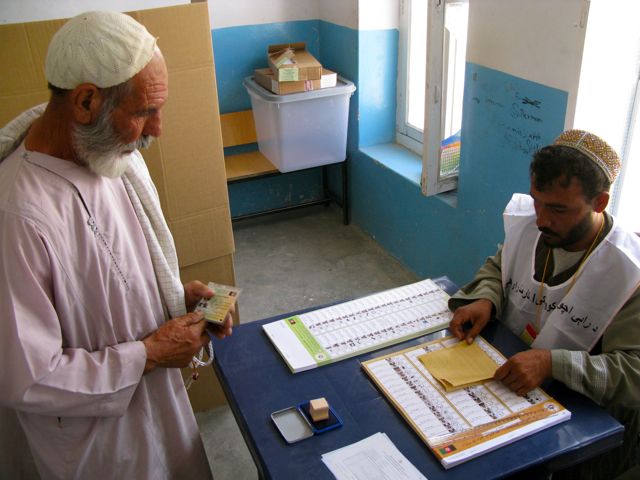
At Zahir Shah High School, however, we met Mr. Zakaria who was there to cast his vote. “I am not afraid. I am here to vote,” or something pretty close to that were his words. After his finger was stained and his card invalidated, he took the two voting cards and walked towards the cardboard voting stations with one in each hand. 30 seconds later he appeared again a voting paper in each hand, shrugging his shoulders, and asking the room what he actually had to do with them now. Several people rushed to help and a minute later, Mr. Zakaria disappeared again. Another man went over while he was standing behind the cardboard shield but was soon asked by the staff to stand back. Mr. Zakaria dropped the ballots into the boxes and and strolled away.
We walked around the corner to go the the women’s polling station. There were a few dozen there at the time, even though half of them were probably election staff. We went into one of the polling station rooms, and found ourselves in the middle of a drama: the ballot boxes weren’t sealed before the voting had started.
In the end, one of the ladies in the room sealed the boxes and stuffed the 14 ballots into them again, and we were sent on our way.
We spent lunch at our computers, quickly learning that the supposedly indelible ink could be removed with bleach. The news was tearing through Kandahar by 1pm. Everyone was on the phone, letting people know that you could remove the ink and vote again. Close to everyone I know down here has 2-3 voter registration cards to his name. I can not be sure how many people cast a second or even third vote, but I know it happened.
After lunch we drove out to Mirwais Mina just west of Kandahar city. Mirwais Mina sees open fighting on the street as well as IED attacks on a regular basis these days. The school we went to, however, is best known for the acid attacks against a number of schoolgirls earlier this year.
In the polling station for men we were escorted to one of the offices as soon as we entered the compound. Ustaz Abdul Halim was sitting in the middle of the room, smoking. Ustaz is the last of the Kandahari dinosaurs of the Soviet Jihad, and Mirwais Mina is his capital. He still has a base out there, and remains pretty influential to say the least. He was the security advisor to the last governor, and a few days ago I saw him on the stage of Karzai’s rally in the stadium. Ustaz seemed to be in high spirits, though, and after a brief chat we walked up the alley to the girls’ school.
At that polling center 94 women had cast their votes at 3.05pm.
With barely an hour left we drove to Shkarpur Darwaza Station, counting 274 votes, and hurried back to Ahmad Shah Baba High School where the day had started. We went to 16 out of the 20 stations at Ahmad Shah Baba, counting 1007 votes, while rockets hit a few hundred meters away from the school causing the ANP and ANA to hastily run towards the gate and number of people to move towards the back of the compound.
We stuck around, watching them seal the ballot boxes and then open them again under supervision, counting the
votes. A journalist came in saying that the BBC had announced that the stations would be open for an hour longer, but people were already counting.
There are about 60 polling stations in Kandahar city and about 260 in the entire province. If I average what I saw on election day (and remember that two of those were the biggest in Kandahar province), and I use only the male polling stations, the most accessible etc. then I arrive at a participation rate of roughly 170,000 people or 17% for the whole province.
But, let’s be real: this is Kandahar. In the 2005 Wolesi Jirga elections roughly a quarter of all registered voters were female. I can’t recall the exact percentage but that number has grown in this year’s registrations, a miracle in itself down here in Afghanistan’s conservative heartland. So at least a quarter of the polling stations are for female voters, leaving 195 male voting stations. Let’s see where that leaves us – at roughly 13%.
In Kandahar we have 1.08 million registered voters. Out of those votes cast in the city we have a number of people who voted twice or maybe three times. In Spin Boldak, General Raziq took all the ballot boxes into his house, and rumour has it that the outcome for the presidential election in Boldak is 100% in favour of Karzai. People are talking about a 60% turnout by now. Based on what I saw and heard, a realistic estimate for the province is somewhere between 6-8%. As I told a friend who might be in the election complaints commission, and therefore a very busy man soon: “down here in Kandahar there was no election.”
But who are we kidding? It’s a milestone achievement. And in the end we will learn that at least 50-60% of the people voted, some 500,000 to 600,000 people. This was the second independent, free, fair and democratic elections in Afghanistan.
Karzai and Abdullah have both already declared their victory.
These elections were at best a sham, but in reality it was pure satire – no wait – actually it’s a divine comedy, and the foreigners are really just visiting the seven circles of hell.
[This post is by Felix Kuehn, my colleague down in Kandahar. It was originally posted over on his blog at www.felixkuehn.com.]
]]>So it finally happened. The election that we’ve been waiting for and looking forward to at least since last winter took place today all over the country. I’ll refrain from writing anything about the rest of the country. There are plenty of places to get a good sense of what happened. Make sure to check out www.aliveinafghanistan.org and the various people who’ve been tweeting news all day from the ground around the country. I’ll just be talking about the things in Kandahar that I saw and was able to confirm from here on the ground.
There weren’t so many foreign journalists down here and most are unlikely to publish detailed accounts of what happened and the things that they saw; NPR decided not to run a piece on the election down here judging that "one piece from Kabul was enough."
Violence
Things were a lot calmer than anyone would have hoped for, I’m glad to report. Not the mass waves of suicide bombers or IEDs lining the road. In fact the casualty count was quite low: Kandahar’s police chief told me at close of business yesterday that 2 children and one adult had been killed during the day and that two others had been injured. The man who died was probably the first casualty of the day, a military commander called Dost Mohammad and who was out running in a field when a rocket struck close-by and he was hit by the shrapnel.
Pajhwok was reporting in the morning that at least 6 IEDs had been removed from the roads in Kandahar City. An ANA commander who spoke to us on condition of anonymity said that 16 or 17 rockets hit the city during the course of the elections. During the night there were not rockets or attacks it seems, apart from the story I just heard from a policeman here at the airport that 5 armed men managed to get onto KAF airfield last night. They were searching all night, apparently.
In Kandahar it seems the Afghan government’s imposition of a ban on any negative coverage of the election during voting hours wasn’t upheld much, if at all. I spoke to a photojournalist yesterday who said he was actually given a police escort to one of the sites where a rocket hit.
The rockets, starting at 6.30am local time, were probably responsible for some people deciding not to go out and vote, but I don’t think it had an overwhelming effect in this respect. Most people had decided either way a long time ago, and in any case – as I’ll come to later – apathy was particularly intense for this election.
My personal experience was a lot like what it’s usually like in Kandahar. There were some isolated incidents — a couple of rockets landed quite close to us near the end of the day — but on the whole it was quite easy relaxed day. Some police manning crossroads in town were a bit edgy and conducted searches of cars at gunpoint, but for the most part the police were somewhat laid back; at quite a few voting stations my colleagues and I were allowed in without body searches or ID checks.
Turnout
I imagine this will be quite an important issue in the coming weeks, perhaps more so than allegations of fraud and vote-rigging. I visited almost a dozen voting stations in different parts of Kandahar City, including two female-only locations, and nowhere was there intense activity. We made sure to get to the big locations in the city centre as well as smaller places in the west and east of town.
During the morning there were people on the streets walking around town to get to polling centres, but it was far from an enthusiastic turnout. Everyone I spoke to who was present at the previous elections in Kandahar noted the big difference in numbers of voters. "At this large station we had several thousand people waiting to vote at any one time – there were that many people," one told me.
Near the end of the day we travelled to a selection of voting stations to take figures for how many people had voted in each location at the various voting booths. In the interests of full disclosure, here are the numbers I collected:
— Mirwais Mina Girl’s School (3.05pm)
35
18
18
23
TOTAL: 94
— Zahir Shahi High School – (3.15pm)
210
140
314
292
255
238
142
126
TOTAL: 1717
— Shkarpur Darwaza Station – (3.30pm)
42
62
59
51
60
TOTAL: 274
— Ahmad Shah Baba High School – (3.50pm)
356
135
67
40
28
33
14
45
26
19
9
6
60
64
41
64
(missing 4 stations that we didn’t count)
PARTIAL TOTAL: 1007
There are several things to note from these numbers. Firstly, turnout was EXTREMELY low. Zahir Shahi High School and Ahmad Shah Baba High School are arguably the two biggest voting stations in Kandahar City, where in previous elections large numbers of people were seen. Neither location saw more than 2000 voters by the end of the day. Obviously, there is a possibility that some of these locations saw lots more voters after we left, but it is highly implausible, and in fact we were present at Ahmad Shah Baba high school at the 4pm cutoff time and there was no last-minute surge.
There was, though, a bit of confusion as to whether voting had been extended for an hour or not. The school I was at started locking vote boxes and counting votes at 4pm. A man who came in and said that BBC had just announced a one hour extension was ignored and as far as I know no more votes were cast past the 4pm mark.
In all the stations that we visited, there were far more election staff than voters — with the exception of Zahir Shahi high school that we visited in the morning where there were several hundred voters lining up to vote. In Mirwais Mina Girls School, there were a lot of girls staffing the polling locations, but hardly any voters to be seen. In fact it seems that most of the vote numbers that we noted (above) were probably from election officials themselves.
So what do these numbers mean, and what can we deduce further from them? In Kandahar province as a whole, there were around 250 or 260 voting stations open. In the city there were around 50 open and receiving voters. Even if we assume that they were all as well-visited as Ahmad Shah Baba High School or Zahir Shahi High School (a preposterous assumption) then this is still a really low number.
If I take an average of the voting stations that I visited, we have perhaps 600 votes per voting centre (which itself is illusionary since almost no women came out to vote and since hardly any of the centres I visited had 600 people vote there). There were an estimated 1,080,000 registered voters according to IEC officials yesterday and so Kandahar potentially saw 160,000 voters out on the streets. I think this is an almost completely optimistic figure, assuming more people were out on the streets than my eyes saw.
There still is little information on voting in the districts aside from some stories from Spin Boldak (see below), but anecdotal accounts suggest that hardly anyone voted in the districts as well. All this indicates a turnout of less than 15%, probably in reality somewhere approaching 7 or 8%.
One further point: since the last vaguely useful census of Afghanistan and the south was decades ago, it’s very difficult to get a sense of demographics and how many people are living where etc. But given the figure of 1,080,000 total registered voters, I’m amused to take a look at the Afghan government’s own Central Statistics Office document on population statistics for the period 2008-9. I don’t really buy the numbers they state in the booklet, but they state that Kandahar has 1,057,500 total residents (352,200 urban and 705,300 rural). Get your head around that one…
Fraud/Improper Practices
I’ll admit that I’m not as familar with Afghanistan’s actual written voting and election law as I ought to be, but these are some things that I thought seemed pretty ‘off’. The first thing that I saw when I went to watch the governor, Torialai Weesa, cast the first vote of the day was the large number of Karzai ‘observers’ present . This was repeated at all the other centres I visited, and apparently it was quite uniform all over the country. These young men were recruited to watch and report instances of voter fraud, but in reality these functioned as campaigners for the incumbent, handing out badges and baseball caps to those who came. I heard from a number of people during the day that there were 6000 of these observers for Kandahar province alone, although one person warned me that there were fewer as some didn’t come out to take up their duties that day.
I noticed a fair number of FEFA observers, particularly around the end of the day, in Kandahar City. They were busy taking figures for how many voters were recorded as having voted in each station. I look forward to their report on voting irregularities.
Around noon, the news that the supposedly indelible ink could be washed off from fingers with domestic bleach started to hit the streets in Kandahar. This was good and bad. On the one hand, a lot of people who were scared of voting for fear that they would be identified by the Taliban by the ink-stain on their fingers suddenly realised that they could go and vote. I personally witnessed one group of people who were due to travel to Arghestan (district of Kandahar) the next day for a funeral who had decided not to vote for this reason; when it became clear that the ink wasn’t permanent, they all got up and voted.
On the other hand, it meant that lots of people came out and voted twice or more. I personally witnessed this. I don’t think there was too much of this, though, and certainly not enough to sway the vote significantly in one or the other direction. I believe it was a problem in other parts of the country, too. If you’re wondering how people managed to get multiple voter cards, please refer to previous blog posts that I’ve made, as well as the numerous media accounts of corruption in the registration system, where officials of the election commission and various other power brokers work together to manipulate the system.
From the start of the day, it was noted that the voter cards were not being properly invalidated with the card-puncher. Again, this was a problem all over the country. At subsequent voting stations that I visited, staff had taken differing initiatives to correct this – some cut the corners off the cards, others cut a triangle in the bottom right corner, and so on.
From what I observed during the counting of votes, there seemed to be some confusion as to how this was meant to work. I was based at Ahmad Shah Baba High School and some of the voting rooms were counted very fast, others took much longer. The difference was of course in the numbers of votes that each room had taken, but also in individual styles — some people would check everything two or three times, and others would just do it once. Occasionally observers working for the Karzai would come in and shout at some of the election people to do things differently, especially if they were taking a long time over the vote count. I imagine over Kandahar province as a whole there was a lot of variation in how the vote count went.
Women’s voting centres were interesting to visit. The first that I saw, Kaka Said Ahmad High School in the centre of the city, had some women voting (perhaps several dozen) early in the morning. In one room that we entered, however, the two boxes were open and women were in the process of handling the vote papers. When we asked the head of the voting centre what was going on (boxes were supposed to be locked and closed) she said that some women had come very early in the morning (before the official opening time) and asked, hands trembling out of fear, to vote quickly.
Later on in the morning an irregularity was noticed, though, since one box had 13 votes inside and the other had 14. They were in the process of dealing with this when I entered with my colleague and some journalists from the local Hewaad television station.
In another women’s voting station (Mirwais Meena Girls School), we were kept waiting outside the locked main gate for around 10 minutes before finally being allowed in (a policeman outside gave us a hand opening the gate). When inside, there were hardly any voters (under a dozen in the whole building) but lots of election workers and other girls. Again, I’m not sure if this was an irregularity, but my guess is that women’s polling stations, especially ones in the districts, were easy places for fraud to occur.
I overheard several conversations between provincial candidates or their representatives and people working/observing at voting centres — they didn’t realise I speak Pashtu — during which sums of money were promised in exchange for votes to be cast in their favour. In this manner, at one station 1000 votes were thus sold for $400.
I heard stories of this kind of trade in votes throughout the day, and in fact the ‘warm bazaar’ had been open for several months. Earlier in the year it was possible to buy voting cards for $1 a card (they were sold in booklets of 100 usually). By the time the day before the election arrived, they were being sold (in some instances) for $5-10 per card.
The Afghan friends I was travelling around with that day called one of the voting stations for which I gave numbers above (Shkarpur Darwaza) ahead of our arrival. "Don’t come! Don’t come!" our friends were requested. "We’re about to start stuffing the ballot boxes and we don’t need foreigners here messing up our work." That was one of the election officials of the station talking on the phone. Needless to say, we went there and took note of how many voters they had on their lists.
Spin Boldak is an interesting case, although, since I didn’t manage to get down there myself and I haven’t yet heard from people who did, I suspect we’ll never get to the bottom of what happened there. In the months prior to the election, I heard numerous accounts of how General Razziq’s men — Razziq is a local border police commander, well-respected in southern Afghanistan — were preventing any non-Karzai supporters from campaigning in town. "If anyone puts up pictures of the opposition presidential candidates, like we did a few days ago with 1000 pictures of Ashraf Ghani, they’re all gone and taken down by the next day," one campaigners told me.
So not really a free and fair environment. As the election day progressed, I started hearing reports that Razziq was influencing the voting. At 4pm when voting stopped, I received several credible reports that Razziq had sent his men round to every polling station in Spin Boldak and collected all the ballot boxes. He then reportedly took them to his house – ‘to keep them safe and secure’ – and prevented election observers from entering. The boxes were stuffed overnight, many claimed.
Again, I have no way of confirming any of this, but I can certainly imagine it happening. Today just before stepping onto the plane I heard from a friend down in Spin Boldak that there weren’t necessarily extra votes cast but that all votes that weren’t for Karzai were invalidated (i.e. multiple candidates were selected or some such trick), thus giving Karzai a 100% taking down in Boldak.
These reports all seem pretty blatant and in the open to be wholly true, but given that so many people know about these events I imagine that Spin Boldak will be one of the most highly contested voting districts.
Local Kandahari Perspectives
The saddest thing about all that I described above was watching the faces of my friends — particularly Kandahar’s youth — as they found out what was going on. A great sense of disappointment darkened most of my conversations during the last few hours of polling and during the evening and next day.
People focused on some of the details, especially the non-indelible ink that had been promoted with such fanfare by the United Nations earlier that year. People frequently blamed "the foreigners" for mismanaging things and allowing so much fraud and deception to take place. Admittedly these days conspiracy theories about the invisible hand of ‘the foreigners’ are omnipresent in southern Afghanistan, but "the farce of this year’s election" (as one friend put it) struck a nerve among those people who did want to vote, who did want a change, who didn’t have a direct stake in anyone’s campaign.
I remember I sat at my desk in the evening waiting for some of the foreign instutitions, embassies etc to make a comment worthy of the day. Instead, we got Kai Eide, the UN special representative, offering his ‘congratulations’. Slowly more internationals started voicing their happiness at how the election had gone. Most seemed to take a deep breath that there wasn’t more violent incidents around the country and that, at least in the public eye, the elections had passed more or less as planned. A pity that the wishes of ordinary Afghans for a free and fair election were not heard…
Most of my friends down in Kandahar voiced concern at how the voting was being managed, with campaigners and observers inside polling centres. The threat of violence was not the major factor in determining the low turnout, as I see it. Rather, apathy among voters meant that only a very small number came out to exercise their right.
There had been such a huge buildup to the elections, in both Afghan and foreign media, that perhaps the only reaction to the day was inevitable disappointment. Maybe the day could never have fulfilled all our expectations and hopes. There was a sense that the election could possibly have been a moment where a change or a shift could have changed the trajectory of Afghanistan – I remember watching Afghans around the time Obama was elected and wonder how many of them had hoped Afghanistan could also have its own Obama moment.
For many in Kandahar, and, I imagine, in the districts as well, the provincial council elections were also very important. From what friends of mine said to me yesterday, people seemed prepared to tolerate more ‘dirty business’ for the provincial council than for the presidential voting. The voting was more of an approximation, they said, and offered a chance to shift the power balance in the province a little.
Nevertheless, watching the low turnout but knowing that the next days would see the ‘Independent’ Electoral Commission announce large numbers of voters was enough to make the staunchest optimist just a little bit despondent.
Predictions and Conclusions
It’s too late for me to predict — as I was going to do — that Karzai will announce his victory; he already did. In the coming days a highly dubious turnout will be announced by Karzai and the IEC. When the final results come out, Karzai will have won, and will have captured over 50% of the votes. Ashraf Ghani and Abdullah will go into overdrive for a while, but slowly deals will start to be made behind the scenes.
After several weeks of confusion, the foreign community will cave in (it pretty much already has done so) and validate the results. This will, in turn, lead to further disillusionment with the foreign community. To a certain extent, especially in Kandahar and the south, the damage is already done. Even if the internationals were to have a change of heart and get serious, they’re already being blamed for the failure of this election. But of course there won’t be any serious outcries by the major voices of the international effort because too much is riding on this election passing, and passing without incident.
So we’ll pick up the pieces and stumble onwards. The change that people had hoped for didn’t happen. It was denied them. And despite all the hope and expectation of some kind of shift, we’ll just continue forward down the same path we were going before, just now without something ahead of us to light the way forward.
]]>"In the January 20, 1980, issue of the Village Voice, the left-wing writer Alexander Cockburn employed such a rationale to justify the Soviet invasion of the month before: ‘We all have to go one day, but pray God let it not be over Afghanistan. An unspeakable country filled with unspeakable people, sheepshaggers and smugglers … I yield to none in my sympathy to those prostrate beneath the Russian jackboot, but if ever a country deserved rape it’s Afghanistan.’"
No comment.
]]>-thumb-650x267-769.jpg)
Tribal elders in Kandahar like to explain how they’re waiting to see what will happen before committing themselves to any particular ‘side’. Well, we’ve all been waiting to hear from President Obama on his grand plan for Afghanistan and Pakistan – or the latest neologism, ‘Af-Pax’. Two days ago, finally, we heard.
In the words of a colleague, it’s "more of the same thing – much much more." There was very little of the so-called radical change that myself and other commentators had been hoping for. Of course there must be things that came out of the ‘grand strategic review’ that weren’t said (and that won’t be said), but I’m guessing that they weren’t mentioned because people might not be so receptive…
Speaking of problems, I read these two reports (here and here) this morning about problems with the Awakening Councils in Iraq. Remember this is the strategy that they want to start implementing in Afghanistan (and have started doing so in Wardak province under the watchful eyes of the Ministry of the Interior…).
-thumb-500x626-780.jpg)
On an unrelated note, I went to see someone from Kandahar’s Ulemaa Shura (or ‘Council of Religious Clergy’). Hajji Mahmoud (picture above) is a member of the shura and helps write articles for their monthly magazine, Islami Diwa. It all sounds a little dull, I know, but he was a lovely guy, and pretty world-wise, too. He had served as an MP in the parliament in Kabul during the 1970s (when King Zahir Shah ruled the country) and remembers the various manoeuvres that Afghanistan conducted during the Second World War in order to stay neutral and independent of the fighting going on all round.
We sat on a mat in the grass outside his house, drinking green tea while he reminisced. It wasn’t all pleasant memories, though. By his count 24 members of the 150-strong Ulemaa Shura have been assassinated in Kandahar since 2001. Four of those were from 2009 alone. These include the recent murder of Mawlawi Mohammad Rasoul (killed outside the Qadiri Mosque in Kandahar City), Qari Ahmadullah (killed in his home on March 1st 2009), Mawlawi Abdul Qayyum (shot dead outside the Red Mosque in Kandahar City), and – most famously – Mawlawi Fayyaz, the first president of the ulemaa council and son of Mawlawi Darab Akhundzada.
They are targeted because they offer a legitimate opposition to the radical mobilisations and motivations offered by ‘the Taliban’ to young madrassa students and jobless villagers. This is not to suggest that the ‘insurgency’ is primarily motivated by ideology — there are a variety of influences but ideology or religious motivation is not at the top of the list.
Ulemaa council members are actively and deliberately provocative in this respect. They write articles, make pronouncements and issue statements arguing against suicide bombing, for example, saying that it is an illegitimate form of jihad and so on. The articles published in their magazine are calculated to be provocative in this way.
When I get up in the morning I always cast my eye over the latest commentary on Afghanistan. My latest favourite is one entitled, "The Winnable War" by David Brooks, full of little gems:
"the Afghan people want what we want"
and
"I finish this trip still skeptical but also infected by the optimism of the truly impressive people who are working here"
Now I don’t know who he spoke to or where he visited, but this article felt like it was written about a different country. Or maybe Disneyland?
Speaking of strange things, I ordered some food from a local restaurant for lunch and found a little reminder of England in the packaging:
-thumb-600x252-777.jpg)
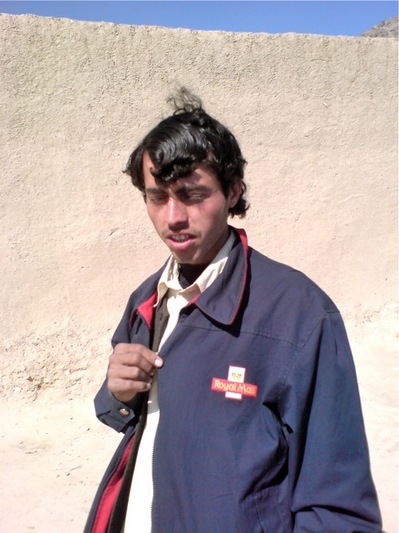
And even stranger, my colleague went out to Sperwan (in Panjwayi district) to see what was going on there and he found an Afghan wearing a "Royal Mail" jacket. An actual jacket that your local postman in England wears. And how did it end up in Panjwayi?
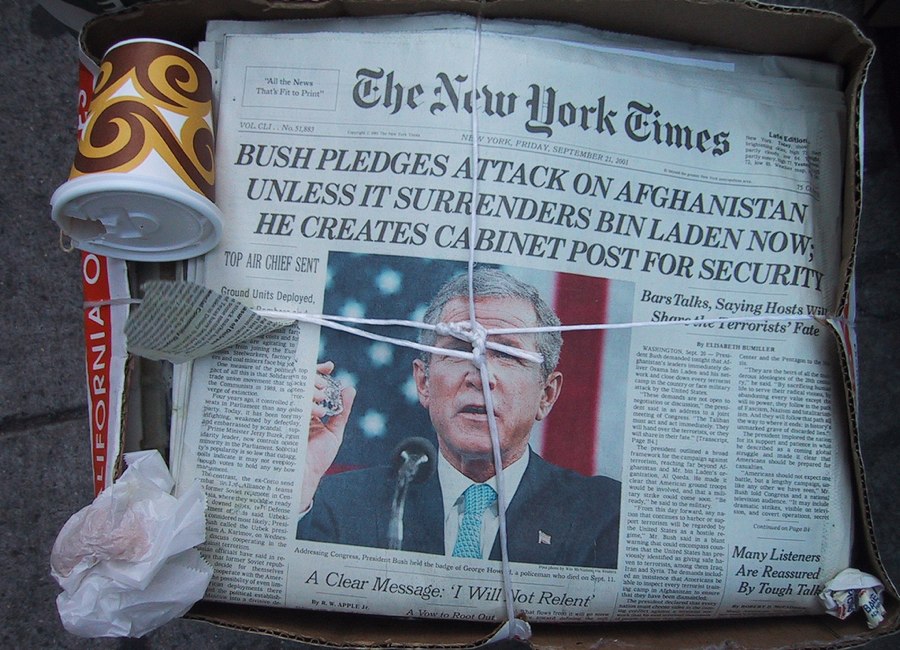
Is Afghanistan at risk of being forgotten by the outside world? Not at the moment, you might think, what with lots of print generated each day at the hands of foreign reporters. Obama, too, is considering his own surge of resources to the country, and it seems the larger newspapers on both sides of the Atlantic (the Guardian, for example, or the New York Times) can’t go a day or two before publishing yet another story on the war that never ends.
But how much of the real story are we actually hearing? I was surprised last week to hear the editor of a fairly large European news outlet wondering whether Afghanistan would soon fall off our radars and would go the way of so many conflicts. Surely, I said, surely he wasn’t serious… US media outlets are sending out correspondents to be based full-time in Kabul, and it’s not as if there is a shortage of things to write about…
Or so you would think…
A colleague of mine is living in Kandahar City at the moment – he’s the only non-embedded journalist permanently based in southern Afghanistan – and yesterday morning he sent me a mail letting me know about a double-bombing in the city which happened at around 7:20 in the morning.
We eventually found out that it had targetted an ANP (Afghan National Police) car and that one child was reported killed, and 1 civilian and 2 policemen injured. The BBC’s Pashtu radio service reportedly ran a report, as did local Kandahari TV stations, but otherwise nothing. It seems that not a single western (or eastern) newspaper or wire service covered the story.
I am amazed.
wrote my friend. Now all this is nothing new. We all know that there are next to no foreign correspondents in southern Afghanistan (or the north, for that matter). They’re mostly to be found in the capital. The rights and wrongs of that are worth being covered in a separate blog post, and indeed I’ve written about it before, as has Josh Foust of Registan.net who noted the double-standard at play in the way we cover the Afghan War.
The main result of all this is that there are some fairly important stories and places that have been left uncovered as regards Afghanistan. So here are five important things that I hope to see journalists writing about in 2009:
1. NGOs who indirectly (or directly) fund the Taliban – most people based down in southern Afghanistan have at least an inkling of an idea that this is what’s happening; if you want to run a programme in remote districts of almost anywhere in the south you’re going to have engage on some level with local Taliban. Most NGOs would counter that they’re providing ‘basic services’ and so have ‘no choice’. But at least some of the money they’re putting into local economies to run their programmes are just being spent on bullets used to fight against foreign troops.
2. Ghor, Dai Kundi and Khost – these are the names of 3 provinces in Afghanistan which receive far less coverage than they ought. Khost, most importantly, is where a sizeable number of US troops are based, but this article is the only thing I’ve read for months, and it’s nothing special at that. Ghor and Dai Kundi are in the centre of the country but are increasingly being used as a staging post for the Taliban.
3. Western Government Payouts for Hostages – there’s clearly a strong disincentive at work here. No journalist really wants to bite the hand that feeds him/her, and so we have only heard hints and rumours as to how this process works. And we’ve heard far too little about how destructive this is – kidnapping by criminal groups will continue only as long as people continue to pay money for the release of hostages.
4. Contractor Wars – One of the most worrying developments in southern Afghanistan, construction companies waged a sporadic low-intensity war against each other through 2008, sometimes kidnapping each other or at other times placing bombs in each others building sites so as to take over their contract from them. We hear far too little about the bad effects of western non-military assistance.
5. Effects of the Financial Crisis on the Taliban – I’ll leave you to fill in the dots on this one. Someone tried to write this story the other day, but it was a pretty poor effort. Will need a bit of travel to the Gulf and around Afghanistan, but potentially a really great story here.
So let’s not allow Afghanistan to be forgotten. And please – PLEASE – can we make sure there are no more first-person stories in spring 2009 written about journalists who travel from Kabul to Kandahar on the road.
[Image credit: main photo @ Flickr]
]]>
Ghorak district is north-west of the city, and not especially important in itself. Off the top of my head, it was the first district that the Soviets abandoned during the 1980s when they started their slow wind-down and withdrawal to the city. Nowadays its only value is its use and value as a transport hub for the Taliban.
Ghorak is relatively straightforward tribally speaking. It’s somewhere between 25 and 50% Popolzai (the same tribe as President Karzai), and two other big tribes are the Alikozai and Eshaqzai (along with dribs and drabs of others). There are maybe around 8000 people living there in just over 100 separate villages, with apparently only one teacher to cater for all of them. And there are no schools in the district – just 9 ‘inactive’ schools. There are no hospitals, no health clinics, and no doctors. There is no mobile phone coverage in the district either (although I imagine that will change in the next year).
It’s also not covered by the National Solidarity Programme (the NSP) which is often touted as evidence for development going on around the country (although the reality is a lot less clear). There are supposedly just under 100 Afghan policemen stationed there, but actually there are probably only about 30 present in the district, and even then they’re only in the district centre defending the building. There is no ANA (Afghan National Army) base, and the Canadian soldiers who were stationed there left some 8 or 9 months ago.
All in all, Ghorak is pretty far away from the city, and everything that the city might be seen to represent.

It also happens to be the only way to cross from Helmand (Sangin) into Uruzgan (Deh Rawud) province. It’s an important district in terms of drug traffic being transported from one place to another. The photo above is of US soldiers from the 82nd Airborne heading out for a patrol into the section of Ghorak valley that juts into Helmand province.
I was speaking to one of the big tribal elders of Ghorak in the middle of August about the jihad in the 1980s, but he kept coming back to the attack on his family home and fort a few days before. The Taliban had killed 3 of his relatives and another 3 were wounded. I saw one of the survivors that night – a bullet had entered in his neck and exited through one of his cheeks.
This attack, the elder told me, was part of a campaign to force all the big tribal families and landowners (often the same thing) to leave the area. Of course in defending their land and tribal ‘space’ many of his family were at the same time being used by the government as ‘police chief’, ‘district chief’ and so on.
Then a few weeks later I went to see a group of policemen who had just arrived that evening from Ghorak desperately seeking help for their fellow defenders of Ghorak district centre. Their guns and RPGs lay haphazardly spread around the room as if they’d just arrived or were about to head out that moment. There were policemen from all over the country sitting in that room – in the photo below you can see some of the guys from Herat, as well as the deputy police commander – and before even speaking to them you could tell that they’d been through a lot. Their eyes were red and a little bloodshot, their faces somewhat sallow and some of the younger ones fell asleep as they sat there.

Just over 8 or 9 months ago, the Canadians and the ANA who were stationed in Ghorak left the district. They handed control over to the ANP (Afghan National Police), of which there were around 120 men. Each had an AK-47 for himself, and they also had 4 PKs, 4 RPGs and 1 mortar (that apparently didn’t work properly). They had some ammunition, but once the fighting started they soon ran out.
Their commander had to travel to Kandahar City personally to petition for more supplies for his men at one point.
Assigned to protect the district centre, these 120 policemen were marooned there for six months (“a nightmare”) under siege from the Taliban. There were four major battles, but the most recent one took place just a few days before I spoke with them. The fighting was characterised by them as “fierce”, and they lost 2 soldiers there in the 12-hour engagement.
One of those two killed was the brother of the deputy commander, Fateh Mohammad, aged 32 (pictured wearing the black turban in the photo above). They had no support during this time from the government or from the Canadians, were resupplied no ammunition, and in fact their commander had to go to Kandahar City and personally knock on some doors to get some more bullets for his men.
And don’t think that ‘going to the city’ is like travelling from Windsor to London.
All the roads leading from the district centre to anywhere else are controlled by the Taliban, as is the land surrounding those roads. At some point during the six-month siege (which you won’t have read about anywhere, by the way) things got so desperate that they decided to send men out of the district centre to summon help. Four left on foot but only two made it back alive. It took them 14 hours to walk to the nearest ‘safe’ road, and that journey took them up and down through mountains and valleys. It was, I was told, “easy to get lost in the mountains.”
They said that they’d left 25 policemen back at the district centre, but that they hoped to persuade the government to open up a real road of some sort to them at the district centre in Ghorak. “If this doesn’t happen, the place will fall any day now…” they said. The lack of any connection to the world outside their district centre building was even killing people. There were no doctors in the district and their inability to transport the injured to where they can be treated meant that policemen were dying of relatively simple wounds. Fateh Mohammad’s cousin was hit by shrapnel from a grenade (or a mortar, depending on who’s telling the story) on his ankle.
A relatively minor injury, but he lost so much blood through the wound and through lack of medical supplies that he died after a day.
They had requested air support six times during their time under siege, but no bomb was ever dropped. When they passed on the GPS data to NATO in the midst of battle, they counted on getting that support. Instead – in what they assume is hesitation borne out of a desire to avoid civilian casualties – planes simply flew past but never actually engaged the Taliban.
As I left to go home they drew my attention to one of the cars standing in the yard. One day they heard that the Taliban were preparing an ambush so some of the policemen went out to challenge them before something happened. A fight ensued, and – don’t ask me how – by the time both sides had disengaged, the Taliban had seized the two police cars, and the police had taken two of the Taliban’s vehicles. These were the vehicles that the policemen had used to get into Kandahar city on the day I met with them.

This afternoon I get a call from an old friend. “Do you want to come to the hospital?” he says. I hold my breath. Every time he asks me this question it means something has gone wrong somewhere; I worry about the friends I have here, that they will get targeted or caught up in something.
The Chinese Hospital in Kandahar city is the mirror of shadows that sometimes allows you a glimpse into what’s going on in the districts. If there was a battle in Panjwayi, the wounded end up there. If there’s a suicide bomb in town, the bodies get taken there to the morgue.
So I spent this afternoon with Hajji Abdul Zahir and several of his sons, in fact relatives of the tribal elder I met in August.
You can sort of see it in the video, but he was injured in his knee, waist, and one of his thumbs had to be amputated – none of which seemed to be causing him any pain, I might add. I did some video recording during the interview with my Flip Camera but you’ll have to excuse the fact that none of this is subtitled. It would take too long, and in any case the clip isn’t long enough for what he said to be especially interesting. I’d rather have this post up sooner than in a week when the story has taken on another dimension again. And apologies for the noise in the background; we were about 15 people crammed into a very small room and everyone was having their own discussion.
600 Taliban versus 8 men from the same family defending their house. Those were the odds Hajji Abdul Zahir and his sons faced, he told us this afternoon. They had been receiving guests for the post-Ramazan ‘Eid celebrations at their homes, as is the tradition. Not all the visitors were necessarily ‘good guys’, and they went back and told the Taliban that there were few people in the house and presumably that it wouldn’t be too difficult to mount an attack.
So a week ago the government called them on their satellite phone to warn them that there were numbers of Taliban moving in their direction and that they should expect an attack. It didn’t happen that evening, but the next morning after the dawn prayer Hajji Abdul Zahir was on the roof and he saw the Taliban setting up their weapons all around. He shouted to his sons (some of whom were in a nearby house) to come and defend the main compound.
A pair of shots rang out from the Taliban side, but nobody was hurt.
Then Abdul Zahir’s sons mounted their own attack, firing some mortars against the Taliban hiding in nearby pomegranate orchards. The Taliban responded with their own volley of mortars and the battle had started. They didn’t stop fighting until many hours later at around 11pm.
The forty surrounding houses were occupied by the Taliban, and Hajji Abdul Zahir and his sons had to defend their compound. The Taliban came up close and started firing mortars and other smaller shells (from a weapon called Agayaz in Pashtu) directly into the compound. When we spoke with the sons they were still wondering how the Taliban managed to get hold of these weapons.
The last time they’d seen them was in Canadian hands while they were working together with the police forces in the area. Maybe that’s how they ended up with the Taliban, they mused.
At any rate, it was these mortars (large and small) which caused most of the injuries. Five of Hajji Abdul Zahir’s nine sons were injured on that day – one had been killed the previous year by the Taliban, also defending Ghorak – as well as two of the women from his family. Some of his grandsons were injured, too.
The only fatality of the battle was a policeman who died stepping on a landmine when leaving the house during the battle.
The 10-year old son of Hajji Abdul Zahir was also injured – he was one of those fighting to defend against the Taliban, injured on his back from grenade shrapnel. He kept quiet about his injuries until they reached Kandahar City because he was a tough guy (essentially).
During the initial hour of the attack members of Hajji Abdul Zahir’s family made frantic calls to friends in Kandahar to rally support and to alert the Canadians at the PRT (who had left a business card ‘in case you have problems in the future’). The calls they made on their satellite phone finally appeared to have paid off when they heard the sound of helicopters and jets in the skies above.
At the same time, they could hear the Taliban shouting amongst themselves to ‘bring the landmines’, with which they wanted to blow up the outer walls to the compound and thus gain entrance. In fact they managed to do this, but the jets appeared roughly at the same time and made several passes close to the area from which a massive smoke plume was now rising.
Down on the ground, neither the Taliban nor Abdul Zahir and his sons could see anything. “It was all smoke and dust, and I think we were all confused,” he said. And nothing happened with the planes either, he was quick to point out. “They hovered around and about for a few hours,” he said, “but not a single bullet was fired.”
Trying to call the PRT over the phone to get them to engage the Taliban wasn’t easy either. “Whenever we made a call, the Taliban could hear our voices and then they knew where we were. A few seconds later several mortars would get launched in our direction,” he said. They gave up trying after a few attempts.
Early the next morning ‘Americans’ came with helicopters and evacuated Hajji Abdul Zahir, all his sons and all the women from the house. The only possession Hajji Abdul Zahir managed to save from his home was a spare pare of clothes, he said. Everything else was lost. He presumes that the Taliban have blown his house up with the landmines that they were using on the outer walls.
So there are three roads leading from the district centre in Ghorak – one going to Sangin in Helmand province, one going to Garmabak/Maiwand and the other going to Khakrez district. All of these are in the hands of the Taliban, the numerous survivors of last week’s battle who were gathered in the cramped hospital room told us. “Now that we have left, the district is 100% controlled by the Taliban.”
Apart from the district centre, that is. The Taliban apparently moved on from Hajji Abdul Zahir’s house and turned on the district centre building, although as I write this there hasn’t been active combat between the police and Taliban for a couple of days.
So why is this an interesting story? Why did I write all this detail.
Well firstly, the actual detail of the story is far more complicated than actually related here, whether that’s when you consider the relationships between the police, the families living in the area, and the Taliban fighting on the other side. Then when you look at the tribal issue the stew thickens. Why, we had asked the policemen who came to Kandahar city a month ago, why are you fighting against the Taliban? Why don’t you just give up? (Or why aren’t you simply fighting with the Taliban?)
“We’re Popolzai,” the ones originally from Ghorak answered. The Taliban – and this is a generalisation, because there are in fact many Popolzai Taliban – see the Popolzai tribe as being tainted by Karzai, and as such they “have no choice” but to fight with the government.
Even if they didn’t want to do so, they couldn’t just live in their houses oblivious to things going on around them – the Taliban force them to fight.
And then there’s the whole issue of district centres. As everyone acknowledged, Ghorak is only one of several districts currently controlled by the Taliban that only have a government presence in the district centre. Others include: Maiwand to the west, Miya Nisheen to the north, Shah Wali Kot to the north, and Khakrez just to the east of Ghorak. “You can’t go even 1 kilometre outside the district centre in any of those districts,” the deputy commander of Ghorak told us. Now of course this isn’t news to anyone who has been following events in Kandahar.
But what does it actually mean to continue holding these district centres? Of the 120 policemen entrusted with Ghorak when the Canadians and ANA left 8 months ago only around 25 are still alive.
Can we say that their deaths have served some greater purpose? Can we say look Hajji Abdul Zahir straight in the eyes and say that we really care what goes on in Ghorak? Or are we holding the district centre just for show, so when the BBC or CNN produces a map of government control we can say that ‘most of Kandahar is being policed by the government’, or something to that effect. Then again, what message would it send to abandon all these district outposts altogether?
All hard questions, I think, but if we’re going to continue to claim the moral high ground in the mission that foreign troops are carrying out in places like Kandahar, we need to thoroughly reconsider our entire presence there. Are the Taliban an inevitable force? And to what extent are foreign troops the Taliban’s raison d’etre?
I ended my last post saying that I hope to write on the small group of ideas being floated around western policy circles these days: negotiations, ‘sons of Afghanistan’ or Afghan Awakening Councils, and the ‘surge’. Will get round to it soon, I promise…
[Thanks to Baghdad Brian of Alive in Baghdad for helping upload the site – unbelievably circuitous process…]
But before you get there make sure to read the Taliban statement denying any Saudi-sponsored negotiations.
Jason Burke broke the story for the Observer (UK) on Sunday, and since then almost anyone with a say in the matter has denied that anything is happening in terms of these negotiations: from Karzai (in a round about way) to the Taliban themselves…
So what’s in the new message from Mullah Omar? Well it contains much of the usual boilerplate, denouncements of the foreigners in the country, of the government and the ‘puppet’ Afghan government etc. But then:
A few years back no one would have conceived that US and its allies will face such resistance in Afghanistan, which will compel their president to beg other counties [sic] to provide economical, military equipment and soldiers assistance to combat the resistance.
But I think this is the newest thing that gets said in this statement:
If you show your intension of withdrawing your forces, we once again will show our principal [sic] by give you a safe way out, in order to show that we never harm any one.
Also a pretty strong statement relating to civilian casualties and other atrocities that ‘the Taliban’ have often been accused of and have carried out:
Every act which is not in harmony with the teachings of Islam or is not according to the Islamic civilization or does not look good with Muslim Ummah and your enemy convert operations disguised under your identity, like blasts in Masjids and where there are a gathering of the general people, looting of the properties on the highways, cutting noses and ears in the name of differences which Islam forbids and consider permissible and non-permissible or burning of Islamic books must be strongly countered.
I think – especially when you read the original Pashtu – it’s clear that the statement is as much (if not more) targeted at a western media audience than at ordinary Afghans. For a start I doubt the mass of Afghanistan’s rural population will ever know that this statement was made. And some of the references seem pretty ‘off’ in this statement, such as the ones to Palestine, Iraq and other countries.
I know people think they’re strong motivating factors for the things that happen outside in places like Afghanistan, but the reality is that – for Afghans – Palestine just isn’t such a strong issue.