Sharek961, a website based on the open-source software developed by Ushahidi, launched this week and will face a busy weekend as it tries to collate first-hand information sent in from voters heading to the polling stations. As the site points out, foreign observers cannot be everywhere at every moment and so it’s crucial ordinary citizens pitch in to encourage free and fair elections.
Lebanese voters will be able to text, tweet, email or submit online any election-related incidents, from "political rallies and polling queues to voteâ€buying and violence." Sharek961 – roughly translated as ‘participate’ plus Lebanon international phone code – will then collect these submissions and publish them in a Google Maps mash-up alongside blog posts, news reports, pictures and videos in an interactive presentation.
The project follows in the footsteps of other crowdsourcing experiments that Ushahidi has pioneered, most prominently during the conflict in Gaza in January when it collaborated with Al Jazeera to map the escalation of hostilities.
As the Economist points out, the technology behind the advances in mapping data is far-reaching, but one of the reasons Sharek961 is such a unique endeavour in Lebanon is its neutrality. In a country where every political player seems to have their own news organisation, it’s refreshing to see a platform emerge that enables the public to be heard.
And it’s good to see that the site is determined to expand the mission of transparency and accountability in Lebanon when all of this weekend’s commotion comes to an end.
I’ll be heading over to the Sharek961 offices this weekend to lend a hand with their election coverage so tune into @mikewhills for more information on the project and the elections in general.
]]>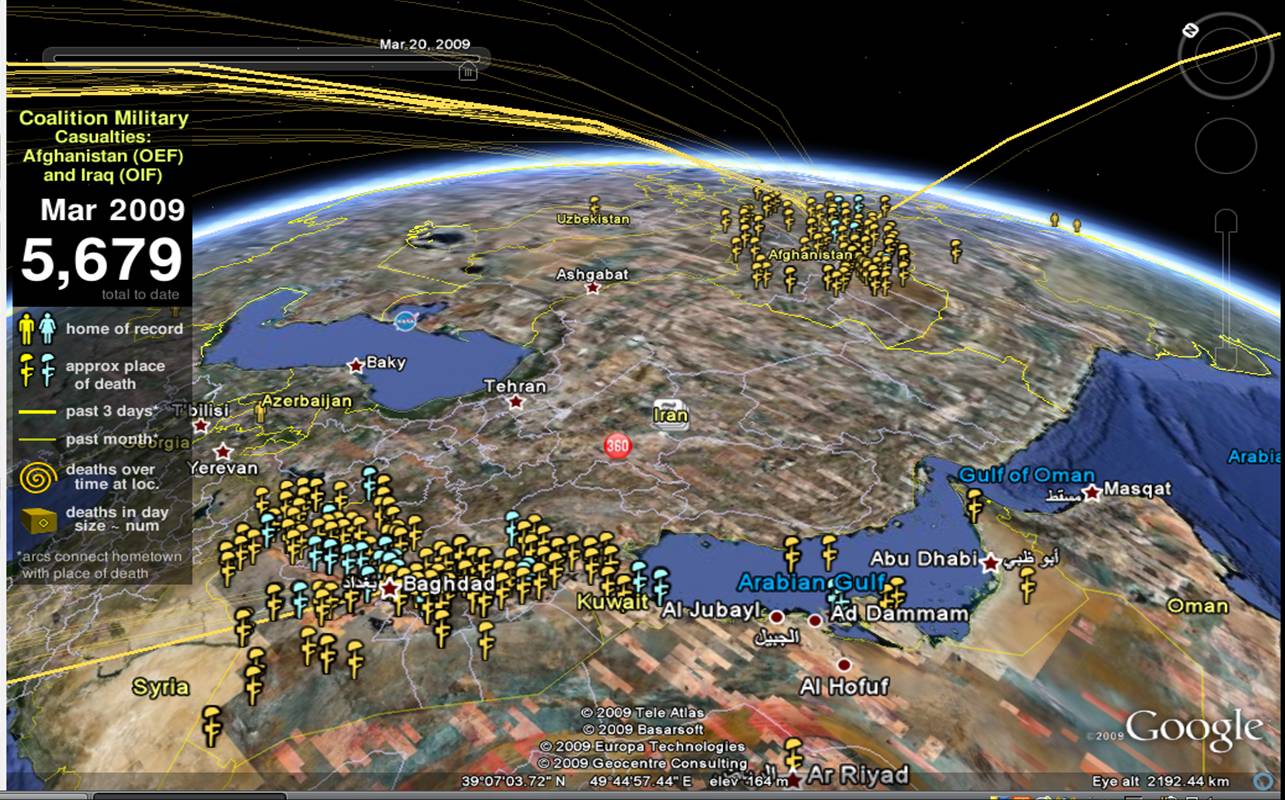
Using Google Earth (or Maps) as a news tool isn’t exactly new. But mapping all the coalition casualties during the military operations in Afghanistan and Iraq is a monumental effort.
It’s the work of Sean Askay, a Google employee. He used the company’s 20% programme (allowing employees to spend one day a week on their own projects) and his spare time to complete the map. He published it yesterday for Memorial Day.
The map is a sobering representation of the conflicts in Afghanistan and Iraq. As you zoom in, what appears to be a few casualties from a distance, slowly becomes long coils of servicemen and women. The map also documents the hometown of the fallen soldiers, and if you click on the markers it links to more information about how they died.
As sobering is the recognition that this is but one side of the story. While coalition casualties are well-documented and can be accurately mapped, nobody really knows how many civilians were killed during the invasion of Iraq. But maybe one day somebody might attempt to map all the casualties in these conflicts to provide us with a broader understanding of the cost of war.
Indeed, the historian in me wonders what a Google Earth map of World War Two casualties would like; perhaps it would be overwhelmingly dense with markers.
You’ll need Google Earth and another download to access the map. It’s best to hop over to Sean’s blog where he has all the relevant links on the right hand side.
]]>