Music is the beating heart of Malian culture. But when Islamic extremists took control of northern Mali in 2012, they enforced one of the harshest interpretations of sharia law in history and, crucially for Mali, they banned all forms of music. Radio stations were destroyed, instruments burned and Mali’s musicians faced torture, even death.
Overnight, Mali’s revered musicians were forced into hiding or exile – where most remain even now. But rather than lay down their instruments, the musicians are fighting back, standing up for their cultural heritage and identity. Through everything, they have used music as their weapon against the ongoing violence that has left Mali ravaged.
‘Disco’ is a renowned singer, UN-recognised humanitarian and outspoken activist. She organises gigs from her refugee camp base in Burkina Faso and is a constant support for musicians in exile, who look to her to eventually lead them home.
Known as the “Nightingale of the North” and speaking all seven languages of the country, Khaira’s home was raided by jihadists and her materials, records and instruments destroyed. Yet she remains firm in her criticism of their actions despite threats to her life. She campaigns tirelessly for elections and is organising the first public concert in Timbuktu since the conflict to prove that musicians will not be silenced. But the rise of ISIS has given Mali’s extremists new life, and realising Khaira’s dream is risky for everyone.
With a specially commissioned soundtrack from Mali’s most exciting artists and a score written by the Yeah Yeah Yeah’s Nick Zinner, They Will Have To Kill Us First leaps headfirst into a tale of courage in the face of conflict.
Directed by: Johanna Schwartz
Country: United Kingdom
Year: 2015
Runtime: 105′

Monday 15 March
On Monday, Japanese Prime Minister Shinzo Abe will host annual consultations in Tokyo with the European Union, attended by European Council President Herman Van Rompuy and European Commission President Jose Manuel Barroso.
Meanwhile, US Fed Chairman Ben Bernanke will be in London where, among other things, he is scheduled to participate in a discussion with his outgoing UK counterpart Sir Mervyn King on lessons learned from the financial crisis.

Tuesday 26 March

Also, South African President Jacob Zuma will host his counterparts from Russia, India, China and Brazil for a two-day summit in Durban.
In Doha, heads of state and government will convene for the annual League of Arab States summit, which also runs until Wednesday.
Lastly, in the United States the Supreme Court will take up the contentious issue of same-sex marriage, when it hears arguments in a case relating to California’s Prop 8. On Wednesday, the nine justices will hear arguments in a challenge to the Defense of Marriage Act.
Wednesday 27 March

The UN Security Council, meanwhile, is scheduled to discuss Mali.
Finally, a review into the ability of US military commanders to overturn convictions of servicemen is due to be handed to Defense Secretary Chuck Hagel. It follows criticism when this was used recently to overturn the conviction of an Air Force serviceman who had been found guilty in Italy of sexual assault.
Thursday 28 March
On Thursday, the latest mission to the International Space Station is due to launch from the Baikonur Cosmodrome in Kazakhstan.

Finally, newly-inaugurated Pope Francis is scheduled to hold a Holy Thursday mass at a juvenile prison in Rome.
Friday 29 March

Pictures courtesy of Shutterstock.com – SeanPavonePhoto / Action Sports Photography
]]>The complex situation of the French-led intervention in Mali and the issues in the surrounding region was untangled somewhat on 6 February 2013 at the Frontline Club’s First Wednesday: A new front in the fight against terrorism?

Paddy O’Connell of BBC Radio 4’s Broadcasting House was the chair and started things off by asking the panel to give their impressions of the region.
Ibrahima Diane, a journalist and editor at BBC Afrique, said that common thought is that the fight is between “Islamists against the southern Mali and it’s more complex than that”.
Wilfred Willey, president of the Malian Community Council in the UK, reinforced Diane‘s point that the complexities must be understood:
“Mali has known several rebellions since it took its independence in 1960. But none of them have had the impact and severity that this one has brought.”
Lindsey Hilsum, Channel 4 News’ International Editor, who had returned from Mali only two days before said that the Malian people are rejoicing now that François Hollande has intervened, but “liberator soon becomes occupier”. There is “hatred and vitriol” building for the Tuareg, a nomadic community spread out over Mali, Niger and Algeria, with people looking for who to blame for Mali’s situation.
The debate moved on to the complex number of forces in the region: the MNLA, Ansar Dine, Al Qaeda, Mujao and the Signed-in-Blood Battalion. While some of these forces have been around for years before the Arab Spring, there are some more opportunistic rebel groups who have, as Willey pointed out, “used the opportunity to have a go and take over the whole region”, such as the Signed-in-Blood Battalion who instigated the Algerian hostage situation.
On the question of whether Hollande was right to intervene in Mali, Willey had no doubt that it was the best thing to do at the time:
“There were those on the frontline who had lost all hope . . . and their intervention gave that hope back. . . . Mali has suffered up to 10 months under the Sharia law. . . . We just wanted someone to come and help us with these people. So yes, the French were right to intervene.”
But what should be done going forward in Mali?
Lord Ashdown, former leader of the Liberal Democrats and UN High Representative for Bosnia and Herzegovina, said:
“The Prime Minister has said this will last 10 years. . . . If you think of Afghanistan and Iraq as a model for the next 10 years then you’re going the wrong way and my worry is that a prevailing thought that is in Whitehall at present.
“Using the purely military option as we did in Afghanistan, as we did in Iraq, and as we’re in danger of doing in Mali, not only doesn’t work . . . but anyway we can’t do it. We don’t have the troops any longer, we don’t have the resources, we don’t have the defence budgets. And actually that may be rather a good thing. If this lasts 10 years, it’ll be because we do this in a different, cleverer, smarter way.
“We get ahead of the curve. . . . We begin to use all the networks of skill that we have in order to build up the structures in those countries so that they can do this job for themselves.”
“I want to be optimistic about the fate of Mali and the fate of this region,” Diane said about the next move for Mali and its elections later this year.
Ashdown disagreed, he thought that creating a rule of law would have a greater effect:
“In a post-conflict country . . . if you do not first of all create the rule of law as best you can . . . [elections] will embed the corrupt structures into the process of an elected government.”
Hilsum finished off with a final thought about the people she had met throughout her time in Mali:
“For me the most important thing is that there has to be a process which involves reconciliation, . . . the rule of law and the installing of human rights. Because if you don’t have that then the people I’ve met and . . . have been very excited and delighted at this intervention, those people will be let down and those people’s lives will never improve.”
Watch the full discussion below:
]]>You can watch highlights from this event here.
]]>
Monday 4 February

President Hollande, hosts US Vice President Joe Biden in Paris for talks on Monday, likely to be focused significantly on the mission in Mali, as well as the conflict in Syria. This follows talks between Biden and Russian Foreign Minister on Saturday at the Munich Security Conference. Biden’s next and final stop is London, where similar issues are likely to come up.

Europol, meanwhile, is scheduled to hold a press conference in the Netherlands to announce the results of its investigation into football match fixing.
Finally, there is talk of a three-way summit between Prime Minister David Cameron, Afghan President Hamid Karzai and Pakistani President Asif Ali Zardari in London (confirmation pending).
Tuesday 5 February
On Tuesday, EU ministers are due to meet in Brussels to discuss the training mission to Mali, which could become operational as early as 12 February, according to its head Brigadier General Francois Lecointre.

Joe Biden, as mentioned earlier, is due to visit London where he will holds talks with Prime Minister David Cameron and Deputy Prime Minister Nick Clegg.
Finally, French President Francois Hollande, is scheduled to address a plenary session of the European Parliament in Strasbourg.
Wednesday 6 February
UK Foreign Secretary William Hague will be grilled on Britain’s relationship with the EU by MPs on Wednesday, when he appears before the Foreign Affairs Committee.
Hague’s cabinet colleague George Osborne, meanwhile, will join OECD Secretary General Angel Gurría at the launch of the OECD’s economic survey of the UK.
Finally, German Chancellor Angela Merkel is expected in Paris to meet French leader Francois Hollande. The anticipated travel comes as the two nations’ football teams square up in a friendly match, which they may attend.
Thursday 7 February

In the US, President Barack Obama’s nominee to lead the CIA, John Brennan, will be grilled in an open session of the Senate Intelligence Committee to consider his nomination. Republicans will no doubt focus on the 11 September attack on the US consulate in Benghazi, Tripoli. While Democrats are more likely to be interested in drone attacks and extrajudicial killings (which, incidentally, are the subject of a UN inquiry launched last month).
Incoming Bank of England Governor Mark Carney will appear on Thursday before the UK Treasury Select Committee. The Canadian central banker has already been making waves ahead of his arrival, with provocative policy suggestions and expensive housing requirements.
Friday 8 February
On Friday Samuel Mullet, the delightfully-named leader of an Ohio Amish group found guilty last year of federal hate crimes after cutting off the beards of a rival group, is due to be sentenced alongside his co-defendants.
Also Friday, German Foreign Minister Guido Westerwelle will be discussing prospects for growth in Europe at an event in Singapore.
Saturday 9 February
Rival Palestinian factions Hamas and Fatah are said to be planning to hold a further round of reconciliation talks in Cairo.
Images courtesy of ldambies / Frontpage / Shutterstock.com
]]>
A round up of world news in the week ahead from journalist resource ForesightNews.
Monday 21 January

Barack Obama delivers his second inaugural address on Monday, the climax of a day of festivities in the US capital following his re-election in November. The need for further action to stem gun violence is all but certain to feature, as well as the ongoing economic challenges facing the United States.
In Brussels, meanwhile, eurozone finance ministers are scheduled to meet, with current president of the grouping Jean Claude-Juncker expected to pass leadership to the Dutch Finance Minister, Jeroen Dijsselbloem.
Finally, India’s Supreme Court is expected to issue its ruling in the controversial Niyamgiri bauxite mine case. The bauxite extracted would be used in an aluminium refinery run by mining conglomerate Vedanta Resources but critics say it will cause untold damage to the Niyamgiri Hills, which are in Orissa state.
Tuesday 22 January

Israeli’s go to the polls in parliamentary elections in which Prime Minister Binyamin ‘Bibi’ Netanyahu and his Likud party is all but certain to secure enough seats in the Knesset to retain power. The campaign has been notable for the rise of Naftali Bennett and his hard-right Jewish Home party.
Meanwhile, Germany’s Angela Merkel and France’s François Hollande will lead celebrations of the 50th Anniversary of the Elysée Treaty. A joint cabinet meeting of the two countries will be held, as well as a joint session of France’s National Assembly and the Bundestag. Expect much focus on the future of the European project.
Japan’s Central Bank, which is under pressure from Shinzo Abe’s government, concludes a two-day monetary policy meeting on Tuesday. Observers anticipate an easing of policy and possibly a doubling of the inflation target to 2%.
Finally, Tuesday marks the 40th anniversary of one of the US Supreme Court’s most well-known, and controversial, decisions: Roe v Wade.
Wednesday 23 January
Some of the world’s most influential business figures will gather in Davos from Wednesday at the World Economic Forum. While health is formally the major theme of this year’s gathering, the US economic outlook and the future of the euro will no doubt be major topics of conversation among the attendees.
In Moscow, Russian Foreign Minister Sergey Lavrov is due to address domestic and foreign journalists. Again, although ostensibly a reflection on Russian diplomacy in 2012, questions are more likely to focus on future affairs, especially in as regards the Syria conflict.
In the United States, outgoing Secretary of State Hillary Clinton is scheduled to address the House Foreign Affairs and Senate Foreign Relations Committees on the September attack on the US consulate in Benghazi in Libya, delayed from December. This will almost certainly be her final testimony before she leaves the post (her nominated successor, Senator John Kerry, is due to have his confirmation hearing on Thursday).

Lastly, Jordan holds elections which the country’s Muslim Brotherhood has vowed to boycott.
Thursday 24 January

As mentioned above, Senator John Kerry will appear before the Senate Foreign Relations Committee on his nomination to be US Secretary of State. He will be questioned on the full gambit of US foreign policy priorities, particularly Israel, Iran and Syria. North Africa also expected to be a significant area of questioning.
Also in US affairs, Senator Dianne Feinstein, author of a ban on assault weapons that expired in 2004, will introduce legislation to once more ban the sale of assault weapons and high-capacity magazines.
In Addis Ababa, African Union Foreign Ministers are due to begin a two-day meeting, with the current conflict in Mali likely to be a key point of discussion, in addition to events in the DR Congo, relations between Sudan and South Sudan (a special meeting on this is scheduled for Friday), as well as unrest in the Central African Republic.
Finally, in Strasbourg, the European Court of Human Rights holds its annual briefing for the media.
Friday 25 January
The Czech Republic holds a run-off in its presidential election, with Foreign Minister Karel Schwarzenberg squaring up against former Prime Minister Milos Zeman.

Egypt, meanwhile, marks two years since the protests began that ultimately led to the downfall of Hosni Mubarak.
Also, US Treasury Secretary Tim Geithner is scheduled to step down. His designated successor, Jacob Lew, has yet to be confirmed. Lew’s unusual signature has attracted much attention.
Saturday 26 January
The top US diplomat on North Korea, Glyn Davies, arrives in Tokyo for talks with counterparts. This is the final destination on a trip that also sees him travel to Seoul and Beijing to discuss the secretive communist state. His visit comes amid reports the DPRK is planning to test another nuclear device.

Saturday is also Australia Day and Republic Day in India.
Sunday 27 January
Leaders from the African Union begin their two-day summit. Again, Mali, the Sudans, DR Congo, Somalia and Algeria all likely to be discussed.
Finally, Bulgarians are due to take part in the country’s first referendum since 1989. The issue at stake: whether to approve the construction of a new nuclear power plant.
Images courtesy of
]]>
A round up of world news in the week ahead from journalist resource ForesightNews.
By Jasper Wenban-Smith, international editor of ForesightNews.
Monday 10 December
A bombastic week of international news kicks off Monday with the opening of the window for North Korea’s latest satellite launch attempt. The launch will have important implications, both domestic and international. Domestically, a successful launch would boost the credibility of Kim Jong-un; conversely, a second consecutive failure might have important implications in a country where power is so concentrated among a military elite. Whether successful or not, the launch will add to regional tensions and may even influence the outcome of South Korea’s presidential elections, due on 19th December.

The seemingly endless conflict in eastern Democratic Republic of Congo will be the subject of consultations on Monday when the African Union’s Peace and Security Council meet to discuss the M23 rebel movement at the AU HQ in Addis Ababa.
Meanwhile, in New York, the UN’s Security Council holds what is expected to be one of the highlights of the Moroccan presidency of the SC. The country’s foreign minister Saad-Eddine al Othmani will chair a high-level meeting on security in the Sahel, likely to focus on Islamist militancy in the region, notably in Mali.
In the United States, as the fiscal cliff deadline draws ever closer, President Barack Obama – who has focused almost exclusively on this issue since his re-election in November – is due to travel on Monday to the Detroit area to deliver a speech pressing the case for an agreement to avert the crisis.

Lastly on Monday, key EU figures travel to Oslo to pick up their Nobel Peace Prize.
Tuesday 11 December
Tuesday is a bit quieter, former President of Cote D’Ivoire Laurent Gbagbo is due back in the International Criminal Court for a status hearing; Canada’s Central Bank Governor Mark Carney, who will head up the Bank of England from next July, delivers a speech in Toronto; and Russia and Georgia return to the negotiating table in Geneva for the latest round of UN-mediated talks.
Wednesday 12 December
On Wednesday, Morocco hosts a Friends of Syria meeting in Marrakech. Hillary Clinton has confirmed her attendance, making it likely a slew of other foreign ministers including Foreign Secretary William Hague and French Foreign Minister Laurent Fabius will attend too.
Meanwhile, Russian President Vladimir Putin will deliver his first State of the Union address since returning to the Presidency. There will be significant interest in how the former KGB man chooses to address the increased civil unrest in Russia.
IAEA officials are due in Tehran for their latest round of talks with Iranian officials on ‘outstanding issues’ related to the country’s nuclear programme. The visit follows an announcement by Robert Wood, US Ambassador to the UN nuclear watchdog, of a March 2013 ‘deadline’ for Iran to alter its approach to negotiations or face action at the UN Security Council.

In European affairs, following their failure to reach an agreement on a long-term budget, EU leaders reconvene in Brussels on Wednesday for a two-day summit. Eurogroup finance ministers are due to meet on the sidelines to make a final determination on whether to release funds to Greece. One potential spanner in the works is that the IMF has insisted that Greece complete its debt buyback operation before funds are released. However, the schedule for the buyback operation, announced by Greece’s debt management agency on 3 December, does not foresee completion until 17 December.
Thursday 13 December
On Thursday, Tunisia’s main union the UGTT plans to hold a general strike. It coincides with a visit by Hillary Clinton to attend the final day of the Forum for the Future taking place in the country’s capital. All of this comes ahead of the second anniversary on Monday 17 December of Mohamed Bouaziz’s self-immolation.
Friday 14 December
Clinton travels on to Abu Dhabi, which on Friday hosts the third ministerial meeting of the Global Counterterrorism Forum.

Saturday 15 December
On Saturday, Egyptian President Mohamed Morsi has vowed to press ahead with controversial plans to hold a constitutional referendum, which is likely to result in further unrest.

A three-day conference on nuclear safety kicks off in Fukushima prefecture in Japan. Ministers are due to attend the opening day.
Sunday 16 December
Japan holds parliamentary elections on Sunday, in which Shinzo Abe and his right-leaning LDP are all but certain to regain control of the Shugiin, or lower house. They already control the upper house.
Following presidential elections earlier in the year, Venezuela holds gubernatorial elections on Sunday, with attention focused on whether defeated opposition candidate Henrique Capriles secures re-election as governor of Miranda province.
Finally, on Sunday, South Africa’s ANC opens its five-yearly policy conference. At which, despite widespread labour unrest following the Marikana mine massacre and a very public challenge from former ANC Youth League leader Julius Malema, Jacob Zuma is expected to be re-elected the party’s leader.
Some images courtesy of fotostory / Shutterstock.com.
]]>We don’t choose the colour of our skin, or the place where we are born. But for people with albinism in Tanzania, their appearance has made them a hunted, sub-human species.
“We are killed. We are dismembered,” says Josephat Torner, one of the albino subjects in Harry Freeland’s documentary, In the Shadow of the Sun, which had a preview screening at the Frontline Club Monday 26 November.

Director Harry Freeland discusses “In the Shadow of the Sun” at the Frontline Club
Since 2006, witchdoctors in Tanzania have made ever louder claims that albino body parts, when used in certain potions or rituals, can cure sickness and bring prosperity – a promotion at work, election to office, or a boom in mining or fishing.
“They call me ‘white medicine,’” an albino child says of schoolyard bullies.
Freeland explained during the Q&A after the screening:
“There’s really three [types of] people responsible for the murders. There’s the people that aren’t in the film at all, that no one’s caught, who are the main people fueling the whole trade … body parts are selling for millions of shillings. So, someone with a lot of money … government officials, policemen, fishermen, people in the mining industry. Witchdoctors have obviously started this rumour … and then it’s the poor people in Tanzania who are carrying it out.”
In the film, Freeland and Josephat travel to a cave to meet a witchdoctor, who admits that he will hide in trees, waiting for the right moment to pounce on an albino. In another scene, an albino friend tells Josephat how a man once leapt from a tree and tried to kill him while he walked alone outside his home one evening.
“There’s always fear,” Josephat said.
Josephat spends his life traveling to places where albinos have been murdered, gaining the support of local chiefs to give talks to their villages.
“If society thinks of me as sub-human,” he explains, “then I need to find a solution, to make them re-accept me.”
“Josephat is so lonely,” Freeland reflected. “No one else really wants to do it. No one else is really doing the same kind of thing he’s doing, he funds it himself. So, he doesn’t get paid that much money, but he, kind of, leaves his family behind, and goes around the country to do those things. I always found that amazing.”
Freeland, Josephat and many others are making an impact. Tanzania’s Prime Minister has adopted two children with albinism, and “stripped all the witchdoctors in northern Tanzania of their licenses [so that] they now have to reapply in what is a quite rigorous process,” Freeland said. Tanzania elected its first albino MP, and the number of killings in 2012 finally declined from the previous year.
Nonetheless, the demand for albino body parts remains.
“Tanzania is definitely the worst,” Freeland said, “but it is spreading into other countries, so in Nigeria, there’s been killings, Mali, South Africa, Burundi. As Josephat would put it, it’s ‘spreading like a fire.’”
More information on future UK screenings and the work of Josephat can be found on the website of In the Shadow of the Sun.
]]>On November 12, Land Rush was screened at The Frontline Club as part of a cross-media event entitled Why Poverty?, which uses films, online and TV, to get people talking about poverty.
Land Rush explores the land appropriation debate in Mali. 75% of the population are small-scale traditional farmers who compete with rich nations that lease land, turning large areas into agribusiness farms.

Landrush Q&A at The Frontline Club
Director Hugo Berkeley and Kate Townsend, executive producer at BBC Storyville, discussed the makings of the film in the context of the Why Poverty? series.
Townsend explained that eight documentaries and 30 short films were produced by broadcasters around the world for the Why Poverty? project, including the BBC:
“They are going to be broadcast globally in at least 72 countries. We’re commencing on the 25th of November with a potential audience that we’re estimating of at least half a billion people. It’s a sequel to the Why Democracy? series that was broadcast by the BBC [in 2007]. We’re building momentum to what we hope will be an amazing achievement”.
Berkeley discussed the challenges he faced when making a film about land grabbing in Africa:
“People come at it with a very fixed opinion of whether it’s a good thing or a bad thing … we wanted to speak to the farmers in the region and find out from them … it was trying to keep that impartiality [that] was the most difficult thing in the film, to let the characters decide rather than the production team.”
He added that the issue of land appropriation can no longer be ignored, and that industrialisation in Africa should come with proper legislation to prevent exploitation of the farming population:
“The world food crisis in 2008 showed that this is a world problem. How we feed ourselves isn’t just related to the UK or the USA or to Mali. This is a problem that is going to be increasingly important for the whole world. Particularly in places like India, Saudi Arabia and food-poor countries. They are going to be more and more aggressive; that’s not a tendency that’s going to go away. That would only increase my keenness to see that legislation is in place to make sure that it’s done properly.”
His film highlights how divided Malian farmers are about foreign development projects; some are enthusiastic about change while others are reluctant and view it as an imperialistic threat:
“Malian agricultural policy just flip-flopped all over the place in the last 20 years. Twenty years ago, it was all about getting small farmers to produce rice to feed the country. And then in the late 1990s, they swung wildly in the other direction and said ‘our problem is that we don’t have any industry, so we need industry and factory’. If you’re a farmer in that area, you’re just sort of buffeted around on the winds of whatever is trendy in the development circles.”
Townsend urged the audience to spread the world about the Why Poverty? project:
“We are immensely proud of this body of films. They are meant to be launching pads for debate. Please go onto the website and encourage discussion on the forums. We want this to provoke argument.”
Click here to view the Land Rush trailer.
]]>One of my assignments was gathering multimedia materials about clean water in rural villages. The filming schedule included a slight detour to pop by a Dogon village, about 80 km out of Mopti, to shoot the opening of a new village water pump. Hmm… so on the way there me thinks the potential shot list will probably be something like officials clad in safari suits, ribbon cutting, water pumping, speeches, and as usual, loads of children going completely nuts in front of the camera held by me – a slightly sun burnt bloke wearing a faded Hong Kong Rugby Sevens bucket hat circa 2000. Perhaps best just to get my shots quickly and move on because geepers it’s hot in the midday sun and I’m already dreaming of a ice-cold panache back at the hotel followed by a tasty fillet of local Niger capitaine.
Well, that was the plan until a volley of gun fire erupted as I arrived. And no, not a war over the new water pump, but the welcome from Dogon…um… warriors.
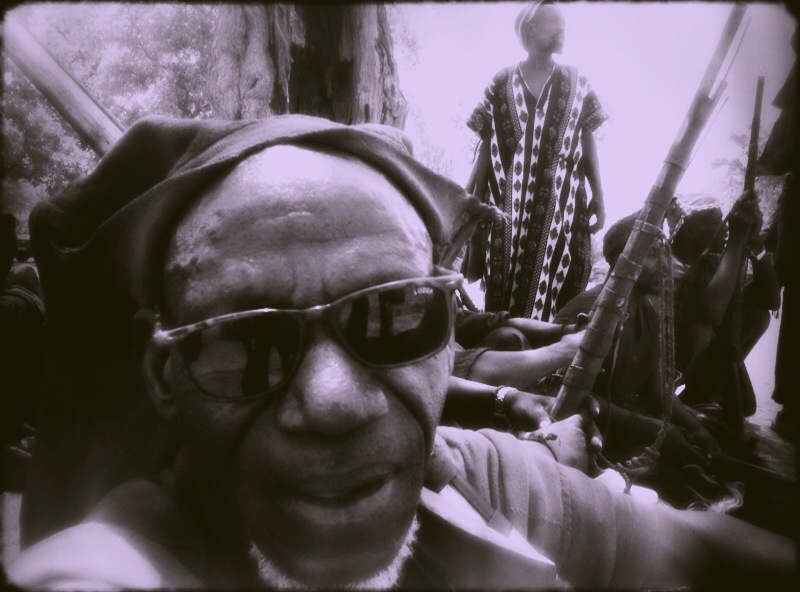 Maybe it’s just the boy in me, but these fellows and their muskets, some sporting some home-made-retro-fitting mods, seemed far more interesting to film than the opening of a water pump. Apologies to any avid readers of Jane Defence Weekly but I didn’t look close enough to note any particular make of musket.
I did note that most men carried gun powder in a small pouch, tin or plastic bottle. Out comes a ramming rod to pack the powder down in the barrel. And thankfully no shot was used as weapon discipline in the ranks was a rather casual affair.
At one point the firing became so intense that someone from the official party dashed over to respectfully ask for a cease-fire so the official speeches could be heard.
Dogon Musketeers in Mali from fieldreports on Vimeo.
By coincidence, while I was in Mali, the annual Operation Flintlock was underway – a large regional military training exercise.
I’m assuming that the Malian army is using more up-to-date weapons than muskets in their training with US Special Forces, but correspondents covering the exercise saw that there seems to be a big gap in military training and basic skills… including knowing how to drive a vehicle.
]]>A U.S. Special Forces instructor leans toward a steering wheel, showing some 50 Malian soldiers gathered around an army pickup how a passenger should take control of a car if the driver is killed in an ambush.
The elite Malian troops look on, perplexed. "But what can we do if we don’t know how to drive?" asks Sgt. Amadou, echoing many of his colleagues’ concern.
There are a few laughs, but the Malians are not joking; most of their unit does not know how.