Rania’s new book is published to mark the anniversary of the outbreak of protests in Syria. Cinematically crafted, it weaves a tapestry of rebels and exiles, radical Islamists and their victims amid the deadliest conflict of the century thus far.
Extending back to the first protests in Damascus in 2011, and based on more than five years of clandestine reporting on the frontlines of the war, No Turning Back presents an unforgettable portrait of a shattered country that “has ceased to exist as a unified state except in memories and on maps.”
Rania Abouzeid is a journalist with well over fifteen years experience in the Middle East and South Asia. A print and television journalist, fluent in Arabic, she has won numerous international journalism awards including the 2014 Frontline Club Print Awards and the George Polk Award for Foreign Reporting. Rania regularly writes for the New Yorker and National Geographic and she has been published in The Guardian, The Los Angeles Times, The Australian, CSM, and a host of other outlets.
Lyse Doucet is an award winning Chief International Correspondent and Senior Presenter for BBC World News television and BBC World Service Radio. She is regularly deployed to anchor special news coverage from the field and interview world leaders. Lyse also reports across the BBC including for BBC Newsnight. She played a key role in the BBC’s coverage of the “Arab Spring” across the Middle East and North Africa and has covered all the major stories in the region for the past 20 years.
]]>
The evening will begin with a drinks reception in the Clubroom followed by a sit down dinner 8.30pm served in the Forum.
The Frontline Fund (formerly the Fixers’ Fund) is an adjunct charity of the Frontline Club which offers emergency financial assistance to local producers and their families in situations of proven distress, such as inprisonment, injury, forced exile, or death.
It was initiated by Jon Lee Anderson in 2007 following the murder of Ajmal Naqshbandi in Afghanistan.
The Fund’s disbursements are intended as a first-stop expression of material solidarity by the Frontline Club and its members on behalf of some of the most invaluable, yet vulnerable, of media workers.
Without the support of local producers, foreign journalists could not operate in the field. They are the unsung heroes of the industry and too often pay the highest price, remaining in the field once the foreign journalists have left.
Join us to support this important cause. Donations to the Frontline Fund can also be made online through the following link: http://www.beta.frontlineclub.com/donate/
]]>


On Wednesday 7 October, former Al Jazeera English bureau chief Mohamed Fahmy joined a packed audience at the Frontline Club in his first public appearance since his release from a Cairo prison on 23 September. Fahmy was joined in conversation by his lawyer Amal Clooney and BBC chief international correspondent Lyse Doucet.
.@MarwaFahmy11 @Mffahmy11 & Amal Clooney at @frontlineclub pic.twitter.com/wz7jF3C87D
— lyse doucet (@bbclysedoucet) October 7, 2015
Fahmy, an Egyptian-Canadian dual citizen, was arrested in December 2013 along with colleagues Peter Greste and Baher Mohamed, and sentenced to seven years in a maximum security prison on terrorism-related charges. He was finally pardoned by Egyptian President Abdel Fattah al-Sisi on 23 September.
“I am a changed man and I am inspired by what’s happened to me – that’s why I’m fighting for other journalists,” Fahmy said of his newly-established Fahmy Foundation, which will support journalists across the world who have been unjustly imprisoned.
Critical in the past of the Canadian government’s failure to intervene strongly enough on his behalf, Fahmy repeated: “I do believe the Canadian government could have done more.”
He went on to emphasise that “governments should be much faster in intervening” when their citizens are held abroad. “Intervention needs to come immediately, from the highest levels of government.” Fahmy expressed his concern that this had not yet happened in the case of Iraqi VICE News journalist Mohamed Rasool, currently detained in Turkey on charges related to terrorism.
Denouncing Canada’s new Bill C-24, which allows the government to revoke a dual national’s Canadian citizenship if the citizen is convicted of terrorism, Fahmy said, “it’s a very dangerous law. It overrides the judiciary… it should be revisited.”
The discussion then moved onto the role of Al Jazeera, with reports of Fahmy suing his former employer for $100m on the basis of negligence in May 2015. “Al-Jazeera’s shortcomings and mistakes contributed to our situation,” he said. “I had specifically asked many times, are we legal in the Marriott [the Cairo hotel where Fahmy’s broadcast team was based]? They said, ‘Yes, stick to the editorial side, don’t worry about it’… but the answer – I found out in court.”
Fahmy continued, “I asked Al-Jazeera to take responsibility, to present a letter to the judge saying ‘[Greste, Fahmy and Mohamed] have nothing to do with this, this is our fault’, but they did not… it really angered me.”
“It was important to make it clear that there is a distinction between the network and the journalists who work in the network,” said Fahmy, describing the re-trial defence strategy.
Clooney took on Fahmy’s case, she said, when she “realised what was at stake, because Egypt is a leader in the region… It sets a precedent.”
Doucet praised her dedication to the cause: “We want to recognise all lawyers who fight for journalists, and we need more.”
Clooney continued: “Elements of the [Egyptian] government… sought to bring about justice. Belatedly, but they finally did do. The work that lawyers and journalists and human rights activists have to do is to make sure they’re pushing those elements of the government that are a force for good.”
Support @MFFahmy11's NGO @FahmyFoundation fighting 4 imprisoned journalists worldwide @bbclysedoucet @frontlineclub pic.twitter.com/eWMeA7D0NA
— Stefan Simanowitz (@StefSimanowitz) October 7, 2015
Both Fahmy and Clooney praised the media’s essential role in the campaign for his freedom. “Social media was so important in this case,” Fahmy said, mentioning the #FreeAJStaff Twitter hashtag. “It does make a huge difference… This collective effort is why I’m here today.”
Optimism remains key to both Fahmy and his lawyer’s ongoing fight for press freedom. “There are signs of positive development in Egypt… but there’s a long way to go,” Fahmy said.
A new press charter to which he contributed will shortly be presented to President Abdel Fattah al-Sisi, in the hope that journalists will consequently be able to work more freely in Egypt.
Clooney echoed this positive sentiment: “Hopefully this pardon means at the highest level there may be some change in approach.”
Clooney concluded the discussion with a few words on Fahmy‘s long-awaited freedom: “Today, we can take a moment to celebrate what’s happened to this journalist.”
“I’m here,” Fahmy replied, “because I have two very powerful women who are behind me,” thanking Clooney and his wife Marwa Omara.
Fahmy and his wife will shortly return to Canada, where he will take up a visiting post at the University of British Columbia and “continue to fight and use the spotlight” on behalf of the “many more behind bars” across the globe.
More information on the Fahmy Foundation – and their work in campaigning for the release of unlawfully imprisoned journalists, including Egyptian photojournalist Shawkan and Saudi blogger Raif Badawi – can be found here.
]]>On Tuesday 8 September, the Frontline Club opened its doors to some of Britain’s most esteemed journalists for a celebration of sixty years of BBC Radio 4’s From Our Own Correspondent. A panel, chaired by Owen Bennet-Jones, discussed the changing landscape of international news reporting, and reflected on the highlights of FOOC since its beginnings in 1955.
Gt. @frontlineclub tnite with some Gt. journalists on the Panel. T.B. Bcast on 17th Sept , BBC R4 @ 9am. pic.twitter.com/s6R45jBvt3
— Darran Rees (@DarranRees) September 8, 2015
The distinguished panel included Lyse Doucet, the BBC’s Chief International Correspondent; Paul Hamilos, World Features Editor at BuzzFeed; Lindsey Hilsum, Channel 4 News International Editor; and James Coomarasamy, presenter of Newshour on BBC World Service.
Hugh Levinson, senior producer with BBC Current Affairs Radio, began the evening by reminding audience members that they were a crucial part of the broadcast and encouraged questions and comments. Amongst those in attendance were Christina Lamb, eminent foreign correspondent for The Sunday Times; top radio critic Gillian Reynolds; and Tim Whewell, BBC correspondent and many time contributor to From Our Own Correspondent.
Bennet-Jones began the discussion by asking the panel to comment on the most significant changes to foreign reporting in recent years.
Lindsey Hilsum responded that technology had had the greatest impact on the field, and commented on the speed and ease with which news can be communicated whilst on assignment abroad.
A clip of Gabriel Gatehouse’s ‘Reporting From Iraq’ from 2014 was played: “I tried to keep my fear of an IS ambush at bay; to keep the images of beheaded journalists out of my mind. I focused on the now – what was going on? Had our route been blocked? Or were we lost? Neither seemed like an appealing prospect. ”
This prompted Bennet-Jones to ask the panelists: “How often do you feel frightened?”
Lyse Doucet replied, “The front line is no longer the front line, it goes through streets and houses… from all the threats kidnapping is the worst.”

L-R: James Coomarasamy, Lindsey Hilsum, Paul Hamilos and Lyse Doucet
The journalists then discussed the extent to which personal voices are appropriate in From Our Own Correspondent. An extract from Fergal Keane’s 1996 ‘Letter to Daniel’ broadcast was played, which provoked strong reactions – both positive and negative.
Keane’s broadcast was composed as he held his newborn son in his arms: “Like many foreign correspondents I know, I have lived a life that, on occasion, has veered close to the edge… Now, looking at your sleeping face, inches away from me, listening to your occasional sigh and gurgle, I wonder how I could have ever thought glory and prizes and praise were sweeter than life.”
Gillian Reynolds was called upon to give her opinion on the piece: “It made me want to vomit,” she laughed candidly.
Whilst foreign correspondents are often reporting disaster from war-torn or disaster-stricken areas of the globe, Lyse Doucet commented on the necessity of humour. “Humour is the most important language,” she said. “I use it to get through checkpoints, to understand people. We can’t just do grim.”
The discussion drew to a close with comments from both the audience and panel as to why From Our Own Correspondent has been so successful and endured for sixty years.
“It’s like a buffet,” said a member of the audience, and suggested that it feeds you with bits of news that you didn’t even know you were interested in.
Lindsey Hilsum concluded that she’d loved writing for the programme and continued to compose unpublished pieces in the style of FOOC.
The recording will be broadcast on BBC Radio 4 at 9:00 AM on Thursday 17 September.
]]>
As part of marking 60 years this autumn of Radio 4’s From Our Own Correspondent, the Frontline Club will host an event on reporting foreign news. A panel will discuss how reporting in Britain about international news and current affairs – particularly but not only by broadcast journalists – has developed over the last six decades and explore what the future holds in a world of social media and digital correspondents.
The panel:
Owen Bennett-Jones, from the BBC’s World Service (chair)
Lindsey Hilsum, Channel 4’s international editor
Paul Hamilos, world features editor at Buzzfeed UK
James Coomarasamy, presenter on BBC World Service
and Lyse Doucet, the BBC’s chief international correspondent.
Club members and guests are welcome and encouraged to contribute to the discussion. The event will be broadcast on Radio 4 on Thursday 17 September at 9:00 AM and on the BBC World Service.
There is no charge for this event. It will start promptly at 6pm – the event is being recorded for broadcast so I’m afraid if you arrive after the start time you will not be permitted to enter.
This event is organised by BBC Radio 4.
]]>Your wonderful and kind messages mean so much to us, as has your friendship, council and support over so many years. There is no prize in our trade that we could ever value as much as your belief in us.
– Vaughan and Pranvera Smith
Thank you to Stewart Purvis, Richard Gizbert, Tina Carr, Emma Beals, Allan Little, Mani, Stuart Hughes, Richard Sambrook, Jon Snow, Marina Litvinenko, Martin Bell, Tom Fenton, Anthony Loyd, Lyse Doucet, Bill Neely, Lindsey Hilsum, Charles Glass, John G Morris, Salim Amin, Liz Palmer Gary Knight, Jon Lee Anderson, Jeremy Bowen, Matt Frei and Jean-Jacques Gonfier.
]]>
The month of Ramadan is usually a time for festivities and celebration but in Syria there is little to rejoice about. The United Nations has estimated around 93,000 Syrians have died since the civil war began in 2011 and the number of refugees fleeing the country recently exceeded 1.5 million.
On Wednesday 17 July, the Frontline Club hosted a discussion with four leading journalists to dissect recent developments on the ground in Syria, in the international community and to analyse the role the media has played in reporting the conflict. The event was chaired by the BBC’s Chief International Correspondent Lyse Doucet.
A consensus was made early on that the Syrian conflict has reached an impasse. James Harkin, director of think-tank Flockwatching and a journalist who has covered the Syrian conflict for numerous publications, argued that despite recent media analysis that President Assad is winning the war, the reality is a stalemate:
“On the ground the regime forces are regaining Homs. They may even be able to recapture the whole of Homs, but if they do their combined forces . . . won’t be able to hold the city for very long. There simply aren’t enough government forces to recapture the whole city. As for government forces marching on Aleppo, that is propaganda puff… ”
Patrick Cockburn, a Middle East correspondent for over forty years who has written for the Financial Times and The Independent, agreed with Harkin but focused on how poor reporting has led both governments and the public to have a skewed idea of what is happening on the ground:
“At the beginning of this conflict, the idea of the citizen journalist . . . was taken somehow as being neutral, but it’s not citizen journalists or citizen activists, it’s citizen propaganda. It gave an impression early on that the government was on the verge of defeat. . . . Giving the impression that Assad was going to go down at any time.”
He further argued that no side would gain any “conclusive victory” over the other which will mean no solution for Syria.
“Cutting to the chase, I don’t think there will be successful negotiations. There may be a ceasefire and maybe you can do it in two hops. Until you have a ceasefire you have what we called in Northern Ireland ‘the politics of the last atrocity’ where everyone is so het up about things that no one can really talk until the level of violence is reduced.”
Anthony Loyd, an award-winning writer and current roving foreign correspondent for The Times, concurred with the previous two speakers in that the north of the country has now reached a bloody stalemate, but recent successes by government forces will “make them even more intransigent to negotiations.”
For Dr Halla Diyab, an award-winning screenwriter, producer and broadcaster from Syria, the question of who will win is a relatively unimportant one. What is happening in Syria now is simply war:
“These people have killed what ordinary Syrians want… What we need to work on now is how to end this conflict… We need to strengthen the political opposition in Syria – where are the future Syrian leaders, ministers, MPs? Where are the people who will stand in future elections? The West has to order a ceasefire and bring Assad and the opposition to the negotiating table and find strategies to contain violence and extremism in the country.”
Diyab further opened up the debate by arguing that Syria has now become a proxy war for other countries – Qatar, Saudi Arabia, Egypt, Turkey, Russia and America – all weighing in and supporting their own national and ideological interests.
There was disagreement on various issues including on whether and how the rebels should be armed, with reference to the arming of the Mujahideen in Afghanistan as an example of how one can never be sure who one is arming and where the weapons may end up.
Diyab and Harkin also disagreed strongly on the role Salafism is playing in the country, especially with younger Syrians.
The debate finished with all parties predicting a gloomy near future for Syria.
https://soundcloud.com/frontlineclub/syria-conflict-developments-on
]]>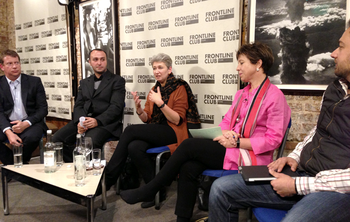
The conflict and humanitarian issues Syria faces is at the forefront of many peoples minds at the moment, this was reflected by the full house that gathered at the Frontline Club’s panel discussion, Communicating about Syria – A humanitarian perspective on 10th October.
Lindsey Hilsum, Channel 4 News’ International Editor chaired a panel which included Hicham Hassan from the International Commitee of the Red Cross (ICRC); Lyse Doucet, BBC Chief International Correspondent; Ben Parker, head of the UN Office for the Coordination of Humanitarian affairs (OCHA); and Fadi Haddad from the Mosaic Initiative for Syria.
Hilsum started things off by asking Doucet to set out the current situation in Syria, where over a million people are now displaced within the country, 50% of which are children.
There can be no doubt that when it comes especially to war we [journalists] take the side of the people. And sadly it’s ugly terrible bloody wars that drag on there’s a lot of people that are affected and Syria is no different…And of all those people that are stuck in the middle one of the other sad realities of the Syrian conflict is that most of them are children.
Parker, who was only in London by coincidence on a break from his post in Syria as head of OCHA then spoke about how the problems in Syria are unlike any he has faced before.
I’ve never in my career spoken less to journalists. It’s a very unusual situation; aid agencies want to talk to the media for three things: 1. Cash. 2. To make sure that the attention doesn’t go away, and 3. We also have advocacy, in the sense that we want the people with power to take a certain course of action. In Syria, none of these three really work. In terms of the course of action, nobody has the answer. And what is the course of action? Stop the violence? ok…We’re heading into unknown territory.
There’s normally criticisms that we’re too tight with journalists… but here I can’t help you [journalists] at all, I can say maybe you should check out that school, but you being associated with me makes your job even harder. The state of Syria feels that the humanitarian people need to be watched just as much as the journalists because they have the potential to delegitimise and confuse and be instrumentalised by hostile forces.
Hassan who is the Middle East spokesperson for the International Commitee of the Red Cross (ICRC) said that the humanitarian aid is not there to solve the problems in Syria:
A very good friend of mine said: “The solution in Syria is not humanitarian because the problem in the first place is not humanitarian; it is political so don’t you think you guys are there to solve the problems.” It is true, we are not there to solve the problem, humanitarian aid is just there to push the limit a bit more and a bit more and a bit more.
Haddad from the Mosaic Initiative for Syria who works directly with human rights defenders and NGOs inside Syria and neighboring countries, gave some insight into how he gets supplies to people in Syria by foot through Turkey, but how even that is getting more difficult.
I’ve been targeted now more than the Free Syrian Army, if they know that there’s a field hospital in a place, they will try to shut it straight away. It’s getting more stressful.
When you’re dealing with these groups you need a good relationship with the local community and this is where journalists have to help us, as they go inside they know these communities so our mission is to work in partnership with them and to work like a middle agent between the international NGOs and the people on the ground.
Melissa Flemming, chief spokesperson for the UN High Commission of Refugees (UNHCR) was in the audience and Hilsum asked her to give her take on the situation. She finished with a final thought about the displaced people of Syria, before the discussion was opened to questions from the audience.
They’ve all lost family and they’ve all got horrendous stories to tell and they’re living in places like Lazatri camp which is inhospitable because of the landscape…It would be like any one of you who is used to living in an apartment having a high standard of living, and from one day to the next having to pick up everything probably having lost a lot and run for your lives across the border and try to make a life for yourself in a tent.
Listen to Lyse Doucet talk about the current state of affairs in Syria:
Listen to Lindsey Hilsum talk about the different kinds of people who have been caught up in the Syrian conflict:
Listen to Fadi Haddad talk about the problems he faces when getting aid to the people who most need it in Syria, he also tells the story of one man he couldn’t get aid to quick enough:
Watch the full event here:
]]>As we approach the one year anniversary of the death of Osama Bin Laden, Ahmed Rashid will be joining senior BBC presenter and special correspondent Lyse Doucet to discuss the future for Pakistan, Afghanistan and the United States.
An expert on Central Asia, jihad and Muslim extremists movements and insurgency, Ahmed Rashid is also an authority on the catastrophe of US policy in the region after 25 years of reporting from there.
Author of three books including Taliban: Militant Islam, Oil and Fundamentalism in Central Asia and Descent into Chaos: The U.S. and the Disaster in Pakistan, Afghanistan, and Central Asia Ahmed Rashid is a regular contributor to the Financial Times, Washington Post and the International Herald Tribune, among others.
Join us for what is sure to be an insightful discussion on the future of the region with two highly respected journalists as they share their knowledge and experience.
]]>