Warning: Cannot modify header information - headers already sent by (output started at /home/dh_ueu9qi/beta.frontlineclub.com/wp-content/themes/frontline3.6/functions.php:1) in /home/dh_ueu9qi/beta.frontlineclub.com/wp-includes/feed-rss2.php on line 8
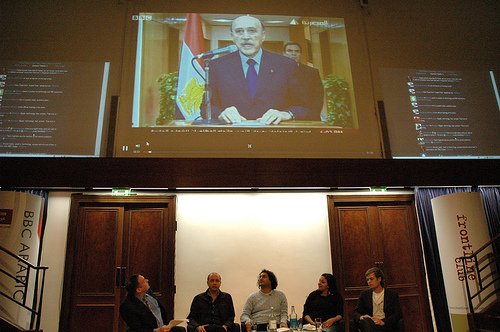
Louis Lewarne – Frontline Club http://www.beta.frontlineclub.com Championing Independent Journalism Tue, 04 Sep 2012 14:47:21 +0000 en-US hourly 1 https://wordpress.org/?v=6.9.4 Egypt’s digital revolutionaries: It’s not about the technology http://www.beta.frontlineclub.com/yesterday_i_was_at_the/ http://www.beta.frontlineclub.com/yesterday_i_was_at_the/#respond Thu, 31 Mar 2011 19:07:44 +0000 http://www.beta.frontlineclub.com/dev/?p=3171 The special joint event organised by the Frontline Club and the BBC Arabic Service brought together some of the key players, journalists and experts to discuss what has taken place in Egypt over the last few months.

The first half of the evening at the Royal Institution of Great Britain, considered the role of technology in the Egyptian revolution and the panel resoundingly downplayed the role of Facebook, Twitter and even the Internet.
5578838101_c7271abdf7.jpg

Alaa Abd El Fattah, an open source software developer, summed up the mood early on by stating that Egyptians used their "voices", "rocks" and "clubs" more than they used technology. He didn’t mention his work aggregating Egyptian blogs or building websites for activists at any point in the evening.
 
Manal Hassan is the co-founder of the Egyptian GNU/Linux Users Group. She said that social media tools were simply "the tools of this generation" and that the revolution would have taken place with whatever tools were available. 
 
Continuing the theme, Louis Lewarne, who ran occupiedcairo.org, was unconvinced about the power of the Internet. Although he collected contributions, comments and images on the blog during the revolution, the use of technology was always "a reaction" to events, he said.
 
When the Egyptian authorities clamped down on the Internet he noted that it encouraged more people out onto the streets because they wanted to find out what was going on.
 
Lewarne also played down his role setting up an ad hoc media centre using one of the few working Internet connections in Cairo, even though he was circumventing the state media narrative in a way that wouldn’t have been possible in days gone by.  
 
It was a panel about technology that didn’t want to talk about the role of Facebook, Twitter, the Internet or mobile phones. For these digital activists, it was the obvious way to communicate and a normal thing to do.
 
Instead, they wanted to talk about the extraordinary political change that had swept through their country. And who can blame them?
 
El Fattah tweeted as much after he had finished speaking:
"I guess [the] audience could tell we didn’t really want to talk about media and tech rather we wanted to talk revolutions"
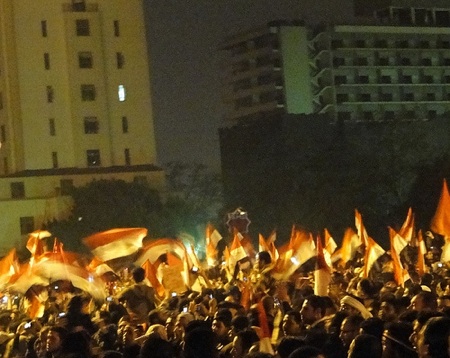
Although Hassan noted that there were people collecting photos and media on the Web, she was more interested in conveying the nature of the revolutionary spirit which sustained the protest:
 
"Being in Tahrir and being part of these discussions and this unity…it was different." You didn’t think about audiences or the international dimension, "you just thought about your country", she said.
 
Only Sam Farah, the lead presenter of BBC Arabic’s flagship interactive programme, Nuqtat Hewar (Talking Point), really discussed the workings of the new media landscape.
 
He noted that Egyptians were sending BBC Arabic material and that "old media" were playing an important role in amplifying discussions that were circulating on new media platforms. El Fattah noted that Al-Jazeera played a "very important" role in that respect.
]]>
http://www.beta.frontlineclub.com/yesterday_i_was_at_the/feed/ 0
Louis Lewarne: We were in awe of the Egyptian people that rose up http://www.beta.frontlineclub.com/louis_lewarne_we_were_in_awe_of_the_egyptian_people_that_rose_up/ http://www.beta.frontlineclub.com/louis_lewarne_we_were_in_awe_of_the_egyptian_people_that_rose_up/#respond Mon, 28 Mar 2011 13:00:52 +0000 http://www.beta.frontlineclub.com/dev/?p=4297 TahrirSq.jpg

Independent film maker Louis Lewarne started the collectively written blog occupiedcairo.org during the internet blackout and continued to chronicle events in Egypt.

Louis who has been living in Cairo since 2006 and is married to blogger and activist Salma Said, will be taking part in our discussion on Thursday on Protest, technology and the end of fear.

Recalling his experiences during the revolution in Egypt, Louis says one of his most memorable moments during the protests was hearing that his wife “was safe with friends after she had escaped from the state security forces that had kidnapped her and held for hours”.

These past years I have seen the impunity with which the Egyptian government has brutalised and silenced its citizens.

When a general call to demonstrate against the regime came out I thought it only natural to go and offer my solidarity.

On the evening of 27 January, the government instructed internet providers and mobile phone companies  to cut off the service. One internet provider remained online as it was the provider for the stock exchange and I presume the government did not want to risk the consequences of cutting this. A handful of individuals subscribe to this provider, one of whom is a friend.

Landlines were still working so a few of us agreed to take turns manning a phone line and internet connection to relay information to friends as events unrolled. I used twitter and occupiedcairo.org to get as much information circulating as possible. Of course when mobiles came back online they were in constant use.

The violent revenge of the state apparatus against peaceful protestors is abhorrent

With the amount of information I processed over that period I really cannot remember one thing in particular that I read except perhaps the testimonies of those that had been arrested and tortured by the Army.

The announcement of a law banning protests and stating that it is punishable by one year’s prison or half a million Egyptian pounds is yet another reminder of the changes that need to happen.

We were all in awe of the Egyptian people that rose up to demand their rights as citizens

Their determination to persevere until their demands were met was a real inspiration. We saw them on 28 January relentlessly push against the riot police until they reached Tahrir square. Then, as things got worse and the state sent thousands of thugs to murder those in the square, we saw civilians organise themselves into a shield to protect fellow protesters. Many lost their lives doing so.

The old regime has a lot of money and experience in quashing rebellion

The energy of the street and the adrenalin that kept people there is being systematically destroyed and undermined by the remaining elements of the old regime. The real challenge is to keep that original desire to change Egypt for the better keen in people’s minds and galvanise it into a true political change. The movement is far from over.


You can book tickets for Thursday’s discussion here.


Picture credit: RamyRaoof via a creative commons licence.

]]>
http://www.beta.frontlineclub.com/louis_lewarne_we_were_in_awe_of_the_egyptian_people_that_rose_up/feed/ 0