Foreign reporting is changing. With news outlets’ budgets tightening, and competition, pressure and risks on the rise, foreign journalists working in conflict countries are abandoning traditional methods of reporting in favour of using cheap, local hires to get the story:
“It used to be that you were a local journalist, and treated kind of like the Red Cross. That has completely changed,” said Callum Macrae, producer and director of Channel 4’s ‘Sri Lanka’s Killing Fields’.
“That is why we are using more and more local fixers and journalists. It’s not safe for us anymore. In the long run, maybe that’s a good thing.”
“When I saw the title of the debate, my heart skipped a beat,” argued Arun, who has worked closely with local journalists in Iraq as editor of the Institute for War & Peace Reporting.
“I didn’t want to see ‘ruining’ next to ‘local hires’ – you can’t have enough local journalists in the field.”
“I don’t think foreign correspondents can get as close to a story as a local journalist can.”
“In some cases we don’t know their [the stringer’s] real identity. He only [files] through a fake name he has provided. He’s a photographer, I’ve been told he’s legit,” she said.
“Local correspondents are paid a lot on local terms, so it’s worth the risk for them, but not a lot compared to the rest of the world. In terms of Hostile Environment courses and security, that is very new for stringers. Reuters in Afghanistan is making sure stringers are starting to get training,” she added.
“We [foreign correspondents] are doing the same job – turning it in to a narrative, getting it to a wider audience. You have to make stories into a narrative that people understand,” said Marcae.
“The slow death of the foreign correspondent is the rise of the local journalist,” said Arun.
“Just as insurgency has evolved very fast, reporting has evolved very fast. It is this new beast… It is this strange animal.”
Download this episode
View in iTunes ]]>
By William Turvill
Dubbed the “documentary of the year” by The Guardian, this film follows the campaign trail of Walsh, a “disillusioned Labour Boy gone stray”, as he attempts to dethrone Labour’s Sir Stuart Bell as MP for Middlesbrough.
Although the film originally started out with a focus on Walsh, by the end all attention seemed to be on Bell, an audience member pointed out after the showing. “Yes,” said Walsh. “This was originally going to be a short 20-minute documentary on me becoming a Tory boy, but there was an organic change and I turned from a politician into an investigative reporter looking into Sir Stuart.”
“On paper, winning seven elections in a row, Bell is the Alex Ferguson of Labour politics,” he explained, “but, as the film demonstrates, Bell is a terrible MP, and I’d be very surprised to meet a worse one."
Bell, the documentary reveals, seems to spend more time in Paris than in his constituency, he is unheard of or unpopular with locals, and yet, he has now been elected seven times. How much of a role has party tribalism- blind devotion to the Labour Party – played in this, asked an audience member.
“We found a lot of people, when you mentioned the Conservative Party, would aggressively refer to Thatcher,” said Walsh’s colleague Cowen, who played a very active role in the campaign. “Maybe in 15 to 20 years time, it will be the same thing with the Labour Party being associated with Blair and Brown. One bad egg can tarnish the reputation of a party for a generation.”
Despite Bell’s Labour status hindering political progress for Walsh, the ToryBoy admitted that Sir Stuart’s presence certainly added a good story to the documentary. Although not able to make an impact as an MP, Walsh is confident the film can help make a difference to Middlesbrough and was pleased to say that some good had already come of it.
“It took a while to produce the film, but local and national awareness has been generated,” said Walsh. “For instance, a local journalist, following a local screening of the film, attempted to get hold of Bell regularly over a 100 day period, and then heavily reported on his failing to do so. Then, on a national level, The Independent named Bell ‘Britain’s laziest MP’. So progress has been made – people have started to realise how damaging over-protected MPs can be for democracy.”
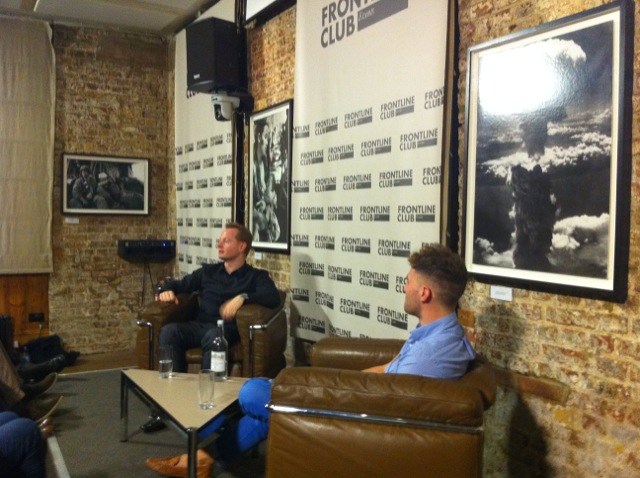
This was just one screening of many, but, according to Cowen, the chance to screen the film at the Frontline Club was “hugely pleasing”, and said “it was nice to get some in-depth questions from a well-informed audience.” Walsh added: “It was a real honour to be invited to show the film at such a prestigious venue.”
]]>Journalists need skills other than subbing and writing: they need to fill a niche and to stop being afraid of dealing with money.
And with the new Lib-Con government finally and conclusively shutting the door on the idea of giving over public funds to support innovative multimedia regional franchises (Independently Funded News Consortia, or IFNCs) – they might need those entrepreneurial skills sooner rather than later.
That was the general feeling at last night’s Frontline Club panel discussion entitled “On the media: What now for local and regional media in the UK?”
On the panel were Richard Hooper, former deputy chairman of Ofcom and chair of the IFNC selection panel; Alex Connock, CEO of the multimedia production companany Ten Alps; Jon Slattery, freelance journalist formerly of Press Gazette, and Marc Reeves, editor of The Business Desk and formerly editor of the Birmingham Post. The panel was chaired by the Frontline Club’s Patrick Smith.
The discussion began with the local media industry’s perennial problem: regional advertising revenue is drying up almost faster than we can sack journalists and nobody can offer up a business model to revive TV and newspapers.
The panel took place only hours after culture secretary Jeremy Hunt confirmed the government would market test the roll-out of nationwide “super-fast” broadband connections instead of the £47 million-a-year IFNC progreamme.
Local news isn’t covered unless there’s a rampage or Notting Hill involved, but you could have had IFNCs getting together covering those if the funding hadn’t been axed.
Hunt argued that although the IFNC bids had merit, they risked turning the regional media into “subsidy junkies and Richard Hooper said he agreed with him that the solution might lie in relaxing media ownership regulation.
Marc Reeves, whose employer thebusinessdesk.com is set to make £1 million in revenue this year, said that the answer doesn’t lie in subsidies, but rather in niche content and good sales people:
I’m surprised there isn’t more specialised, focused journalism such as sport or arts and leisure…the problem is, hyper-local (journalists) are really rubbish at being hyper-local salespeople
Later, I caught up with Reeves on the subject of niche content and job creation. Here’s what he said:
Suffice it to say, there’s still much to chew over when it comes to solving the problem of failing regional media. Until we resolve that one, however, here are a selection of tweets from the evening to give some food for thought:
In February this year, the Uzbek documentary-maker and photographer, Umida Akhmedova, was sentenced by a court in Tashkent, Uzbekistan for “slandering the nation”. She did this in a photoalbum depicting scenes of ordinary life, mostly in rural areas of Uzbekistan, and in a documentary film, which detailed the burden on young brides to prove their virginity. Both were funded by the Gender Programme of the Swiss Embassy. She was found guilty on the basis of the conclusion of a panel of "experts", whose expertise derived solely from their positions in state structures – positions which they have conveniently retained in the transition from the Soviet era to independence, lining their pockets while doing so.
Although Akhmedova was magnanimously granted amnesty in honour of independent Uzbekistan’s eighteenth birthday, the message was clear: members of civil society like Akhmedova, particularly when funded by Western backers, do not have the authority to depict life in Uzbekistan – only the state can do that.
The case has rightly attracted notoriety, as a severe infringement of freedom of expression, which is indicative of the increasingly totalitarian atmosphere in post-Soviet Uzbekistan. But to understand the full import of the case, we have to enter the minds of the "experts" who convicted her, and ask: what was she "guilty" of?
In the verbose conclusion of the panel of "experts", two points stand out. First, she insulted the national traditions. Perhaps most importantly:
“she interpreted relations to Woman from the position of ‘gender’ politics, without paying attention to the national mentality and centuries-old traditions…”
Notice how "gender" – a newfangled, Western term – is put in inverted commas and implicitly rejected, in favour of "relations to Woman" – a phrase with inequality built into it, whose authority derives from "centuries-old traditions". Never mind the fact that women occupied a relatively high position in Uzbek society in Soviet times; never mind the fact that "national mentality", if the term has any meaning at all, is always in flux, that "traditions" are never static, but always interacting with historical circumstances.
But secondly, she was found guilty of portraying only “backward” villages, which are of course not representative of the shiny modern Uzbekistan built by President Karimov and his cronies. As a result:
“A foreigner who has not visited Uzbekistan, seeing this album, will come to the conclusion that this is a country where people live in the Middle Ages.”
This is even more insulting than slandering the centuries-old traditions. Clearly "guilty".
So on the one hand, Akhmedova has dared to insult national traditions from a modernist (i.e. foreign) perspective; on the other, she’s made a modern country look backward. Aren’t these charges a bit contradictory? Actually no: for Uzbekistan’s state elites, divorced from the realities of everyday life in their country, "traditions" are both ancient and modern. So, for state elites, a kitschy national dance performed to pre-recorded music and disco lights encapsulates what it means to be Uzbek.
Akhmedova’s ‘crime’ was to suggest something wholly different, something much more complex – a poignant clash of tradition and modernity which marks Uzbekistan’s place in the twenty-first century. And the rabid reaction against her demonstrates above all the paranoia of the state elites – the awareness that a member of civil society might depict more accurately what it means to be Uzbek than they could ever do.
Read more about Umida Akhmedova’s case on the BBC website here or book In the Picture with Daniel Schwartz: Central Asia, the hinterland of war.
]]>
 By Ewan Palmer
By now it’s unlikely that journalists want to hear any more about how their industry is in turmoil. So how about suggesting ideas to sustain the craft: is the future in freelancing? Does it lie in entrepreneurialism?
From employment to self-employed
Working for yourself is an obvious solution for the thousands of journalists who have lost their jobs over the past two years – if you can’t find work then make it yourself.
Some people have been able to do this like journalism and technology site 10,000 Words – creator Mark S Lucie has since released his own book. The main problem is that this kind of online publishing requires a whole new range of skills.
But the problem is: there are more freelancers around now than ever before which makes standing out all the more difficult. Whereas before, the pitching to an editor skill or winning an elevator pitch was vital, this is no longer enough.
Extra multimedia skills – video, audio, photography – may at first appear to put some people off, as well as the daunting thought of trying to earn a living entirely off your own back.
Show me the money
On top of all that, journalists must also now think like entrepreneurs and answer the question: "How will this make money?"
Some journalists have created their own start-ups or hyperlocal sites. These sites are either run independently by people who used to rely on their paychecks from the mainstream media or by students who are already realizing how difficult finding a traditional job in the industry will be.
The only way these sites will work if they can offer the audience a true niche, the kind that a mass media outlet like a printed newspaper can’t provide. But hyperlocal sustainable? Can advertising revenue aimed at a certain postcode really be enough?
We’ll be discussing all this and more at the Frontline Club on Tuesday April 6, at an event specially for freelance journalists. There will be a discussion on the trials and tribulations of becoming a freelancer, as well as advice for going solo from a our panel of experts Adam Westbrook, Anne Wollenberg, Deborah Bonello and John Brazier. Book tickets here now.
Pic credit, via a Creative Commons licence: sarah_sosiak.
Update: Please find below a link left by Mr Graham Holliday about his start up in Rwanda, and how he doesn’t care about whether it makes money.
http://www.beta.frontlineclub.com/blogs/frontline/2010/03/journalism-doesnt-pay-so-what.html
]]>Greenslade told Journalism.co.uk, that he hopes to take up topical issues raised by the people who live in the diverse community: “And I expect to open a dialogue with the city’s councillors who represent the area. What do they do? Who are the community police officers, and how do they operate?”
Before another week passes here’s a round up of the first event I organised for the Frontline Club. For the past month or so I’ve been finishing my time at Press Gazette – before Wilmington closed down the operation – and working part time at the Frontline, so it’s perhaps not surprising that former colleagues were heavily represented.
A former Press Gazette editor Ian Reeves chaired what proved to be a very forensic examination of the health of the local and regional media. Media commentator Roy Greenslade, Deloitte’s William Yarker, Keith Sutton a former president of the Society of Editors and Jon Slattery, former deputy editor of Press Gazette and now prolific blogger on the press took part in the examination, diagnosis and attempt to find a cure.
You can watch the event above. And for further reporting, journalism.co.uk look at the panel’s take on the social impact of disappearing newspapers; How local media management is stifling digital innovation and why the Society of Editors and Newspaper Society’s plans on competition rules for local newspapers are ‘bonkers’.
]]>