Images and text by Sophia Spring
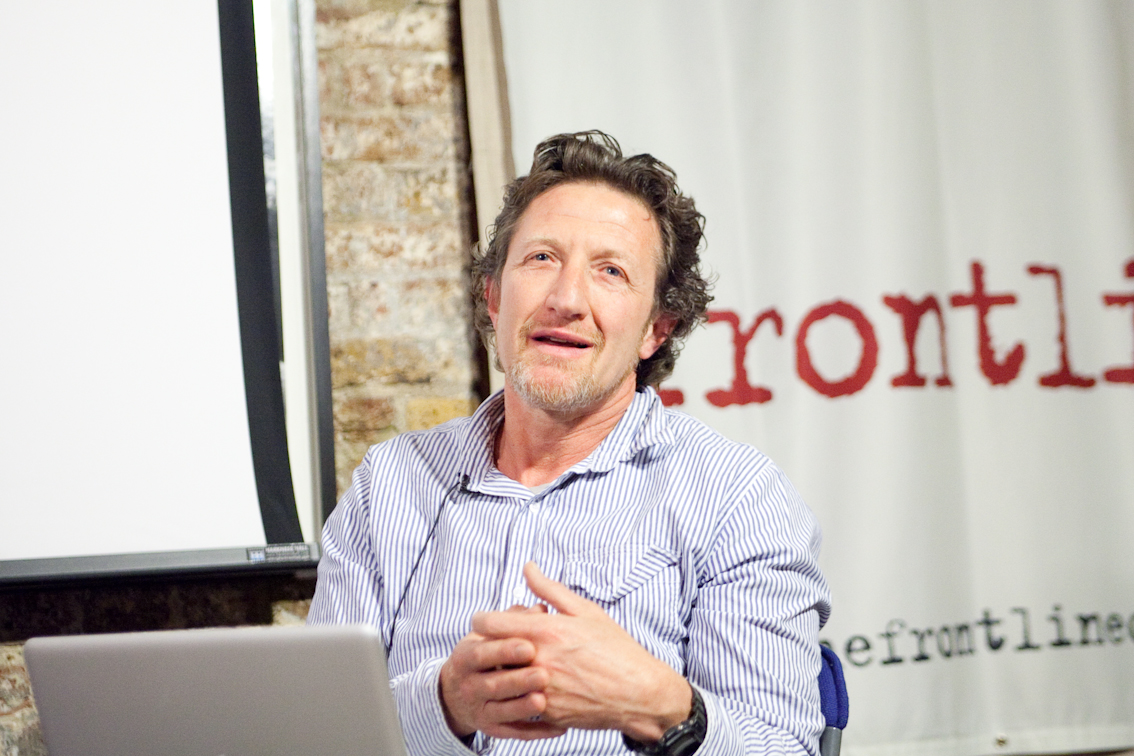
Photographers Liz Hingley and Gideon Mendel speaking about their work at the Frontline Club.
Diana Smythe, deputy editor of the British Journal of Photography, was last night joined by Save the Children’s Chris Wellings, and photographers Liz Hingley and Gideon Mendel to discuss the depiction of poverty within their work.
Both photographers have explored this concept through divergent approaches. While Liz has documented communities living in the UK, Gideon has predominantly spent the last 2 decades photographing the spread of AIDS, and more recently climate change, and its impact amongst some of the world’s poorest people.
Liz Hingley’s slideshow of her project ‘Under Gods: stories from Soho Road’ started proceedings (http://www.lizhingley.com/
This ongoing project centres on the Jones’, a white British family of seven living in a three-bedroom house in Wolverhampton. Taking us through the images Hingely talked of her “initial shock” at their living conditions. Over time she has acclimatised to the environment, and now sees it as a place full of a “lot of love”. She has forged close relationships with the members of the family, celebrating “Christmas and birthdays” with them. Hingley insists that these relationships are very important as her “engagement with people” and the “collaborative process” that stems from this is central to her work. As a result her photographs humanely capture the everyday existence of those living in poverty, without veering into the terrain of stereotypes or reductive representation.
She says of the experience, “it has really opened my eyes…the issues are always in the background (concerning money)…they’re constantly there”.
Up next was Gideon Mendell who acknowledged that depicting poverty is a “problematic concept” and one that has forced him to question his role as a photographer. After years of covering AIDS and natural disasters he began to feel that he “had nothing left to say”.
This has led him to “engage in the field of collaborative photography” in his most recent project ‘3EyesOn’ (http://www.3eyeson.org/). Pupils at Kingsmead School in Hackney, one of the UK’s most deprived areas, were given cameras to capture their daily lives. “No photographer can access the lives of poverty like a poor kid can themselves” said Mendell.
Photographer Gideon Mendel speaking about his work at the Frontline Club.
According to Chris Wellings from Save The Children poverty in the UK is “a phenomenon that’s not particularly apparent”. Hingley agreed that it is very “hard to translate this issue in images”, and Mendell assented that it is far easier to depict poverty in the third world where there is “clear deprivation”. Here in the UK he said, it manifests itself in less obvious ways, such as poor diet.
In light of this, Mendell and Hingley find that a collaborative approach achieves an “access and intimacy” that allows poverty to be photographed in a nuanced way. Chris Wellings hopes that photographs like theirs can “create a case” and a “demand for change” leading to the reduction and eventual elimination of child poverty.
]]>Those who aspire to a career in photojournalism and photographers established in the industry often hope to do the lion’s share of their work abroad, covering war zones and absorbing foreign cultures.
Multicultural Britain has plenty to offer by way of contrasts and acute social issues for photojournalists to explore though. Save The Children has brought together a collective of British photographers to put the spotlight on poverty in the UK. An eye-opening presentation of photographs will be accompanied by a discussion with two photographers. Liz Hingley and Gideon Mendel will speak about their experiences of working in the UK, covering issues on their doorstep. What are the challenges photojournalists face at home compared to overseas? Problems of access, media interest and legal issues will all be covered.
This event will be moderated by Diane Smyth, deputy editor of the British Journal of Photography. She has written about photography for Aperture, PDN, Guardian.co.uk, Thetimes.co.uk, The Telegraph’s Telephoto site, Creative Review and Philosophy of Photography.
Liz Hingley ‘s photography intimately documents political and social issues, with a particular interest in alternative modes of community living. Hingley graduated from Brighton University with a first class BA Honours in Editorial Photography in 2007. Her work has been exhibited internationally, her recent awards include being selected for PND’s top 30, The Eugene Smith award, the Ian Parry scholarship and Canon female photographer of the year. Dewi Lewis Publishing launched her book Under Gods: stories from Soho Road in March 2011.
Liz Hingley‘s work for Save the Children has been made possible through the generous support of Fuji film.
Gideon Mendel is a South African photographer based in the UK and has won six World Press Photo Awards, the Eugene Smith Award for Humanistic Photography and the Amnesty International Media Award. The bulk of his work is for NGOs overseas, but he stayed in the UK for one of his recent projects, Kingsmead Eyes, developing the photographic talents of children from the deprived area around the Kingsmead Estate in Hackney. The project was part of the 3EyesOn project which Mendel developed with fellow photographer Crispin Hughes. Mendel spoke at the Frontline Club in 2008 about nearly 20 years of photographing HIV in Africa and raising awareness of the problems AIDS sufferers face. In his current practice he is addressing the issue of climate change through developing a body of work on the global impact of flooding on the world’s poorest people.
]]>