On Monday 28 July, the Frontline Club hosted the preview screening of One Rogue Reporter, which was followed by a Q&A with director Rich Peppiatt, chaired by professor of television journalism at City University, Stewart Purvis.
Peppiatt was a tabloid journalist with the Daily Star, who publicly resigned in 2011. His resignation letter was printed in The Guardian, and honestly, and hilariously, outlined the list of reasons for his resignation, providing an insider’s account of life a tabloid newspaper. Since then, Peppiatt has continued to lay bare the truth about the ethically questionable methods of journalism used by the tabloids, and has used comedy to spread his stories. The film uses the Leveson Enquiry as a back drop to Peppiatt‘s various attempts to turn the tables on the UK’s most powerful newspaper bosses. One Rogue Reporter began as a comedy stage show, and gradually developed into a film. The film was completely self-funded by Peppiatt and his partner Tom Jefferson.

The Q&A began with a question about our role as consumers in maintaining the power of the tabloid press, and Peppiatt‘s lack of focus on this issue. Peppiatt responding by explaining that they had always wanted the film to be one hour long, and that it was first and foremost a comedy film. As a result, there were certain perspectives that could not be focused on in detail.
“The film started out as a stage show, and so the stunts were filmed . . . individually, without a narrative. We didn’t have a narrative in mind, we just filmed them as separate entities. . . . It worked for a stage show . . . I could do some stand-up in between it and it all pinned together, but then when you’re actually going to make a film about it, it was quite difficult to then impose a narrative on it.”
In addition, Peppiatt explained that, while they wanted to “make a point”, they were always considering the best way for the comedy to come through.
The Daily Mail, and its website, the Mail Online, was mentioned several times throughout the Q&A, with Peppiatt stating that, due to its success:
“All of the broadsheets are trying to be more like the Mail Online . . . because they know . . . that’s where the money is.”
However, he argued that just because it is successful, does not mean that it is morally right. He went to say:
“The minute you start reducing morality down to sales, you really have bought into the ultimate capitalist system ever, where everything is defined by who will buy it, and that’s not a society I want to live in. . . . The capitalist system has overtaken some of the very noble parts of our society.”
While explaining that he is not anti-capitalist, Peppiatt said that the state is not the “most powerful entity anymore”. When Purvis asked him why this is a bad thing, Peppiatt responded by saying that people vote for governments not media moguls who head up corporations, and which now have been allowed to have “zero accountability and massive power”.

When discussing the power of the tabloids, Peppiatt told the audience that he knows that the tabloids are watching him carefully, and that he has made a lot of people angry. However, short of recording everything he says in public, they are unable to take any action. Peppiatt explained that they were very careful when making the film, and were constantly aware of libel laws. In addition, any action the tabloids take against him, can be used to publicise the film and expose the double standards of tabloid newspapers try to censor someone. Anyway, Peppiatt elaborated, “I’m too insignificant to bother writing about.”
In response to a question about the general public’s opinion of journalists, Peppiatt said that, currently, the public’s “trust [of journalists] is below politicians. . . . The trust of journalists is so low . . . that the whole process is undermined.”
Well done @richpeppiatt for a very good and enjoyable debagging of sleazy tabloid editors. #oneroguereporter @frontlineclub
— Bob Ward (@ret_ward) July 28, 2014
Purvis asked Peppiatt if he will go back to “journalism with a capital J”? Peppiatt replied that he is happy with the type of journalism he is doing now; he and Jefferson “have a few a short films lined up”. Ultimately, he said, they have always wanted to do ‘comedy journalism’, involving the public embarrassment of ‘bad people’, and they hope that their version of reporting will engage people in current affairs.
More information about One Rogue Reporter, including any upcoming screenings can be found the film’s website. Follow Rich Peppiatt on Twitter.
]]>
Since Rich Peppiatt’s hilariously withering resignation letter to Daily Star proprietor, Richard Desmond, became a viral sensation in 2011, his brutal honesty has made him a regular tabloid commentator on TV and radio. Peppiatt has appeared before the Leveson Inquiry and his searing testimonies have made headlines around the world.
With One Rogue Reporter, Peppiatt delivers a mercilessly satirical dissection of his former trade. Turning the tables on unscrupulous newspaper bosses, he lampoons the hypocrisy and dishonesty of his former employers through a series of mischievous stunts and interviews with heavyweights from the worlds of journalism, film, comedy and politics.
Directed by Rich Peppiatt
Duration: 60′
Year: 2014
Lord Justice Leveson’s 2,000 page report into the culture, practices and ethics of the press has been met with mixed reactions from the press, politicians and the public. The most divisive suggestion, that the press should have an independent self-regulatory body underpinned by statute has spilt the government.
Join us for a reactive debate to discuss the findings and examine what action may be taken, and what implications it would have on the future of the British press.
Chaired by Torin Douglas, BBC media correspondent.
With:
Martin Moore, director of the Media Standards Trust and a founder of the Hacked Off campaign.
Rich Peppiatt, writer, broadcaster and former journalist at the Daily Star. His One Rogue Reporter has just shown at the Soho Theatre.
Mick Hume, editor-at-large of the online magazine Spiked and author of There Is No Such Thing As A Free Press …and we need one more than ever.
Kirsty Hughes, the Chief Executive of Index on Censorship – an international freedom of expression non-governmental organisation.
In association with Index on Censorship

In the chair was the ever cheery Jonathan Dimbleby, who mapped out the key areas for debate. The panelists began with a feisty exchange over newspaper funding. The Times columnist David Aaronovitch argued that tabloids form a crucial part of a sustainable economic model.<
“The only parts of British journalism that make any money and aren’t subsidised are the tabloid papers, which created the sorts of abuses that we’re talking about…The only one (online) that looks likely to make some money is the Mail online. The model of the Mail Online has nothing to do with quality journalism. It’s essentially sex, tits and murder.”
Academic Angela Phillips replied that public interest journalism was actually subsidised in other parts of Europe, suggesting that this model could actually benefit journalism in the UK.
New Statesman deputy editor Helen Lewis stated that Leveson should take the global reach of internet publications into account.
“I’m surprised to find myself agreeing with Martin Clark, editor of the Mail online. We can regulate the British press all that we want but the American press could still publish very intrusive pictures, they will still follow Pippa Middleton around because there’s a market for that there. I’d like to see an acknowledgement that we’re competing in a global market place.”
Dimbleby moved on to the question of how to protect so-called victims of shoddy journalism. Academic and founder of Hacked Off Brian Catchcart expressed his frustration that when bad journalism has sold newspapers, it’s gone unpunished.<
“The journalists who wrote the stuff about Christopher Jefferies are all still in employment. At the lowest levels you need journalists to feel that there will be consequences when things go wrong… There should be statutory underpinned self-regulation. Self-regulation, but you would have certain criteria that the press would have to meet which would be subject to audit by an external body like Ofcom. Editors and proprietors shouldn’t be left to run the show themselves.”
Aaronovitch offered support for this view but struck a gloomy note in his assessment of Leveson’s impact.
“It feels to me that we’re locking the stable door after the horse has died… This is not where the great abuses are going to come from. These are the kind of epiphenomena of the last twenty years coming back to us in a form of belated accountability, just as the system changes irrevocably.”
In summing up, the panel reached a consensus that the Leveson report will hold very little weight and is almost irrelevant. It will remain up to Whitehall whether they choose to implement the Lord Justice Leveson’s recommendations.
]]>
It has been a year since the Prime Minister announced an inquiry examining the culture, practices and ethics of the media in light of the phone-hacking scandal. Since then we have heard from journalists, editors, proprietors, politicians and victims of phone-hacking.
As the hearings draw to a close and Lord Justice Leveson begins his report, we will be holding a special event in association with Index on Censorship to discuss what we have learned and the key issues Leveson will have to tackle.
Join us with a panel to map out the questions Leveson will be asking. How should public interest be defined? Is regulation required and if so, what would its purpose be? How should relationships between journalists, proprietors, politicians and police be conducted in the future?
Chaired by writer, broadcaster and filmmaker, Jonathan Dimbleby.
Panelists to be confirmed.
In association with Index on Censorship

]]>
 The ‘post-Leveson’ question becomes ever more pressing, as identified at yesterday’s University of Westminster conference, attended by a range of international media researchers, as well as regulation and legal specialists.
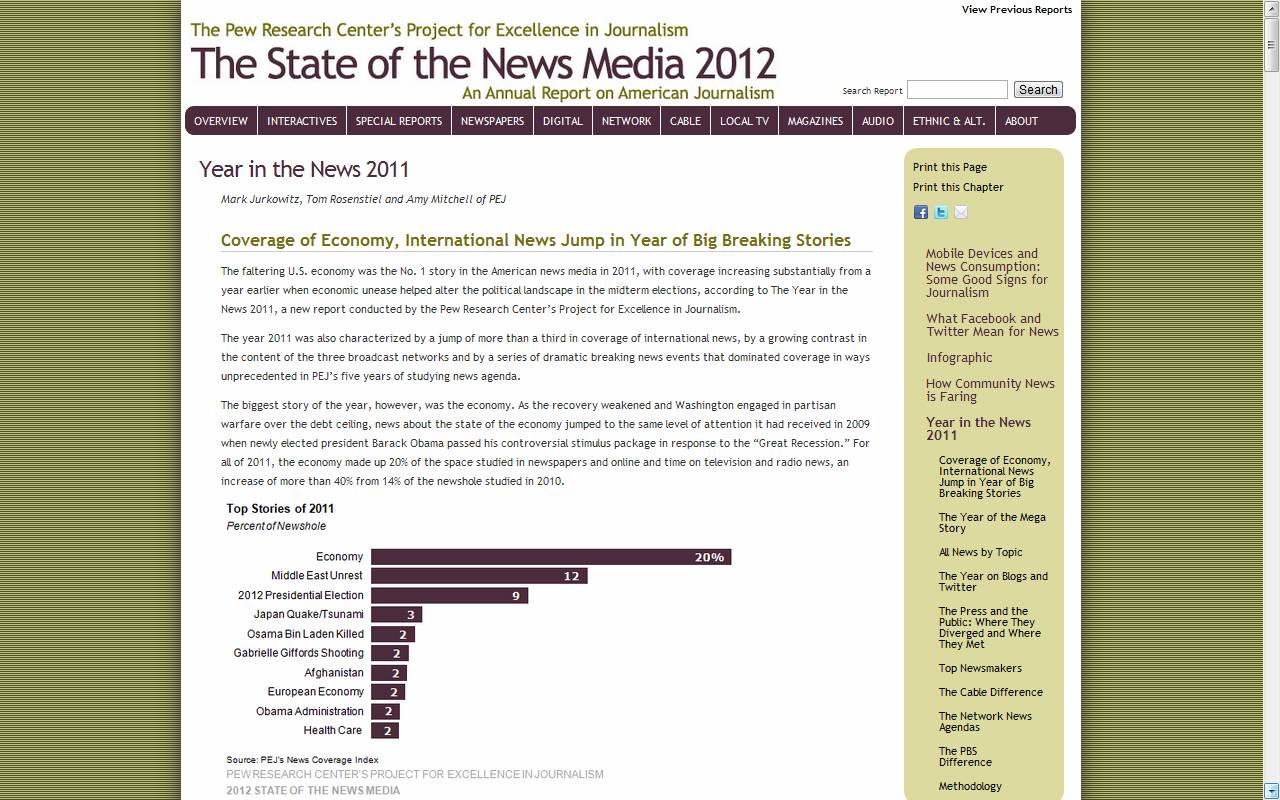 One section of the report offered a comprehensive understanding of which stories and topics were regarded as newsworthy by American journalists and included data for news being shared by bloggers and Twitter users.
Following these latest revelations, hosted by BBC Radio 4's Paddy O'Connell, we will be examining what we have heard and what the ramifications will be for politicians and the press.
]]>Following these latest revelations, hosted by BBC Radio 4’s Paddy O’Connell, we will be examining what we have heard and what the ramifications will be for politicians and the press.
We will be asking how much more will be unraveled and how far these relationships go. Will the release of this information lead to an end of cosy relationships between politicians, journalists and media proprietors?
With:
Ben Fenton, chief media correspondent at the Financial Times. Twitter: @benfenton
Roy Greenslade, media commentator and Professor of journalism at London’s City University. He was editor of the Daily Mirror (1990-91), was managing editor (news) at the Sunday Times (1987-90) and assistant editor of The Sun (1981-86). Twitter: @GreensladeR
Peter Oborne, the Daily Telegraph‘s chief political commentator.
Paul Staines, better known as “Guido Fawkes” of the eponymous Guido Fawkes’ blog. Twitter: @GuidoFawkes
Thais Portilho-Shrimpton, a journalist and co-ordinator of the Hacked Off campaign. Twitter: @Selkie
Picture credit: Leveson Inquiry
]]>
“[the invasion of privacy] came to a head when my little boy died of cot death… My husband and I wrote to every Fleet Street editor we could think of to ask them and beg them personally not to send a reporter to the funeral. The Sun chose to put a photographer there and made it their front page the next day…”
“The first thing the Leveson inquiry has done is to absolutely make it ok to say what you think… Function number 2 is before an inquiry ever reports people concentrate a lot on things they didn’t think about before. The third function… it might say ‘we should do this’… I would say it’s already worked on levels 1 and 2 – I’d say that was a gain.”
“We had reliable sources that didn’t turn out to be quite right… We acknowledge we’ve made a mistake… we acknowledged it 34 times.”
“Tony Parsons for example… he’s got a broadsheet mind and a tabloid tongue and he speaks to people in the country who don’t understand complicated issues in language that they understand – and that is the great thing that tabloids can do.”
As revelations from the phone hacking investigation continue, join us for the first event of 2012 to discuss what has been revealed about the workings of the tabloid press and what the fall out will be for the journalism industry.
A lively public meeting hosted by Paddy O'Connell of BBC Radio 4's Broadcasting House.
]]>
Since the Leveson Inquiry hearings began on 14 November some of the worst of British journalism has been laid bare by the victims of phone hacking, politicians, journalists and editors who have spoken.
As revelations from the phone hacking investigation continue, join us for the first event of 2012 to discuss what has been revealed about the workings of the tabloid press and what the fall out will be for the journalism industry.
A lively public meeting hosted by Paddy O’Connell of BBC Radio 4’s Broadcasting House.
With:
Tom Latchem, freelance journalist, writer, broadcaster and former TV editor for News of the World. Twitter: @theboylatch
Anne Diamond, a journalist who for the past 25 years has been working in daily TV, radio and national newspapers. She is a regular panelist for The Wright Stuff on Channel 5 and a regular columnist for the Daily Mail. She hosts The Anne Diamond Show daily on BBC Radio Berkshire. She gave evidence at the Leveson inquiry on Monday 28 November.
Peter Wilby, who writes a weekly column for the New Statesman, the magazine he edited between 1998 and 2005. A former education correspondent for both the New Statesman and the Sunday Times, he was editor of the Independent on Sunday from 1995 to 1996.
Ben Fenton, chief media correspondent at the Financial Times. Twitter: @benfenton
George Brock, Professor and head of journalism at City University. A journalist at The Observer from 1976 to 1981 he moved to The Times in 1981 and held positions from foreign correspondent to managing editor before leaving in 2009. He is a board member of the World Editors Forum, and a member of the British committee of the International Press Institute. Twitter: @georgeprof
]]>Screenings next week include U.N. Me, an investigation into incompetence and corruption at the heart of the UN and an exclusive preview of Clint Eastwood’s J. Edgar which will be held at Warner House in Bloomsbury.
You are also invited to a private view of the Frontline Television News Exhibition – an opportunity to learn more about the thrilling history of the agency and the work of the pioneering cameramen and women. Tickets are free, but you must register if you would like to attend.
Follow us on Twitter and catch up on any events you missed on the Forum blog or download our podcasts on iTunes.
ALL EVENTS ARE OPEN TO THE PUBLIC