Freelance/Student £125.00
Members £100

This one-day workshop acts as a refresher, to update delegates on new areas of media law. It also serves as an introduction to media law for those with little or no experience in this field. David Banks, three-times editor of McNae’s Essential Law for Journalists, will focus on the law as it applies to online publications and social media, illustrated by the latest cases.
This course covers:
• Libel
• Contempt
• Reporting the courts
• Sexual offences
• Privacy and confidentiality
• Copyright.
The course also includes updates on:
• The future of press regulation after the Leveson report
• The Defamation Act 2013
• The Bribery Act
• RIPA
• Data Protection Act
• Misuse of Computers Act.
While featuring online aspects the session is also suitable for those working in print or broadcast journalism as well.
The day is a mixture of lectures and interactive workshops, where attendees will work in teams to solve legal problems drawn from real-life situations.
Those attending will leave with a good working knowledge of the legal issues listed above as well as the ability to recognise where risks arise, take action to avoid them and ensure they can defend themselves effectively from legal threats.
Schedule:
Morning – Crime, the courts and victims
9.30am: Crime and reporting proceedings – magistrates, crown court and other courts
10.30am: Children, and anonymity
11am: Sexual offences and victims’ anonymity
11.30am: Contempt of Court – dangers and defences
Afternoon – Libel, privacy and ethics
1.30pm: Libel – dangers and defences
2.30pm: Privacy, confidentiality, data protection and the public interest
3pm: Ethics after the Leveson inquiry
4pm: Copyright
4.30pm: Questions and finish
About the trainer
David Banks has been a journalist for 25 years and has been training journalists since 1999. He is an expert on media law and has taught courses to most of the major national and regional newspaper groups, as well as a range of other organisations including the Crown Prosecution Service, the Post Office, police forces, local authorities, charities and NGOs. He was a member of the Ministry of Justice working party on libel reform in 2010 and contributed to the Leveson Inquiry into press standards. He co-authored three editions of McNae’s Essential Law for Journalists and now writes for The Guardian on media law.
In February this year Private First Class Bradley Manning pleaded guilty to sending restricted documents to Wikileaks in violation of military regulations, making him the source of the largest intelligence leak in US history. Ahead of his trial in June we will be examining the charges he faces and the implications if he is found guilty.
In his statement to the court he talked about “revealing the true costs of war” and how he “believed that if the general public, especially the American public, had access to the information… this could spark a domestic debate on the role of the military and our foreign policy in general”.
Manning has denied some of the most serious charges such as “aiding the enemy” which would see him face a life sentence, but has pleaded guilty to 10 out of 22 charges, which could carry a sentence of up to 20 years.
We will be discussing the questions raised by this case about the fate of whistleblowers and the future of relationships between journalists and their sources.
Chaired by Richard Gizbert, presenter of The Listening Post on Al Jazeera English.
The panel:
Naomi Colvin is a London-based writer and activist. In late 2010 she founded UK Friends of Bradley Manning, which successfully lobbied the UK government to recognise Bradley Manning’s dual citizenship status.
Professor David Leigh was the Guardian‘s investigations editor until 2013 and is a professor of journalism at City University. He is one of Britain’s leading investigative journalists, and winner of the 2007 Paul Foot Award for Campaigning Journalism. He is co-author of WikiLeaks: Inside Julian Assange’s War on Secrecy.
Chase Madar is a human rights attorney in New York, where he specializes in youth law, LGBT law and disability law. He reports and reviews for the London Review of Books, Le Monde diplomatique, CounterPunch, Al Jazeera, and the TLS. He is author of The Passion of Bradley Manning: The Story Behind the Wikileaks Whistleblower.
]]>At an event hosted by the Frontline Club, an expert panel of speakers shed light on the ongoing oppression of political opposition in Bahrain, one of the most under-reported aspects of the Arab Spring, and the government’s systematic use of Western public relations companies to manage the regime’s global reputation.
In the early months of 2011, thousands of Bahraini citizens took to the streets to demand greater representation and more equitable treatment of the country’s Shia citizens, who make up 70% of the population. Dozens were killed, and hundreds more were incarcerated or went missing.
But, as moderator and The Guardian‘s Comment is Free editor Brian Whitaker explained, the story has been overshadowed by events in Syria and elsewhere in the Middle East, and buried by governments in both the West and the Gulf region that see Bahrain’s royal family as political allies.
“This doesn’t justify the repression that is happening in Bahrain, and it doesn’t reduce the need for people’s rights there,” he said.
Organised by advocacy group Bahrain Watch, the event highlighted the organisation’s efforts to draw attention not only to the brutality of the Bahraini government, but also to its use of international PR firms to hide its activities from the global community.
“Opposition has been suppressed by methods including incarceration and torture, extra-judicial killing and the excessive use of force,” said Marc Owen Jones, doctoral candidate at Durham University and member of Bahrain Watch.
“This has resulted in the death of at least 60 protestors, and probably more.”
The government is using what Jones described as “soft tactics” to influence international opinion, including the recruitment of international PR firms to “delegitimise the pro-reform movement and push the government narrative.”
“Since February 2011, contracts have been awarded to 18 companies, 15 of which total $32.5m – and this is a conservative estimate,” said Jones. “All of them are based in the US and the UK…the largest being M&C Saatchi and Bell Pottinger.”
These activities continue unhindered by the governments of the UK and the US, earning London the unofficial title of the “world’s reputation laundering capital”, said Jones.
“It’s worth exploring whether these companies can be targeted here,” said pannelist Adam Hunt, a human rights solicitor and partner in Deighton Pierce Glynn.
“Companies can be excluded from competing for UK government contracts if they are found guilty of professional misconduct.”
Bahrain’s leader, King Hamad bin Isa Al Khalifah, has set up a commission of enquiry to investigate abuses by the regime. But the panel concluded that although the commission’s findings were important, its report was nothing more than window-dressing.
“There continue to be daily allegations of abuse of protestors and there have been no convictions of anyone with any level of responsibility [within the regime],” said Carla Ferstman, director of international human rights organisation REDRESS.
“The most galling aspect is that they are documenting human rights violations but not doing anything about them,” said Jones. “It’s just a testament to impunity.”
The regime has hidden the worst of its excesses from the public eye and now tortures people in secret detention centres, explained Mohammad Al Tajir, a human rights lawyer who was tortured and detained for more than three months by the regime for speaking publicly in favour of the release of political prisoners.
When Al Tajir was arrested, his bank account was frozen and his wife was told that he was dead.
“The problem is that there is no will to bring justice,” said Al Tajir. “Confession is still the only evidence in most cases. Torture has not stopped. Out of 20 people arrested, 10 will have to go to hospital.”
Asked what they expected of Bahrain in the months to come, none of the panellists had high hopes.
]]>“I’m not optimistic at all,” said Jones. “Maybe we’ll see the release of some prisoners. But I don’t see any sincerity in any of the reforms.”
Women leaving Moldova and crossing the border into Romania and then on to European countries to work illegally has become a mass phenomenon that is tearing families apart.
Bordering Romania and the Ukraine, Moldova is the poorest country in Europe, with an unemployment rate of 80%. Mamma Illegal follows three women between 2004 and 2011 as they work illegally in Europe to earn money to provide their families with a better life.
Vienna 2004 – Auralia is making a living illegally cleaning in Austria. As she watches a video of her family back home the demands of being so far away are made clear. She cries as she sees her children missing their mother.
She has chosen to leave her family and work in Vienna in order to send money home. As the film progresses the strain that this is putting on the women and the families is evident. They start to wish they had never let their loved ones go.
Auralia’s family is not a one off – footage of a Moldovan school shows a classroom of crying children, pleading to the camera for their parents to return home. The teacher speaks to the camera saying, “They leave in order to work and hopefully they will be better off afterwards”. Nearly all of the children present in the class have a mother working abroad, some have both parents working in separate countries. The result is a generation of children left behind, being brought up by their grandparents and remembering their parents only through distant memories.
As the years progress the effects on the women become more noticeable. Natasha, a Moldovan woman living in Italy, is very obviously struggling to cope. “I left because I had to, I couldn’t see any other way out”. She refuses to return home. When he receives a letter stating she has to leave the country; she is visibly distressed, fainting when leaving the immigration office. Her messages to her 10-year-old daughter are of love, yet she insists on staying rather than returning to be with her.
“You mustn’t judge me because I left you at such a young age, I am doing this for you”. This reason for their mothers leaving them is repeatedly drilled into the children. As the children grow up into young adults, though, it is interesting to see that they would not make the same decisions as their parents – “I would not leave if I had children of my own, this is my home”.
It becomes clear that the women see what kind of life they could have and when they do finally return home they view their homes as dirty and poverty stricken, the pressure this puts on their marriages could not be made more heart-rending. When Auralia’s husband commits suicide, she shouts at his coffin “why did you leave us?” The film’s Producer, Arash Riahi, took questions after the screening and explained that Auralia’s husband could not face her leaving for Vienna again and suicide was his last, desperate attempt to force her to stay at home with her children.
The film leaves you reflecting on what you would do if you were in the same situation – it is in the human condition to want to better yourself and your situation, but at what price?
]]>Maryam Al-Khawaja from the Bahrain Center for Human Rights comes from a family of activists, many of whom have been on the receiving end of the police brutality in the Kingdom.
So much so that she joked that “Bahrain should adopt family cells in prisons, so family members could spend some time together.”
Her sister Zainab, aka @angryarabia, was arrested on 15 December during a non-violent sit-in west of Manama. She is one of tens of thousands of women of the revolution.
“Bahrain revolutions is at least 50 per cent made-up and led by women,” says Maryam Al-Khawaja, “It has been breaking a stereotype of Muslim women, according to which they need to have a certain personality if they dress a certain way.”
Al-Khawaja described seeing a video of a traditionally dressed Muslim woman, in the early days of the Bahrain revolution, spraying a graffiti which fully illustrated the steely determination behind the abaya.
“Even if men stop, women will continue.”
Al-Khawajawarned that the revolution in Bahrain was far from over, despite some seemingly positive developments.
Bahraini government set-up an Independent Commission of Inquiry, which was supposed to investigate human rights violations. However, “it is dangerous precedent,” said Al-Khawaja:
“We have an authoritarian regime setting up their own Commission of Inquiry. They will use this report to sweep under the carpet all the human rights violations that they have committed.
“I don’t think we would have had the same reaction had Mubarak visited London in January 2011. King Hamad and his son came to London a few days ago. His son still has the allegations of torture against him.
“And yet, there was no huge outcry from the international community. All because of this, so called, human rights report.”
Al-Khawaja was also critical of the media coverage of Bahrain because even well-minded journalists often refer to the uprising there as a “Shia revolution.”
“People came out demanding dignity, human rights and freedom against an oppressive regime. It has nothing to do with them being Shia or Sunni.
Iran is another country where women have been no strangers to revolutions. It also acts as a warning how they can be let down by the exact causes they are so passionately fighting for.
The women’s contribution to the Iranian revolution of 1979, which saw the overthrowing of the Shah, was “rewarded” by curbs on their rights and the interpretation of Sharia law was adopted.
Sussan Tahmasebi worked at grassroot levels for 11 years in her native Iran on promoting women’s rights and strengthening of the civil society.
She is a founding member of the award-winning One Million Signatures Campaign, which collects signatures of Iranians who support an end to gender-biased laws in the country.
Tahmasebi stressed that women in Iran are better educated than men and the average age of marriage was 25. Women are doctors, lawyers, teachers – active participants in the civil society – all of which defies Western stereotypes of women in the Middle East.
“Of the background of the repressive laws that had been adopted 30 years ago, you have a very strong society with women’s presence. Iran has one of the strongest women’s movements in the region.”
During her work in Iran, but also throughout the Middle East and North Africa, Tahmasebi noticed that the greatest challenge for women who advocate for their rights is the “discourse of culture and religion versus human rights.”
“We must remember that human rights and Islam are not mutually exclusive.
“We need to really advocate for a civil law, which takes into consideration universal human rights standards. Because they are universal. They are not only Western. They are just as much Islamic as they are Christian.”
Tahmasebi talked of the danger of women and their rights being sidelined once the political revolutions in the Arab world are over.
She said that the Western world cited “cultural reasons” in their frequently hands-off approach to women’s rights. However, the risk is that the Arab world will fail the democracy test.
“No democracy is going to be a democracy when 50 per cent of the population have half of the rights of the other 50 per cent”
When asked about the political rise of the Islamist parties in post-revolution Arab world, Tahmasebi said:
]]>“It is still better than the dictatorships we had before. But, what makes me nervous is that some of these Islamic parties are not clear on the specifics. We need to ask questions like What do you think about polygamy? Can you see women in high positions? We need to hold these people accountable.
“These countries have a golden opportunity to to draft constitutions. They need to draft laws that they can defend to their daughters, their children, in 30 years time.”
With more than one billion of the world’s population reliant on fish as their main source of protein and up to 90 per cent of fish disappearing in some parts of the oceans, the impact of illegal, unregulated and unreported fishing operations – known as ‘pirate fishing’ – has never been greater.
After a screening of documentary Deadly Catch, there was a Q&A session hosted by Channel 4 News science correspondent Tom Clarke.
John Pearce, MRAG senior consultant and expert in fisheries management, said that pirate fishing was a “devastating” problem. Within the last year there were 189 reports of illegal trawlers, from more than hundred people in more than 23 communities.
The global fishing industry generates between $9-23bn per year and 20% of the catch is done illegally. A recent seizure of fish, caught illegally of a west African coast, in a Spanish port that was worth $6.5m alone.
The problem is surprisingly compounded by the EU providing huge financial incentives for pirate fisherman, added Domitilla Senni, an environment policy advisor. She said:
We looked at the amount of subsidies these fleets received from the EU – enormous amounts of funds like €10m given to a third of vessels to convert their fishing boats. Also €3m was given to those fishing illegally to improve their practices.
Other concerns were also highlighted. Andy Hickman, an oceans campaigner with the Environmental Justice Foundation (EJF), said that hygiene standards on illegal fishing vessels, which cannot be inspected, are “appalling”.
It was also pointed out that the working conditions on such vessels rendered men as nothing more than indentured slaves paid a dollar a day and do not see land for lengthy periods.
All agreed that the vast majority of illegal fishing activity is rooted in international organised crime and can be linked to elusive multi-national corporations. As long as such outfits believe that the economic benefits outweigh the likelihood of being caught they will continue their illegal activities.
To combat such a widespread problem, a co-ordinated effort from port states is necessary. John Pearce said:
[Pirate] fisherman will always find the weakspot and exploit it. Find the weakest ports to sail to, the weakest markets to get their catch into and the weakest areas which do not enforce rules.
It’s like squeezing a balloon: the problem does not go away, it just goes somewhere else – so everyone must act at the same time.
Other solutions discussed included creating areas of protection at particular breeding sites, excluding industrial fishing vessels from certain areas, and getting local communities involved in fishing management is of paramount importance.
Greater transparency is also needed, with current figures considered to be the tip of the iceberg as unreported illegal fishing is a huge obstacle.
In some cases, however, funds generated from illegal fishing has been put to good use, such as financing legal fishing programmes and combating pirate fishing.
]]>In 1998 Jennifer Jenkins was shot four times by her brother, Mason, who was subsequently arrested and convicted for her murder. Their parents, Leslie and Brian Jenkins decided to continue to support their imprisoned son and were ostracised by their community.
Although many would find it surprising, this story of a Canadian family who stood by their son after he had shot their daughter, is the typical reaction of families in similar circumstances.
Dr Rachel Condry spoke to audience members after a screening of Life With Murder, an intimate portrait of the Jenkins family and the aftermath of their daughter’s death. Dr Condry, an Oxford University criminology lecturer and author of Families Shamed, which examines the consequences of serious crimes on the offender’s family, said:
“Can we understand a mother and a father who would stand by their son? I think that sometimes that is the case. If you imagine yourself as them and the person you love has been cast aside by everyone else and you’re the only one left to love them – there is this huge feeling of defence and that you’re the only one to support them. On a public level you want to stick up for them.”
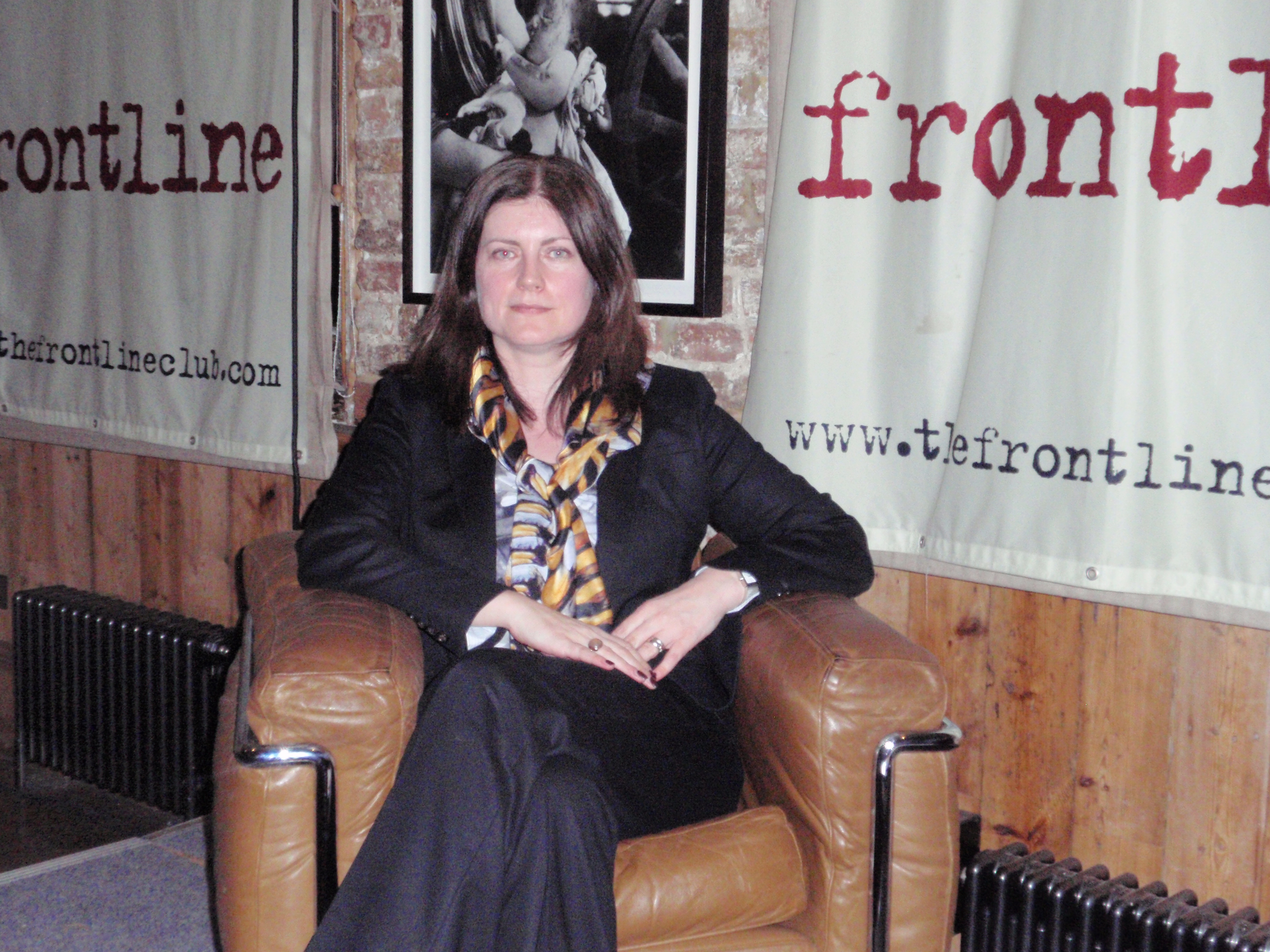
Photograph of Dr Rachel Condry by Shyamalie Satkunandan
Dr Condry said that her research had shown that this experience was actually typical of many families – who, even in the face of obvious guilt, still want to separate the crime from the person they love.
The community’s shunning of the family was also common in Dr Condry’s work.
“Often, the reason why offenders’ families are ostracised is because it is difficult to get to grips with. People think that they are condoning the act – that, in some sense, they think that the crime is okay.”
According to the film’s maker, John Kastner, after showing the film in the family’s area some people began to talk to the Jenkins. The couple also found watching the documentary to be “very cathartic”.
The discussion then turned to the motive and thinking behind such a shocking death:
“In real life there are so many grey areas. I think one of the powerful things of the film is that it leaves that question [of motive] unanswered.”
“We often think parents create their children, but this experience, of a person who commits a crime but comes from an ordinary family rang very true.”
Dr Condry said that the lengthy family visits seen in the film, which are also provided for in the US – which has one of the most punitive prison systems – would be an interesting rehabilitative means for prisoners.
“Research shows that people who have supportive families are less likely to self harm, do better, and on release are less likely to re-offend.”
Which leads to a key point Dr Condry has been a strong supporter of:
“On the point of families, their needs aren’t met by any particular government agency so they are often left on the sidelines. I would make a plea for having more policy that thinks about the needs of offenders’ families.”
]]>
The future green paper is likely to lay the ground for a special form of secret court claimed Gareth Peirce speaking at the Frontline Club last night.
Asked about a current attempt by the Government to hold an entire civil trial in secret the acclaimed human rights lawyer Gareth Peirce said she believed the promised Green Paper on national security and the courts which head of MI6 Sir John Sawers referred to in his recent press conference, would attempt to push the boundaries of secrecy further.
I don’t think [the Government] thinks there is a limit to secrecy at all and I’ll lay you odds that in that Green Paper there is some sort of template for a sceret court so if they lose in the Supreme Court on their scandalous attempt to undo hundreds of years of perfectly normal civil litigation with a tribunal of fact actually knowing the whole of the case, there will be a plan to introduce a special secret court and where the security services are the defendant in the case to push it all into secret.
The growth of the use of secret evidence and secret courts is not just not stopped, it seems to be unstoppable," said Gareth Peirce. who has represented, amongst others, the Guildford Four, the Birmingham Six, Moazzam Begg and the family of Jean Charles de Menezes.
The lawyer was talking to Afua Hirsch about her new book Dispatches from the Dark Side on torture and the death of justice in which she says Britain has a state whose "devices for maintaining secrecy are probably more deeply entrenched than in any other comparable democracy".
Referring to the corruption of legal principles and practices taking place in the prosecution of the ‘War on Terror’ and the treatment of young Muslims, Gareth Peirce said that in Britain we don’t know what we have been complicit in and may never know:
We have such a particular ability to cover up with secrecy on the grounds that it’s justified because of national security. There’s a battle that might not be won to make sure that society knows.
Gareth Peirce said that she hoped that the coalition government would act differently as so much harm was done by the previous Labour government:
It’s certainly an opportunity because so much of what was bad happened on the watch of the last government. Appallingly, so much of what we believed that was inalienable, the heritage of rights that was built up was decimated. There’s the opportunity when there’s a new regime and this regime has said some things that could be significant.
But Gareth Peirce said she was unscertain if significant change was likely. Referring to the ways that the government had got around legal blocks to imprisonment without trial she said that they always had another plan to counter it:
It just breeds bleak cynicism that whatever the legal victory there will be a plan to change it. So if the victory in the Supreme court is that there cannot be a civil court that hears secret evidence then there will be some form of legislation introducing a new experiment.
]]>
How have Facebook, Twitter and blogs changed changed grassroots politics? This was the question tackled at the club on Tuesday, at an event moderated by Deborah Bonello, founder of Mexicoreporter.com and video journalist for the Financial Times.
If you couldn’t be with us for this event, you can watch the whole thing here:
Sunny Hundal, editor of Liberal Conspiracy, cited social media scrums such as the Twitter campaign following Jan Moir’s comments in the Daily Mail about Boyzone singer Stephen Gately; complaints over a BBC World Service messageboard asking if homosexuals should be executed and the campaign to stop Rod Liddle becoming editor of the Independent as examples of how social media can be used to mobilise support on an issue.
But Mike Harris, director of the Libel Reform Campaign, said that these were "quick wins": "Social media is very effective in short term campaigns but it hasn’t converged around a single nexus in the longer term," he said. "I’m concerned that the power of the quick win comes to dominate."
His suggestion that social media would only "come of age" when campaigns were influencing the detail of legislation was disputed by Benjamin Chesterton of Duckrabbit who argued that "It goes far beyond minutiae of policy – therer are so many things beyond politics and policy that people are getting involved in."
Sina Motalebi, of BBC Persian TV, was imprisoned for 23 days in Tehran’s Evin prison and released after thousands of people signed an online petition argued against reducing "social media to our political expectations". Responding to the suggestion that Western media had over-hyped the impact of Twitter in the protests following last year’s Presidential election, Motalebi said:
]]>I don’t think it was unsuccessful in Iran.I know some Iranians are disappointed and are asking this fast-moving buzz, did it change anything? It has: it brought the exclusive power away from the media. I don’t think it can change a government but it can change some of the characteristics of a society and open things up for people whose day job is to create change.
The Digital Economy Act will allow the government to disconnect the very worst offending online piracy offenders from the internet, potentially cutting many ordinary people from an increasingly vital service.
But the act, now passed into law, was undermined by the speed of the legislative "washup" process at the end of the last Parliament and the extreme positions taken by organisations contributing to the debate, according to a member of the House of Lords who tabled a number of amendments to the bill.
Speaking at a Frontlline Club debate on the future of the Digital Economy Act, the Labour peer Lord Puttnam said that "common sense went out the window” during the bill’s passage. The film producer and former CEO of Columbia Pictures said that difficulties caused by the government’s decision to push through the Bill resulted in an “inadequate draft and no time for proper scrutiny scrutiny.
If you couldn’t be with us for this event, then you can watch the whole thing here:
Lord Puttnam said the lack of scrutiny of the bill was compounded by the hostility between rights holders and those advocating a more open approach to copyright, coupled with the failure of rights holders and internet service providers (ISPs) to agree on providing alternatives to illegal file sharing.
“Instead of a sensible thoughtful move towards 21st century copyright legislation. We had almost lunatic opposing forces. Two groups who couldn’t agree on the cash split, and another group who didn’t want anyone to be paid for anything under any circumstances.
We had to navigate our way through some sensible middle. In some respects we got there, and in some respects we patently didn’t.”
Lord Lucas, who also proposed changes to the legislation, laid the blame for music piracy at the feet of a record industry “which wants to be the way it always was”. He said copyright law is an “essentially undesirable” tool necessary to protect creative individuals and organisations, but that rights holders had failed to provide a viable alternative to illegal downloading.
However, Richard Mollet, Director of Public Affairs at music industry body BPI, disagreed, insisting there are many legal alternatives to piracy. “Let it not be said that the music industry is relying on legislation to do the dirty work because we are not providing services online,” he said.
Mollet also welcomed provisions in the Digital Economy Act for sending warning letters to those whose connections are being used for illegal file-sharing, saying the tactic would be effective in reducing copyright infringement without the need to disconnect large numbers of people.
“You’ve simply written letters and said ‘do you know there’s another way?’. That is at the heart of the digital economy act.”
Andrew Heaney, Executive Director of Strategy & Regulation for ISP TalkTalk, said ISPs do not see the debate over file sharing in purely financial terms, insisting that “it’s down to a set of principles.” However, he said the cost of licensing content from rights holders currently stops many ISPs from providing legal alternatives to file sharing.
]]>