90% of the goods we consume in the West are manufactured in far-off lands and brought to us by ship. The cargo shipping industry is a key player in world economy and forms the basis of our very model of modern civilisation; without it, it would be impossible to fulfil the ever-increasing demands of our societies.
Yet the functioning and regulations of this business remain largely obscure to many, and its hidden costs affect us all. Due to their size, freight ships no longer fit in traditional city harbours; they have moved out of the public’s eye, behind barriers and check points. The film answers questions such as: Who pulls the strings in this multi-billion dollar business? To what extent does the industry control our policy makers? How does it affect the environment above and below the water-line? And what’s life like for modern seafarers?
Taking us on a journey over seas and oceans, the newest film from veteran director Denis Delestrac (Banking Nature) reveals in an audacious and gripping investigation the many faces of worldwide freight shipping and sheds light on the consequences of an all-but-visible industry.
Directed by: Denis Delestrac
Country: Spain
Year: 2016
Runtime: 90 mins
]]>
In 2008 the Indian Government launched an initiative to train 500 million of the rural poor to work in its growing industrial sector. Migrants from the rural areas of India now make up a significant percentage of the country’s labour force.
Seduced by the opportunity to be independent, many hopeful young women, like best friends Bhanu and Bhutu, try their luck working for garment factories. As part of a wider recruitment and training scheme, these factories are monitored by mediating advocates such as British academic Orlanda. Her task is to bring in women from the impoverished countryside to Bangalore and other manufacturing centres, where she believes they can be “empowered” by the national economic boom.
Yet the women’s relative inexperience leaves them susceptible to exploitation, putting Orlanda’s capitalist optimism to the test. Documentary filmmaker Chloe Ruthven, who is also the protagonist’s sister, follows Orlanda as she and the workers are confronted with the brutal reality of sweatshop conditions and deliberate corporate negligence.
Directed by: Chloe Ruthven
Produced by: Mike Lerner
Country: India/United Kingdom
Runtime: 80′
Food Chains examines the relationship between the policies of corporate supermarket chains and the working conditions of American farm labourers who pick the produce that is distributed across the nation. Featuring Eric Schlosser, author of Fast Food Nation, and actress and advocate Eva Longoria, this award winning documentary exposes the horrific abuses farmworkers face and reveals the forces behind that exploitation: the $4 trillion global supermarket industry.
The film tracks the Coalition of Immokalee Workers, an intrepid and highly lauded group of tomato pickers from Southern Florida, as they battle the giant Floridian grocery chain, Publix. Their story is one of hope and promise for the triumph of morality over corporate greed – to ensure a dignified life for farmworkers and a more humane and transparent food chain.
Food Chains was nominated for a 2015 James Beard Foundation award for food journalism.
Directed by Sanjay Rawal
Producer: Eric Schlosser
Executive Producer: Eva Longoria
Duration: 86′
Year: 2014
Among the world’s poorest countries, Bangladesh is also rapidly developing. Mass migration from villages results in densely populated slums and crowded factories. Across the country, 7.9 million children work every day to support themselves and their families, forced to grow up at an incredibly early age.
Filmmakers Hannan Majid and Richard York follow 20 year old Nasir who moved from a rural village to the city. As a child he worked in rubbish dumps and sweatshops, before eventually realising his dream of getting an education. Today, he tries to convince children of Dhaka’s Korrai slum to enrol in school for a better future. Mass E Bhat is a portrait of a developing nation through the eyes of its children.
Directed by Hannan Majid and Richard York
Duration: 72′
Year: 2014
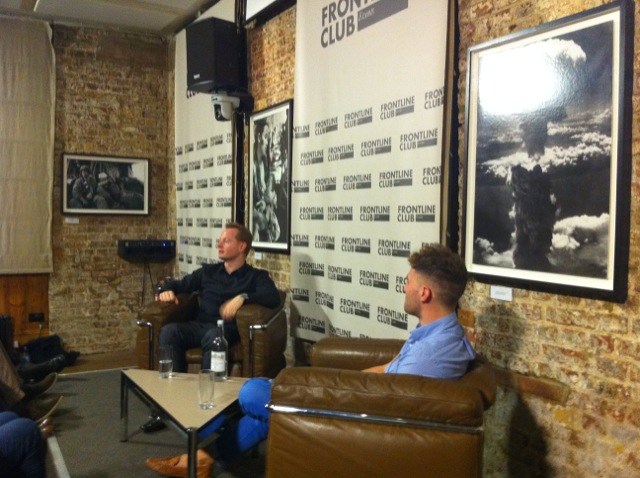
By William Turvill
Dubbed the “documentary of the year” by The Guardian, this film follows the campaign trail of Walsh, a “disillusioned Labour Boy gone stray”, as he attempts to dethrone Labour’s Sir Stuart Bell as MP for Middlesbrough.
Although the film originally started out with a focus on Walsh, by the end all attention seemed to be on Bell, an audience member pointed out after the showing. “Yes,” said Walsh. “This was originally going to be a short 20-minute documentary on me becoming a Tory boy, but there was an organic change and I turned from a politician into an investigative reporter looking into Sir Stuart.”
“On paper, winning seven elections in a row, Bell is the Alex Ferguson of Labour politics,” he explained, “but, as the film demonstrates, Bell is a terrible MP, and I’d be very surprised to meet a worse one."
Bell, the documentary reveals, seems to spend more time in Paris than in his constituency, he is unheard of or unpopular with locals, and yet, he has now been elected seven times. How much of a role has party tribalism- blind devotion to the Labour Party – played in this, asked an audience member.
“We found a lot of people, when you mentioned the Conservative Party, would aggressively refer to Thatcher,” said Walsh’s colleague Cowen, who played a very active role in the campaign. “Maybe in 15 to 20 years time, it will be the same thing with the Labour Party being associated with Blair and Brown. One bad egg can tarnish the reputation of a party for a generation.”
Despite Bell’s Labour status hindering political progress for Walsh, the ToryBoy admitted that Sir Stuart’s presence certainly added a good story to the documentary. Although not able to make an impact as an MP, Walsh is confident the film can help make a difference to Middlesbrough and was pleased to say that some good had already come of it.
“It took a while to produce the film, but local and national awareness has been generated,” said Walsh. “For instance, a local journalist, following a local screening of the film, attempted to get hold of Bell regularly over a 100 day period, and then heavily reported on his failing to do so. Then, on a national level, The Independent named Bell ‘Britain’s laziest MP’. So progress has been made – people have started to realise how damaging over-protected MPs can be for democracy.”
This was just one screening of many, but, according to Cowen, the chance to screen the film at the Frontline Club was “hugely pleasing”, and said “it was nice to get some in-depth questions from a well-informed audience.” Walsh added: “It was a real honour to be invited to show the film at such a prestigious venue.”
]]>Ross Perlin, an ex intern himself and the author of Intern Nation will be at the Frontline Club to take part in a panel discussion about internships and his investigation into a trend which, he argues, is destroying "what's left of the ordered world of training, hard work and fair compensation".
]]>The explosion of the internship in the past 10 years has begun to raise some serious questions about the implications for a generation expected to work wage-free in order to move onto the career ladder.
Ross Perlin, an ex intern himself and the author of Intern Nation will be at the Frontline Club to take part in a panel discussion about internships and his investigation into a trend which, he argues, is destroying "what’s left of the ordered world of training, hard work and fair compensation".
This issue was highlighted in early February when it was reported that a selection of prestigious internships at major City firms, media outlets and PR companies were auctioned off to party donors at the Conservatives’ annual Black and White Party.
Are internships for the privileged, and to what extent are those professions where intern experience is compulsory now closed off young people from lower income families?
Or with no framework in place to protect their rights, is the internship a money-saving system for businesses, formalising the exploitation of young people by requiring them to do jobs that would otherwise be paid positions and work long hours without pay?
Join us at the Frontline Club to discuss the world of the intern and the culture of work.
Chaired by Martin Bright, political editor of The Jewish Chronicle and founder of New Deal of the Mind, an organisation which aims to boost employment in Britain’s creative industries. In 1996 he was appointed education correspondent at The Observer, where he also worked as home affairs editor, in 2005 he became political editor of the New Statesman, a job which he left in January 2009.
With:
Ross Perlin, former unpaid intern and author of Intern Nation: How to Earn Nothing and Learn Little in the Brave New Economy, he is now gainfully employed researching obsolescing languages in China;
Fiona O’Cleirigh, freelance journalist and vice-chair of the London Freelance Branch of the NUJ. She set up the NUJ’s Cashback for Interns campaign, to help unpaid media interns sue former employers for the National Minimum Wage. The union has recently won its first intern’s National Minimum Wage case at London Central Employment Tribunal;
Andrew Scherer, marketing manager of internship agency Inspiring Interns, having started at the company as an intern and has seen almost 900 graduates find placements through Inspiring Interns. Currently completing a guide to internships to be published in the autumn.
Dupsy Abiola, founder and CEO of Intern Avenue, Oxford Alumni and former employed barrister. Intern Avenue hosts the world’s first Intern Directory™ and connects interns and employers by automatically matching them via their objective criteria.;
Dom Potter, co-founder of Internocracy, the youth-led social enterprise which works to lower the barriers and raise the bar in internships. Former intern he has since found work with the OECD, Involve and the Young Foundation. He is also a Trustee of TimeBank, a Fellow of the RSA and was Future 100 Young Social Entrepreneur of the year in 2009.
]]>
What is it to endorse and vote Labour? Principally, it is to vote for the party of cosying up to the banks and super-rich in order to bestow on them fabulous wealth at crippling public expense, and create the widest gap between the richest and the poorest since the early 1960s. It is to vote for the party which took Britain vaingloriously into an illegal war on the basis of a pack of lies. It is to vote for obsessive authoritarianism and survelliance of a bludgeoned, stressed out one-nation-under-CCTV. It is to vote for the overpaid civil servant, for education cuts and tuition fees, bumper bonuses and bank bailouts. It was under a Labour government which promised to eradicate child poverty that London won the Olympic games: but in the Olympic city, 19 per cent of children now live below the poverty line. Under such circumstances, one would expect the Conservatives to be romping home with the same incomprehensible public euphoria that propelled Tony Blair to power 13 years ago. But, after their initial spurt in the polls, not even Labour’s wreckage seems to be able to muster much enthusiasm for the Bullingdon Tories. The true-blue base will of course turn out as usual. Many will transfer from Labour in pursuit of novelty value or out of lack of imagination – and a few even more desperate liberals will be voting Eton, after visions of David Cameron reigning in the City, calling off the bailiffs, dismantling surveillance cameras, curbing energy prices – and just generally getting the trains they privatised into becoming the worst and most expensive in Europe to run on time. What a rude shock awaits them: for what is a vote for the Conservatives? The launch issue of Frontline last year carried an article called ‘Looted Britain’, about the smash-and-grab of this country’s ‘Family Silver’ as Harold MacMillan called it, by an oligarchy of free-market zealots both Labour and Conservative. Perhaps there are enough people who remember that to vote Conservative is to vote for the destruction of the country’s proud manfufacturing base (of a kind kept by the Germans and French), the sleazy sell-off of those utility companies and railways in the first place and the prospect of losing the little that is left of infrastructure in Britain.
Some might be tempted to flee to the Liberal Democrats, who can afford to appear as angelic as they do because they have never had to govern and never will, since the two so-called ‘main parties’ have stitched up the electoral system to ensure just that. They might well, however, hold the balance of power. This third party is best judged not by what it promises it could never do in government, but what it does in local government, when it gets the chance to give us a glimpse of its real self. On Merseyside, the Lib Dems have supervised the wholesale demolition of a city, to build a vast, white elephant shopping mall. On Tyneside, they have similarly packaged a downtown showroom while failing utterly to rennovate the ragged edges. In Southwark, the party is so adept at managing public housing that a crowded block of flats lethally caught fire through negligence, while anyone trying to live on water along the Thames is extorted and threatened into homelessness. The Lib Dems have a European vision, but no record at local level to qualify them nationally and little national credibility since Paddy Ashdown’s leadership.
A vote for a minor party may be a tempting option for various communities: environmentalists (The Greens), fascists (BNP), nostalgics (Scargill) or ridiculous little-Englanders (UKIP). But even more than for the Lib Dems, the system is rigged so as to rob anyone so inclined of even the voice one might enjoy in another country.
The MPs’ expenses scandal, and its minimal impact on the political class, helps to demonstrate what kind of political parties now claim newspapers’ endorsements and public votes. The political class demonstrated that it acts as a body, in its own interests and its own interests only. To behold the parties strut their mediocrity – in Parliament, on ‘Question time’ and in the embryonic hustings – is an insult to the people in a time of recession and crisis. They demonstrate no more than that the differences between them are ersatz and non-existent, and that none are capable of meeting the challenge of rebuilding this battered, looted country.
Frontline considers that for a publication to endorse any political party at this election is to demean itself, and that for citizens to flatter any party with a vote is to demean themselves. There may come a time – but it is unlikely – when “None Of The Above” is an option on the ballot paper, as it is in some countries – and were that option to exist now, it would probably be the number one choice. There may even come a time when the parties reform themselves and cease to dumb down the discourse and with them the country. But until they do, there is nothing honourably to do but vote for a devolutionary or separatist party in Scotland or Wales, a party comitted to peace in Northen Ireland, an independent in England, or – rather than stay at home – spoil the ballot, with humour or otherwise.
]]>