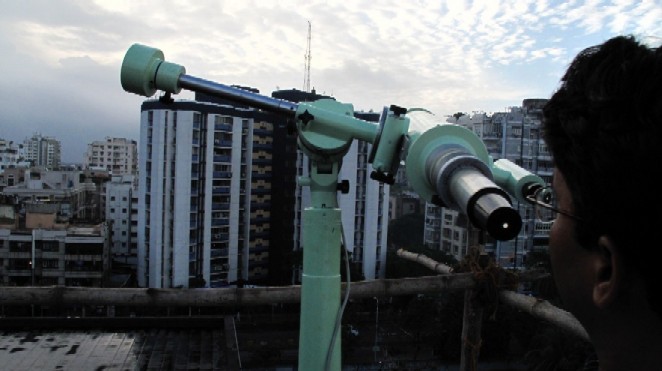
A telescope scanning the Kolkata skyline early on Wednesday (Photo: Devjyot Ghoshal)
The dichotomy that rests within a modernizing city with an ancient heart came out of the shadows early on Wednesday as thousands strove to catch a glimpse of India’s final total solar eclipse for another century to come. Science and superstition held their own across their respective constituencies in Kolkata, though there was a shared animosity towards the weather gods for dispatching an errant cloud cover that hid the sun through much of the eclipse.
Atop the Birla Industrial and Technological Museum, a small army of school students stared intently at the skyline through their instruments. Chaperoned by teachers and museum personnel, there was little enthusiasm lost throughout the dawn vigil, despite only occasional viewing of the celestial spectacle. Amidst instructions to use protective gear and short discourses on the specific phases of the eclipse, applause erupted every time the shadowed sun made an appearance.
Completely enveloped by scientific conversations, the cultural and religious manifestations of a solar eclipse were lost on this gathering of stargazers. "The superstitions surrounding eclipses are completely rubbish. Not only do they lack any scientific validation, but I wouldn’t miss this once-in-a-lifetime opportunity for anything in the world," class XII student Pranik Basu asserted.
Alongside him, Swagato Roy, another final-year school student, casually added: "All of those myths are bogus."
Of the older generation present, too, there were few takers for the ancient traditions that are connected with such specific celestial occurrences. "When I was pregnant with my daughter, my family wouldn’t allow me to watch the eclipse for the fear of harming the fetus. Despite their best efforts to keep me indoors, I sneaked out and saw it. As it happened, my daughter was born just fine," school-teacher Ranu Datta revealed.
A few kilometers away from the scientific citadel, at Chandpal Ghat by the Hoogly river, myth and ritual dominated all else. Between chanting, bathing and rites, the spiritual gravity of the eclipse lay bared.
"This is a time of great significance and shouldn’t be easily disregarded. My family and I haven’t eaten anything since last evening. We’ll break our fast after bathing in the river and praying," D A Sharma, from Chennai, explained.
Standing by the clay coated stairs of the ghat, housewife Laxmi Saha spoke of certain traditions that she continues to strictly follow.
"I don’t cook anything during an eclipse and I always leave a tulsi (holy basil) leaf in the leftovers, as the food spoils otherwise. We also don’t eat during this time and the clothes worn now must be washed properly before being used again," she asserted.
"And pregnant women, especially, should ensure that no sunlight touches their body during a solar eclipse. It can deform the child," she added after a short pause.
Under a darkened sky, one city told two very different tales about a single shadowed sun.
]]>
I have wanted to write about Sonagacchi since I moved back to Kolkata for one reason: in a country where morality is all pervasive, here exists an isolated world, centuries old, which has lived and grown with India’s democracy.
In the beginning, Sonagacchi — literally ‘The Golden Tree’ in Bengali — was where the city’s well-to-do gentlemen housed their mistresses during the days of the British Raj. Today, it has transformed into a massive red-light district; the once grand mansions converted into tiny flats which are rented out to the women who ply their trade there.
I went to Sonagacchi last week, with my colleague Sumati Yengkhom of The Times of India as my guide and guardian, to see for myself what life there is like. More significantly, though, I went there to try and understand what matters to the women there, a week before the district, along with large parts of the country, went to the hustings.
This elections, the electoral discussions in West Bengal has been dominated by the withdrawal of the Tata project from Singur — where the cheapest car in the world was to be produced — and the violence over land acquisition that rocked Nandigram in 2007.
In Sonagacchi, I discovered that very little influences the women there except for the trials and tribulations of their daily lives.
Filth and feces that line the narrow lanes of Asia’s largest red light district come close to overpowering the senses. But with a mere handful of sex-workers wandering about this early in the afternoon, it is the poll paraphernalia that squarely catches one’s attention in Sonagacchi.
The ubiquitous wall graffiti, custom-designed flex posters and an array of party flags breathe life into the squalid dank alleyways. Under tall, dilapidated buildings that come together crowding the narrow sliver of sky above, a group of sex workers sit nonchalantly. With her back against a bright poll graffiti, a middle-aged woman talks after a little persuasion.
"We have no interest in party politics. All I care about is who will do the most for the women who ply their trade here, their children and families. My vote will go not to those who merely hear our demands, but those who do something about them," she says. The unfulfilled promises of many an election evident in her terse tone.
Squatting beside the dark fetid waters that rise out of ancient drains, another woman, with a sharp streak of vermilion on her forehead, speaks in clearer terms. " Nandigram and Singur have little resonance here. We are women who live and work here. We need to think about our lives. No other issue will dominate the voting," she declares through her betel-stained teeth. Those that sit around her nod in agreement.
Singur might not sway the votes of the scarlet women of Sonagacchi, but they are anything but reluctant to exit the electoral loop. Indeed, it is this determination to honorably cast their ballots that has driven ‘Durbar’ — the local sex workers forum — to procure voters identity cards.
"There are 9,000 sex workers in Sonagacchi. Although most of them have their names on the voter list, barely 10% have voter identity cards. That is why we approached the Election Commission and, so far, we have been able to get about 300 new cards issued for sex workers residing here," Durbar’s project director Bharati Dey revealed.
The number of new voter identity cards might yet be disproportional to the actual population here, but the very fact that sex workers — who have little or nothing in the way of legal documents to prove their identity — are been officially given the mandate to vote, is igniting interest in the hustings.
But mere interest will not be enough to avoid illegitimate voting on May 13, when the approximately 11,000 adult franchise holders of Sonagacchi will queue up to vote. The red light district, unfortunately, has a history of unregistered voters casting their ballot in large numbers.
"During every election, the party cadres come and take our girls to vote even though they don’t have voter cards. Sometimes their names aren’t even on the list. Yes, more girls have cards this time, but this will still happen. We are just asking them not to vote more than once this time," a sex worker at Durbar disclosed, while labouring on her Bengali alphabets.
Outside, the narrow lanes begin to fill as the twilight deepens. As numerous gaudily-painted women descend for a night of work, few are in the mood to answer questions. "I am a citizen of this country too. Card or no card, I will vote. There’s nothing more I have to say," one dispatches sharply. The neighbor shouts loudly in agreement through a grilled window. Now is not the time for talk.
Here in Sonagacchi, where the world’s oldest profession will shortly confront the world’s largest democracy, the poll rhetoric that has engulfed Bengal holds little weight. It is the local ground realities that matter here, not the small car which never drove out of Singur.
This story appeared in The Times of India, Kolkata edition, on May 11, 2009.
]]>