I never thought about making money when I set up Kigali Wire. From the beginning it has always been an experiment and it remains so. I never thought about making money when I shot my first photojournalism essay – which is in dire need of an editor’s hand… forgive me, it is my first bash at the medium. And I never think about money when people use my stuff. So, why am I thinking about money now?
Because, I reckon I stand to make more money on by-products than I (probably) ever could from straight journalism. Since doing the photojournalism essay, I’ve received the following enquiries:
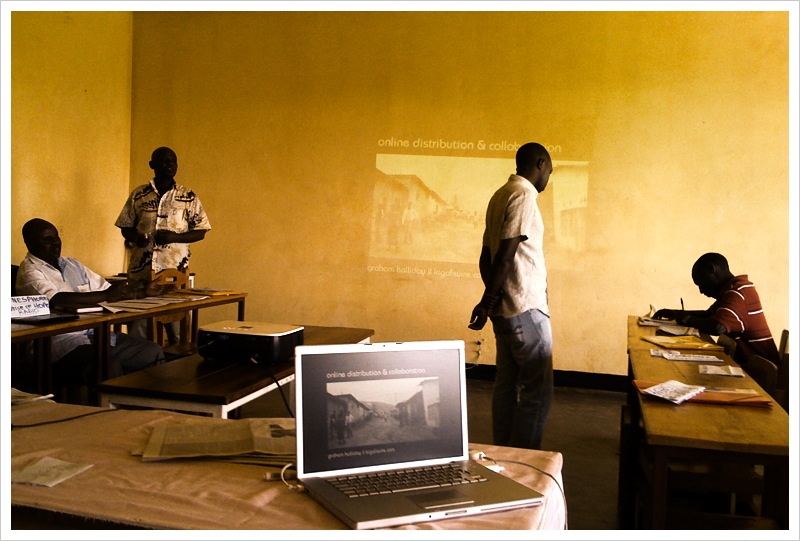
– 5 invites to give paid talks – that’s me above, about to give one of them in Kigali.
– interest from a major newspaper in commissioning an edit of the piece.
– interest from a couple of NGO’s about doing similar photojournalism pieces on a commission basis.
That’s almost $2,000, even if the latter two don’t come off. All the tools I use are cheap. All the digital tools I use are free or low cost.
I’m beginning to hope think it might be sustainable to do the stories I want to do, in the way I want to do them, if I keep in mind that by-products are the only earner. And if I get more creative in what by-products I come up with.
This is something Vaughan and I have talked about loads over the years – maybe one day we’ll unveil our world-beating chip van model for the future of journalism... And I’d say this kind of thinking is at the core of what the Frontline Club stands for.
Of course, this isn’t new, but – in these utterly grim times for old media – thinking along these lines might offer a glimmer of hope for any would-be freelance journalists out there. And it deffo plays into the whole how to be a foreign correspondent thinking some of us talked about recently. To make this work best, I reckon you still need to…
go somewhere cheap. And odd. The odder the better. link
Photo taken from my personal Flickr account
]]>Former foreign correspondent Thomas Crampton talks to Eric Weiner, another former foreign correspondent, about his thoughts on the 10 career options left for foreign correspondents. As media giants crumble and budgets for "the old way of doing things" no longer exist it’s a timely (and funny) 10 minute chat. I’m guessing option number 5 – "Public Relations" is proving to be the most popular for all journalists, not just foreign correspondents, purely for economic reasons, but…
"Deep down, in your heart of hearts, you know, you’re just a flack" link
However, after several years of media training for the Frontline Club, the BBC, Al Jazeera and others, it looks as if I’m heading yet deeper towards two of the other options. Firstly, option number 4 – "The Professor".
I won’t quite be a professor, but I will be training Rwandan journalists here in Kigali, where I moved with my family one month ago. I’ll be trying to impart a little of what I know and hopefully learn a fair bit of what they know about journalism.
I’ll be working part-time on a USAID funded programme in association with the Rwanda Initiative, a Canadian media NGO based in the Rwandan capital. I’ll have around 5-8 journalists per month, from radio, newspaper and TV, and I hope to learn a bit about what they do, how they work and where they work.
This shouldn’t take up more than a day or two per week, which leaves me plenty of time to desk-based research work, schedule training overseas with a little left over for option number 10 – "Digital".
I’ve handed over the bulk of the online end of Frontlineclub.com to the very able Charlotte Cook. And finally, instead of writing about journalists working on the frontline, I get to be one. Almost. I’ll be blogging for Frontline about life in Rwanda and I’ll be launching my Kigali Wire news/blog site in a week or so
You can follow me on Twitter @kigaliwire and if you’re really keen (and you’ve read this far) you can learn about the process behind building Kigali Wire which will possibly form part of the training I’ll be doing here in Rwanda.
Press accreditation in Rwanda currently costs $1,000 per year for foreign journalists, but it looks like the fee might come down to a more freelance friendly $300 in the near future. As and when it does, I’ll look at getting accredited and adding a bit of Eric Weiner’s option number 1 – "The Journeyman" – to my portfolio of jobs.
So, please stay tuned. And, if you’re passing through Kigail – do let me know.
]]>