On the day the 2014 Academy Awards Nominations were announced, the Frontline Club hosted a screening of The Square. After winning the Audience Award at both Sundance and the Toronto International Film Festival, the film is now in the run-up for an Oscar for Best Documentary Feature.
The Square portrays the Egyptian revolution and some of its passionate activists, including British–Egyptian actor and filmmaker Khalid Abdalla (The Kite Runner, 2007), who was present for a Q&A together with cinematographer Cressida Trew.


Documenting from the early days of Egypt’s uprising against Hosni Mubarak to the aftermath of Mohamed Morsi’s ousting by the military, American–Egyptian director Jehane Noujaim’s film follows ‘revolutionaries’ Abdalla, Ahmed Hassan and Magdy Ashour as they live, and fight, through three years of revolution.
Coming from three generations that have been fighting for political reform in Egypt, and with his father in the audience, Abdalla explained he finds it problematic to answer questions about “what does now tell us about where we are going”. In response to a question about the current situation, he said he would rather look at what is moving people and what this can “tell us about where we come from and where we are headed”.
The film’s delivery was almost as problematic as its production. According to Abdalla and Trew, the documentary had several cuts because of the tumultuous and constantly changing events taking place. On her way to the film’s premiere at Sundance, director Noujaim realised events were unfolding in Egypt, that had to be included. The Square is now in its third cut.
“We had terabytes of footage,” said Trew, who said she joined the production team when she met Noujaim in Tahrir Square.
“It’s textbook on how you should never film a documentary.”
She explained filming the documentary was a very collaborative effort, with only little direction because of the constantly shifting and unpredictable events.
“We were bobbing around on this massive tide, this sea change. All you could do is follow your guts,” she said.
She added that it was the first time she had seen that version of the film.
Abdalla said that despite the struggle and unpredictable nature of Egypt’s revolution he was determined to continue the fight for change.
“At no point of the story did we know what the story was,” he said.
“We’re going through a massive shift. It’s possible that things will die down, but for this kind of stability that is fetishised you need the circumstances that ignited this revolution to go away.”
“As long as I’m not certain that in six to eight months time the balance of power won’t be the same as it is today, then we’ll be living in a revolution.”
“The Oscar [nomination] is great, it’s great that it might be able to be seen in Egypt,” said Abdalla, referring to the fact that that the film has yet to have a public showing in the north African country. The 2014 Academy Award winners will be announced on Sunday 2 March.
The film is now available to view on NetFlix. To stay up to date on the developments on the film, follow them on twitter, find the film on facebook or go to the film’s website.
]]>Mohammed Mursi has become Egypt’s first democratically elected president – but while he may have been chosen as the people’s representative, the country still has to contend with the powerful Supreme Council of the Armed Forces (SCAF), who may thwart any attempt at change. The panel was divided over Mursi’s ability to bring the country together and to pursue the desperately needed reforms to security, the economy and the political landscape.
Dr Maha Azzam from Chatham House and Dr Omar Ashour from Exeter University were both concerned by the enormity of the task faced by Mursi. But they remained hopeful that he would succeed in moving away from a military dictatorship so long as he could mobilise popular support. They both argued that his democratic mandate was already a major political and institutional step in the right direction, however he faced challenges in steering the institutions of state away from the shadows of Mubarak’s regime.
Tariq Ramadan from Oxford University struck a more pessimistic note, arguing that Mursi’s election was nothing more than a symbol behind which the military continued to govern. The panel seemed to agree with his claim that the military had their finger on the ‘reset button’, and could reverse democratic reform at any moment.
Khalid Abdalla, a British-Egyptian actor, producer and activist also suggested that the political transition was more symbolic than real, and that military were still ‘writing the rules of the game’. However he passionately argued that the greatest change occurred in the hearts and minds of the people: they were no longer afraid, and would continue to challenge the military – a point upon which all the panel agreed.
Carina Kamel, a senior correspondent for Al Arabiya drew attention to the loss of trust suffered by the Muslim Brotherhood, and argued that it was a divisive force in Egypt – making it even harder for Mursi to govern. Her claims split the panel, underlining the uncertainty surrounding the Brotherhood’s ability to govern and stand up to the military. She then rounded on Egypt’s economy, its dire state and the extent to which it was controlled by the Generals – further undermining Muri’s mandate.
The panel were united in their analysis of external influences on Egypt. They agreed that in the past the US was never far behind Egypt’s military, but warned that their influence could decline as Egypt sought to forge new links with emerging powers.
The audience made incisive interventions, drawing attention to the struggle of women under an Islamist government, the tendency for military regimes to endure, while pushing the panel to talk more about Egypt’s economy and its relations with the military.
Watch the full event here:
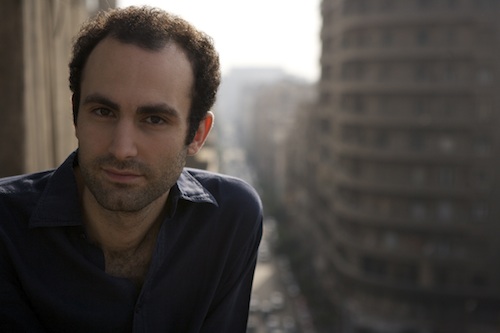
British-Egyptian actor and producer Khalid Abdalla flew from London to Egypt soon after it became clear that the protests of 25 January were gathering momentum and was there for the Friday ‘Day of anger’ on 28 January.
The Kite Runner star, whose other credits include Green Zone and In the Last Days of the City, was memorably interviewed from Tahrir Square by Channel 4 News’ Jon Snow while his father Hossam Abdalla was in the studio.
The co-founder of Zero Production, a film and documentary production house based in Cairo is currently setting up a non-profit media centre called Mossireen (Adamant) to support filmmakers and citizen journalists through the revolution.
Like everyone in Egypt I did not expect anything to happen like in Tunisia
Tunisia, it felt to me, had massively rejuvenated the narrative of popular protest in the Middle East, but having filmed almost every protest in Cairo over the last two years as part of an independent film called ‘In the Last Days of the City’, I thought Egypt’s watershed moment was a while away.
I discovered I was completely wrong at about 5pm, on a phone call to a Lebanese friend who asked me if I’d seen the images of Tahrir. It wasn’t until the following afternoon that I felt the full force of what was coming.
The images of Tahrir being dispersed and news of my friends continuing their protest through to 6am in Shubra was heartening. It was the shock of protests continuing the following day that made clear to me that this time was different. I’d seen plenty of demonstrations in Cairo and faced a minor arrest once. I’d never seen demonstrators take on the authorities no matter what, directly in the line of fire.
I booked my plane knowing that Friday would make or break the movement
From that moment I became a protester and an activist. Prior to that I was neither a blogger, nor a political activist, I had no Facebook account, and I dreaded the idea of Twitter. I had on the other hand been a filmmaker and actor working in the alternative scene in Cairo. Which is to say that the fight for a new Egypt, in my opinion, is not and was not just a political one.
It is a movement spearheaded by everyone who was willing to make a personal sacrifice of whatever kind to create their own version of Egypt, against and despite Mubarak’s regime as it was, and sadly, still remains.
Prior to 25 January I couldn’t bear the idea of new media in my life
Being ‘followed’, or sought as a ‘friend’ was not something I wanted because my privacy was important to me, not to mention the fact that even with a smartphone addiction, I suffered from a regular email backlog that made me guilty enough.
When the revolution came, it became clear that social media was a way for me to join the dots. It took a while because within hours of my arrival in Cairo, all forms of communication had been cut.
Social media helped manage the balance of access to truth
The need to bear witness and share opinions in a political context in which the voice of the majority is opposed by the lies of state media at worst, and the economic interests of commercial media at best, means free social media is essential.
Without the myriad of bloggers and individuals using Twitter, Facebook, and YouTube, fighting alongside high quality reporting made by respectable journalists across all forms of media, the media war in this revolution would have been lost.
I joined Twitter and Facebook because it became clear to me that they were the best tools I had as an individual to access and benefit from as many people as possible. It was also an opportunity to do my bit in trying to convince others to protest or at least let them share in my thoughts.
In my opinion, the power of new media has been both over and under-estimated in its importance to what happened in Egypt. Under-estimated as a source, over-estimated as a mobilising force.
The Facebook generation did not create what happened in Egypt
A second and third generation of political activists used social media as an important tool in a heavily weighted fight that was only counterbalanced when consensus on the street about an unjust regime became fearless. Tunisia broke the back. Social media helped the frenzy build in the run up to 25 January and fought as best it could against the state media afterwards.
But it was the spirit of generations of activists, demonstrators, workers and unions fighting as a shunned minority, under the most difficult circumstances, that meant a flame remained to light the fire when the time came. Mubarak’s idiocy, alongside that of his regime’s, was a big help too.
As we look forwards, the current situation puts into context both the power and limitations of new media. Despite the many gains won by the 25 January movement, the regime still stands, for the moment.
New media has temporarily lost the power of its audience
Consensus doesn’t exist anymore about anything – strategy, parties, the army, even torture. With the movement having lost the power of consensus, Facebook has lost its ability to draw primetime audiences, if you like. Meanwhile, the state remains in the hands of the regime and its interests (at home, and abroad), and most people are worrying about how to feed their families.
It is the army that hangs in the balance
From the very beginning they have had to choose between the millions that rose up, and the regime and its interests. Whenever they have chosen to be an obstacle to people’s demands for social justice, civil liberties and democracy, they have been met with an outcry that has forced them to give ground, and threatened to turn them into a target.
If they continue as they are, torturing, putting civilians on trial in military courts, banning protest and not bringing heads of the former regime to justice, I’m convinced that revolution stage two will come. An unstoppable force was unleashed on 25 January, in a just cause.
The present challenge is to organise ourselves
That is starting to happen. The losses our movement has incurred have been on account of our inability post-February 11th to act in unison, with clarity of purpose. Once we have achieved that, finishing this will be a matter of months, if not days.
]]>Screenings in the week ahead include Victory Day, a portrait of journalism and crime in Russia; a special preview screening of Armadillo following young Danish soldiers stationed in Afghanistan and Granito, documenting the search for justice in Guatemala
Next week’s third party event will be examining the tools of the modern media age. We will be annoucing the subject of April’s First Wednesday discussion tomorrow.
And don’t forget our Club Quiz tonight – enter as an individual or as a team of six for an evening of entertainment hosted by David Dickinson.