The film is divided into six chapters, with the first two focusing on the kidnappings and murders of countless women in the Mexican cities of Juarez and Ecatepec. From there, the film reveals that these abductions go further; journalists, union leaders, social justice activists and priests are among the many victims of cartel-related violence. The most damning parts of the documentary come when the federal and state governments’ involvement in these atrocities is revealed.
An audience favourite, Elie’s beautifully shot and original film has won numerous awards including the FACT:AWARD at CPH:DOX 2019, Grand Prize for Best Canadian Feature at Montreal International Documentary Festival 2018 and Audience Award & Special Mention at FICUNAM 2019.
The screening (duration: 152′) will be followed by a short Q&A with the director, moderated by award-winning filmmaker James Jones.
Speakers
Julien Elie made his film debut in 2002 with The Last Meal, his first documentary about the death penalty in Texas. Several years later, after many travels in Mexico, he decided to do a film about the surge of violence in this country. Dark Suns is his first film in fifteen years.
]]>
The Frontline Club will be hosting the first RISC (Reporters Instructed in Saving Colleagues) training course in the UK. The four-days of training will end with a Group Show that is open to everyone on Wednesday 9 October at 7pm, to register to attend see HERE.
RISC offers a four-day course in emergency medicine to freelance journalists working in dangerous areas. The course is completely free for qualified journalists working in all media – photography, print, radio and video. RISC covers instruction fees and accommodations (if needed). Each graduate is provided with a comprehensive medical kit to take with him or her back into the field.
RISC is a nonprofit organisation based in New York City. It was founded by journalist Sebastian Junger after the death of his friend and colleague, Tim Hetherington, in Libya in 2011. Hetherington’s wound, though very serious, may not have been fatal had one of the journalists or rebels around him had the right medical training. Surviving a gunshot or shrapnel wound is often a matter of doing the right thing in the first few minutes, and RISC training focuses on that brief, critical period of time.
]]>Throughout June, in association with BBC Persian, we will be joined by experts, journalists and commentators to make sure you are up to date with events in the country. We will be offering a portrait of outgoing President Mahmoud Ahmadinejad, analysing the candidates and, following the election, we will be asking what the result means for the future of the country.

Sneak Preview BBC Persian screening: Ahmadinejad – The Populist and the Pariah
Monday 3 June 2013, 7:00 PM
The screening is organised by BBC Persian Service.
Since his election in 2005, Iran’s President Ahmadinejad has become the most well-known Iranian since the founder of the Islamic Republic, Ayatollah Khomeini. Produced by the BBC Persian Service, this documentary looks at the rise of Ahmadinejad and explains how this provincial politician with a PhD in traffic management became a personality to be reckoned with.
Followed by a panel discussion with: Sadeq Saba, head of BBC Persian; Bozorgmehr Sharafedin, filmmaker and journalist and Kasra Naji, special correspondent for BBC Persian TV.

First Wednesday: Who will be the next president of Iran and why does it matter?
Wednesday 5 June 2013, 7:00 PM
On 14 June Iranians will go to to the polls to vote for a president to replace Mahmoud Ahmadinejad, but what significance does this election hold? Join us to analyse the approaching election, the main players and what the result will mean for the future of Iran. With: Kelly Golnoush Niknejad, founder and editor-in-chief of the award-winning Tehran Bureau; Roberto Toscano, Italian Ambassador to Iran (2003-2008); Saeed Barzin, Iran analyst with BBC Persian Service and the BBC Monitoring service since 2006; and Roger Cohen, a journalist, author and op-ed columnist for The New York Times.

Iran after Ahmadinejad
Wednesday 26 June 2013, 7:00 PM
Following the presidential election in Iran, we will be bringing together a panel of experts to deliberate the results and what they mean for the future of the country. In association with BBC Persian Service, we will be taking an in-depth look at Iran’s new president, exploring his affiliations and policies both at home and internationally. With: Mark Fitzpatrick, director of the Non-Proliferation and Disarmament Programme at the International Institute for Strategic Studies (IISS); Saeed Barzin, Iran analyst with BBC Persian Service and the BBC Monitoring service since 2006. Additional speakers to be confirmed.
In association with BBC Persian:

https://soundcloud.com/frontlineclub/first-wednesday-who-will-be
On 14 June Iranians will go to to the polls to vote for a president to replace Mahmoud Ahmadinejad, but what significance does this election hold? Iran’s Guardian Council has approved eight candidates from the list of more than 600 hopefuls. Two notable exclusions were leading contenders Ali Akbar Hashemi Rafsanjani and Esfandiar Rahim Mashaei.
We will be joined by a panel of experts to ask if these disqualifications signal a demise of hope for peaceful change in Iran and a move towards absolute dictatorship. What does this mean for the reform movement?
Join us to analyse the approaching election, the main players and what the result will mean for the future of Iran.
Chaired by Martin Fletcher, former assistant editor and foreign editor of The Times. He covered the 2009 presidential election in Iran.
The panel:
Kelly Golnoush Niknejad is founder and editor-in-chief of the award-winning Tehran Bureau, which is hosted by the Guardian. She is also the inaugural recipient of the Innovator Award from Columbia Journalism School for “inspiring, creating, developing, or implementing new ideas that further the cause of journalism”.
Roberto Toscano was the Italian Ambassador to Iran for five years (2003-2008). As a career diplomat, he has served in a number of other posts (India, Chile, USSR, Spain, United States, as well as at Italy’s Permanent Mission to the United Nations at Geneva). He is the author of books and articles on human rights, peacekeeping, conflict prevention, ethics and international relations.
Saeed Barzin has been an Iran analyst with BBC Persian Service and the BBC Monitoring service since 2006. He has written extensively on Iranian politics, media and society for general audiences, internal BBC customers and UK government officials. Over the past 15 years he has written for a number of current affairs journals and has published several books, including the Political Biography of Mehdi Bazargan which was among the top ten best-selling books in Iran in mid 1990s.
Roger Cohen is a journalist, author and op-ed columnist for The New York Times. He joined The New York Times in 1990 where he was a foreign correspondent for more than a decade before becoming acting foreign editor on 11 September 2001, and foreign editor six months later. Since 2004, he has written a column for the International Herald Tribune and 2009 he was named a columnist of The New York Times. He is author of Hearts Grown Brutal: Sagas of Sarajevo and Soldiers and Slaves: American POWs Trapped by the Nazis’ Final Gamble, he has also co-written a biography of General Norman Schwarzkopf, In the Eye of the Storm.
This session is in association with BBC Persian Service.
By Nicky Armstrong
Half way through the film the ripple effect that war has on journalists and the stresses that leak out from being present at such horrific moments in people’s lives are laid bare for the audience to see. The question of morals, as well as dealing with your own problems and family life back home seem to be put to the back of the reporters minds; the job in hand is their only real focus at the time. But these problems cannot be ignored, and the psychological cost of covering a war really becomes apparent.
PTSD (Post Traumatic Stress Disorder) is a repetitive premise throughout the film. The reality of dealing with war once you are out of combat is a different task all together. When producer Anthony Feinstein was asked if every journalist suffers from Post Traumatic Stress Disorder his answer was no, but the reality is that journalists, and indeed soldiers have a much higher risk of suffering from PTSD than the average person – the way each individual journalist deals with the trauma is different. It was made clear by the journalists in the film that they seek no sympathy for their troubles, after all these are their decisions, but this does not stop the overwhelming feeling of guilt that comes with the job. As mothers and fathers, with families back home, it is hard to withhold emotion when witnessing events where they are faced with the dilemma of ‘report or help’.
The film shows that a recurring side effect from reporting is that most of the journalists seem to suffer from nightmares, “it is not a normal nightmare, it is impounding and insisting,” and many use drink to block out the memories. It seems that journalists learn to cope with these intrusive thoughts, but not all are successful.
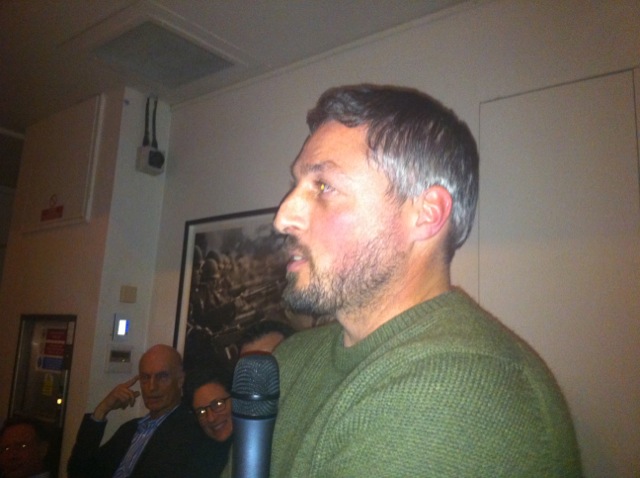
Why do you do it? Was the key question asked of Finbarr O’Reilly, a Reuters reporter featured in the film and present at last night’s screening; “I don’t enjoy being scared” he stated, and certainly the loss of friends such as Tim Hetherington has shifted his focus and left him questioning his future. But the truth is these pictures need to be taken, and as one reporter said in the film “you will never feel as alive as when you are staring death in the face.”
It seems that news agencies are finally recognizing the stresses of reporting in combat and that PTSD is a very real phenomenon among combat journalists that is starting to lose its stigma and is being accepted as reality. The nature of war reporting has changed over the years, journalists put themselves in highly volatile environments and many pay for it with their mental health and in some cases even their lives. Under Fire: Journalists In Combat is a film that addresses these issues.
]]>
After the headlines trumpeting that Alex Crawford and Sky News were clear winners of the battle for reporting Tripoli, we will be taking stock of this recent chapter in covering modern warfare.
With a panel of newsroom executives and frontline journalists we will discuss how the conflict in Libya was reported and what its legacy is likely to be.
]]>IN ASSOCIATION WITH BBC COLLEGE OF JOURNALISM
After the headlines trumpeting that Alex Crawford and Sky News were clear winners of the battle for reporting Tripoli, we will be taking stock of this recent chapter in covering modern warfare.
With a panel of newsroom executives and frontline journalists we will discuss how the conflict in Libya was reported and what its legacy is likely to be.
If the death of ITV News correspondent Terry Lloyd in Iraq in 2003 raised awareness about safety and risk in modern conflict, what can we learn from the reporting that took journalists right into the heart of the battle, the journalists who were held in the Rixos hotel and the competition between the channels? What are the pressures for both news executives and journalists in such circumstances?
Chaired by former BBC executive Vin Ray.
With:
Bill Neely, international editor for ITV News;
Sarah Whitehead, head of international news at Sky News;
Jon Williams, BBC’s world news editor.
Inigo Gilmore, award winning journalist and filmmaker who has worked across the world, with extensive experience in the Middle East, Africa and Asia. He won the Royal Television Society Award in 2011 for his work in Haiti last year, following earthquake.
Picture credit: Gwydion M. Williams
]]>He will be joining former BBC executive Vin Ray to take a look back at his career as a journalist, MP and UNICEF Ambassador.
]]>In association with BBC College of Journalism
He has reported from more than 80 countries and 11 wars, from Angola to Vietnam and was one of the first journalists to be defined as a ‘war correspondent’
Martin Bell, joined the BBC in 1962 and is one of the best known and distinguised journalists of his generation, he has reported from Vietnam, the Middle East, Nigeria, Angola, and Northern Ireland during the “Troubles”.
Twice awared the Royal Television Society’s Reporter of the Year award, Bell changed course in 1997 and successfully ran as Independent MP on an anti sleaze ticket inTatton against Conservative Neil Hamilton.
He will be joining us at the Frontline Club with former BBC executive Vin Ray, to take a look back over his career reporting around the globe that includes an OBE, a shrapnel injury from Bosnia, and five books including A Very British Revolution: The Expenses Scandal and How To Save Our Democracy.
]]>From the future of newspapers like the New York Times and whether they can adapt quickly enough to survive to the emergence of new business models offering alternative sources of funding. They will be addressing some of the big questions that are exercising many minds within the media.
A remarkable opportunity to debate the future of the news industry with two of its key players.
]]>https://soundcloud.com/frontlineclub/david-carr-in-conversation-1
David Carr has been writing about the media and its relationship with business, culture and governments for 25 years and has watched the print landscape change dramatically. Now a media and cultural columnist at the New York Times he writes the Media Equation column for the Monday Business section.
He will be joining us in conversation with Richard Gizbert, presenter of Al Jazeera English’s The Listening Post, a weekly show that looks at news coverage by the world’s media. Gizbert has also spent 25 years working in the media world as a foreign correspondent, covering stories around the world.
Drawing on their experiences working with two very different global media players, Carr and Gizbert will be discussing the future of the news industry.
From the future of newspapers like the New York Times and whether they can adapt quickly enough to survive to the emergence of new business models offering alternative sources of funding. They will be addressing some of the big questions that are exercising many minds within the media.
A remarkable opportunity to debate the future of the news industry with two of its key players.
]]>Looking back at a career that includes covering major stories around the world since 2002 and posts in Europe, Washington Bill Neely will discuss the stories that he has covered and the work and people that have inspired him.
]]>In the latest of our Reflections series, Bill Neely ITV News’ international editor, will be joining us in conversation with former BBC executive Vin Ray.
Looking back at a career that includes covering major stories around the world since 2002 and posts in Europe and Washington Bill Neely will discuss the stories that he has covered and the work and people that have inspired him.
The award winning journalist, who began his career at BBC Radio in Northern Ireland, was commended for his reporting from Haiti by BBC political editor Nick Robinson when he took part in our March Reflections discussion.
He will be discussing a career that includes covering the conflicts in Iraq and Afghanistan, the Pakistan floods and most recently the events in Libya and offering invaluable advice to aspiring journalists.
In association with BBC College of Journalism.
]]>We'll be bringing together a panel of experts to talk about their experiences of reporting, including kit, the realities of going it alone, and working relationships with the established news organisations.
]]>As many established media organisations are forced to cut back on their foreign bureaux, new opportunities are emerging for a new type of foreign correspondent – the independent multimedia journalist.
But if the days of the foreign press pack who parachute in for a big story are numbered, what are the opportunities for this new generation of journalists and how can they make the most of them?
This event will seek to answer some of the questions raised during previous discussions about the changing nature of foreign reporting – namely “How do I do it?”.
We’ll be bringing together a panel of experts to talk about their experiences of reporting, including kit, the realities of going it alone, and working relationships with the established news organisations.
This event is in association with the BBC College of Journalism
Chaired by Matthew Eltringham, editor of the BBC College of Journalism website and events.
With:
Vaughan Smith, independent video journalist, co-founder of Frontline Television News agency a group of freelance journalists who reported from the frontlines of the world’s conflict from 1989 – 2003 following which in he founded the Frontline Club;
Ben de Pear, is Head of foreign news at channel 4 news. Before taking up this position he was a field producer for Chanel 4 and Sky news, and has worked all over Africa the middle east and the Balkans. He has been part of teams that have won numerous awards including last weeks Amnesty award for TV- for the third year in a row. The winning story which depicted executions in Sri Lanka was today cited by the UN as reflecting "crimes of the highest order- definitive war crimes."
Kitty Logan, independent video journalist and TV reporter specialising in coverage of developing countries and areas of conflict. Over the past nine years she has covered foreign news for several major broadcasters, including Sky News. She also regularly films for international aid agencies and the UN. She began her freelance career in Afghanistan in 2002 and has since worked in many other countries, including Pakistan, Iraq, Lebanon and most recently Libya as a self-contained ‘one-woman-band’ – producing packages and lives for a 24 hour news channel. Kitty Logan uses a simple setup of camera, edit laptop and BGAN to allow her to operate solo from anywhere in the world.
Rosie Garthwaite, producer and occasional reporter at Al Jazeera English since 2006, she spent a year in the army in 1999 and went on to report on their activities as a cub reporter at 22 years old freelancing in Iraq. She has worked for The Baghdad Bulletin, Times, Reuters and BBC in Basra and Baghdad before going on to join the BBC as staff in 2004. She is author of How to avoid being killed in a war zone: The essential survival guide for dangerous places, a collection of practical advice from journalists and operators including John Simpson, Sebastian Junger, Jon Snow and Wadah Khanfar.
Featuring a presentation by Graham Holliday, independent freelance foreign correspondent, media trainer and online journalism specialist. He started freelancing in Vietnam, where he was based for ten years. He later worked for Scoopt, the worlds’ first citizen journalism photo agency and as the Frontline Club’s Digital Media Editor. He moved to Kigali, Rwanda in August 2009 where he runs the newswire and blog Kigali Wire. He recently appeared on the BBC World Service programme From our own Correspondent.
Picture credit: Danfung Dennis
]]>