Anglo-American media coverage of the Middle East and North Africa (MENA) region is dominated by news of conflict. There is no doubt that the region has seen many conflicts throughout the 20th and into the 21st century, from anti-colonial uprisings, to the Arab-Israeli conflict, the rise of militant religious groups like Al-Qaeda and the self-declared Islamic State (or ISIS), and recent Arab “revolts”.
Nevertheless, coverage of the MENA region in mainstream Anglo-American media has been impacted by “Orientalist” perspectives that perpetrate negative stereotypes and connotations about Arabs and Muslims. These in turn reinforce Islamophopic sentiments in mainstream news discourse and various sectors of the Anglo-American society, and engender hate and fear against Arabs in general and Muslims specifically.
The evening will be formatted in a country-by-country approach to analyse the region, discussing coverage of Egypt, Syria, Gaza and Lebanon.
Chair
Rima Maktabi is a Lebanese TV presenter and award-winning journalist and is currently the London Bureau Chief for Al Arabiya. Before this Maktabi hosted CNN’s monthly program Inside the Middle East for two years. She has done extensive field coverage from Syria focusing on the political, military as well as the humanitarian aspect of the war torn
country; numerous news reports were produced by Maktabi from Aleppo, Idlib and Daraa provinces. She also produced thorough coverage from the frontline of Mosul in Iraq focusing on stories about the battle with ISIS.
Speakers
James Rodgers is Leader of International Studies in the Department of Journalism at City, University of London. James is the author of three books on journalism and war: Headlines from the Holy Land: Reporting the Israeli-Palestinian Conflict (2015); No Road Home: Fighting for Land and Faith in Gaza (2013); Reporting Conflict (2012). James formerly worked as a journalist for Reuters TV, GMTV, and the BBC. While at the BBC, he worked as a producer, correspondent, editor, and occasional presenter. He completed foreign correspondent postings in Moscow, Brussels, and Gaza. James continues to contribute to broadcast, print, and online journalism. Most recently, he has had work published in The New European and on the Prospect website.
Dr Omar Al-Ghazzi is an Assistant Professor at the Department of Media and Communications, the London School of Economics and Political Science (LSE). Omar is interested in the role of media and communication in political conflict, activism, and collective memory, with a focus on the Middle East and North Africa. Before joining LSE, he was a lecturer (assistant professor) at the University of Sheffield’s Department of Journalism Studies. Omar’s research has appeared in journals such as Communication Theory and Media, Culture & Society and has been recognized by the International Communication Association. A former Fulbright scholar, Dr Al-Ghazzi comes from a journalism professional background. He has previously worked as a reporter for Al-Hayat Arabic daily and as a media analyst at BBC Monitoring. He completed his PhD at the University of Pennsylvania’s Annenberg School for Communication.
Dr Zahera Harb was a TV journalist in her native Lebanon for over 11 years, reporting for local and international organisations and anchoring news and current affairs programmes. She has completed assignments for BBC Arabic service, CNN world report and Dutch TV. She still commentates on Media and Politics in the Middle East. A Senior Lecturer in International Journalism at City, University of London, Zahera is widely published on journalism, media and politics in the Arab world. She is the author of Channels of Resistance: Liberation Propaganda, Hezbollah and the Media, co-editor (with Dina Matar) of Narrating Conflict in the Middle East: Discourse, Image and Communications Practices in Lebanon and Palestine and editor of Reporting the Middle East, the Practice of News in the 21stCentury, published by I.B.Tauris. Board roles include the Ethical Journalism Network. She is Associate editor of Journalism Practice and member of editorial boards of several academic journals including Journalism and Journal of Media practice.
]]>On the release of his new book Holy Lands: Reviving Pluralism in the Middle East, we will be joined by writer and Jerusalem correspondent for The Economist Nicolas Pelham – and others – to discuss his optimistic and vivid reportage that spans the region, from Israel and Palestine to Bahrain and Saudi Arabia. We will discuss the roots of today’s sectarian tensions and how they have come to characterise the region as a whole – often without a full recognition of historical context, socio-economic factors, or the rich differences of the countries contained within it. We will look to the future and assess hope for a recovery from conflict and a return to religious plurality.
This event will be chaired by Iraqi-British journalist and political analyst Mina Al-Oraibi, a senior fellow at the Institute of State Effectiveness and a Yale World Fellow. She is a member of the Global Agenda Council on the Middle East and has written extensively on US and European policies in the Middle East, in addition to conducting several high profile interviews including with US President Barack Obama and Iraqi Prime Minister Haider Al-Abadi.
The panel:
Nicolas Pelham is The Economist’s Middle East correspondent, and a writer on Arab affairs for the New York Review of Books. He spent five years as a senior analyst for International Crisis Group, covering the growing power of regional national-religious movements in Iraq, Lebanon and Israel/Palestine, and has worked as a consultant for the United Nations in Gaza. He was The Economist’s correspondent in Iraq during the 2003 American invasion and in the Maghreb. He is the author of A New Muslim Order (2008), which maps Shia resurgence in the Arab world, and co-author of A History of the Middle East (2004).
Patrick Cockburn is an Irish journalist who has been a Middle East correspondent since 1979 for the Financial Times and, currently, for The Independent. He was awarded Foreign Commentator of the Year at the 2013 Editorial Intelligence Comment Awards, and is the author of several books on Iraq’s recent history, including The Occupation: War and Resistance in Iraq, Muqtada Al-Sadr and the Battle for the Future of Iraq and most recently The Jihadis Return: Isis and the New Sunni Uprising.
Safa Al Ahmad is a Saudi Arabian journalist and filmmaker, and joint winner of the 2015 Index on Censorship Freedom of Expression Award for Journalism. She has been reporting on Yemen since 2010, and was one of only a handful of journalists reporting from inside the country for a Western news organisation as the crisis escalated. She has directed numerous documentaries for the BBC and PBS, including Al Qaeda in Yemen: A New Front (2012), Saudi’s Secret Uprising 2014), and more recently, Yemen Under Siege (2016).
Firas Abi Ali is a Senior Principal Analyst for IHS Country Risk, with a focus on forecasting political and violent risks in the MENA region. His expertise includes Islamic finance in Syria, Lebanon, Libya and Egypt, with a concentration on political stability and the rise of Islamist militant groups, as well as the likely evolution of conflicts and ensuing risks across the region. He makes regular appearances in the media, including interviews with Reuters, Bloomberg, the BBC, Newsweek and CNN.
]]>A panel of freelance journalists and photographers joined an audience at the Frontline Club on Thursday 28 January 2016 to discuss the story behind a new exhibition of freelance war photography. Osie Greenway, Anne Alling, Benjamin Hiller and Jeffry Ruigendijk introduced photography and footage from their time in the Middle East – particularly Iraq, Syria and Lebanon – and explained that the exhibition’s purpose was to bring to light to the complexities that surround freelance journalism, which are rarely recognised by those who ultimately view the content produced.
The @WZFreelance team discussing their project & exhibition @frontlineclub https://t.co/ZkVVWndicu #Support #WZF16 pic.twitter.com/T1T0874Eft
— Metro Imaging (@metroimaging) January 28, 2016
“We think there needs to be more light shone on [freelancing], to understand where the news comes from and how the news is reported. There’s a lot more going on behind the scenes when you see a picture,” explained photojournalist Osie Greenway.
The panel commented that the War Zone Freelance Exhibition was also created in order to draw attention to the vital – and sometimes highly dangerous – work of fixers and local journalists.
“They are often forgotten in the long run,” said photojournalist and writer Benjamin Hiller. “We leave, they stay behind, and often they have to take up the consequences of that.” Without them, he said, the work of western journalists would be near impossible. “We are intertwined; we are dependent on each other,” he said.
Dutch photojournalist Jeffry Ruigendijk agreed, saying that local journalists frequently don’t receive recognition for their contributions – even when the western media picks up their stories or photographs. “You see a byline with a name from an Arab country, but apart from that you never hear these guys. You never hear them speak on the radio; they never appear on talk shows. They’re ghosts with a name and a beautiful photo.”
Ruigendijk also commented that the exhibition aimed to provoke a discussion about the inconsistent payment of freelance journalists. “Usually [editors] want the photo or video last week, but you get your invoice paid in a couple of months. At the moment I’m waiting on two invoices: one which is a year and a month old, and a second which is nearly a year old.”
If the exhibition could provoke a discussion of “what is ethical and not ethical” in this context, Ruigendijk said, then it would “help freelancing in general.”
Anne Alling, a Danish writer and reporter, said the exhibition was a “developing project” with the purpose of exposing the unique work of freelancers. She added that the exhibition reflected some emerging trends in freelance work, such as the use of crowdfunding and social media to maximise support for the project. She hoped the exhibition would “give an insight into what it takes to be a freelancer, and provoke some kind of debate about freelance journalism.”
Such an interesting evening @frontlineclub on warzone freelancing. Be back tomorrow for the follow-up on #warzonefreelancingexhibition
— Sarah Mbengue (@sarah_mbengue) January 28, 2016
Ultimately, Greenway said, freelance journalism is not a new profession: “it’s an ancient craft, we’re not trailblazing.” Instead, he said, “our goal is to bring it back into the light, to make people see what it takes to take a photo.”
The panel will return to the Frontline Club this evening – Friday 29 January – for a discussion on the future of freelance journalism.
Contact warzonefreelance@gmail.com for more information on the exhibition, and visit the Frontline Freelance Register website for more information on freelance conflict reporting and its risks.
]]>United Nations Special Envoy for Global Education and former Prime Minister Gordon Brown joined chair of the Global Partnership for Education and former Australian Prime Minister Julia Gillard and the Overseas Development Institute’s Executive Director Kevin Watkins at the Frontline Club on 25 January 2016 to discuss Funding for Syrian Child Refugees, on a panel moderated by foreign correspondent David Loyn.
Former PMs @JuliaGillard @OfficeGSBrown campaigning for 1 million school places for young Syrians #auspol @SBSNews pic.twitter.com/Jw2Fr97rgr
— Brett Mason (@BrettMasonNews) January 25, 2016
The panel discussed the aim of the new UN International Commission on Financing Global Education, chaired by Brown, to provide one million school places for Syrian refugee children in neighbouring countries, as well as the wider challenge of educating refugees globally. The Frontline event took place ten days ahead of a major UN-sponsored Syrian relief conference in London.
“At our current rates of change,” said Gillard, “it won’t be until 2111 that the world first sees a generation of sub-Saharan African girls who universally have a primary and lower secondary education. That means no one in this room will live to see it. It’s too long to wait.”
Since 2010, the enrolment of Syrian refugee children in regional schools has increased from 60,000 to 200,000, “largely down to the advocacy work that Gordon has done,” said Watkins.
“It has both demonstrated what is possible, and allows us to hang our heads in shame at what we’ve allowed to happen. It’s taken an entire primary school generation to stop us sitting on our hands,” Watkins continued.
Many of the school places found for the refugees are in “double shift” schools. Existing schools double the number of students that can learn by running the same programme twice in one day. Typically, the existing students join one shift and the refugee children join another.
“Four years ago, an average Syrian child had the same prospects of getting through primary school as a kid in a high-performing middle income country like Thailand,” said Watkins. “In the space of a single generation, they’ve gone to education indicators close to Sierra Leone and South Sudan. You can see these consequences on streets across the region – there’s an epidemic of child labour. They’re forced into labour markets and early marriage.”
Watkins quoted from Graça Machel’s 1996 report on children in conflict: “It’s difficult to imagine greater depths to which humanity can sink when you look at the violation of rights and freedoms of children in conflict.”
“Half the children who are out of school in the world are in conflict zones,” said Brown. “It’s now said it is safer to be a soldier in a conflict zone than to be a girl because of the risk of child marriage, child trafficking and child labour.”
Gillard emphasised that increasing education for refugee children isn’t just about more school places, but about raising the quality of the education the children receive.
While there are “121 million children of primary and lower secondary age out of school” in the world, she said, there are “250 million who get access to some schooling… but still can’t do most basic literacy and numeracy tasks.”
“Is there a great deal of point in having kids go and sit in this thing called a school if they aren’t learning? In many countries where we’re trying to improve education systems, there are nowhere near enough trained teachers. It requires us to think how… to deliver education in a systemised way. We’re thinking about some breakthrough models that can be scaled up and rolled out in some of the poorest places on earth.”
Brown said: “it is almost ridiculous to think that when you’re in desperate need, it’s only the public sector who’s going to contribute. We need foundations, we need charities, philanthropists, businesses to make their contribution to humanitarian aid.
“We need to find other governments who are prepared to take this up. Both Julia and I tried to make our governments pro-education in the global development sphere, but we need more governments to take up the cause, and we need to find philanthropists and foundations. People are prepared to give to education in their own country, but when it comes to global education – very little.”
Intimate event at @frontlineclub w @JuliaGillardGPE, Gordon Brown & @kwatkinsodi on #education funding for #refugees pic.twitter.com/sNzCAveOXJ
— Sophie Gaston (@sophgaston) January 25, 2016
Audience member Dr Mairead Collins from Christian Aid raised concerns of families in Lebanon that the late timetables in double shift schools prevented them allowing their daughters to go to school in the dark, for safety reasons. How does the commission address these obstacles, she asked?
“Safe transport to schools is a well-understood problem,” said Brown, and money will be directed towards it. “Safe schools are a very important concept now,” he said. “We have assumed schools are safe havens without doing anything about it. But you’ve got to make the schools safe.”
Gillard agreed, saying “overwhelmingly, funds for education come from domestic governments, and for many domestic governments, until they’ve got robust taxation systems you’re always going to be running behind the curve.”
Augustus Della-Porta, trustee of Educate a Child International, said he has an eight-year-old niece in the besieged town of Yarmouk in Syria who has never been to school. What about education for the children still in Syria?
Chris Gunness, spokesman for UN Relief and Works Agency (UNRWA), said children in Palestine often tell him that they hear education offers hope – but there is no political situation in which this hope can be realised. “In Gaza, there’s 44% unemployment”, Gunness said, “and in Lebanon, Palestinians are banned from more than 100 professions. What does it mean to have education in the absence of a political process?”, he asked.
“Education isn’t the solution for every problem,” said Gillard, but “it’s hard to imagine a problem that isn’t advantaged by the benefits that education brings.”
“If people are educated, there is more capacity to negotiate differences and find solutions to conflict, to look for peace and stability, and to build institutional government systems.”
Brown said there are “new proposals for economic zones in these countries so that people denied the chance to work as refugees are finally given a chance to work within economic zones. The World Bank is now involved in Jordan and Lebanon, and I think will be involved in Turkey… [These proposals] will prevent a lot of child labour. Because [at present] children become the only income earners.”
“Despite the failure of the political process, we cannot leave these children without an education,” Brown said.
“We cannot allow them to become not just a lost generation, but a discontented and dispossessed generation, with all the implications that 200 million young people growing up in the Middle East have for the security of that region and the rest of the world.”
]]>On Wednesday 18 November, the Frontline Club hosted photographer Giles Duley to discuss the themes and individual images in his latest project, One Second of Light. Duley was joined by Roger Tatley, director at the Marian Goodman Gallery, and Jon Levy, a photo editor currently working with Médecins Sans Frontières (MSF).
One Second of Light is a diverse collection of photographs that Duley has taken over the last seven years. He explained to the Frontline Club audience that he began to work on self-funded projects ten years ago, in order to maintain more control over the content and time dedicated. The project features photographs from a wide range of countries, including Angola, Afghanistan, South Sudan, Jordan and Ukraine.

Duley told the audience that the images chosen for the book are those that have stories attached to them, and that haven’t been published or received exposure previously. In reference to the title of the project, he explained that as he was compiling the collection, he noticed that – despite there being 100 photos included – the shutter speeds of all photos combined only amounted to roughly one second of time.
“I was interested in this idea that we see photos as permanent records, and really they are only fleeting moments of others… They can give us a little window, a little insight into those people’s lives, but really we have to accept that that is just a fraction of a second.”
Fascinating talk by @gilesduley @frontlineclub last night. Incredible images and interesting debate on the ethics of conflict photography
— Dominique Cutts (@domcutts) November 19, 2015
Duley explained that he prefers to spend a substantial period of time with the subjects featured in his work, who are often in extremely difficult situations. In response to an audience question about whether the photographer worried about the psychological impact of witnessing such harrowing scenes, Duley replied that the stories and names are “etched in [his] brain,” and that he would be concerned if such stories no longer affected him.
In explaining why he decided to work largely on self-funded projects, Duley said that he was interested in finding the story behind the photo, rather than taking the more provocative images often sought by NGOs and news publications. “For me personally that’s often not the story, those are often not the people you find.”
Duley then discussed his current project – photographing refugees in Lesvos for UNHCR.
He has continued to purposefully avoid taking the “obvious” photographs, and will not take a photo without permission of the subject. However, he did reveal that he is often frustrated that his photographs “don’t shout… and sometimes I wish I was taking photographs that were more angry.”
In discussing Duley‘s preference to focus on the complex stories that surround his photographs and their subjects, Tatley described him as a “conduit for the story,” rather than “imposing the story” of those who commissioned it.
As a result, Duley commented that many of his photographs become a crucial “part of the text.”
'Someone asked me if I was a war photographer, I said no, I'm an anti-war photographer' @gilesduley @frontlineclub
— Susie_Coen (@SusieCoen) November 18, 2015
Duley commented that he often looks to present his subjects carrying out day-to-day tasks, without their obvious labels, in order that they become more relatable.
This has its difficulties, as Levy pointed out: “How do you reconcile your role? You can’t be a refugee.”
Duley responded that ultimately he is not “looking for the ‘truth’, I’m looking for a narrative.”
]]>On Monday 16 November, the Frontline Club hosted a screening of the documentary Yallah! Underground, a vibrant look at a diverse groups of Arab artists and musicians using culture to challenge the status quo. The film is set in the years prior to and during the Arab spring, and focuses on artists from Palestine, Israel, Jordan, Egypt and Lebanon. The film was followed by a Q&A with director Farid Eslam, via Skype.
The film puts its soundtrack at the forefront, and uses music to weave its way through different Arab cities, swiftly moving its focus between the individual artists’ discussions over the struggle between individuality and tradition. Freedom of expression and thought are common themes that are mentioned regularly, particularly in relation to the events of Tahrir Square in Egypt.

Eslam had spent a lot of time in the Middle East, mostly filming on commercial projects, and explained that his motivation for this project came from the desire to provide a different presentation of Arabs. He commented that Western perspective often sees Arabs being “closely connected to violence, frustration, aggression, which is only a fraction of the reality.”
“Most people want the same thing all over the world: to live in peace, freedom and to raise their families. It’s important to remind people and ourselves from time to time that we’re talking about just normal people, and it’s sad that we live in a time where we actually have to be reminded of this simple fact and simple truth.”
One audience member was curious about the absence of Syria from the film, considering its presence of underground artists. Eslam explained that he was keen to include Syria, and had tried to feature artists in Damascus and Jeddah. However, due to the escalation of the situation, “it became impossible.” Eslam did manage to film some Syrian artists in the Golan Heights, but this was not included in the film.
Eslam explained that he was able to film such a diverse group of people partly due to limited and sporadic funding, but also due to a large network of artists to draw from. Most of the artists filmed did not make it into the film; the total footage for the project was extensive, and probably enough to “make five more films.”
Will be discovering Egyptian hip hop today after watching Farid Eslam's 'Yallah! Underground' @frontlineclub last night. What a great film!
— Josephine Casserly (@JoCasserly) November 17, 2015
He found it very easy to meet artists: “Basically, you meet one artist and he points you to ten new ones.”
While a lot of his research was carried out on social media, he was also able to spend a lot of time talking directly to artists and people connected with the alternative scene.
Information about Yallah! Underground can be found on the film’s website and Facebook page. Yallah! Underground will have its first screening in an Arab country next month in Dubai.
]]>On Thursday 6 February at the Frontline Club, Dan Smith, secretary general of International Alert, chaired a panel which discussed the impact of the war in Syria on the surrounding states.

Dan Smith, Victoria Stamadianou, Martin Chulov, Julien Barnes-Dacey and Nadim Shehadi discuss Syria and the surrounding region at the Frontline Club. Photo: @mattmencarelli
Smith asked the panel what could be done to improve the situation in the region?
Julien Barnes-Dacey, who was based in Syria as a journalist from 2007 to 2010, said:
“Clearly the only solution is a Syrian solution. Syria is sucking the life out of the region. It’s Syria that is promoting a refugee crisis and until that situation is resolved you’re not going to get a regional resolution to all of the accompanying issues.”
http://twitter.com/maggieinlondon/status/431517865490259969
Lebanon is absorbing many of Syria’s six million displaced people but the country has many of its own existing problems. An audience member asked if these problems had got worse since the influx of refugees.
Nadim Shehadi, an associate fellow for the Middle East and North Africa Programme at Chatham, said:
“. . . You would consider it as a failed 20th century state as compared to Syria, Iraq, Jordan, Egypt, Libya who were successful. These components that we thought were the failure of Lebanon are what’s holding it together now. . . . Lebanon as a society can live without a state because it never had any.”
But the influx of people, while being supported by Lebanon’s ability for self-preservation without the structure of a state, is not sustainable, said Victoria Stamadianou, Lebanon country manager for International Alert:
“It’s important to remember that resilience is depletable. . . . We’ve seen a lot of refugees being hosted by communities, everyone expected that there would be massive conflict across the country and that hasn’t happened . . . they’ve managed to be resilient but that’s something that can be depleted and needs to be strengthened.”
From the audience, Sarah Williams, who spent six months in Jordan last year, asked how the country has been stabilised by the Syrian conflict.
Barnes-Dacey:
“[In 2011-2012] things were really rough. . . . There was a lot of unprecedented domestic pressure against the king . . . you had unrest in the south . . . I think that what Syria has done is to quell that. . . . In a general sense in Jordan at the moment, ‘This is better than what’s happening in Syria at the moment and we don’t want to risk that.’
“It’s worth saying that this is a short-term thing. Long term you’ve got the refugees, you’ve got Islamists . . . the king [still] has huge economic problems.”
The panel agreed that the battle lines may seem to be drawn along religious and ideological lines but they are in fact political.
Shehadi said:
“I think the Shia–Sunni rift is overplayed, when Erdogan of Turkey and Hamad of Qatar and also Abdullah of Saudi Arabia were supporting Assad, it was not because he was Shia or because he was Sunni, it was because they thought they could do business with him.”
Martin Chulov, Middle East correspondent for The Guardian, said that they do however sustain the conflict:
“While I agree with that analysis and the cause of this conflict wasn’t sectarian, what’s sustains it in part certainly is.”
Barnes-Dacey agreed:
“Very deliberately. . . . [It’s about] regional power play and regional alliances but those alliances are using sectarian networks to achieve their political ambitions.”
Syria the arena for contest between regional powers #peacetalks @intalert
— Phil Champain (@BigPhil127) February 6, 2014
An audience member asked, what is the long-term solution?
Chulov:
“I don’t put any faith at all in the feckless political class in Lebanon. I think that the issues are far bigger than them even if they wanted to confront them. I do think there has to be a point, an intersection of the strategic interests of the key players – the Saudis, the Iranians in particular, but also the Russians and to some extent the Americans.”
Barnes-Dacey: Parties to conflict must accept no "winning" option – including opposition, who must negotiate with Assad #peacetalks
— International Alert (@intalert) February 6, 2014
Carol Allen-Storey, a photojournalist in the audience asked, where are the visionaries of the future, who is going to inspire?
Chulov and Shehadi said that they couldn’t come up with many suggestions for the future leaders in the region, however Stamadianou was more optimistic:
“You can’t just hope that you’re going to find this new breed of people that didn’t exist there and they’re going to solve all the issues. . . . What you can do is . . . see if you can find ways to model different approaches to doing politics and supporting them to change the grain – working with the grain to change the grain.”
Barnes-Dacey:
“Today in a sense the Syrian population has been unleashed, so one can say there are no distinct ‘Mandelas’ that one can see on the horizon but there’s a whole people that have discovered a political awakening which was kept away from them for so long.”
Watch and listen to the full discussion below:
Followed by a Q&A with undercover reporter Hanan Khandagji
BBC Arabic investigation has uncovered cases where children had been seriously injured in Jordan's private care homes for the mentally disabled. The film also uncovers allegations of sexual abuse at one private care home. Hanan Khandagji is the undercover reporter who produced BBC Arabic's investigative documentary Jordan's Secret Shame. The film explores care homes abuse of disable children in Jordan, which received massive media coverage as well as a reaction from the public and the Jordanian government alike.
]]>Followed by a Q&A with undercover reporter Hanan Khandagji
BBC Arabic investigation has uncovered cases where children had been seriously injured in Jordan’s private care homes for the mentally disabled. The film also uncovers allegations of sexual abuse at one private care home. Hanan Khandagji is the undercover reporter who produced BBC Arabic’s investigative documentary Jordan’s Secret Shame. The film explores care homes abuse of disable children in Jordan, which received massive media coverage as well as a reaction from the public and the Jordanian government alike.
Following the first broadcast of the investigation a press release was issued on 13 May and on Monday morning, the King of Jordan, Abdullah, has made a surprise visit to some of the home cares in Jordan. He later commissioned an investigation, which includes all care homes for disabled children, elderly homes and nurseries among others. Two weeks later, the investigation committee submitted its final report and found additional evidence of child abuse. Some care homes were announced closed and some others have been given warning notices. Several care workers were referred to court, some were jailed.
Hanan Khandagji holds Palestinian nationality, she was born in 1989 in Saudi Arabia and raised and lives in Jordan. While finalising her BA in Business Administration, Jarash University, she worked with Arab Reporters for Investigative Journalism (ARIJ), BBC Arabic partners in producing the investigative documentary on Jordan. She also works as a volunteer in Al Balad Radio and Amman Net website, in the investigation Affairs Department.
]]>By Nicole Hunt
IMF, European Central Bank and EU officials are scheduled to arrive in Athens on Monday to conduct a week-long assessment mission of Greece’s debt-reduction measures. Everyone will be hoping the troika visit goes better this time around than it did in September, when officials left Greece for nearly a month amid rumours of disagreements with their Greek counterparts.
Following controversial elections last year which were marred by allegations of electoral fraud,Liberian President and Nobel Peace Prize winner Ellen Johnson-Sirleaf is inaugurated for her second term.
UN Secretary General Ban Ki-moon and Chinese Premier Wen Jiabao are among speakers at the opening day of the World Future Energy Summit in Abu Dhabi. Wen’s speech is part of a six-day Gulf tour to discuss energy interests, which began in Saudi Arabia and wraps up in Qatar.
On Tuesday, China’s National Bureau of Statistics holds its first economic press conference of 2012, discussing China’s growth in 2011 and releasing the country’s most recent GDP figures.
In Washington, President Barack Obama meets with King Abdullah II of Jordan. Discussions are expected to focus on the Israeli-Palestinian peace process, as Jordan has recently played host to a renewed round of discussions.
Embattled Spanish Supreme Court Judge Baltasar Garzon, who was suspended from his Supreme Court post in May 2010 amid allegations that he had overstepped his authority by investigating Franco-era disappearances despite a 1977 amnesty, goes on trial for allegedly ordering illegal wiretaps in the 2009 Gürtel case.
Attention turns once again to the EU debt crisis on Wednesday, as President Nicolas Sarkozy hosts a jobs summit in Paris, where it is rumoured that he will announce the end of the 35-hour work week. In London, Prime Ministers David Cameron and Mario Monti meet for the first time since Monti took over from Silvio Berlusconi last year.
The US Department of Defense has until Wednesday to comply with a request from the UK Government to transfer Yunus Rahmatullah to British custody so that he can be tried or released. Rahmatullah was captured by British forces in Iraq in 2004 and handed over to US forces before being rendered to Bagram Prison in Afghanistan where he has since been held without charge. The Government’s request was made in response to a writ of habeas corpus issued by the Court of Appeal.
The Arab League’s monitoring mission to Syria is expected to conclude its work on Thursday and issue a report into the situation in the country. In response to the report, the Arab League is expected to decide whether a strengthened mission must return to the country, or whether other action needs to be taken against President Bashar al Assad’s regime.
Mexico hosts the first G20 event of its presidency as Deputy Finance Ministers gather in Mexico City for a two-day meeting. The Deputies will lay the groundwork for a Finance Ministers’ meeting at the end of February.
As European banks face a deadline to submit their plans to raise some €115bn in capital on Friday, President Nicolas Sarkozy, Chancellor Angela Merkel and Prime Minister Mario Monti meet to discuss the new EU fiscal stability treaty ahead of an EU summit at the end of the month.
Meanwhile, the troika review missions in Greece and Ireland are expected to finish, with the troika likely to issue its assessment of Ireland. The Africa Cup of Nations kicks off in Bata, Equatorial Guinea on Saturday. The first match sees Equatorial Guinea face off against Libya; the final is held in Libreville, Gabon on 12 February.
The Africa Cup of Nations kicks off in Bata, Equatorial Guinea on Saturday. The first match sees Equatorial Guinea face off against Libya; the final is held in Libreville, Gabon on 12 February.
Republican candidate hopeful Mitt Romney is hoping to follow up success in the Iowa Caucuses and New Hampshire primary with a win in the South Carolina primary. The South Carolina vote is an open primary, which allows Democrats and Independents to participate in the vote. Since 1980, the winner of the South Carolina primary has always gone on to win the Republican nomination.
The week closes with two European elections. Croatia holds a long-awaited referendum on EU accession following the signing of an accession treaty on 9 December. If accession is approved in the vote, Croatia will officially join the European Union on 1 July.
Finland holds the first round of its presidential election, with a potential second round scheduled for 5 February if necessary. Incumbent Tarja Halonen isn’t eligible for a third term, and her Social Democrat Party’s candidate Paavo Lipponen has been dwarfed in recent polls by the National Coalition Party’s Sauli Niinisto.
]]>
In a couple of days she’s rocketed up from a handful of followers to around four thousand. So far, we’ve heard of her ariel acrobatics, as her husband pilots the royal helicopter – we’ve found out about her taste in films and her struggle to be a mother and queen. And it’s all written in irritating txt spk.
It seems to be the real deal. CNN’s Octavia Nasr is sure it really is Rania logging-in to Twitter.
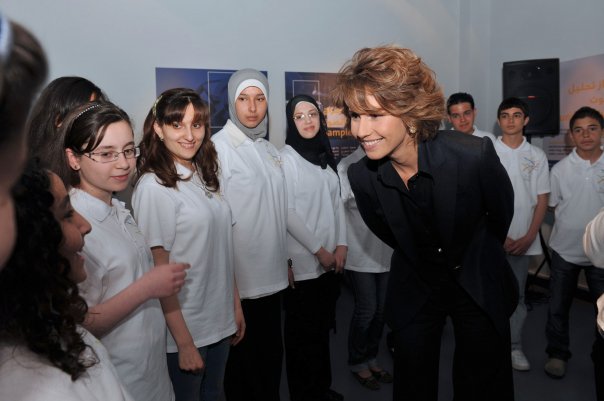
North of the border, Syria’s First Lady Asma Al-Assad is also jumping on to the technological bandwagon. She’s on Facebook, talking about her charity work. Appropriately, she’s helped launch a project to get disadvantaged children online.
Let’s face it, politics is a popularity contest. And with the absence of Western-style free and fair elections in the region, what better way to measure their appeal than by social networking sites. Queen Rania comes in at 4000 Twitter followers (although she just registered a couple of days ago, so that figure will grow). Asma Al-Assad tops the lot with 9000 on Facebook.
]]>