A compelling Frontline Club event on Wednesday 25 June showcased film and photographic work from across the globe that revealed both the depth of suffering and the strength of human spirit in some of the world’s most devastating internal conflicts.
Featured at the event was a series of photographs from Tim Freccia in South Sudan, Alvaro Ybarra Zavala in Venezuela, Eman Mohammed in Gaza and Daniel Berehulak in Afghanistan, curated by multimedia photojournalist and filmmaker John D McHugh.
The event culminated in a screening of Ground Zero Syria, a dramatic film by Robert King featuring unprecedented footage of the brutal conflict in Syria, and an impassioned interview with King by The Times journalist Anthony Loyd that offered some chilling conclusions about the future of the conflict.

Robert King and Anthony Loyd at the Frontline Club.
All of the showcased work shared a common theme: that of the determination of each journalist to bring to light the plight of people facing oppression or armed struggle in their home countries, and to reveal the characters of those individuals caught up in some of the world’s most dangerous conflicts.
Among Freccia’s work was a set of portraits of soldiers from the White Army, a ruthless militia group fighting alongside former Vice President Riek Machar in his campaign against the government of South Sudan.
In Freccia’s unique portraits, presented against a white background, he aimed to show through the expressions and postures of his subjects the “humanity present in these characters, for good or bad, which is often neglected”.
Zavala’s photographs were captured in Caracas and San Cristobal in February and March this year as the protests against Venezuela’s government escalated.
A picture of a woman slumped over the coffin of a lost loved one revealed the sacrifices made by the protestors, while another featured a combatant in plastic protective glasses making Molotov cocktails to take into the fray.
Mohammed took up photojournalism at the age of 19. In a narration of her photographs, she explained how she had to overcome cultural barriers to a woman pursuing such a career.
“I thought I had what it took to be a career photographer,” she said. “I was wrong. To gain acceptance in a male dominated field was next to impossible.”
Covering the war in Gaza in 2008-09 and under fire from aerial bomb attacks, the ground “shaking like a swing beneath us”, Mohammed was abandoned by the two male journalists with whom she was travelling. “Terrified, humiliated and feeling sorry for myself”, she learned a valuable lesson.
Mohammed‘s career has been characterised by a constant tension between capturing her own agony and that of others:
“You can freeze, but your camera cannot. If you don’t document history, it never happened.”
Her work included touching portraits of Mohamed Hodr, who along with 22 members of his family lived for several years beneath the rubble of what was once his home.
The only surviving remnant of what was to be a retirement retreat was a jacuzzi, which he hauled up to the roof of his shattered home so that each morning he could give his children a bubble bath.
Berehulak’s work focused on the terrible impact that the rapidly rising use of heroin in Afghanistan is having on the local population. One in 10 urban households in the country has at least one drug user, and in rural areas heroin use is as high as 30 per cent.
A set of photographs of one hospital ward that was admitting 200 children a month for severe malnutrition featured pictures of young children so wrinkled with starvation that they looked more like the elderly than the newly born. At a year-and-a-half, Mohammed weighed just 10 pounds.
“Nearly every potential lifeline is strained or broken here,” said Berehulak in his narration. “Women are kept away from everyone except those in their immediate family.
“Farmers can’t grow crops because of mines, and doctors can’t get to children until the situation is already severe. Women can’t nourish their own children [because of the heroin use].”
At the country’s premier children’s hospital in Kabul, a five-year-old boy weighing just 20 pounds was being treated on a bench because the infusion line wouldn’t reach to a bed. The drug problem, said the director of demand reduction at the ministry of health, is a tsunami for his country.
Ground Zero Syria
Screened in the second half of the event, King’s film gave a unique insight into the fighters of the opposition Free Syrian Army (FSA) in their efforts to survive the brutal attacks of Bashar al-Assad’s regime.
“For six to seven months we didn’t even think about picking up weapons,” said one.
“We started out with olive branches, but [in the end] the only option was to take up arms and put him [Assad] out of office.”
At a field hospital in Al-Qusayr, southwest of Homs near the border with Lebanon, a young boy looked forlornly up at the camera with a single streak of blood spilling from the corner of his mouth. Across the ward, another child’s guts were bursting through his sundered stomach.
“If I die when I help people it is good for me,” said a doctor at the hospital. “I’m a doctor, I must help people.”
At the Dar al-Shifa field hospital in Aleppo, Dr Osman, a physician at the hospital, explained how he had nightmares about amputating children’s limbs, but each day resisted the urge to return to normal life because there was no one else to help these people.
According to Osman, about 80 per cent of the patients at Dar al-Shifa are civilians. At the time of the interview, the hospital had already been bombed five times, with another 15 bombings nearby.
“The Syrian regime considers medical staff as a perfect target, as a military target,” he said. “When you kill one doctor it is better than killing a thousand fighters.”
In November 2012, King was there when the hospital was hit yet again, but still hope was not vanquished.
“Dar al-Shifa is not a building, it’s not a machine; it’s people, it’s doctors, nurses,” said Osman, speaking amidst the rubble.
“We will continue. We will build this hospital again and we will work again.”
In one striking scene, Dr Abaman, a former veterinarian working as an assistant physician at the hospital, appealed directly to the camera, emotion cracking his voice:
“We have enough shown TV. Do something. Do something. We are suffering here alone.”
The film also featured the tragic burning of Aleppo’s market, a world heritage site and one of the world’s best-preserved souks.
King asked Ahmed Alhaji, who had witnessed the fire, to explain what he had seen.
“I saw a lot of things that make me cry,” he said. “I saw Assad destroy our history. My heart is broken, I was crying blood.”
Towards the end of the film, King asked an FSA fighter what he thought of the West’s Syria policy. The West’s inaction before – and even after – evidence came to light of the use of chemical weapons in Syria, he said, was a sign to Assad that:
“Whatever you want to do, go ahead and do it. You want to kill 100,000 people that’s okay; you want to drop 100,000 tonnes of bombs that’s fine. Chemical weapons? Just keep 20–30 per cent of them.”
Most of the characters featured in the film, said King, are now dead.
Beyond the obvious perils of filming during an almost constant artillery bombardment, King faced his own challenges in shooting the film, not least the very lack of engagement from the West and its media that was alluded to by the film’s characters.
“I had to reassess why I was risking my life to cover slaughter,” said King in the Q&A with Loyd.
“I’d been there for four months and had photographed 5,000 dead bodies and nobody cared. No one would buy my photographs, so I started shooting video.”
The politics within Syria were also a source of frustration for King. He saw a shipment of powdered milk he had helped facilitate first held up in customs and then less than welcomed by those who had been benefiting from the black market in the product.
Those people who had helped him gain access to the country started to try to influence his material and, when he refused, banned him from going back.
“In the first year I figured that their politics were holding up the medical needs of the community,” said King. “Then they wanted to control the message.”
Asked by members of the audience whether his work could be used to try the perpetrators of the violence, King expressed his frustration with the absence of a more effective international legal system:
“If there was an international court of law that could hold people accountable for their war crimes . . . but why give my stuff to some organisation that fantasises that it can prosecute people?”
Loyd and King agreed that the future for the country is bleak and the potential fallout dire.
“The war launched against Al Qaeda was one thing,” said Loyd, wearing a cast around his leg after sustaining gunshot injuries in the latest of many reporting trips to Syria.
“Now something far worse [Islamic State in Iraq and Al-Sham (ISIS)] has taken up a huge block of the Middle East running almost to the Mediterranean, and the West is aghast as to how to deal with the situation.
“Syria has raised a huge question mark and nobody knows what to do.”
King is convinced that chemical weapons have been smuggled out of Syria and have already reached Western European capitals. Asked whether he was planning to go back to Syria, he said:
]]>“I don’t have to go to Syria. It’s done. It’s here. It’s over. I’m going to sit and wait.”
The Taliban have made steps towards wanting to be seen as a legitimate political force, by setting up an operations office in Qatar on 18 June this year. The First Wednesday discussion chaired by Paddy O’Connell at the Frontline Club on 3 July asked: Is talking to the Taliban a solution?

Dawood Azami, Frank Ledwidge, Lucy Morgan Edwards. Credit: Sally Ashley-Cound
John D McHugh, a multimedia journalist and filmmaker said that talking to the Taliban is the only option:
“Politics is the solution to war so sooner or later we’ve got to talk to these f—ckers so let’s make it sooner and lets ease the pain.”
Not long into the discussion, basic problems in communicating between different parties involved were brought up – what language would talks be held in?
Dawood Azami a journalist working for the BBC World Service replied:
“If you don’t speak the language you cannot communicate, you don’t understand the complexities of the situation… There are so many players; there’s history, ideology, nationalism, grievances…and so many other things.”
It was also unclear as to who Western negotiators would be talking to as Frank Ledwidge, former Naval reserve military intelligence officer said:
“They – whoever ‘they’ are – are the opposition [whether the officials in Qatar or local fighters on the ground] . . . the time has come to stop fighting for the sake of fighting. However we put it, what we have is existential war.”
https://twitter.com/MWStory/status/352495888985387008
If talks were to be held, would the office in Qatar even reflect what’s going on in the ground? Azami replied:
“It’s the other way around. People on the ground have control over people in in Doha. . . . They don’t control the fighters, the commanders. The commanders have more power than those in the Doha office.”
McHugh said that there is a difference between “those who claim to be in command and those who are doing the nasty… fighting and killing – the disconnect is huge. . . . There are people in Qatar that are saying they can do X, Y and Z, and I’m not convinced that they can at all.”
An Afghan audience member added:
“People in Afghanistan… now believe this is a conspiracy. A game. The Americans are leaving, that we’re going to be left alone; who knows what happens. We’re going to be handed over to the Pakistani government. . . . We need more transparency.”
McHugh reiterated that there was concern over the lack of transparency in talks as a friend on the ground had told him:
“The lack of transparency is the biggest fear. He said ‘we don’t know what’s being talked about’. . . . There’s a fear that concessions are going to be made.”
Lucy Morgan Edwards, author and researcher at Exeter University agreed:
“Talks, if they did happen are likely to happen behind closed doors and run by foreigners. I believe they should be run by Afghans.”
However any talks taking place could seem halfhearted, with the knowledge that the West will be pulling out of Afghanistan in 2014.
Ledwidge felt that the British have no say at all:
“People pulling the strings here are not British diplomats – nobody trusts us and we have no influence anyway. The US and Pakistan, they’re the players here.”
McHugh continued:
“We [the West] look like people who are trying to get out and will talk to pretty much anyone who offers a way of getting out and saving face.”
A member of the audience, who had served with Ledwidge in Iraq, suggested the West needs to be smarter in the way they use military force alongside talks:
“There is a much more fluid situation . . . where people are quite willing to pursue talking and at the same time to apply military pressure and to very skillfully weave those two things together. . . . Using the violence in order to further the talks. The Taliban are more skilled at doing this because, quite frankly, they’ve had more practice.”
O’Connell asked what the panel thought should, or would happen to bring about successful talks.
Ledwidge said that the most successful peace conference would involve “all parties, all surrounding countries, all interested nations without preconditions and you talk to whoever will talk back.”
McHugh added:
“If Pakistan are not involved you’ve no hope.”
@frontlineclub @LMorganEdwards #Pakistan holds all the cards here. #Taliban #Afghanistan @frontlineclub #BBC
— Roxanna Shapour (@roxbox2) July 3, 2013
Azami finished by saying:
“Afghanistan has been a battlefield for other countries adventures… They deserve peace and the rest of the world should help them.”
Watch the full discussion here:
https://soundcloud.com/frontlineclub/first-wednesday-is-talking-to
]]>Photojournalist and filmmaker John D McHugh led the discussion and brought out the contrasts between Winning’s regimented, orderly entry and exit from the country and Gilmore’s more chaotic, less regulated approach. Projections of both their work emphasized the surreal imagery of the civil war that nobody could have anticipated a year ago, as ordinary Libyans take up arms to defend their freedom.
Both journalists spoke of the frustration they observed from rebel soldiers about the lack of coordination and training among their ranks, and a great optimism from the people in the East of Libya, finally free of the yoke of Gaddafi’s regime.
The panel paid tribute to their colleagues and friends Tim Hetherington, Chris Hondros and Anton Hammerl who lost their lives covering the conflict in Libya, reminding us of the terrible dangers journalists face to bring us truthful accounts of events at the front line.
You can watch the event in full in the video below. The first 15 minutes are a rolling stream of Andrew Winning’s images projected in the Forum before the start of the event. Skip to minute 16 to watch the talk from the beginning:
]]>
The deaths of Tim Hetherington and Chris Hondros in Libya in late April were a grim reminder of the dangers that journalists face in covering conflicts like the one that has been raging in Libya.
Getting the best images possible means that photographers and video journalists in particular need to get hair-raisingly close to the action, often putting themselves in danger.
Reuters photographer Andrew Winning and video journalist Inigo Gilmore will speak at the Frontline Club about shooting on Libya’s front line. Presentations of their work will be followed by a panel discussion and Q&A about the reality of covering events in Libya. The talk will be moderated by multimedia photojournalist John D McHugh.
British photographer Andrew Winning has been working for Reuters for 15 years. Twelve of these he spent in Mexico as the chief photographer there. He specialises in hard news, covering natural disasters, political and civil unrest as well as editing assignments and sports. Libya is only the second armed conflict he has covered, the other being President Aristide’s ousting in Haiti.
Haiti has also been a key country in Inigo Gilmore‘s career. After the 2010 earthquake, Gilmore covered the aftermath of the disaster for Channel 4, tracing the journey of an injured baby to a hospital in the UK and the eventual reunion with her mother. His films about baby Landina won him the RTS Television Journalism Independent Award.
John D McHugh‘s career spans the gap between photojournalist and filmmaker. His multimedia work from Afghanistan won him the 2007 Frontline Award and in the past he has worked for the Associated Press, The Guardian, Channel 4, Al Jazeera and Agence-France Presse. McHugh‘s experiences of embedding in Afghanistan with US, Canadian and Afghan troops has given him well-rounded insights on a very different kind of war. He spoke at the Frontline Club in 2009 about his work in Afghanistan. McHugh recently made a film about Bahrain during the Arab Spring, and has just returned from a month in Kandahar.
]]>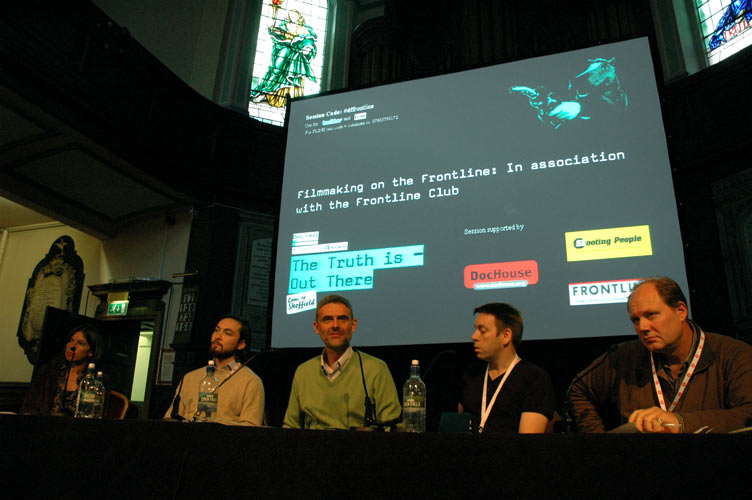
Putting the panel together was extremely difficult as, due to the nature of the job, many of our panellists were either stuck in difficult places filming or had to rush off to film in reaction to sudden changes in the world.
However, it worked out for the best and our final line-up had an incredible array of experience and insight. Joining Frontline Club founder Vaughan Smith were Danfung Dennis, Jules Williamson, John D McHugh and James Mullighan from Shooting People as chair.
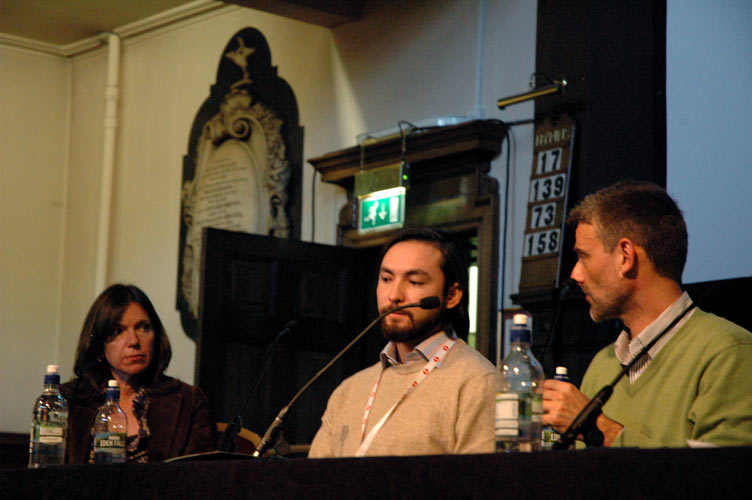
It was a fantastic discussion and all panellists showed clips from their work.
The panel discussed various aspects involved when preparing to shoot in a conflict zone. The resounding advice was explained best by Vaughan who said that fundamentally you should make sure you go on a shoot with a purpose. He went on to caution potential filmmakers that it’s easy to get scared before you go to a warzone when, if you work it out, the risks they could be very low.
John D. McHugh and Danfung Dennis went into greater detail about how to behave whilst on a shoot. John D. spoke of how the more you can think about what you’d do in situations the better you’ll be prepared and not get it wrong and Danfung stressed that telling the story is really important and that you must decide whether you are going for the experience or to tell a story.
Jules Williamson (apologies I don’t have a link to her stunning new film looking into a radio station helping child soldiers, but keep an eye out for it) spoke from the perspective of setting up a shoot and explained how risk assessment is important as it gives you focus, no matter what topic or situation.
It was fantastic to see the club have a greater presence at the festival this year and to bump into the various members attending. We also got a mention at various panels and it was particularly wonderful to hear Jess Search of BritDoc telling a packed room that she loved the club.
A huge thanks to the other organisations that helped us with the discussion. The session couldn’t have been possible without our producing partners DocHouse and the help of Shooting People.
John D’s Rory Peck nominated film can be seen in full here
You can see the trailer for Danfung’s new film here:
]]>
Multimedia journalist and Frontline Club Journalism Award winner John D. McHugh will be talking at the Frontline Club tonight about reporting war across a range of media for The Guardian newspaper. We start at 7pm GMT/11am PST and as usual we will be streaming the event live on the Frontline Club live channel on the Club Events page and in the screen above.
]]>In 2008, The Guardian commissioned him to produce an online project called “Six months in Afghanistan.” The project was to include photography, short films, audio slideshows, and blogging.
“I wanted to use the full range of multimedia options open to me to tell the story of the war in Afghanistan,” says McHugh, “and The Guardian gave me the opportunity to do this, and the platform to present the results to a worldwide audience.”
McHugh will present a selection of this multimedia work at The Frontline Club, and will talk with Roger Tooth, The Guardian’s head of photography, about the reasons why he has moved from working solely in traditional photojournalism into other fields. link

John D. McHugh, club regular and Frontline Club award for journalism winner, sees his latest multimedia production from Afghanistan about the U.S. soldiers view of their Afghan counterparts, on the Guardian website. You can feel the frustration dripping from the U.S. soldiers as they find Afghan colleagues without helmets on, smoking dope and otherwise in something approaching, if not quite arriving at, complete disarray. John will be talking about his experience working as a multimedia journalist at the Club this coming Friday, April 3. Should be a good talk,
]]>I have heard it described as ‘convergence journalism’ by some, and others have called me a ‘multimedia practitioner,’ but really, the label is unimportant. The simple fact is that by learning and adopting these new skills, I have been able to produce a much stronger body of work, and have brought the reality of the situation in Afghanistan to far more people than through purely still photography, and as a journalist, that is my job," says John. link
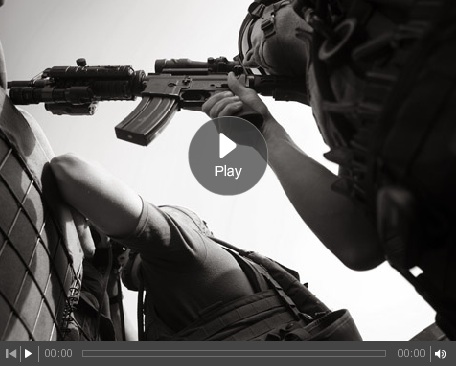 John D. McHugh drops us a line to tell us that his latest report from Afghanistan for The Guardian is up on the site. John has been filing multimedia reports from the frontline in Helmand over the past year. As he says in his email,
This is without doubt the most difficult and dangerous place I have worked so far, but I think the film gives a good insight into the futility of the current strategy in Afghanistan, and the pointless dangers the soldiers are facing every day. link
John’s about to take a short break from Afghanistan as he’s getting married this coming Saturday. Congratulations from all at the club John.
]]>John D. McHugh will talk about his work as he accepts the inaugural Frontline Journalism Award at the Frontline Club tonight. Brent Stirton will also receive the inaugural Frontline Memorial Tribute. Please tune in to our live stream channel to watch and listen to John in conversation with Jon Lee Anderson and club members. More info here,
Freelance photojournalist John D. McHugh wins the Frontline Club Award for his work in Afghanistan in 2007. McHugh financed his own trip and worked as a freelance for AFP, the Sunday Times, Newsweek as well as filing to his personal blog. He later sold images to FHM magazine and other outlets. McHugh was shot by a Taliban fighter on May 14, 2007 after spending five weeks in country embedded with the 10th Mountain Division in northeastern Afghanistan.
And if you’re a blogger, please feel free to grab the embed code from beneath the video pane and broadcast the event on your blog. UPDATE: Here’s the recording of the evening in full. Photo this & that has some pictures from the evening.
]]>
Right from the very beginning the Frontline Club broke all conventions. From cameraman Vaughan Smith’s late 80’s visions of flying over the Afghan frontline in a Microlite to shacking up in Osama Bin Laden’s residence in Kabul. The founders of the Frontline Club didn’t just shirk convention, they booted it out the door. With those ideals firmly in mind, and this being a Friday night, we choose this moment to announce the winners of the inaugural Frontline Club Journalism Awards. There are two awards, there are no finalists, there are only winners. The Frontline Club Award will be given annually and the Frontline Memorial Tribute occasionally. The Frontline Memorial Tribute is dedicated to the memory of Frontline Club members killed in the course of their work. The judges are drawn from the club’s 1000+ membership and currently comprise of Jon Lee Anderson, Patrick Cockburn, Carlotta Gall, Gary Knight, Christina Lamb, Allan Little, Anthony Loyd, Seamus Murphy and Vaughan Smith (Chair) The winner of the 2007 Frontline Club Award is currently in Afghanistan for The Guardian newspaper,
2007 Frontline Club Award Freelance photojournalist John D. McHugh wins the Frontline Club Award for his work in Afghanistan in 2007. McHugh financed his own trip and worked as a freelance for AFP, the Sunday Times, Newsweek as well as filing to his personal blog. He later sold images to FHM magazine and other outlets. McHugh was shot by a Taliban fighter on May 14, 2007 after spending five weeks in country embedded with the 10th Mountain Division in northeastern Afghanistan. He very nearly died. He has returned to Afghanistan on two occasions most recently on a multimedia commission for The Guardian newspaper.
The winner of The Frontline Memorial Tribute is Brent Stirton,
2007 Frontline Memorial Tribute Brent Stirton wins the inaugural Frontline Memorial Tribute Award for his photographic essay on gorillas in the eastern part of The Democratic Republic of Congo. The judges focussed on one image in particular (no. 33 from this series link http://www.brentstirton.com/feature-gorillas.php). The image is of a dead male gorilla, one of four found in the forests in Virunga and transported by around 16 rangers.
The awards ceremony will take place at the Frontline Club in London on 20 June. All proceeds from the event will go to the Fixers Fund – set up by the Frontline Club Charitable Trust to promote responsibility in the news industry for the welfare of fixers and translators. The Fixers Fund was inspired by the story of Ajmal Naqshbandi.
]]>