By Nicole Hunt
The two men charged with the April 2010 murder of South African white supremacist leader Eugene Terre’Blanche go on trial in Ventersdorp on Monday. Chris Mahlangu and an unnamed teenager are accused of killing the leader of the Afrikaner Weerstasbeweging (AWB) party over a wage dispute.
EU Foreign Ministers meet in Luxembourg, with Syria expected to be on the agenda after a UN Security Council resolution condemning Syria was vetoed by Russia and China last week and Syrian opposition members officially formed a National Council.
Liberians go to the polls on Tuesday to elect their president for the next six years. Ellen Johnson-Sirleaf, who became Africa’s first female leader when she was elected in 2005, is hoping to win a second term.
A verdict is expected in the corruption trial for Ukrainian opposition leader Yulia Tymoshenko in Kiev, who is accused of ‘misspending’ some $280m during her time as Prime Minister.
In New York City, alleged Russian arms dealer Viktor Bout’s trial for selling weapons to Colombian rebel group FARC gets underway.
The European Commission presents its 2011 enlargement package in Brussels on Wednesday, which includes a formal favourable opinion on Croatia’s accession and a much-awaited opinion on Serbian accession following the arrest earlier this year of alleged war criminals Ratko Mladic and Goran Hadzic.
The European Central Bank, the Bank of England, the Swiss National Bank and the Bank of Japan hold the first of three unlimited US dollar auctions, which were announced last month and are designed to flood the financial market with dollars to support banks through the EU debt crisis. Two more auctions are planned for 9 November and 7 December.
On Thursday, Ivorian President Alassane Ouattara pays his first visit to the country’s troubled western region since taking power in May following months of post-election violence and a power struggle with former President Laurent Gbagbo. Violence has continued in the west, where suspected Gbagbo loyalists are thought to be conducting armed raids over the Liberian border.
In France, journalist Tristine Banon publishes her book Le Bal des hypocrites, detailing her accusations of attempted rape against former IMF managing director Dominique Strauss-Kahn.
G20 Finance Ministers and Central Bank Governors begin a two day meeting in Paris on Friday, with the EU debt crisis expected to be high on the agenda.
In Dublin, the OECD publishes its latest Economic Survey of Ireland. The last edition was published in 2009, so there should be plenty of new material given the country’s economic woes in the interim.
The Chinese Communist Party’s Central Committee begins its annual gathering on Saturday. The meeting is seen as a key part of the power handover that should see Xi Jinping replace Hu Jintao as President next October.
Elections are held in Oman to name the 83 members of the country’s lower house of parliament, the Majlis al Shura, a consultative assembly which was granted legislative and regulatory powers in March as the Arab Spring spread across the region. The upper house is still appointed by the monarchy.
France’s Socialist Party holds the second round of voting in its presidential primaries on Sunday, choosing the person who will go up against Nicolas Sarkozy in the 22 April presidential election. Dominique Strauss-Kahn had been a favourite to win the party’s candidacy before he was charged with sexual assault in May; despite the charges being dropped, he opted not to run.
It’s also Blog Action Day, which encourages bloggers worldwide to post about the same topic in hopes of driving collective action and sparking global discussion. This year’s theme is food, with the date chosen to coincide with World Food Day. Around 5,600 bloggers from 143 countries participated in last year’s event, which focused on water.
]]>There has been a considerable amount of discussion about the implications of events in Ivory Coast for the rest of Africa – we will be addressing this issue at our event The Ivory Coast: What now for Africa and its strongmen?
Analyst Knox Chitiyo argues that with no higher authority available to decide and implement the decision the stage was set for ‘a violent showdown’ after the stakeholders boxed themselves into a corner:
The lesson? Ivory Coast needs a higher, independent judicial body which has the mandate to resolve post- electoral disputes; and which has the tools to implement decisions.
And such a body must exist in other countries, too.
The arrest of Laurent Gbagbo sent a message to dictators that they cannot disregard the verdict of free elections, US Secretary of State Hillary Clinton said.
There was a great deal at stake in the Ivory Coast, not least because the African Union and the Economic Community Of West African States (Ecowas), have taken an increasingly hard line against illegal takeovers and recalcitrant incumbents in recent years. The continent had to be seen to back its pledge to support democratic transitions of power, Knox Chitiyo argues:
Ivory Coast is a step change in Africa’s support for electoral democracy and democratic transitions.
Over the past decade the tradition has been for power-sharing governments to resolve post-electoral disputes – as seen in Sudan, Zimbabwe and Kenya.
Power-sharing is an important way of resolving military conflict, but it does not always resolve political conflict.
Ivory Coast may mark a shift away from the power-sharing default setting, and back to the tradition of the electoral winner becoming the national leader and forming a government of their choice – either inclusive or single party government.
Ideally, elections are held to choose leaders, but in many cases in Africa, elections are either intended to launder regimes that fought their way to power, or otherwise dress up despots in democratic garb – so the idea of losing is academic. In these neopatrimonial states, the big man, like Mugabe or Museveni, believes only he has the capacity and the right to rule. Hence, Museveni sees "no one else with the vision" to lead Uganda, and Mugabe believes Tsvangirai cannot lead Zimbawe because he did not fight for independence.
With such logic, elections are routinely rigged – the Ugandan courts have found the previous two presidential polls were. And if the rigging falls short, there must be a mechanism in place to announce the big man as the winner.
In Kenya, Zimbabwe and Ivory Coast, the pressure to end the chaos has come from abroad. Whether such pressure can be sustainable is questionable, but perhaps Ivory Coast represents a watershed for African democracy – the optimistic exceptions of countries such as Ghana and Botswana notwithstanding.
Less than a week after Laurent Gbagbo was captured, it was the turn of Nigerians went to go to the polls on Saturday.
Already described as free and fair, it was clear that the elections were judged important by ECOWAS and the EU, which said it was looking to the country to model democracy.
Nigerian-born novelist and journalist Kingsley Kobo – who has spent the past 16 years in Ivory Coast reflects on lessons that could be learnt from events in Ivory Coast and urged the people of Nigeria to play their part in ensuring the same didn’t happen there:
Elections are meant to create a peaceful atmosphere for progress and development, in the way we imagined the Ivorian presidential election would. Sadly, artilleries and mortars, pillaging and looting are speaking.
I urge you never to let this happen in our great country, Nigeria.
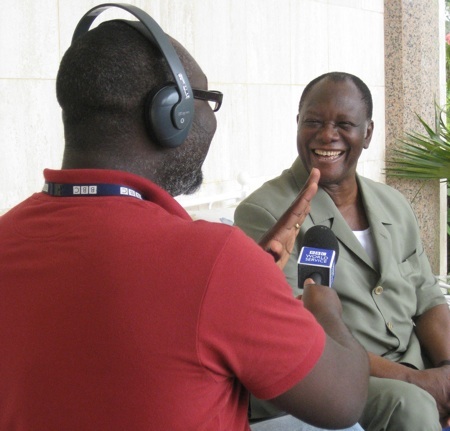
Events are moving fast in Ivory Coast, with a ceasefire reportedly being negotiated and suggestions that the besieged incumbent Laurent Gbagbo who has stubbornly refused to cede the presidency to Alassane Ouattara may now be considering surrender.
At our event on 20 April we will be discussing what message the events in Ivory Coast will send to Africa’s strongmen. With a number of elections due in in Africa in the coming year, the dispute in Ivory Coast took on added significance.
But news of a possible ceasefire comes as the UN announced the discovery of a mass grave with nearly 200 bodies. Sky News’ Emma Hurd puts the number of bodies at more than 300 and writes that the massacre in the western town of Duekoue last week shows that there are "no good guys in this conflict".
At least 800 people were killed in intercommunal violence in Duekoue last week and UN investigators believe president elect Alassane Ouattara‘s fighters were responsible for at least 220 of the deaths.
The warnings had been there for months – a disputed election, an illegitimate president clinging to power through force, and the rightful claimant arming his supporters for a battle.
But the world was focusing on Libya and Colonel Gaddafi as the simmering violence erupted into a full-scale war.
There seems no doubt now, Hurd concludes that Alassane Ouattara will win this battle.
But the atrocities committed by his fighters will taint his presidency and leave the country deeply divided.
The "robust" position taken by UN peacekeeping force which, supported by the French military, targeted forces loyal to Laurent Gbagbo after itself coming under attack, appears to have broken the impasse, writes the Guardian’s Africa correspondent David Smith.
He also highlights concerns about the role of the UN "if they are seen to be co-ordinating with the rebels to topple Gbagbo". And what if Gbagbo has stepped down?
Human Rights Watch worker Corinne Dufka, on Channel 4 News warned that even if if Abidjan and Laurent Gbagbo fall quickly, violence may continue:
A few things raise alarm bells: Ouattara’s forces the RFCI are a loose coalition from different rebel forces, Gbagbo defectors, and decommissioned soldiers, so there is a high potential for undisciplined members to commit abuses" she said
Many of them have committed war crimes in the past, which they have not been prosecuted for. And given the level of brutality of Gbagbo’s side in Abidjan, there is a very high possibility of reprisal killings by Ouattara’s forces were they to take the city.
What role should UN play in disputed elections? What role has the Economic Community of West African States (ECOWAS) and the African Union played and how effective has it been in its handling of the conflict? Join us at the Frontline Club on 20 April to discuss events in Ivory Coast and the implications for future elections in Africa. You can book tickets here.
Picture credit: bbcworldservice via a creative commons licence.
]]>]]>Mohammed Yunis Mohammed, a Mosul policeman, had been drinking when he approached the home of neighbour Salam al-Dosaki, a journalist with the local al-Hadba newspaper, police said. An argument ensued between the two men and Mohammed, an Arab, shot and killed Dosaki, a Kurd, on his doorstep. Mohammed was in police custody on Thursday evening, police said. Police said it was a personal dispute. link
]]>“Our editor-in-chief was arrested by the police in front of MACA prison, where he was covering the prisoners protest. He was later dragged out and detained like a bandit,” declared Trésor Affri, the marketing director of Alerte Info.
He added: “We exhausted every means available to us to get him released but no way. This is an arbitrary arrest and detention because Mr. Viwami was exercising a professional duty.” link

Jean-Paul Ney, the investigative journalist and war reporter arrested in Ivory Coast nine months ago, is in ill health according to the Intelink website,
Today after 9 months in jail, the health of Jean-Paul Ney is in danger. He has been hospitalized twice for Malaria and typhoid fever, and put back in jail each time. He also tried to attempt to his life. His health is our main concern, we fear for is life. link
There is a website about Ney’s situation and last week a Facebook group was created and now boasts 383 members.
]]>The 10 are accused of conspiracy against the state, belonging to an armed group, and threatening public safety and state security, said state prosecutor Raymond Tchimou. Among those detained was French photojournalist Jean-Paul Ney, who was arrested Dec. 27 outside the headquarters of national TV. He was accompanied by an Ivoirian national, Tchimou said. “The Ivoirian was carrying a firearm and the Frenchman had a number of electronic gadgets on his arm,” the prosecutor said. link
A government spokesman is quoted as saying the authorities believe Ney is tied to Ibrahim Coulibaly, a former army sergeant who lives in exile in Benin and is accused of involvement in a 2003 plot against President Laurent Gbagbo.
]]>