By Nicole Hunt
This week’s roundup includes no fewer than eight elections at all levels of government, beginning with a leadership ballot for Australia’s Labor Party on Monday. Prime Minister Julia Gillard called the snap ballot on Thursday after the sudden resignation of Foreign Minister (and former PM) Kevin Rudd amid allegations of infighting and leadership coups. Gillard has said she expects the support of her party, but will retreat to backbench politics if she loses the ballot.
If you feel like there’s a US Republican primary every week, you’re probably not far off. On Tuesday, Arizona and Michigan take their turns at choosing who they want to lead the party into battle against Barack Obama. So far, Mitt Romney is leading the pack with a delegate count of 91 to Newt Gingrich’s 32, Ron Paul’s nine and Rick Santorum’s four, but as the winner needs 1,144 delegate votes to win, everyone still has a long way to go.
The Pakistani Supreme Court is going through what one might call a bit of a busy period at the moment, handling two high profile, national interest cases. The first, which has seen Prime Minister Yousuf Raza Gilani charged with contempt of court over his decision not to investigate corruption among politicians (including President Asif Ali Zardari) after passing a controversial amnesty law in 2007, is back in court on Tuesday, with Gilani’s defence lawyer’s expected to make representations.
The second case is in court on Wednesday, and addresses allegations that the Pakistani Inter-Services Intelligence Directorate, better known as the ISI, distributed $6.5 million to opponents of the Pakistan Peoples Party in what amounts to vote-rigging in the 1990 election. The much-feared ISI is also facing a separate case involving 11 men it allegedly abducted from Rawalpindi’s Adiala jail in May 2010; the spy agency is being asked to explain the mysterious deaths of four of the detainees over the past six months.
Two psychiatrists asked to assess the mental health of Anders Behring Breivik, who admitted to carrying out the deadly 22 July attacks in Oslo and Utoya, are due to begin their four-week psychiatric evaluation on Wednesday. The experts have been asked to report back on Breivik’s mental state by 10 April, just days before he is due to stand trial. A November evaluation declared Breivik insane and unfit to stand trial.
On a day that only comes once every four years, the European Central Bank offers up something unusual, too – a 36-month longer-term refinancing operation (LTRO), one of three announced in December as part of emergency measures to support bank lending and market activities.
The success (or otherwise) of the LTRO will feed into what’s sure to be the now-customary high-pitched frenzy ahead of Thursday’s European Council meeting, at which the participating member states (that is, everyone besides the UK and the Czech Republic) are planning to sign the new fiscal responsibility treaty. The Council is also carrying out a review of the European Financial Stability Facility’s €500bn lending capacity.
Villagers in Wukan, China, hold a democratic election to choose their new village committee, unusual in China even at this level of politics. The villagers, who held unprecedented protests in December last year after a man negotiating a land dispute with authorities died in custody, had a practice run in February when they voted for the committee that would oversee Thursday’s polls.
Back to Pakistan on Friday, where the country elects 54 of the 104 members of the Senate for six year terms. The remaining 50 members are safe in their seats for another three years, when the other half of the Senate is up for grabs. Four new seats, which are reserved for minorities, have been added for this round of votes, which some hope will be followed quickly by parliamentary polls.
Iranians also go to the polls on Friday, to elect the 290 members of the Majlis for four-year terms. The election is the first national poll since controversial 2009 presidential elections, which saw the emergence of the opposition Green Movement, a subsequent crackdown on dissent, and disputed results. Reformist candidates will be hoping to beat the 51 seats won in the 2008 elections, especially as President Mahmoud Ahmadinejad is due to appear before Parliament for questioning over alleged mismanagement of the economy sometime soon.
France’s Constitutional Council is due to rule by Friday on a challenge lodged by two groups of MPs and Senators against a law criminalising denial of the Armenian genocide. The law was passed by the Senate on 23 January, but on 31 January was referred to the Council for a ruling on its validity. The Council is due to rule within one month.
Prince Harry begins a Caribbean tour as part of the Royal Family’s Diamond Jubilee celebrations. I think most people would envy him this business trip, which kicks off in Belize, and takes in the Bahamas and Jamaica before wrapping up in Brazil on 9 March.
On Saturday, a Cairo court is due to rule on charges against Free Egyptians Party founder and telecoms mogul Naguib Sawiris, who is accused of defamation and contempt of Islam over a picture he posted last summer depicting Mickey and Minnie Mouse in traditional Muslim garb.
The last of five local elections scheduled in India this quarter takes place in Goa three days before the results for all five are due to be announced. Elections have already taken place in Uttar Pradesh, Manipur, Punjab, and Uttarakhand; elections in Gujarat and Himachal Pradesh are expected later this year. The local elections are being closely watched as an early barometer of party support ahead of 2014 general elections.
The last election of the week is also the biggest, as Russia gears up to elect its next President on Sunday. While the election of former President/current Prime Minister Vladimir Putin is basically a foregone conclusion, the recent spate of anti-government protests and anti-Putin rhetoric means that Putin might find his vote percentage closer to the 52 per cent he received in his first election in 2000 than the 71% he managed in 2004.
Meanwhile, in Washington, Barack Obama is scheduled to address the annual American Israeli Public Affairs Committee’s (AIPAC) policy conference. At last yea
r’s meeting, Obama famously and controversially referred to a two-state solution based on 1967 borders with agreed land swaps, borders which Israeli Prime Minister Benjamin Netanyahu later called ‘indefensible’.
Even in the face of daily suicide bombings and a recurrent crisis of governance Pakistanis tend to get prickly when the troubled country is tagged by the western media as the most dangerous place on earth. There is even a motley crew of turgid television anchors and sundry media commentators loosely termed the Ghairat (Honour) Brigade which devotes itself to defending the nation from what it perceives as a western conspiracy to sully its reputation.
The Ghairat Brigade was revved up when CIA operative Raymond Davis killed two muggers in Lahore but very quiet indeed when news of the cruel murder of investigative journalist Saleem Shahzad hit the headlines the same time his book, Inside Al-Qaeda and the Taliban: Beyond Bin Laden and 9/11 was published. Others, especially more liberal factions of Pakistan’s journalistic community were not so silent when Shahzad was found dead, with torture markings, on a canal bank 80 miles south-east of the Pakistani capital of Islamabad. Curiously the police took it upon themselves to arrange a hurried burial and the body had to be exhumed for a proper autopsy.
Angry journalists across the county demanded explanations, many openly claiming he was picked up by the country’s intelligence outfit, the ISI, which is purportedly one of the most ruthless in the world. Last year the News reporter Umar Cheema came forward to describe how he was abducted on his way home, stripped, blindfolded, handcuffed, and beaten. He is convinced the ISI was responsible. So when Salim Shahzad disappeared a few days ago the conclusions were fast and furious. "Any journalist here who doesn’t believe that it’s our intelligence agencies?" tweeted reporter and bestselling author Mohammed Hanif.
Adding weight to this assertion was Human Rights Watch (HRW) Senior Researcher Ali Dayan Hasan who disclosed that a “reliable interlocutor” had confirmed the ISI was behind the abduction.
"This killing bears all the hallmarks of previous killings perpetrated by Pakistani intelligence agencies," he said.
When the ISI uncharacteristically issued a detailed statement through an unidentified spokesperson challenging the HRW statement, Hasan’s remarks were emphatically verified by All Pakistan Newspaper Society (APNS) President Hameed Haroon.
“Nobody not even the ISI should be above the law,” said Haroon, recalling that Saleem Shahzad had spoken to him in detail about receiving death threats from the intelligence agency and veiled warnings in supposedly “cordial” meetings. Haroon confirmed that he was one of the three recipients of an email from Shahzad disclosing these exchanges, he other two being HRW and Asia Times.
The army, specially the ISI, have long been sacred cows in Pakistan. Reporters and media groups have been quick to attack the political establishment but have been less eager when it comes to criticising the men in uniform. Writing in Foreign Policy after Shahzad’s death Pakistani journalist Huma Imtiaz, highlighted the perils of reporting on the ISI:
Reporting on the security services for Pakistan’s electronic media is a tricky, deadly game. In most cases, journalists end up censoring themselves, fearful of the either verbal or physical repercussions. In some cases, when journalists do file reports, channels refuse to air them — again, fearful of upsetting the men in Rawalpindi.
Yet in the revised climate of the American attack on Osama Bin Laden and the terrorist takeover of the naval base PNS Mehran at Karachi (both incidents exposing gaping chinks in the army and intelligence make-up) many more seem to be ready to take them on. Just a few days ago Supreme Court Bar Association President Asma Jahangir openly called Pakistani generals a bunch of “political duffers” on a local news channel and demanded they tried doing their job instead of playing politics. This is evidence of shifting ground – disparaging remarks against the country’s most organized political entity rarely make it to national broadcast.
However Shahzad, who worked for the Hong Kong based Asia Times and an Italian news wire service had hardly been the most circumspect of reporters and was particularly fearless in the first part of a comprehensive report last week where he detailed negotiations between Pakistan’s navy and al-Qaeda. Within a week of that report Shahzad was dead.
Salim Shahzad’s access to some of the world’s most treacherous terrorists was impressive enough for him to be occasionally labelled as a Taliban mouthpiece. Actually it was probably more that his reporting style was extremely accessible and that he forged relationships over time. He first interviewed Ilyas Kashmiri and Sirajuddin Haqqani when they were almost foot soldiers; Kashmiri later went on to mastermind the Mumbai bombings and Haqqani became the most influential Afghan Taliban commander. Along with his newly published book which offers an unparalleled view of the neo-Taliban, Shahzad’s contributions to reporting from the frontline of Pakistani terrorism is invaluable.
Saleem Shahzad’s murder has brought the dangers of being a journalist in Pakistan to the forefront. According to the Committee to Protect Journalists (CPJ) more journalists were killed in Pakistan in 2010 than anywhere else. Omar Warraich, who covers Pakistan for The Independent and Time magazine says that local journalists bear the brunt of the attacks from the agencies even though all journalists face equal danger from militant groups:
Western journalists are not subject to the same levels of harassment that officialdom can visit on local reporters…It is a testament to Saleem Shahzad’s bravery that he regularly travelled to the most dangerous parts of Pakistan to report important stories. He survived those trips. The chilling thought is that he faced the greatest danger in Islamabad, the sleepy capital we’ve long depended on as a safe base to work from.
It has taken Salim Shahzad’s sudden, brutal death to galvanise the Pakistani Press to act definitively. Protests have been organized at Press Clubs in Islamabad, Lahore, Karachi and Peshawar and the APNS has officially committed itself to the creation of a national body for the investigations of serious threats to the lives of journalists. The Interior Minister, Rehman Malik, has ordered an investigation into Shahzad’s murder but it will surprise many if this will yield any real results. According to the CPJ’s Bob Dietz,
the problem in Pakistan is that there is an incredibly high level of impunity. And that is, people who kill journalists are not brought to justice. The government does not fully pursue the cases and does not bring trials and prosecutions.
- Fifi Haroon is a Pakistani journalist and producer based in London. She was previously Commissioning Editor at GEO TV and now a columnist for the Express Tribune
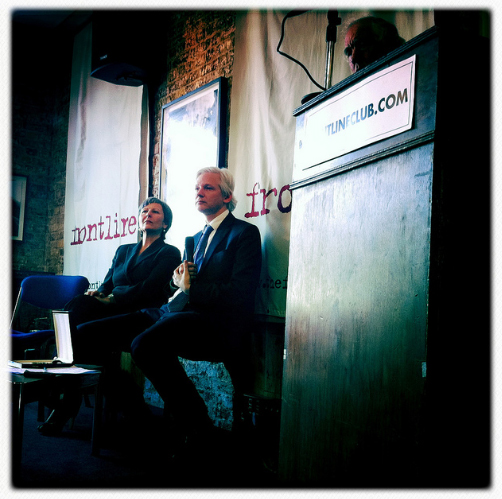
After Assange gave his acceptance speech, there was time for a question and answer session. He spoke in depth in reponse to many questions, giving insight into his position on everything from the role WikiLeaks may have played in the uprisings across the Arab world, to his opinion on the News of the World phone hacking scandal.
We have already posted the first half of the Q&A here, with word from Assange on the Arab Spring, phone hacking and WikiLeaks’ ethics.
You can now find the second and final part of the edited transcript of the Q&A below, in which Assange gives a stern evaluation of the Wall Street Journal’s new ‘Safe House‘ leaks site and suggests new WikiLeaks material on the Lockerbie bombing may be appearing soon in a Scottish newspaper…
*****
There are many who think that [convicted Lockerbie bomber Abdelbaset] al-Megrahi was simply a fall guy who was used to cover up other people who were involved in that atrocity. My question is whether WikiLeaks has information, that goes back to that sort of period (1988), on any conspiracy between the British and American governments at that time in uncovering the perpetrator of that atrocity?
 We have published quite a bit of material on the Lockerbie bombing. I suspect you will see more soon in [Scottish national newspaper] the Scotsman, but I can’t say off hand whether it will change the view that has evolved over the last year.
Some of the media have now tried to set up their own version of WIkiLeaks – the Wall Street Journal for example. I’m just wondering if you’ve had a look at them and what you think about those operations?
So we have pushed for a long time for media organisations to be more aggressive in their sourcing and to be more protective of the people who actually are involved [in leaking information]. So in so far as the Wall Street Journal represents a tendency to take up our ideas we were really pleased, and in fact we told everyone: ‘look, the Wall Street Journal’s doing this’. al-Jazeera has also done a similar thing.
Unfortunately, it’s not as easy as it looks. It’s not as easy to stand up to influence as it looks and taking heat is not as easy it looks. So, the Wall Street Journal, if you look at the fine print, says that it can sell you out to anyone at any time – law enforcement, any other interests that it feels like. It makes no guarantees. And a security system analysis shows that it is also weak. But there is a broader general principle, that I think that we’re going to see over the next couple of years – as major media organisations try to retain their role of having sources of information coming directly to them and not having any intermediary – and that is: whistleblowers, like writers, need agents. And for all the same reasons: that if they become captive to a particular publisher … they need someone who knows the system and knows how to deal with potential publishers.
Similarly, those presenting to a court need lawyers to represent them. And those presenting to the court of public opinion need experts in how to understand the difficulties and dangers of presenting to the court of public opinion.
What about the distrust between the ISI [Pakistani intelligence agency, Inter-Services Intelligence] and the US? How real is it?
From my reading the distrust has been there for a long time. But when a strong relationship started to occur between the ISI there was computerisation of ISI’s systems by the US – there was also scrutiny of the top tier staff within the ISI. There are divergent interests between the ISI and the United States as I outlined before. I don’t expect those divergent interests to go away. The battle between divergence and convergence I think is possibly on the side of divergence. But that’s just speculation on my behalf.
The Wall Street Journal have said that they won’t be able to protect sources. What do you think about that? And secondly, is it possible at the moment to give information to WikiLeaks?
Presently we are reengineering our submission system and that has to do with quite a long and difficult story of sabotage of various kinds and the differing and extra hostile environment which we have found ourselves in.
However, it is possible to get us information in a number of ways. We’ve also reached a publicity profile so high now that it means we have to do things differently. Because we’ve started to become completely inundated with material. So that’s a matter of the appropriate engineering, and making sure the material is of a particular calibre that fits the size of the number of people who can assess it.
It’s quite an interesting psychological problem, when dealing with sources, in that, most sources, most of the time, don’t reveal anything. People can go 40 years without revealing anything and then one day they do. So this is about an activations threshold. That at some point, the feeling becomes strong enough that if they want to act and they then need to be caught at this moment and protected at this moment. And some of them have a feeling that they want to act that is so strong that they don’t care about the risks at all. So one also must protect them from themselves, which is quite a difficult thing to do.
So the Wall Street Journal and the similar organisations that whistleblowers are thinking about dealing with: it is not just the technology, it’s a combination of technology and people. The technology is opaque and very complex and sophisticated if done right. So how are you to assess whether the technology has been done right? How are you to assess whether these people will sell you out? You have to look at the people who are running the organisation. What is their history and their experience. Have they stood up to pressure before? And have they managed themselves before?
There’s almost no organisations that have that track record other than us – and individual journalists, there’s just a few with a track record of not buckling when they receive pressure. So I advise everyone who’s thinking about disclosing confidential information to look very closely at the track record of the people that they may be dealing with. But don’t Google their name from your home.
So the Wall Street Journal doesn’t measure up?
No. It doesn’t measure up on any criteria.
]]>