It is now thirteen years since US and British troops entered Iraq and the significant costs are still being counted: hundreds of thousands of lives lost, millions of refugees, increased insecurity for the UK, enormous financial cost, and the emergence of Daesh contributing to an increasingly volatile region. Will the much-delayed report sufficiently address the UK’s widely criticised involvement? We will be joined by a panel of experts to hear their initial reactions – and without the power to assign criminal culpability, we will consider the report’s potential impact in bringing those accountable to justice and in assuring that a foreign policy disaster of this scale is not repeated.
Chaired by Channel 4 News international editor, Lindsey Hilsum.
The panel:
Hayder al-Khoei is an associate fellow at the Middle East and North Africa programme at Chatham House and research director of the Centre for Academic Shi’a Studies. He is also a member of the Atlantic Council’s Task Force on the future of Iraq.
Carne Ross is the executive director of Independent Diplomat. He is a former British diplomat who resigned in 2004 after giving evidence to the Butler Inquiry into the Iraq war.
Emma Sky is a Senior Fellow at Yale University’s Jackson Institute. She worked in the Middle East for twenty years and was made an Officer of the Order of the British Empire for services in Iraq. She is the author of The Unraveling: High Hopes and Missed Opportunities in Iraq.
Christopher Elliott, retired as a major general from the British Army in 2002. He is currently a visiting professor of Cranfield University, an associate fellow of RUSI and author of High Command: British Military Leadership in the Iraq and Afghanistan Wars.
]]>Jo Metson Scott spent the past five years photographing American and British soldiers who spoke out against the wars in Iraq and Afghanistan. Using their letters and portraits, her book The Grey Line explores the soldiers’ reasons for doing so, and the fates that have awaited them.
Metson Scott introduced The Grey Line to a Frontline Club audience on Tuesday night, with journalist Victoria Brittain and former SAS soldier Ben Griffin joining her on stage.

Metson Scott described the proces of collating her book:
“The Project is about individuals, or soldiers, who have moral doubts about their involvement in the Iraq War, and over a period of five years I went back and forth to America and I interviewed about 40 soldiers. . . . I essentially was looking at what an individual does when they’re contractually obliged to do something that they’re morally opposed to.”
“The thread that runs through them all,” Griffin said of Metson Scott’s subjects, “is a moral objection to what’s going on – seeing a moral bankruptcy in what is being done in these countries.”
Griffin himself fought in Iraq in 2004:
“We would go out in the nighttime and use explosives to smash our way into people’s homes. . . . These were normal civilians . . . I suppose it could all be summed up when my commanding officer . . . said that he was worried that we were becoming the secret police of Baghdad. . . . I contemplated this every day. What was I doing? What was I doing taking part in this?”
In 2005, he refused to return and was discharged. He began criticising the Iraq War in public, and in 2008, a High Court injunction banned him from ever speaking again on what he knew from his time in the service.
Griffin adhered to the injunction for two and a half years.
“I actually became quite ill,” he remembered, “in a sort of PTSD kind of way. Got very depressed, and I was drinking a lot, and I was thinking about Iraq, and the rest of it. And I decided that maybe what was causing the illness to be worse was that I had this duty to speak.”
In 2011, he founded the UK Chapter of Veterans for Peace.
Griffin praised Metson Scott for capturing the courage in her subjects:
“The most important point to make about this resistance is that of all the guys I’ve met . . . this is not about being scared [of getting hurt].
“This is about being morally opposed to doing it to other people . . . to shooting people . . . to killing people, to torturing people, to dragging them out of their houses in the middle of the night.
“[Yet] the media likes to portray these [soldiers] as cowards.”
At its core, Griffin tied the problem to Empire – “Britain and America are basically an Empire,” he said – and that the projection of power – “the war in Iraq I think is pretty straightforward: it’s about controlling the oil supply” – has lacked a real moral footing.
Audience member Anwar Sarwar, also a British veteran of the Iraq War, agreed:
]]>“I’ve been to Auschwitz and Birkenau . . . it was absolutely horrific. . . . This is a wider case about whether you should fight for Queen and Country, etc. When something like that happens, you’ll feel it in your stomach. And I’m sure that loads of people here are willing to get up and fight that kind of tyranny.
“That’s not the kind of thing that was going on in Iraq, where I served twice, and I was also one of the first troops to invade. . . . I was the guy kicking the doors in.”
View in iTunes
Despite hundreds of thousands of people having taken to the streets of London and elsewhere to voice their opposition to military action in Iraq, on 19 March 2003, air strikes on the Presidential Palace in Baghdad began.
What followed was a US-led invasion that toppled Saddam Hussein’s government, and marked the start of years of violent conflict. Ten years on, in a debate chaired by Channel 4 News’ Jon Snow, we will ask: have lessons been learned?
The legacy of the Iraq War changed Western foreign policy, but with talk of Northern Africa becoming a new front in the war on terror, have the mistakes of Iraq been sufficiently ingrained on the consciences of populations and governments? To what degree is the impact on relations between the Middle East and the West still felt?
We will also be examining what has been heard at the Chilcot Inquiry and why we are still waiting to hear the findings.
Chaired by Channel 4 News presenter Jon Snow.
The panel:
Caroline Wyatt has been BBC defence correspondent since October 2007, covering the work of British Forces in Iraq and Afghanistan. In 2003 she was embedded with British troops reporting on the war and its aftermath in and around Basra. Previously she has been BBC correspondent covering Paris, Moscow, Berlin and Bonn.
Rt Hon Jim Murphy is Labour Member of Parliament for East Renfrewshire. He is currently the Shadow Secretary of State for Defence and has previously served as Secretary of State for Scotland.
Jack Fairweather is the author of A War of Choice: Britain in Iraq 2003-9. The Daily Telegraph’s Baghdad and Gulf correspondent for five years, he was an embedded reporter during the Iraq invasion, winning the British equivalent of the Pulitzer prize for his reporting. Most recently he has been the Washington Post’s Islamic world correspondent. He is a fellow of the Centre for Middle Eastern Studies at Harvard University, and is working on a history of the Afghan war.
Peter Oborne, the Daily Telegraph‘s chief political commentator and author of The Rise of Political Lying and The Triumph of the Political Class.
Sir Jeremy Greenstock is chairman of the UN Association in the UK, the strategic advisory company Gatehouse Advisory Partners Ltd and Lambert Energy Advisory Ltd. He was a career diplomat from 1969 to 2004, developing specialisations in the Middle East, Transatlantic Relations and the United Nations. He served as UK Ambassador to the UN in New York from 1998 to 2003 and as UK Special Envoy for Iraq, based in Baghdad, from 2003 to 2004.
]]>
 "He was there!" Director Thomas O’Connor said of English author and journalist Graham Greene (1904-1991), the subject of his documentary Dangerous Edge: A Life of Graham Greene, which was viewed by a full house at the Frontline Club on 1 October.
"There, you know, for 70 years, from one place to another, in these hot spots."
Greene – whether meeting with the Pope, giving a speech to Gorbachev’s Kremlin, conversing with Latin American rulers, or journeying in the 1930s through the hinterlands of Mexico or Liberia – had his finger on the very pulse of the 20th century: its crimes of foreign policy, the inner angst of its inhabitants.
In his own life, Greene left his wife and two daughters early on, indulged in drugs, prostitutes and affairs, suffered from bipolar disorder, and fought powerful suicidal urges, often admitting to his own yearning to die.
"Dear Vivien," he wrote to his wife, "the fact that must be faced, dear, is I have been a bad husband. You see, my restlessness, moods, melancholia, even my outside relationships, are symptoms of a disease, not the disease itself. Unfortunately, the disease is also one’s material. Cure the disease and I doubt whether a writer would remain."
"He was a tremendously courageous writer and journalist," O’Connor reflected, sharing that a driving motivation to make the film was that he "worried about journalism [today]," that future generations would lack voices as brave and voluminous as Greene’s.
"Some writers write their novels," O’Connor said, "and then every once in a while a letter to the Editor. Greene had a whole book of letters to the Editor!"
His eyes searing with intelligence and sensitivity, Greene asked readers to see more deeply into the world around them. He challenged the injustices of big business, globalization, Soviet totalitarianism, and British and American interventionism.
"I would go to any lengths to put my feeble twigs into the spokes of American foreign policy," Greene wrote.
His 1955 novel The Quiet American paired the damage done by a naive American idealist with that by a cynical English journalist like himself, both living in Saigon and desiring the same Vietnamese woman. The work so touched a nerve that, as O’Connor highlighted, even George W. Bush could not help mentioning it in a 2007 speech to American war veterans.
O’Connor wished Greene had been alive to challenge the narrative that led to the latest invasion of Iraq.
]]>"We still need writers," he argued, "as [Greene] famously said, ‘with a sliver of ice in their heart,’ and willing ‘to be a piece of grit in the state machinery.’"
In 1970, English documentarian Michael Grigsby released I Was a Soldier, which explored life after war for three young men returning from Vietnam to their homes in the heartland of Texas.
Grigsby went back to Texas last year, rekindling his friendships with these men and their families, and telling their updated story in We Went To War.
After a screening at the Frontline Club on September 17, Grigsby and co-director Rebekah Tolley answered questions from the audience. They elaborated a philosophy of film that seemed, at its very core, to be about feeling, healing, and connecting – processes that veterans, weighed down by trauma and loneliness, can find as rare as they are vital.
Tolley and Grigsby were asked how they had captured such authenticity in their subjects.
"It’s a word called trust," Grigsby answered. "Very simple."
When making We Went to War, he and Tolley spent the first few days with their subjects discussing directions the film might take, but the next three weeks without a camera, simply spending time together. In the end, Grigsby reflected:
"We gave the [subjects] the space to be themselves … That’s a crucial thing in the way I like to make pictures: let people be what they are, and don’t let’s try to have an agenda in which we try to force the pace."
Yet once filming began, they shot We Went to War in only 11 days.
"I like to shoot fast, actually," Grigsby said. "The main reason is … if you’re invading some people’s life, you want to give them the minimum hassle."
Meditative in style, We Went to War’s scenes often contain little more than shots of Texas’ beautiful rustic landscape, set to a mournful guitar. Grigsby explained:
"When you hear some very powerful dialogue, I want time to absorb it, actually. I don’t want to be pushed on to the next scene, and the next scene. And one of the ways we’ve done that, I think, is just cutting to a landscape … and you can just resonate, and think, about things … just to give us, the audience, time to think, to feel, to listen. And I feel very deeply this is something sadly missing now … that time, the space, to think, to feel."
Another reason to highlight space, Grigsby said:
"Was to emphasize all that loneliness. I feel, in the world, we’re like figures in a landscape. We rarely communicate and rarely touch one another."
"In a sense, I don’t think we [as documentary makers] have a mission to explain. We have a mission to feel."
Both I Was a Soldier and We Went to War have drawn rave reviews, particularly from veterans. Grigsby shared:
"We heard of one veteran who saw the film … and we’re told that he went home and apologized to his lady of 40 years, that he hadn’t been able to understand what she was going through. And for the first time in 40 years, it seems that they are now having a dialogue. And that’s incredible. It’s just incredible to ask that one film can actually just open the eyes and the heart a little bit and enable this thing to happen. That’s, that’s beautiful."
We Went to War has not been officially released yet, but the trailer and future screening dates can be found on this website
]]>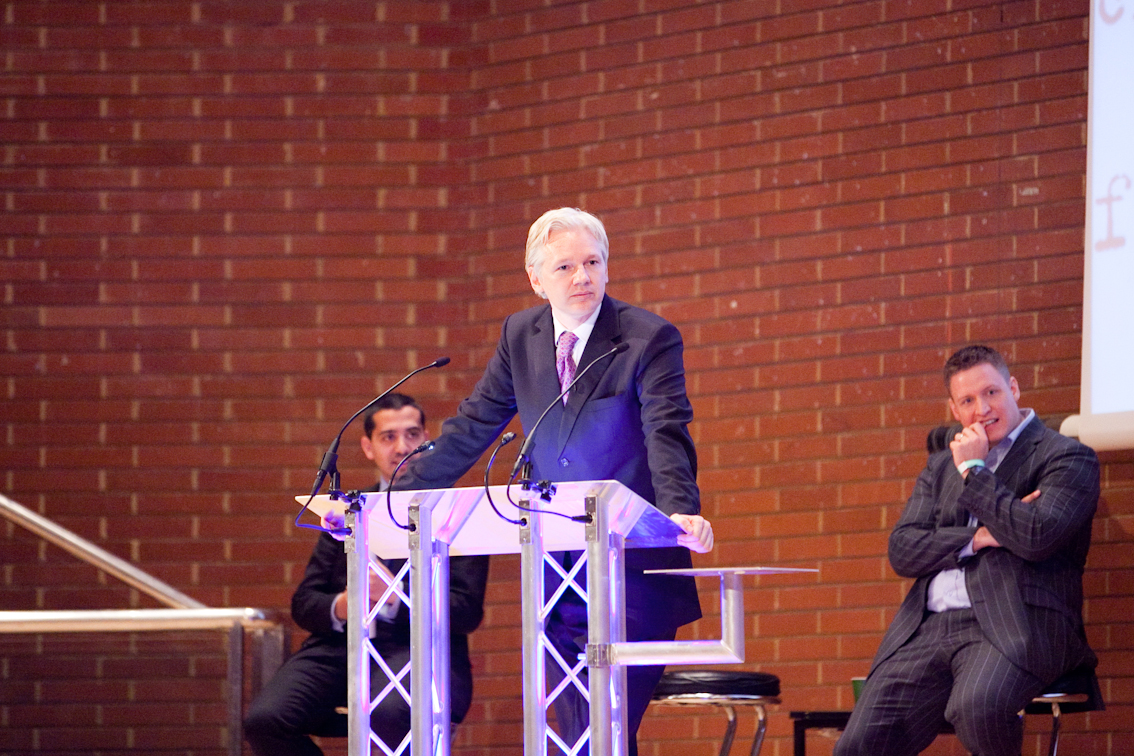
WikiLeaks editor-in-chief Julian Assange makes his case at Kensington Town Hall. Photo by Sophia Spring.
You can view the full event here.
This is part II of our report on the special debate, “whistleblowers make the world a safer place,” organised by the Frontline Club in collaboration with New Statesman magazine. Part I can be found here.
Bob Ayers
It was always going to be fascinating seeing former CIA agent Bob Ayers share the stage with Julian Assange. It is well documented that the WikiLeaks editor-in-chief has been trailed by intelligence agents many times before – but rarely has he engaged with one head on in a public debate.
Ayers, now an international security analyst, spoke quietly and calmly. His argument was nuanced, raising his voice only briefly at one point to tell Assange to “sit down” as he attempted to make an interjection. “As people, we’ve developed a very rich language that describes people who reveal secrets,” he said. “We call them a ‘snitch’, a ‘rat’, a ‘squealer’, a ‘traitor’ or a ‘whistleblower’.”
Unlike his fellow panelist Sir David Richmond, Ayers made no concessions. His argument appeared critical of anyone who broke what he repeatedly referred to as “an oath.”
Reaching his conclusion, he seemed to take a veiled pop at Assange and WikiLeaks, asking: “Individuals, or organisations, who encourage us to break that oath, or facilitate our breaking of that oath, or promote us breaking that oath … are they just as guilty as the person who breaches the oath itself?”
The whistleblowers
After Ayers, there was a brief interlude for the input of two prominent whistleblowers, Paul Moore and Annie Machon. Machon, an ex-MI5 agent who in 1996 revealed, among other things, an illegal MI6 assassination attempt against Colonel Gaddafi of Libya, was first to talk about her experiences. Machon spoke about her shock at uncovering criminality within the British intelligence services and said revealing the information to the public was the right thing to do. When challenged by Douglas Murray over signing the Offical Secrets Act, she quickly retorted: “We signed the Official Secrets Act to protect secrets, not crimes.”
Former head of risk at the bank HBOS, Paul Moore was next. Moore spoke out in 2009 after being made redundant for blowing the whistle on alleged recklessness at HBOS. Quoting the bible, he said that whistleblowers are necessary as we are “transformed by truth”. Expressing his disapproval that a whistleblower was not on either panel, Moore also blew a whistle on stage in protest. “Whistleblowers prevent disasters but they get treated like toxic waste or lepers,” he said.
Questions
After contributions from the whistleblowers, chair Jason Cowley read out a question submitted by the audience. The question was based on a common criticism leveled against WikiLeaks – that the information they have published could, in some instances, put lives at risk. What about the “collatorial damage”? Cowley asked Assange.
The 39-year-old Australian stepped forward and confidently proclaimed his belief that “WikiLeaks has never got it wrong”. The Pentagon, Assange said, had more blood on its hands than WikiLeaks.
(Assange then told the audience to Google “Pentagon” and “blood on its hands”, and compare the results with “WikiLeaks” and “blood on its hands”. It is a far from scientific measure, but interesting nonetheless … the WikiLeaks search gets around 30,000 results and the Pentagon 125,000.)
Mehdi Hasan
Next to take centre stage was Question Time heavyweight, New Statesman senior editor and Ed Miliband biographer Mehdi Hasan. A natural orator, Hasan’s passionate speech was immediately hailed on Twitter as the best of the evening (even before the final speaker, Douglas Murray, had got his chance to speak).
Hasan began by talking about Joe Darby, the former US soldier who exposed horrendous abuses of Iraqi prisoners at Abu Ghraib prison in Baghdad. Quoting Darby, he recounted: “’They say ignorance is bliss, but to actually know what they were doing – you can’t stand by and let that happen’ …
“That is what whistleblowing is all about,” said Hasan, “and that is why it is so important.
“In a perfect world, of course we wouldn’t need whistleblowers, we wouldn’t want whistleblowers. But, surprise surprise, we don’t live in a perfect world … We live in a very imperfect world, where out governments and others lie to us, repeatedly.”
He continued: “They engage in corrupt backroom deals, they break the law at home and abroad and then they demand our trust … and then they say, ‘well you don’t need whistleblowers’ … well stop lying to us and we won’t have any whistleblowers!”
Hasan then questioned the political right’s fear of whistleblowers, urging support for the motion “whistleblowers make the world a safer place” for the sake of the whistleblowers themselves.
“Whistleblowers empower us all by exposing the truth,” he concluded.
Douglas Murray
A ubiquitous commentator, author and journalist Douglas Murray is often touted as the UK’s only neoconservative. Murray began slowly, building up his argument towards a gradual crescendo.
At first he acknowledged there were flaws inherent in western democratic governments. “It is perfectly true that democracies and democratic governments can be and in most cases are at some point dishonest,” he said, “and yes, they can be corrupt.”
Reiterating a similar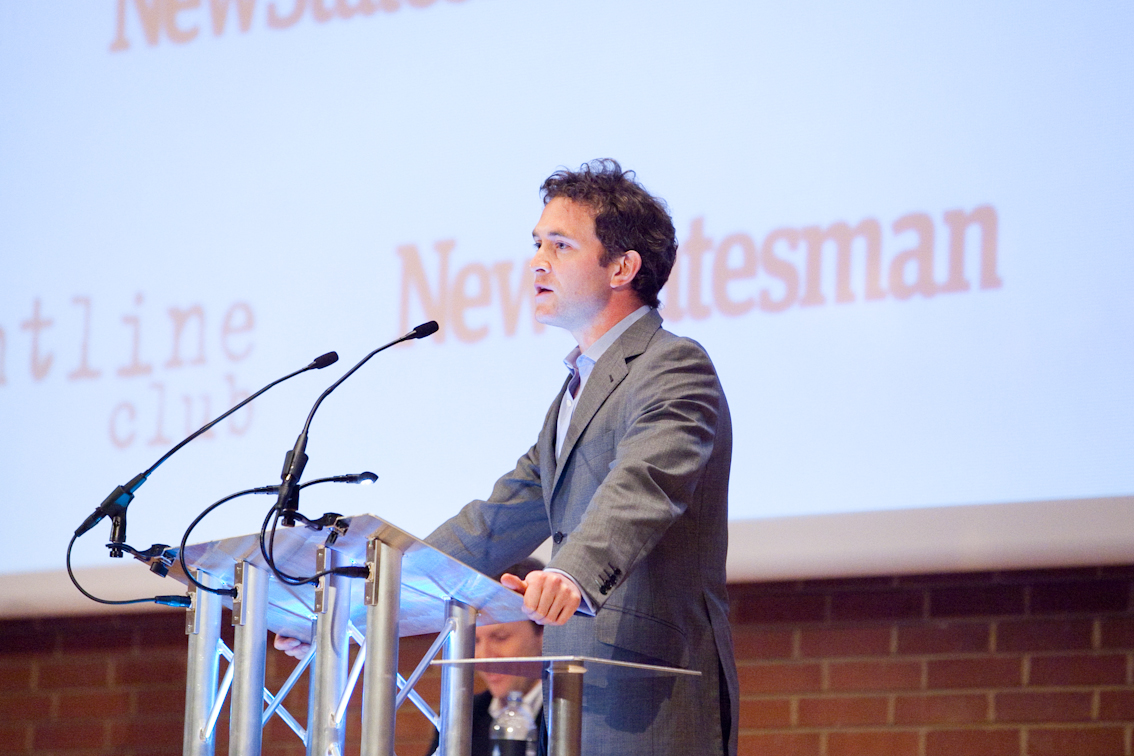 line of argument taken by his fellow panelist Sir David Richmond, Murray spoke about “checks and balances” and said he didn’t believe it should be up to “leakers” to decide what we know.
Looking at Assange, he then went on the attack. “Do the leakers – do WikiLeaks – know what they’re doing?” he asked.
“My own personal feeling is this: when you unleash thousands and of documents that were never meant for the public eye, were never meant for your opponents eyes, were never meant for foreign intelligence agencies eyes – you introduce an element of chaos. It’s like war. It’s very hard to contain once you start it. You may think you know what you’re doing … but what about the collateral damage in your campaign.”
Straying from the discussion about whistleblowers, Murray rattled off a number of questions in Assange’s direction. He asked why WikiLeaks has never
exposed wrongdoing in countries such as Russia and asked about WikiLeaks sources of funding.
“Who works for you?” Murray asked. “Who are you involved with? Where are you even based? …
“What gives you the right to decide what should be known to governments and what should not?
“Governments are elected. You, Mr Assange, are not.”
Midway through his speech, each member of his opposition – Assange, Swisher and Hasan – attempted to make an interjection, but were sent back to their places by a firm Murray.
Assange was eventually allowed to make a ‘point of information’ when Murray repeated a claim – made by the Guardian’s David Leigh – that he had stated Afghan informants deserved to get killed.
Assange said he was taking legal action over the remark, and asked Murray if he wanted to “join the cue” of those he was suing. (Note: David Leigh has since stated there has been no law suit filed against him or the Guardian.)
Cowley then asked Assange: “Should the great champion of open society use libel law to sue newspapers?”
Assange responded: “Lies have no social utility, the truth has a social utility. The abuse of libel laws is a terrible thing. That is why I was involved in constructing the world’s strongest libel legislation, in Iceland, to protect us all from the abuse of libel laws, and have complained constantly here in the UK.
“But actual lies, by powerful organisations that abuse the size of their megaphone in the industry, must have recourse. And that recourse is in the courts and in the court of public opinion.”
By the time Murray neared the end of his speech, there was little time for more contributions or points of information. He accused Assange of thinking he was “better than our governments”, to which someone in the audience retorted, “that’s because he is!”
Moments later, due to the delays at the start of the event, Assange was forced to leave the stage early in order to meet the conditions of his bail. A vote was cast while he was still on the stage, which showed little change in the audience’s opinion.
The motion, “this house believes whistleblowers make the world a safer place,” was passed overwhelmingly and the debate was concluded.
Many thanks to all those who came along and made the event a great success!
Full video footage coming soon. All photos by Sophia Spring.
Download this episode
View in iTunes
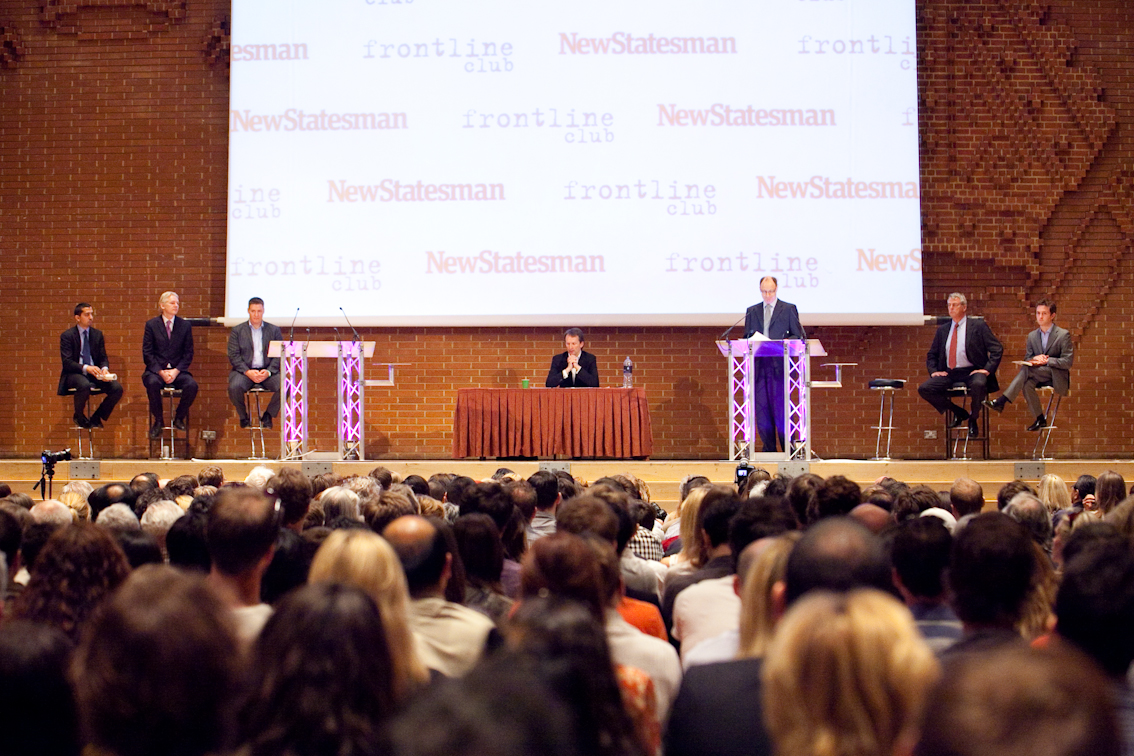 Sir David Richmond makes his case against whistleblowing at Kensington Town Hall. Photo by Sophia Spring.
More than 850 people crammed in to Kensington Town Hall on Saturday evening for our special debate in collaboration with New Statesman magazine, “this house believes whistleblowers make the world a safer place.”
In the style of Oxford University debates, there were two teams – one arguing against the motion, the other arguing in favour of it. Each speaker was given no more than seven minutes to make his case, and objections were encouraged in the form of ‘points of information’ or ‘interjections’.
For
* Clayton Swisher, head of Al Jazeera’s transparency unit
* Julian Assange, WikiLeaks editor in chief
* Medhi Hasan, New Statesman’s senior political editor
Against
* Sir David Richmond, former director, defence and intelligence, British Foreign & Commonwealth Office
* Bob Ayers, former director of the US Department of Defence Information Systems Security Programme
* Douglas Murray, author and political commentator
Also featuring
* HBOS whistleblower Paul Moore
* MI5 whistleblower Annie Machon
The debate
After a 20 minute delay because of large queues to get in to the venue, the room fell silent as Frontline Club’s founder Vaughan Smith took to the stage to welcome the audience. He then introduced the debate’s chair, New Statesman editor Jason Cowley.
Each of the panelists gathered silently on the stairway beside the stage, awaiting their introduction. Clayton Swisher was first, followed by Julian Assange and Mehdi Hasan. Then the opposition: Sir David Richmond, Bob Ayers and Douglas Murray. Before the debate got underway, there was an audience vote on the motion. It revealed that the overwheming majority of those in the room believed whistleblowers did indeed make the world a safer place.
Clayton Swisher
Swisher was first to take to the podium. A previous US federal investigator turned journalist, he spoke at length about what he described as “unprecedented government secrecy”.
“We live in a time of unprecedented govt secrecy and unprecedented wrongdoing,” he said. “We also have a phenomenon of collusion between mainstream media organizations … it’s a distressing trend in this era of journalism.”
He went on to describe data journalism of the kind pioneered by WikiLeaks as “the future”, before recounting the problems al Jazeera faced in January prior to the publication of the Palestine Papers.
Interestingly, Swisher revealed the British secret service – Mi6 – had directly pressured al Jazeera to prevent publication of an alleged MI6 agent’s name prior to the release of the Palestine Papers.
“We were under tremendous pressure from the British government,” he said. “In fact, we fielded calls from MI6 to withhold publication of the name of an alleged MI6 officer who proposed a secret rendition programme to take mid level operatives and intern them with EU funding. Now this is a plan that is illegal under international law.
“At the end of the day we said, if this was a Libyan intelligence officer, would we withhold his name? No…
“We put the name out there and guess what? The world kept turning. No one got hurt; the end was not nigh. “
Sir David Richmond
Next to the podium was member of the opposition, Sir David Richmond. He started by acknowledging that his panel had their “work cut out”, and immediately conceded that “blowing the whistle can be justified.”
But, in a direct attack on WikiLeaks, he condemned the leaking of information on a massive scale.
“Genuine examples of whistleblowing are buried in an avalanche of classified material that shows no abuse at all,” he said.
“Many leak not to expose wrongdoing but for political advantage, because they disagree with a particular policy or because they take the view that governments should not be in the business of keeping information secret.”
He then proposed there were better ways to improve government than whistleblowing, suggesting that reform was the answer:
“If the right balance is not being struck [between the public’s need to know and the government’s need to keep secrets], the democratic way to address this is not by whistleblowing … instead we should improve the democratic and constitutional processes by which the executive is held up to scrutiny: parliament, the media, the courts and the rights enjoyed by individual citizens operating within a framework established by law.”
Julian Assange
By a long way the most anticipated speech of the evening, Julian Assange was greeted by a huge wave of applause as he took his turn to argue in favor of the motion, “this house believes whistleblowers make the world a safer place.”
Standing tall in a black suit and red tie, Assange began by reframing the question, asking: “would the absence of whistleblowers make the world a more harmful place?”
He dismissed previous speaker Sir David Richmond’s position, before making his case against secrecy.
“How are we going to know if the secrecy process is working or not?” he said, “because when information is concealed, we do not know about it. The only way we can know if information is legitimately kept secret is when it is revealed. All systems of censorship have that problem encoded within them. And because of that original sin of censorship they all must be held to outside account.”
He went on to describe whistleblowers as “courageous individuals” who in difficult circumstances engage in “squirreling out” information. He also took a jab at the mainstream media, describing it as “rarely” an “honest conduit”.
Referencing the Iraq War Logs as well as Cablegate, Assange criticised the Chilcot Inquiry into the Iraq war, calling it a “set up”.
“I could speak for hours about what has occurred in Cablegate and all the tremendous revelations that have happened there,” he said. “Just yesterday the editor of the Hindu – the most respected paper in India – brought over 21 front pages from the past six weeks that were based on Cablegate material. The Indian parliament has walked out four times and there is now a tremendous anti-corruption movement that is building up in that country. . . something that hasn’t happened since the time of Gandhi.”
He then reached his conclusion, in which he made an underreported and often overlooked clarification on his position, by asserting that he does in fact not believe in absolute transparency.
“It is obvious that whistleblowers make the world a safer place,” he said. “And when we try to look at the counter arguments we see hot air. It doesn’t mean that everything in government should be exposed. What it does mean is that the system of breaking alleged laws is working. And that must be kept going … otherwise wars cannot reflect accurately the reality that we are in.”
More to follow
]]>The sheer scope and significance of the revelations is shocking. Among them are great abuses of power, corruption, lies and war crimes. Yet there are still some who insist WikiLeaks has "told us nothing new". This collection, sourced from a range of publications across the web, illustrates nothing could be further from the truth. Here, if there is still a grain of doubt in your mind, is just some of what WikiLeaks has told us:
* American planes bombed a village in Southern Yemen in December 2009, killing 14 women and 21 children (see Amnesty)
* The Secretary of State’s office encouraged US diplomats at the United Nations to spy on their counterparts by collecting biographic & biometric information (see Wired.com)
* The Obama administration worked with Republicans to protect Bush administration officials facing a criminal investigation into torture (see Mother Jones)
* A US Army helicopter gunned down two Reuters journalists in Baghdad in 2007 (see Reuters)
* US authorities failed to investigate hundreds of reports of abuse, torture, rape and even murder by Iraqi police and soldiers (see the Guardian)
* In Iraq there were scores of claims of prison abuse by coalition forces even after the Abu Ghraib scandal (see the Bureau of Investigative Journalism)
* Afghan President Hamid Karzai freed suspected drug dealers because of their political connections (see CBS News)
* Israeli Prime Minister Benjamin Netanyahu expressed support for the concept of “land swaps” (see Yahoo News)
* The United States was secretly given permission from Yemen’s president to attack the Al-Qaeda group in his country (see the Guardian)
* Then-Secretary of Defence Donald Rumsfeld and his top commanders repeatedly knowingly lied to the American public about rising sectarian violence in Iraq beginning in 2006 (see the Daily Beast)
* The US was shipping arms to Saudi Arabia for use in northern Yemen even as it denied any role in the conflict (see Salon.com)
* Saudi Arabia is one of the largest origin points for funds supporting international terrorism (see the Guardian)
* A storage facility housing Yemen’s radioactive material was unsecured for up to a week (see Bloomberg)
* Israel destroyed a Syrian nuclear reactor in 2007, fearing it was built to make a bomb (see the Sunday Times)
* Top officials in several Arab countries have close links with the CIA (see the Peninsula)
* Swiss company Trafigura Beheer BV dumped toxic waste at the Ivorian port of Abidjan, then attempted to silence the press from revealing it by obtaining a gagging order (see WikiLeaks)
* Pakistan’s government has allowed members of its spy network to hold strategy sessions on combating American troops with members of the Taliban (see the New York Times)
* A stash of highly enriched uranium capable of providing enough material for multiple "dirty bombs" has been waiting in Pakistan for removal by an American team for more than three years (see CBS News)
* US military Special Operations Forces have been conducting offensive operations inside Pakistan, despite repeated denials from US officials (see the Nation)
* China was behind the online attack on Google (see ZDNet)
* North Korea is secretly helping the military dictatorship in Myanmar build nuclear and missile sites in its jungles (see CBS News)
* The Indian government "condones torture" and systematically abused detainees in the disputed region of Kashmir (see CBS News)
* The British government has been training a Bangladeshi paramilitary force condemned by human rights organisations as a "government death squad" (see the Guardian)
* BP suffered a blowout after a gas leak in the Caucasus country of Azerbaijan in September 2008, a year and a half before another BP blowout killed 11 workers (see the Guardian)
* Saudi Arabia’s rulers have deep distrust for some fellow Muslim countries, especially Pakistan and Iran (see CBS News)
* Saudi Arabia’s King Abdullah repeatedly urged the United States to attack Iran (see the Guardian)
* Iranian Red Crescent ambulances were used to smuggle weapons to Lebanon’s militant Hezbollah group during its 2006 war with Israel (see CBS News)
* Dozens of US tactical nuclear weapons are in Germany, the Netherlands and Belgium (see * The Libyan government promised "enormous
repercussions" for the UK if the release of Abdel Baset al-Megrahi, the Lockerbie bomber, was not handled properly (see CBS News)
* Pope Benedict impeded an investigation into alleged child sex abuse within the Catholic Church (see MSNBC)
* Sinn Fein leaders Gerry Adams and Martin McGuinness carried out negotiations for the Good Friday agreement with Irish then-prime minister Bertie Ahern while the two had knowledge of a bank robbery the Irish Republican Army was planning to carry out (see CBS News)
* Anglo-Dutch oil giant Royal Dutch Shell PLC has infiltrated the highest levels of government in Nigeria (see the Guardian)
* A US official was told by Mexican President Felipe Calderon that Latin America "needs a visible US presence" to counter Venezuelan President Hugo Chavez’s growing influence in the region (see Yahoo News)
* Cuba’s economic situation could become "fatal" within two to three years (see Business Week)
* McDonald’s tried to delay the US government’s implementation of a free-trade agreement in order to put pressure on El Salvador to appoint neutral judges in a $24m lawsuit it was fighting in the country (see the Guardian)
* British officials made a deal with the US to allow the country to keep cluster bombs in the UK despite the ban on the munitions signed by Gordon Brown (see Politics.co.uk)
* The British government promised to protect America’s interests during the Chilcot inquiry into the Iraq war (see the Guardian)
* The US government was acting on behalf of GM crop firm Monsanto in 2008, when the US embassy in Paris advised Washington to start a military-style trade war against any European Union country which opposed genetically modified (GM) crops (see the Guardian)
* Pfitzer tested anti-biotics on Nigerian children, contravening national and international standards on medical ethics (see Medical News Today)
* Prisoners at Camp Delta (Guantanamo Bay) were denied access to the Red Cross for up to four weeks (see the Telegraph)
* More than 66,000 civilians suffered “violent deaths” in Iraq between 2004 and the end of 2009 (see the Telegraph)
* Russia is a “virtual mafia state” with rampant corruption and scant separation between the activities of the government and organised crime (see the Guardian)
* The Obama administration tried to “sweet-talk” other countries in to taking Guantanamo detainees, as part of its (as yet unsuccessful) effort to close the prison (see the New York Times)
]]>