“This is not a phone conversation…”
– Soviet saying
Introducing his new book The Red Web: The Struggle Between Russia’s Digital Dictators and the New Online Revolutionaries at an event at the Frontline Club on Tuesday 29 September, co-author and founder of Agentura.Ru Andrei Soldatov began by saying that to understand modern Russia you must first understand the mentality and historical relationship between citizen, state and surveillance.
“The saying – ‘this is not a phone conversation,’ used by soviet citizens – is still in use today and reflects a continuity of some habits we inherited from the soviet past.”
The impact of this soviet legacy is mirrored in the methods and the principles of the FSB’s modern communication interception systems, as well as the “strange” and complicit relationship between the state military industrial complex and the telecommunications industry in Russia.
Soldatov continued: “The most important principle for the Russian system of surveillance is the back door to all Russian communications, which provides direct access to all servers, all networks on Russia soil.” The country’s revolving door policy between state and private sector results in a “complete lack of resistance, even collusion from the industry itself.”
Furthermore, said Soldatov, the “surveillance mentality” seen today derives more from the soviet approach to control, which prioritised intimidation and self-censorship, than from the use of technology.
“Russia’s system of online surveillance is not very sophisticated. The problem is that the Russian state is extremely skilful in sending a message: ‘You might be spied on… Be careful.’ And in a country with a very recent totalitarian past one needs to be only reminded of what might happen and that is enough.”
@AndreiSoldatov @irinaborogan presenting new book the Red Web in @frontlineclub #russia #putinAtWar pic.twitter.com/jI9W7OnBq0
— Agne Dovydaityte (@AgneDovydaityte) September 29, 2015
Co-author Irina Borogan acknowledged the problems of this soviet legacy and suggested that while the strategy President Putin has tried to apply to the internet is similar to that he successfully used to suppress traditional media in the early 2000s, his basic misunderstanding of how social media works post-Arab Spring leaves room for optimism.
“Once again, the Kremlin’s approach was based more on intimidation than mass oppression or technology. Putin believes that all things exist in a hierarchical structure and if you exert pressure from the top you can rule all things. But this fails to understand the internet as a network, which we all know has no centre – everyone can participate without authorisation.”
For Privacy International researcher Edin Omanovic, from the perspective of the state it is less a problem of a soviet citizen mentality than Putin’s worldview shaped by KGB/FSB surveillance policy.
“It is the narrative between how the horizontal approach to new technology is changing the world and being a force for liberation, versus how new technology is actually a force for oppression.”
Omanovic added that this is not merely a problem confined to Russia, but one that involves the billion-dollar private surveillance industry throughout the world, where cooperation between surveillance manufacturers and state defence contractors is often implicit.
The future of #Russia's internet: walking on the knife's edge – one kept purposefully obscure. http://t.co/LmzbEczf8m
— oDR (@opendemocracyru) September 14, 2015
For the BBC’s former Moscow correspondent and event moderator Daniel Sandford, while the KGB tactic to focus solely on dissident leaders and “well known trouble-makers” combined with often high levels of incompetence led to a certain lack of control, there is a concern that the FSB’s increasing professionalism – and a better organised and resourced state surveillance programme than existed in the 1970s and 80s – will see the state bring the internet under its control as it has done with other traditional media outlets.
Borogan, however, disputed this suggestion, claiming that what differentiates today from the soviet era is that “technology is getting cheaper and cheaper all the time and to install an all-powerful surveillance network throughout the entire country is ever more difficult.”
The widespread nature of internet networks will, in essence, beat Big Brother.
For Tonia Samsonova, foreign correspondent for Echo Moskvy, it is the actual goal of decision makers who are establishing the surveillance state that is the issue.
“One part of [these people] are actually working for the government, for the security of the regime, the others think of their job as a business. So one might ask what are the real goals of those guys? Are they to protect Putin, protect themselves as a class or to make as much money as they want?”
For Samsonova the danger lies not in the cynical surveillance measures of today, but in data departments and analytical models which can be used to predict issues and trends before they happen and to preemptively target potential trouble-makers.
]]>A packed audience filled the Frontline Club forum on 23rd October to hear a panel tackle the question: In whose hands should internet governance be entrusted? Chaired by the Chief Executive of Index on Censorship Kirsty Hughes the event, in association with BBC Arabic, featured: Icelandic MP Birgitta Jónsdóttir; developer for The Tor Project, Jacob Appelbaum; independent media technology consultant, Karl Kathuria and director at the Cyber Security Centre Dr Ian Brown.
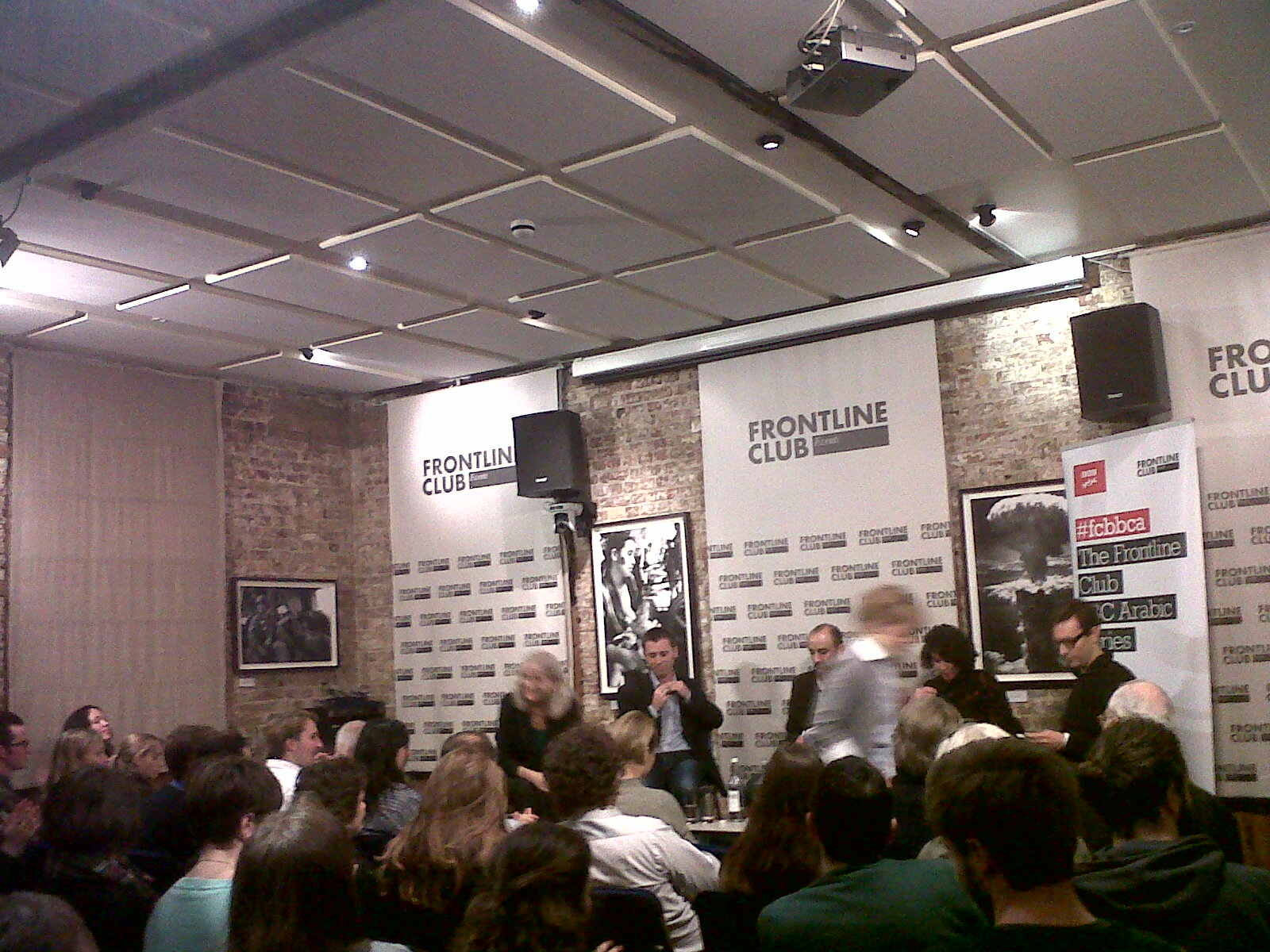
Dr Ian Brown kicked off proceedings by describing the distribution of power over cyberspace. Referring particularly to ICANN (Internet Corporation for Assigned Names and Numbers) which runs the international domain name system and although it is a “international facing” it is governed by US laws.
“Is it fair that this one powerful country the US should have such say over something that is a global resource?… Since so many large internet companies; the Googles, the Facebooks, the Twitters and so on, that are becoming increasingly important in internet governance debates, are headquartered in the US or at the very least have significant exposure to the US, and US law and case law has very firmly said that the behaviour of companies… with any assets exposed to the US had better watch out when it comes to their behaviour elsewhere in the world because there have been a number of US laws applied to the behaviour of these companies elsewhere in the world”
Karl Kathuria then moved on to discuss the censorship of information by governments from a more optimistic viewpoint, describing his time at the BBC on access to users in Iran and China:
“People were still able to get access to that content anyway, people are always looking for the content… its average everyday people who are reaching out.”
Birgitta Jónsdóttir has misgivings on calls for further global internet governance:
“Shouldn’t we have a global freedom of information act?… it is impossible… it would destroy the internet as it is today… maybe we need to start to look at this differently.”
Jacob Appelbaum, a core member of the anti snooping software Tor described the rise of cyber snooping and the oppression it can bring:
“Surveillance is a support system for violence.”
“What we see is a massive expansion of authoritarianism across the globe, even in so called free countries… the mere fact that it has gone so far and the American government has become so brazen.. is an incredibly bad sign, because in a lot of ways the US has led the world in these matters.”
“Freedom from suspicion is part of the necessity for feeling free… we should look at Facebook as stasi-book, and we should look at human data as human data-traffic. It is not a problem of over there-istan, it is a problem over here.”
Birgitta Jónsdóttir discussed the Iceland Modern Media Initiative as a solution to internet governance and excessive cyber snooping, and its uptake by the Icelandic Government to turn Iceland into a “safe haven” for freedom of information.
“Take the same concept as if you were to create a tax haven, so why not create the same for a freedom of expression and speech haven… if you have one country that sets the standard [other countries will rise to it]. I have a dream for a ‘Scandinavian Shield’… as the Scandinavian countries now have a good idea of the importance of these rights to bring the laws into the 21st century.”
Dr Ian Brown finished on a note about public uptake of new technology that can divert around any governmental snooping, “encouraging people to use the tools that already exist is the first step”.
View reaction to the debate on Twitter: #fcbbca, or watch the debate as it happened below.
]]>External event held at the Royal Institution of Great Britain, 21 Abermarle St, London W1S 4BS.
Recent government proposals to allow increased police and intelligence agencies’ monitoring of email and social media communications have angered civil liberties campaigners who claim they are a breach civil liberties.
A new report by the think-tank Demos examines “the ethical, legal and operational challenges involved in using social media for intelligence and insight purposes”. Co-authored by former GCHQ director and ex-cabinet office security and intelligence chief Sir David Omand, it argues that police and intelligence agencies need to use social media as a form of intelligence but that laws need to ensure a balance is struck between security and intelligence work in this new environment.
Join us as we discuss to what extent security services should be able to monitor our cyber activity. Is this form of cyber surveillance a threat to the public’s civil liberties or necessary to keep them safe? Can a balance be struck?
The Demos report, entitled #intelligence can be downloaded here.
Chaired by Rory Cellan-Jones, the BBC’s technology correspondent and author of the blog, dot.rory. Twitter:@BBCRoryCJ.
With:
Isabella Sankey, the Director of Policy at Liberty (the National Council for Civil Liberties) which she joined in November 2007. She leads Liberty’s parliamentary lobbying and policy development, working in particular on the protection of human rights in the context of counter-terror policy. As such, she was heavily involved with Liberty’s successful Charge or Release campaign against holding terror suspects for 42 days without charge. She is a non-practising barrister and previously worked for the Legal & Constitutional Affairs Division at the Commonwealth Secretariat.
Rt Hon David Davis MP, Member of Parliament for Haltemprice and Howden since 1997 and former Shadow Home Secretary. As a Minister in the last Conservative government he served in the Cabinet Office and the Foreign Office. In the latter, he was responsible for Security Policy and European Policy, overseeing the majority of the country’s international negotiations. In 2008 he resigned his seat and his position in the Shadow Cabinet to fight a by-election to highlight the Government’s undermining of civil liberties. After winning with a large majority, he returned to Parliament.
Jamie Bartlett, head of the violence and extremism programme at Demos. His primary research interests lie in terrorism, radicalisation and extremism, conspiracy theories and integration policy. He is the co-author of #Intelligence and in 2011 undertook the first ever survey of Facebook fans of far-right parties in Europe. Twitter: @JamieJBartlett.
Professor Anthony Glees MA MPhil DPhil, a professor of Politics at the University of Buckingham and director of its Centre for Security and Intelligence Studies (BUCSIS). He has a specialist concern with Security and Intelligence issues and has written and lectured on aspects of the history of British intelligence, on the Stasi, on Islamism, on terrorism and counter-terrorism, and on subversion in western democracies both today and in the past.
Additional panelists to be confirmed.
In association with:

]]>
Download this episode
View in iTunes
This event will take place at the Frontline Club, 13 Norfolk Place, W2 1JG.
Recent government proposals to allow increased police and intelligence agencies’ monitoring of email and social media communications have angered civil liberties campaigners who claim they are a breach civil liberties.
A new report by the think-tank Demos examines “the ethical, legal and operational challenges involved in using social media for intelligence and insight purposes”. Co-authored by former GCHQ director and ex-cabinet office security and intelligence chief Sir David Omand, it argues that police and intelligence agencies need to use social media as a form of intelligence but that laws need to ensure a balance is struck between security and intelligence work in this new environment.
Join us as we discuss to what extent security services should be able to monitor our cyber activity. Is this form of cyber surveillance a threat to the public’s civil liberties or necessary to keep them safe? Can a balance be struck?
The Demos report, entitled #intelligence can be downloaded here.
Chaired by Rory Cellan-Jones, the BBC’s technology correspondent and author of the blog, dot.rory. Twitter:@BBCRoryCJ.
With:
Isabella Sankey, the Director of Policy at Liberty (the National Council for Civil Liberties) which she joined in November 2007. She leads Liberty’s parliamentary lobbying and policy development, working in particular on the protection of human rights in the context of counter-terror policy. As such, she was heavily involved with Liberty’s successful Charge or Release campaign against holding terror suspects for 42 days without charge. She is a non-practising barrister and previously worked for the Legal & Constitutional Affairs Division at the Commonwealth Secretariat.
Rt Hon David Davis MP, Member of Parliament for Haltemprice and Howden since 1997 and former Shadow Home Secretary. As a Minister in the last Conservative government he served in the Cabinet Office and the Foreign Office. In the latter, he was responsible for Security Policy and European Policy, overseeing the majority of the country’s international negotiations. In 2008 he resigned his seat and his position in the Shadow Cabinet to fight a by-election to highlight the Government’s undermining of civil liberties. After winning with a large majority, he returned to Parliament.
Jamie Bartlett, head of the violence and extremism programme at Demos. His primary research interests lie in terrorism, radicalisation and extremism, conspiracy theories and integration policy. He is the co-author of #Intelligence and in 2011 undertook the first ever survey of Facebook fans of far-right parties in Europe. Twitter: @JamieJBartlett.
Professor Anthony Glees MA MPhil DPhil, a professor of Politics at the University of Buckingham and director of its Centre for Security and Intelligence Studies (BUCSIS). He has a specialist concern with Security and Intelligence issues and has written and lectured on aspects of the history of British intelligence, on the Stasi, on Islamism, on terrorism and counter-terrorism, and on subversion in western democracies both today and in the past.
Additional panelists to be confirmed.
In association with:
]]>
US intelligence, he argued, is overly focussed on the enemy, unable to answer basic questions about local political, economic and cultural dynamics and is "only marginally relevant to the overall strategy". He also claimed that US military culture was "emphatic about secrecy but regrettably less concerned about mission effectiveness".
The fact that the report was published via the Center for a New American Security (CNAS) rather than through conventional military channels has also raised a few eyebrows.
I’ve selected a couple of interesting blog posts on the report which understandably has invited a significant level of comment:
1. Tim Lynch runs an Afghanistan based security firm. He’s a retired Marine and is not too keen on the intelligence techniques of the CIA in Afghanistan:
"Our vaunted CIA never leaves the wire under any circumstances even in tame places like Jalalabad so all their intel comes from people who walk into the FOB’s. How good is the product they are producing using these risk averse intelligence gathering techniques and procedures? It is worthless – or as the general in charge of military intelligence put it ‘marginally relevant.’"
(It’s worth visiting Lynch’s blog just to check out the slightly alarming comment under a photo of a guard searching people entering a British base in Helmand).
2. Similarly, this civilian advisor based in Regional Command South reckons the authors of the report are spot on:
"There’s lots of information out there about the civilian population in Afghanistan. Where is the closest market? What are the roads like between here and there? Is there a district governor? Does he come to work? What tribe is he from? How many people get “night letters” from the Taliban? Who “controls the night?”
But the problem is that the people who are supposed to collect and analyze intelligence don’t think those questions are important."
3. The Small Wars Journal has a good list of other posts if you’re interested.
]]>