
Joshua Oppenheimer
It is estimated that over 500,000 people were slaughtered in Indonesia between October 1965 and the early months of 1966.
Paramilitary militias and vigilante groups, coordinated by the Indonesian army and aided by British and American intelligence agencies, were responsible for mass killings in the country’s anti-communist purge. Nearly 50 years later and the perpetrators still hold power and are heralded as national heroes.
In his groundbreaking 2012 film, The Act of Killing, Joshua Oppenheimer exposed the impunity with which the perpetrators live. On 18 September The Fontline Club screened Oppenheimer’s follow up piece, The Look of Silence.
After the screening Oppenheimer joined the Frontline Club over Skype.
The Look of Silence follows Adi, an optometrist whose brother was murdered during the anti-communist purges. Throughout the film Adi meets and directly confronts those responsible for his brother’s death.
Although he does not feature in The Act of Killing, Oppenheimer told the Frontline Club that Adi was an important collaborator in both films. “Over the years making The Act of Killing, Adi would watch everything we had time to show him,” said Oppenheimer.
It was this involvement that lead Adi to ask Oppenheimer to help him meet his brother’s killers. “I sat down with [Adi] and he said, ‘you know Josh, I’ve spent seven years watching your footage of the perpetrators, and it’s changed me and I need to meet the man who killed my brother… I need to confront them and see if they can take responsibility for what they’ve done.’”

Joshua Oppenheimer
Making the film with Adi could have been extremely dangerous. “There has never before been a film where survivors confront perpetrators who still hold a monopoly on power,” said Oppenheimer who initially refused to make the film this way.
However after their experience working on The Act of Killing, Ali believed that confronting his brother’s killers would help reconciliation. “He though they would welcome this as this chance to sort of be forgiven by their victims families… and to stop this manic boasting which he always felt was defensive,” said Oppenheimer.
“I didn’t realise that he might be right until after I started to film Anwar Congo,” Oppenheimer said referring to the main protagonist in The Act of Killing. None the less he was still sceptical that Adi would receive the apology he was hoping for. In the five years that he filmed with him, Oppenheimer told the Frontline Club that never once did Anwar Congo consciously admit to himself that he was wrong to have killed.
Instead, with The Look of Silence, Oppenheimer hoped that the meetings between Ali and his brother’s killers would allow him to capture the unconscious guilt
“Maybe if I can film with precision and empathy and intimacy,” said Oppenheimer, “the complex human reactions that are inevitable when you go into someone’s home and say ‘look you’ve killed my brother, please can’t you take responsibility for this for the sake of our children’… then we can make visible the previously invisible abyss of fear and guilt that’s dividing everybody in this society.”
Oppenheimer told the Fontline Club that the primary audience was always intended to be Indonesians. There was an outpouring from human rights groups and survivors that Oppenheimer needed to keep filming with the killers in order to expose the lie that the 1965 killings were heroic.
“[I] felt as though I was entrusted by the survivors and the human rights community to do a work that clearly they could not safely do themselves… and I felt therefore much more like their agent than I ever felt like a foreign filmmaker,” said Oppenheimer.
The release of The Act of Killing has started a transformation around the way that Indonesia talks about its past. “Whereas the mainstream media was once, with very few exceptions, or before with very few exceptions silent about the genocide or celebrating the heroic extermination of the Indonesian left, now they talk about the genocide as a genocide,” said Oppenheimer.
Because of the changes that The Act of Killing have made to the national discourse, Oppenheimer told the Frontline Club that The Look of Silence released in a much bigger way than would have been possible if it was a standalone film. “Adi came to both [premier] screenings as a surprise guest and received a 15 minute standing ovation,” he said.
The two films have prompted the introduction of a truth and reconciliation bill into parliament. “It’s woefully inadequate,” said Oppenheimer, “… but it’s a great step because it sort of enshrines the acknowledgement that what happened was wrong.”
As well as catalysing change within Indonesia, Oppenheimer is also hoping to pressure both the UK and US governments to openly admit to their role in the killings.
“That’s, I think, terribly important if we’re going to actually stand up against impunity at home in the west, and if our talk about human rights, our rhetoric about human rights is not to be merely hypocritical.”

Joshua Oppenheimer
In this multi-award winning companion piece to The Act of Killing, filmed before its release, Joshua Oppenheimer further explores the terrible legacy of the Indonesian genocide fifty years ago, this time through the lens of one family.
Adi was born in 1968, two years after his brother Ramli was slaughtered in front of many eyewitnesses. Now an optometrist, Adi lives with his elderly parents and his children. Not only does he live under the ongoing rule of his brother’s killers, but he must listen to his children regurgitate the propaganda that instigated the killing, and is still being perpetuated in schools.
Adi decides to confront some of the perpetrators of the genocide, who are surprised when his questions are more probing than Oppenheimer‘s. His breaking of the silence leads to some electrifying scenes, in a film where the beauty of the Indonesian landscape belies the bone-chilling horrors carried out there in the name of democracy.
Radically different to Oppenheimer’s previous film, The Look of Silence is equally shocking and keenly observed. Filmed in his characteristic visual style, the film bears witness to the collapse of fifty years of silence.
“One of the greatest and most powerful documentaries ever made. A profound comment on the human condition.” – Errol Morris
“Profound, visionary, stunning.” – Werner Herzog
Director: Joshua Oppenheimer
Producer: Signe Byrge Sørensen
Year: 2014
Runtime: 103′
Distributor: Dogwoof UK
www.thelookofsilence.co.uk
The second Between the Lines Festival follow-up event took place at the ICA on 29 June, and was a showing of the director’s cut of the Act of Killing followed by a Q&A with director Joshua Oppenheimer. This remarkable film provides a look at the 1965-66 anti-Communist mass killings in Indonesia from the perspective of the former members of death squads. Oppenheimer offered perpetrators the opportunity to re-enact some of their murders in the style of their favorite movies, providing a unique and controversial insight into a period of Indonesian history that still remains largely ignored and unknown.

Oppenheimer filmed almost every perpetrator he could find within the North Sumatran Plantation Belt and collected some 1,400 hours worth of material. He explained how he was motivated to understand how these men saw themselves and how they felt others perceived them. If these questions could be answered, he would be able to better understand the regime, its motivation, as well as the perception of the killings in Indonesia today.
The film largely follows one man, Anwar Congo, who, like all the other perpetrators that Oppenheimer interviewed, proudly boasts of the murders he committed, even demonstrating the methods he used to kill to the camera. Towards the end, after participating in and viewing scenes from his past being re-enacted, Anwar appears to express remorse. Oppenheimer stated that the film holds up a ‘dark mirror, first to Anwar, and then to Indonesian society as a whole, and I hope that we . . . will see ourselves in that dark mirror to’.
Oppenheimer described how scenes were put together: the perpetrators provided ideas for how the scenes would be portrayed and Oppenheimer encouraged them to re-enact scenes in the style of different film genres. These re-enactments, and the justifications the perpetrators gave for the killings, were important as they began to serve as ‘allegories for impunity, allegories for what happens when no one’s held to account’. In listening to these justifications, he realised that they may actually ‘be a sign that the person is too afraid to admit that what they were doing was wrong; it can be a symptom of remorse…or…a conscience’.
In addition, Adi, another perpetrator, states regularly in the film that the killings were wrong and that the government should apologise. By stating that the killings that he participated in were wrong, he is portraying himself as someone who is tough and can live with himself; he is ‘showing off his numbness’ and lack of conscience.
In response to a question regarding a scene where Adi is shown at the mall with his family, Oppenheimer explained that he wanted to show an image of consumer society that could be anywhere in the world, that relies on devastation to exist:
“We destroy everything we touch, and we’re almost helpless to do so. . . . We’re collectively responsible insofar as we depend on these kind of men everywhere in the world, to keep labour cheap, to keep our consumer society going. . . . We also should remember that the military dictatorship allows Western corporations to break strikes, to seize land – this is the West’s vision for Indonesia.”
An audience member pointed out that in the closing credits, many roles are credited as anonymous. Oppenheimer explained that while Indonesia has welcomed the film, it is still unsafe for the many of the Indonesians that worked on the film – including his co-director – to give their names. It is still very difficult for Indonesians to discuss the events from 1965-66, and Oppenheimer explained that his motivation stemmed from encountering survivors from this period who had been terrorised into silence. He felt that what he was witnessing was too similar to his own family’s experience of the Holocaust for him to not try to expose truth to other Indonesians.
★★★★★ for The Act of Killing in the FT: 'mind-boggling, psyche-boggling, soul-boggling' http://t.co/IpJ6aeykmf Director's cut screening here
— Institute of Contemporary Arts (@ICALondon) June 29, 2013
From the beginning Oppenheimer was in contact with the organisation Tapol and many other Indonesian human rights organisations, who all contributed to the filmmaking process. He acknowledged that the government of Indonesia needs to apologise, before any changes to society can be made. This film has had a big impact on Indonesian society, and has ‘triggered an opening in Indonesia’, where there are discussions about what happened in the media. Investigations are being held and young people are becoming more interested in their history. There is also a movement to recover Indonesian culture, which was destroyed.
Oppenheimer expressed his hopes that Indonesia can go further by holding tribunals for the high-ranking men who ordered the killings, beginning the process of truth and reconciliation, along with developing grassroots political movements to reform the government, remove corruption, and work towards a fairer redistribution of wealth.
Both the regular and director’s cut of The Act of Killing are distributed by Dogwoof and continue to play throughout London and the UK. A list of upcoming screenings and Q&A’s can be found here.
Between the Lines was a three-day festival that took place at Rich Mix from 1 to 3 March. In a series of follow-up events we continue to explore the challenges facing documentary makers, investigative journalists and citizen reporters in the new media landscape.
This screening was in association with Picturehouse Docs and Tapol.
]]>
In this chilling and inventive documentary, produced by Errol Morris and Werner Herzog, the unrepentant former members of Indonesian death squads are challenged to re-enact some of their many murders in the style of the American movies they love.
In the 1960′s Anwar Congo was a leader in Indonesia’s pro-regime paramilitary the Pancasila Youth who, along with his band of dedicated followers, was amongst those who participated in the murder and torture of more than a million alleged Communists, ethnic Chinese and intellectuals. Proud of their deeds and completely unpunished, Anwar and his pals are delighted when the film’s director asks them to re-enact these murders for the documentary – in any genre they desire. Initially Anwar and his friends enthusiastically take up the challenge using hired actors, making elaborate sets and costumes and even using pyrotechnics, but eventually as the movies violence is played out and reconstructed, Anwar finally begins to feel unease and remorse.
Directed by Joshua Oppenheimer
Year: 2013
duration: 159′
Between the Lines was a three-day festival that took place at Rich Mix from 1 to 3 March. In a series of follow-up events we continue to explore the challenges facing documentary makers, investigative journalists and citizen reporters in the new media landscape.
This screening is in association with Picturehouse Docs and Tapol
Presented by:


Supported by:


Position Among the Stars completes director Leonard Retel Helmrich‘s multi award-winning trilogy capturing complexities of religion, politics, and now economics, following the lives of one family in a Jakarta slum.
Helmrich follows Tari, the only educated child of the family, as she struggles with the impulses of becoming a teenager with their expectations of her as their hope for a better future.
Filmed over 12 years using Helmich’s own ingenious technique dubbed "single-shot cinema", each of the three films – Eye of the Day, Shape of the Moon and Position Among the Stars – stands alone in its message and time, while providing both a microscopic look into the changing Indonesian life and into globalisation.
Position Among the Stars will be released in UK theatres on 17 February.
**Winner, Sundance World Cinema Special Jury prize – Best Documentary 2011**
**Winner, IDFA Award – Best Feature-Length Documentary 2010**
Directed by: Leonard Retel Helmrich
Year: 2010
Length: 115′

]]>
By Nicole Hunt
The International Atomic Energy Agency (IAEA) Board of Governors meets in Vienna on Monday, with Iran likely to be high on the agenda following last week’s report expressing increased concerns over ‘undisclosed nuclear related activities’ in the country.
Bouthaina Shaaban, political adviser to Syrian President Bashar al Assad, is in Moscow, where she is scheduled to meet with Foreign Minister Sergey Lavrov and hold a press conference for international media. Shaaban was one of three Syrian officials slapped with sanctions by the US Treasury Department at the end of August.
The African National Congress is expected to wrap up disciplinary proceedings against controversial ANC youth leader Julius Malema on Tuesday, having recently moved the hearing from the ANC headquarters at Luthuli House to an undisclosed location in Johannesburg following violent protests last week. Malema is accused of bringing the ANC into disrepute and sowing divisions within ANC ranks after he encouraged the overthrow of Botswana’s government.
In Brussels, the OECD publishes its annual Education at a Glance report, analysing the education systems and performances in member states. For the first time, this year’s report also looks at education in Brazil, China, India, Indonesia, Russia and South Africa.
The European Court of Human Rights in Strasbourg hears a complaint on Wednesday brought by four people who say they were illegally deprived of their liberty without justification while they were held in a police ‘kettle’ during the 2001 May Day protests in London.
In New York, the UN Security Council holds a debate on drought-stricken Somalia, where security issues have compounded problems as aid struggles to get into the country and people struggle to get out.
Parliamentary elections take place in Denmark on Thursday. Recent polls say Helle Thorning-Schmidt could be the country’s next Prime Minister, as her opposition Social Democrat party looks poised to win the most seats.
A court in The Hague is due to rule on Apple’s application to ban sales of Samsung’s Galaxy phones. A temporary injunction banning sales and distribution throughout much of Europe was issued on 11 August, but is not due to come into effect until 13 October.
Following debates this week in several European parliaments on new powers for the European Financial Stability Fund, European finance ministers begin a two-day meeting on Friday.
The International Criminal Court in The Hague holds a confirmation of charges hearing for Callixte Mbarushimana, a former UN employee charged with crimes against humanity and war crimes in the Democratic Republic of Congo in 2009. Mbarushimana is alleged to have been the executive secretary of the Democratic Forces for the Liberation of Rwanda and directly responsible for at least 32 deaths in Rwanda during the 1994 genocide while still employed by the UN, but has never been charged.
Libyan schools are scheduled to re-open on Saturday, with a brand new curriculum devoid of Gaddafi-era subjects such as the Green Book.
At the Dead Sea in Israel, photographer Spencer Turnick stages another mass nude photoshoot, hoping to bring awareness to the fact that the famously salty lake is drying up.
The week wraps up with state elections in Berlin, the sixth in Germany this year. The regional elections have generally proven disastrous for Angela Merkel’s CDU party, which has suffered losses country-wide to the Social Democrats, a trend that many expect to continue into the 2013 federal election.
]]>
Monday is the beginning of a new month and the beginning of the holy Muslim month of Ramadan.
In Saudi Arabia, the date is doubly significant: following the 18 June beheading of Indonesian maid Ruyati binti Sapubi and the near-beheading of another maid known as Darsem, an Indonesian moratorium on sending domestic workers to the country comes into effect.
There have also been whispers of another women’s driving protest to coincide with the first day of Ramadan, but so far nothing as organised as the 28 June attempt.
Tuesday is debt ceiling day in the US. While one hopes that the increasingly heated negotiations will lead to a solution before then, there remains the increasingly real possibility that the US could default on its $14tn debt.
In Cape Town, Mziwamadoda Qwabe and Xolile Mngeni are due to go on trial over the 13 November, 2010 murder of British honeymooner Anni Dewani. Mngeni was unable to attend the last hearing, reportedly due to surgery to remove a brain tumour, and is unlikely to be in attendance.
All eyes on Egypt on Wednesday, as the trial for ousted President Hosni Mubarak and his sons Alaa and Gamal is due to begin, but looks likely to be postponed. Former Interior Minister Habib al Adly is also tried, after his trial was postponed from 25 July so he could be heard alongside the Mubaraks.
Less dramatic is a Supreme Court hearing taking place in Sydney, where the Australian government is taking legal action against former Guantanamo inmate David Hicks over his 2010 book Guantanamo, My Journey. The government says Hicks is illegally gaining commercial benefit from a crime.
The Food and Agriculture Organization’s (FAO) monthly Food Price Index is released on Thursday, with the July figures of interest as drought and famine continue to ravage the Horn of Africa. US
President Barack Obama celebrates his 50th birthday as the week begins to wind down.
Following the excitement around the final Atlantis mission in July, NASA launches Jupiter explorer Juno on Friday, the first solar-powered spacecraft designed to operate so far from the sun.
Saturday marks the 66th anniversary of the Hiroshima atomic bomb. A commemorative ceremony takes place at the Peace Memorial Park in Hiroshima, and nuclear disarmament campaign groups hold events worldwide.
Voters go to the polls in Cape Verde on Sunday to elect their next President. Incumbent Pedro Pires, who won by less than one percent in the 2006 elections, is not a candidate.
]]>Mapping a Day in the Life of Twitter from Chris McDowall on Vimeo.
It’s worth viewing in full screen, in HD, on Vimeo as you can see some of the fainter spots lighting up around the world.
Among other places, the map clearly highlights the popularity of Twitter in Indonesia.
There are waves of activity in the USA in the middle of the night on 18 November 2010. An East Coast wave occurs just before 08.00 GMT, a Midwest one just before 09.00 GMT and a broader sweep including the West Coast just before 10.00.
McDowall says these are caused by "an automated Twitter service that tweets local news for specific ZIP codes".
There’s more about the technical background on McDowall’s blog.
]]>
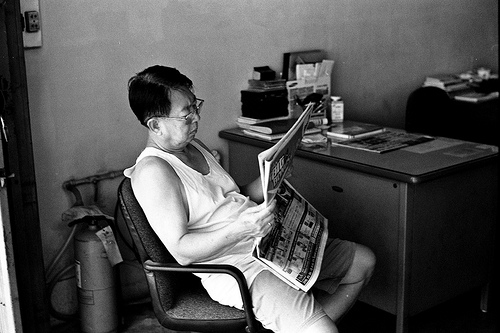
What with reports of newspapers being in survival mode, websites like Paper Cuts twisting the blade, Twitter channels like The Media is Dying dancing on the grave and research that reads like an obituary, any sane journalist must be thinking of shutting up shop, going home and seriously mulling their next move – out of journalism. But it’s not all grim. If this report in TIME is anything to go by, we should all be looking at a move east,
In India alone, 11.5 million new newspaper readers were added in 2008, and ad growth is chugging along at around 10% — less robust than over the past two years but still remarkably strong. "Many people can’t enjoy their morning cup of tea without their newspaper," says Rahul Kansal, chief marketing officer for the Times of India, the world’s most read English-language broadsheet and a major player among a whopping 64,998 newspapers registered across India. link
And it’s not just India. Indonesia, China and Japan all boast healthy and growing newspaper sales – and English language editions. However, it’s not all good news. In a week that saw one journalist killed and another attacked in the region,
]]>The world’s most fertile ground for newspapers is also the most dangerous for reporters. In 2008, 26 Asian journalists were killed in the line of duty, according to the International Press Institute, making Asia even deadlier than the Middle East for the fourth estate. Some 54 Asian journalists are languishing behind bars, says media watchdog Reporters Without Borders. Those disheartening statistics underline, however, the importance of Asia’s newspapers as a check on the excesses of power — something that should never go out of fashion. link

British journalist and filmaker Max Stahl has been documenting the history of East Timor since the 1991 massacre at Dili’s Santa Cruz cemetery. He calls it is “his life’s mission” to give the fledgling country an audio visual record of its recent history. To that end he has set up an audio-visual centre in the capital Dili,
]]>“It is enormously important because you cannot forge an identity without memory,” says the 53-year-old, sporting a hat in the black, red and yellow colours of his adopted country. Stahl’s audio-visual centre in the Timorese capital of Dili is devoted to preserving that memory in digital recordings of events leading up to and after the 2002 declaration of independence. link