At the same time, the controversial leader has shaken up the country’s diplomatic ties, calling for a split from the United States and turning toward China as a new ally. This move presents an obstacle to the United States’ efforts in the South China Sea, unsettling its position as the dominant power in the Pacific.
Will president Duterte be held accountable for the mass killings taking place in the Philippines? How did the disturbing violence currently sweeping the country begin, and what does it teach us about impunity, power and the spread of violence?
Chaired by Paul French, an author and widely published analyst and commentator on Asia, Asian politics and current affairs.
Speakers (full panel announced soon):
Gilberto G.B. Asuque is Deputy Chief of Mission of the Philippine Embassy
Vladimir Hernandez has been working as a journalist for over 15 years in Latin America, covering big stories like the drug war in Mexico, the years of Hugo Chavez in Venezuela and the Kirchner rule in Argentina.
Eric Gutierrez is Christian Aid’s Senior Governance Adviser, and author of the report “Drugs and Illicit Practices: Assessing its impact on governance and development”. He grew up in Manila, where he published on criminal entrepreneurs in illicit economies, and the conflict in the Muslim areas of southern Philippines. His PhD dissertation is entitled “Criminals Without Borders: Agrarian Change and Interdependency in Opium and Coca Producing Territories”, a comparative study of the political economy of illicit drugs in Afghanistan, Myanmar, Colombia, and Bolivia.
Daniel Berehulak (via Skype) is an independent Australian photojournalist and frequent contributor to the New York Times. He won the 2015 Pulitzer Prize for feature photography for his coverage of the Ebola epidemic in West Africa for the New York Time and was a 2011 Pulitzer Prize finalist for his coverage of the 2010 Pakistan floods. His photography has also earned three World Press Photo awards and the John Faber award from the Overseas Press Club. Berehulak recently spent one month in the Philippines where he covered Duerte’s drug war, photographing over 40 murder scenes.
Dr Tom Smith is an academic working for the University of Portsmouths team teaching at the Royal Air Force College Cranwell. His PhD focused on the muslim insurgencies in southern Thailand and the Philippines. Since May 2016 Tom has had 5 op-eds for the Guardian published, 2 in the Conversation and the Diplomat Magazine as well as several other international media outlets including the UN Dispatch podcast, all focused on the many complex issues in the Philippines.
Header image by Daniel Berehulak for the New York Times
]]>On Wednesday 4 December the Frontline Club welcomed Jineth Bedoya Lima, a journalist with Colombian national newspaper El Tiempo and recipient of the 2012 International Women of Courage Award, to discuss her prolific journalistic career and work in combatting violence against women. The discussion, chaired by The Guardian’s Ed Vulliamy, largely focused on the “habitual, extensive, and systematic violation” of women in Colombia, the record levels of impunity for crimes of sexual violence, and Colombia’s peace process.
Whilst on assignment for the daily newspaper El Espectador in her native Colombia, Jineth Bedoya Lima was abducted, tortured and raped by members of the AUC, a right-wing paramilitary group. She was kidnapped again in 2003 by left-wing FARC guerrillas whilst investigating a FARC-held town forced into cocaine production. Vulliamy introduced Bedoya Lima with the statement that “in terms of courage and endurance and experience, there’s nobody…who knows what Jineth knows.”

L-R: Ed Vulliamy, Jineth Bedoya Lima, James Lupton
When questioned by Vulliamy as to how she was able to return to work just 15 days after her first abduction, Bedoya Lima responded (with the help of translator James Lupton):
“I believe as a journalist I fell in love with the profession from the first day that I started it – and they say that love conquers all… But also I had a need to know what had happened… and why.”
Vulliamy raised the issue of the proliferation of conflict-related sexual violence:
“This is not some byproduct of warfare, this is the quintessence of what is happening, it is at the core of what is happening. Great hidden, unspoken crime and horror that appears to an ubiquitous experience.”
Bedoya Lima offered examples specific to Colombia:
“There are dramatic cases in rural areas in Colombia where women have been beaten, where their breasts have been cut off, where they’ve been amputated, where – and this is especially a practice of the paramilitaries – they’ve been abused and beaten in order to serve as a warning.”
She later added that “the bodies of women are weapons in all wars”.
The question of impunity for crimes of violence against women was explored, with Bedoya Lima highlighting striking statistics:
“In Colombia, the levels of impunity for crimes of sexual violence have reached 98%…Of the 150,000 rapes of women that had been recognised by the paramilitary groups, only 2 have resulted in guilty verdicts. The levels of impunity are just terrifying.”
An audience member enquired as to whether recent attempts to publicise Colombia as a tourist destination – and the optimistic terms in which the country is currently being discussed – were beneficial to Colombia’s future, or if they were in fact distracting the focus away from the scale of systematic violence. Bedoya Lima responded:
“I want to hear people speak well of my country. I love Colombia…But we can’t allow that to happen behind a smokescreen that tries to cover up…the bad things that are happening… Medellin has just been named the ‘Innovation City of the World’…and that’s true for the people who have got the money to enjoy it…but just 15 minutes away from the beautiful, innovative centre of Medellin there are 10 year old children…who are packing a pistol!”
Another audience member asked whether it was realistic to hope for the active involvement of the International Criminal Court (ICC) given the level of impunity for crimes of sexual violence in Colombia. Bedoya Lima:
“In Colombia, there is only one case of sexual violence that has been recognised as a crime against humanity – and that’s my case. But even in that case, there has been no will shown by the government, or by the state to punish the perpetrators…. So it is our hope, as survivors of sexual violence, that with the pressures and the actions of the ICC, that something might be done about sexual violence in Colombia.”
A member of the audience asked Bedoya Lima whether her trip to Europe had been successful in drumming up international support for an end to conflict-related crimes of sexual violence in Colombia. She responded:
“For me, this has been a very positive trip… I do think that we are going to be able to exert a certain amount of influence over the negotiations in Havana (the site of recent peace talks between the Colombian government and FARC rebels), and also on the Colombian government and the state, in order for them to act against sexual violence.”
Bedoya Lima closed the discussion with mention of her recent victory in drawing up an agreement with the Colombian Football Federation, in partnership with the UN, forcing footballers to publicly denounce crimes of violence against women, in order to raise awareness amongst Colombia’s male population.
The ABColumbia report, entitled Colombia: Women, Conflict-related Sexual Violence and the Peace Process, is available for download here.
A video of the event is available to watch below:
https://soundcloud.com/frontlineclub/insight-with-jineth-bedoya
]]>
https://soundcloud.com/frontlineclub/attacks-on-the-press-stamping
Across the world everyday journalists face injuries, kidnappings and death in the line of their work. In the majority of cases the perpetrators are not brought to justice and this evading of punishment often leads to self censorship by other journalists.
Reporting on corruption, crime, conflict, politics and human rights is crucial in society, but how can we better protect the journalists doing this work?
Following World Press Freedom Day we will be bringing together some of the key players that are working on tackling impunity, to discuss the level of the problem and the work they are doing to combat it.
Chaired by Peter Horrocks, the director of BBC Global News, responsible for leading the BBC’s international news services across radio, television and new media. He has worked at the BBC since 1981.
The panel:
Kim Sengupta is the defence and diplomatic correspondent at The Independent. He covers international and domestic news and his extensive reporting from around the world has included many of the major conflicts in recent times.
Heather Blake is the UK Director for Reporters Without Borders (Reporters Sans Frontières) and an affiliate to Pembroke College, Oxford University, Changing Character of War programme.
Elisabeth Witchel is a Committee to Protect Journalists (CPJ) consultant, she served for many years as the organisation’s journalist assistance coordinator. She launched CPJ’s Global Campaign Against Impunity.
Aidan Sullivan is a photographer, picture editor and vice president of Getty Images. He is the director of the Ian Parry Scholarship and founder of the campaign A Day Without News?.


By Helena Williams
A documentary on journalist casualties during the Iraq war came under fire last night as members of the audience questioned the director’s stance on the US military.
Greek journalist Nikos Megrelis’ 2011 film, ‘Shooting vs. Shooting’, centres around the killing of Western journalists by American soldiers in Iraq and suggests that US forces often deliberately targeted the press.
It investigates the death of two cameramen, Jose Couso and Taras Protsyuk during the attack on the Hotel Palestine on 8 April 2003, the targeting of Al Jazeera which led to the death of correspondent Tareq Ayyub, the killing of ITN journalist Terry Lloyd and the execution of Italian journalist Enzo Baldoni by Al Quaeda.
But Megrelis’ controversial stance touched a nerve as some members of the audience found the film – which has recently won a number of awards – “anti-American”. When asked by a member of the audience in a Q&A session following the screening whether he thought the documentary was biased, he said:
“It is not my conclusion – it is fact. Facts drive us to make these conclusions.
“I don’t want to say they [the US military] committed crimes. I’m not judging them. The courts should judge them, but they were not judged.
“We have to change the culture of impunity – there is a lack of investigation. This doesn’t only concern journalists,” he added.
The documentary centres around interviews with colleagues and family members of the victims, along with Aidan White, former General Secretary of the International Federation of Journalists (IFJ).
In his interview, White said:
“What goes on in war is deeply unpleasant. People violate other people’s rights. People act in very cruel and inhumane ways.
“The last thing that military leaders want is to have independent observers of those sorts of violations.”
But some audience members found that Megrelis had failed to create a balanced film.
“The film was not made for TV – it was made [as a] theatrical [documentary],” Megrelis said, adding that he had chosen dramatic music to accompany his graphic archive footage and interviews for this purpose.
But the aim of the documentary, he said, was to highlight the dangerous conditions journalists faced – and still face – while trying to cover conflict zones, and the impunity that often accompanies journalist deaths.
“There should be a strategy so that journalists will be protected in a conflict zone. The important thing is they stay alive so that they can tell the truth,” he said.
Iraq remains one of the deadliest countries in the world for journalists. The International News Safety Institute (INSI) has recorded that 275 journalists have died in Iraq from 2003 to the present day.
]]>
To mark World Press Freedom Day, we’ll be debating the state of press freedom at the Frontline Club this morning. We start at 10am GMT May 1. The debate will cumulate in an audience vote on the motion “Governments at war are winning the battle of controlling the international media”. Taking part will be Jeremy Dear, National Union of Journalists, Andrew Gilligan, Evening Standard columnist, Alan Fisher, Al-Jazeera London correspondent, James Shea, Director of Policy Planning in the Private Office of the Secretary General NATO, Sharif Nashashibi, of Arab Media Watch, Norbert Mbu-Mputu, a former UN worker in DRC, writer and journalist. The debate will be moderated by William Horsley – Association of European Journalists.
UPDATE: Tim Unwin live blogged the event from the floor. And following up on some of the points raised, Amy Stillman offers her thoughts and selected quotes,
“People tend to think that if a tree falls in the forest, and an American broadcast network isn’t there to record it, did it really fall?”
We don’t just need the BBC or the Times, Fisher explains, now there are many other places to go. Of course it helps that Fisher represents one of those “other places”, coming from the emerging trend-setting news channel Al Jazeera.
My own two cents to be added to the debate is that while there are local journalists that have access to conflict zones which western media is often prohibited from, for example during the recent conflicts in Gaza and Sri Lanka, do we actually ever hear what they have to say? link
In addition, Annabel Symington, winner of the UNESCO World Press Freedom student journalism competition, adds her thoughts,
Today’s debate at the Frontline Club never quite got to this point because it was too Western-centric, a fault that Andrew Gilligan, Evening Standard columnist, acknowledged and apologised for.
Press freedom is not a beacon that the established Western press searches for alone, but something that unites, or should unite, all journalists. And the ‘free press’ hurdle is not reached if journalists don’t use one another and benefit from one another’s knowledge and information.
Governments will try to use the media. And the media needs to fight that. But, in my opinion, the most effective weapon against government propaganda is a media community that shares informaiton, knowledge and experience to search for the truth and to report the story. link
Robert Sharp adds his take on the debate and World Press Freedom Day on his blog,
]]>My feeling is that the truth of the motion depends on what we include as “international media”. If we are talking just about established, authoratitive news outlets, then maybe the “ayes” have it. However, if we include bloggers and citizen journalists in the definition, then maybe the “noes” are closer to the truth.
There is also the distinction between “combat operations”, when real time reporting seems to go in favour of governments at war, and after the event reporting, when more facts and viewpoints emerge. The established news organisations have the edge in the heat of battle, and alternative, dissenting voices emerge only over time. link
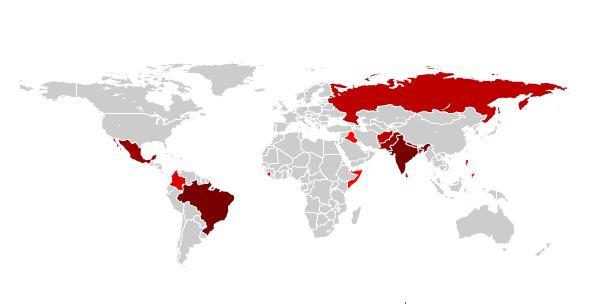
Iraq, Sierra Leone and Somalia are the most dangerous place for journalists according to the 2009 Imupunity index released by the Committee to Protect Journalists today. However, the report entitled Getting Away With Murder 2009, highlights worrying trends in South Asia, particularly in Sri Lanka and Pakistan,
]]>“We’re distressed to see justice worsen in places such as Sri Lanka and Pakistan. Our findings indicate that the failure to solve journalist murders perpetuates further violence against the press,” said Joel Simon, CPJ executive director. “Countries can get off this list of shame only by committing themselves to seeking justice.” link
"The situation in Pakistan is quickly eroding," [said Shawn Crispin, CPJ Asia programme consultant and a former foreign correspondent based in Southeast Asia.] "There are more and more journalists getting caught, not necessarily in the crossfire itself, but by competing groups. They don’t like the coverage of the journalist, they target the journalist." link