New tools were used to disseminate traditional military messages with little regard for a new online culture of communication.
How times have changed.
Nearly four years later, the IDF’s social media strategy is much more sophisticated, offering online audiences regular and engaging updates on the progress of Israel’s military activities in Gaza – Operation Pillar of Defense.
Comparing 2009 with 2012: YouTube and Twitter
The differences are striking. In the 2009 post, I included a link to this YouTube video:
As I noted at the time, this bland ‘press statement’ delivered by Capt. Benjamin Rutland takes place in a washed out ‘non-place’ with the Israeli flag propped up against the wall. Not exactly engaging content.
It’s a far cry from the IDF’s most recent YouTube videos which now include short, snappy infographic explainers:
And dramatic images of “precision strikes” in which the viewer is on-board with the missile, transported to a video-game like first person perspective:
(These videos offer a compelling illusion – apparently taking the viewer closer to the conflict, but at the same time distancing the viewer from the human cost as airstrikes appear to primarily affect buildings, infrastructure or only the most ‘evil’ of enemies.)
Back in 2009, Twitter was mainly used as a way of linking to exceptionally dry updates on the IDF Spokesperson blog which were often written in impenetrable military jargon. On both the blog and the Twitter feed there was little evidence of the IDF trying to influence, drive and engage in the conversation around the conflict.

Now the IDF Twitter feed is being written in plain English. What’s more, the IDF is using hashtags (#IsraelUnderFire), encouraging Twitter users to retweet their content and creating imagery that the IDF believe will be circulated by online communities.
It is also posting all manner of facts and figures and commenting on the issues which might affect the outcome of the battle for public opinion.
From 2009 to 2012: The IDF’s social media learning curve
In 2009, Noah Shachtman revealed in Wired just how ad hoc the planning for the social media element of the information war had been during Operation Cast Lead, describing the IDF’s YouTube campaign as “off-the-cuff” – a last-minute idea by a group of “twenty-something” soldiers.
Shortly after Operation Cast Lead, the IDF’s Twitter fell silent for 179 days and only began updating again in August 2009. In December, Haaretz reported that a new media unit would be set up to engage online audiences on Facebook, YouTube and Twitter.
In the three years since then, the IDF has clearly revisited its approach to social media. According to Reuters the Israeli foreign ministry invested $15 million dollars in social media in 2010 and although the IDF was still learning it was notable that their YouTube channel was beginning to attract the attention of news journalists by the time of the Gaza flotilla raid in May 2010.
A ‘behind-the-scenes’ TV report demonstrated how the online presence of IDF Spokesperson was updated by a fully operational “New Media desk” by 2011.
Communicating conflict: The blurring boundaries
The 2012 online media campaign for Operation Pillar of Defense is undoubtedly a significant ‘improvement’ in Israel’s attempt to communicate their version of the conflict using social media tools. But challenges remain.
In particular, the use of Twitter more explicitly blurs an already blurred boundary between psychological operations and public information campaigns.
In the last few days, the IDF has addressed all manner of online audiences with its Twitter feed.
Some updates are probably designed to be picked up by journalists – announcing the onset of the airstrikes via Twitter rather than in a news conference was an interesting departure, but hardly surprising given the widespread adoption of Twitter by journalists at media organisations.
A tweet on Sunday was even more obviously directed at journalists:
Advice to reporters in #Gaza, just like any person in Gaza: For your own safety, stay away from #Hamas positions and operatives.
— IDF (@IDFSpokesperson) November 18, 2012
The IDF’s Twitter feed is also trying to leverage an active online community which is supportive of Israel’s goals by producing content which can be disseminated online through retweets on Twitter and sharing on social networks. Other content, such as the YouTube explainers, can be seen as an attempt to convince sceptics of Israel’s military operation.
These activities might all fall into the remit of public information campaigns, but at the same time the account is being used for purposes which could be viewed as a function of psychological operations.
One IDF tweet issued a warning to Hamas operatives and as Stuart Hughes pointed out on the BBC’s College of Journalism blog the IDF’s Twitter account has attracted the attention of Hamas’ military wing, the Al-Qassam Brigades.
It is no longer unusual for a war of words on Twitter to accompany armed confrontation. (See also: ISAF Media vs the Taliban and the Kenyan Army vs Al Shabaab.)
Communicating messages successfully to different audiences in the same space is problematic, particularly when the ‘audience’ can write back. Critics have argued that the IDF’s Twitter feed is a distasteful addition to an immoral military campaign. The Now Lebanon blog, for example, headlined a post with the title: ‘IDF cheerily live-tweets infanticide‘.
And the unanswered question is this: what difference, if any, will the IDF’s more coherent approach to social media make?
A template for the future?
It is perhaps too soon to make a judgement, but the IDF’s social media campaign in support of Operation Pillar of Defense might prove to be a template for future information operations online as militaries attempt to influence a more fiercely contested informational battlespace.
In 2010, Lt. Gen. W. Caldwell, Dennis Murphy and Anton Menning published an article in the Australia Army Journal in which they suggested that the US military could learn from the IDF’s use of social media.
I think they were wrong then in relation to the Gaza conflict in 2009, but they might have subsequently been proved right by events in 2012.
]]>The video is a year old, but I’ve been looking for this sort of material for a while.
The IDF started with a blog and a YouTube channel in 2008 during Operation Cast Lead which included airstrikes and a ground incursion into Gaza. The IDF began a Twitter account several days into 2009.
I was critical then, but it looks like things have come a long way since that hastily conceived project.
]]>
I’ve been doing some research into the coverage of the Gaza conflict (back end of 2008, front end of 2009) on blogs. One of the English-language blogs that covered the war was the Muqata blog.
The Muqata blog was started in 2005 by ‘Jameel’, a Jewish settler who had lived in Chomesh in Gaza before the Israeli withdrawal.
The blogger says his aim was to promote ‘aliya’ or ascension to Israel by promoting the ‘love of Israel, the land of Israel, and aspiration of living in Israel to the JBlogosphere’. Jameel’s friends assisted with blog postings.
During the Gaza crisis the blog provided dozens of rolling time-stamped updates on the conflict aggregating information from a variety of sources.
There was much discussion at the time about the nature of the media or information war which was running alongside and indeed as part of the Gaza conflict.
The interesting thing about the Muqata blog was that the authors envisaged themselves as combatants in this information war. In a post on 5 January the authors said:
"We’re doing our part, to help with the war on the information front, while the [Israeli Defence Force] IDF does it’s (sic) job in Gaza."
Two days later, the Muqata bloggers suggested IDF radio could not be trusted as a reliable ally in this struggle:
"With news sites around the world taking the Gaza side, with pro-Gaza demonstrations going on everywhere, we need to be as forceful as possible in our media reporting on behalf of Israel.
"Our soldiers in Gaza do not need to be stabbed in the back by IDF radio — they need our full and total support, and not hearing interviews with the head of the Shifa hospital, which is housing munitions, rockets, and where Hamas terrorists are dressing up as doctors and nurses."
Not only, then, were the Muqata authors taking up the blog as a digital weapon in a media war against a perceived enemy, they were also calling out those they regarded as information traitors from within their own ranks.
General Rupert Smith’s observation that war is now fought amongst the people ‘in every living room in the world’ appears even more prescient given the way individuals are actively deploying digital technologies to participate in media wars.
And if the media, in the broadest sense of the term, is adjudged to have a central role to play then the distinction between civilian and combatant is becoming increasingly blurred.
Photo: Vrypan, Flickr, Creative Commons.
]]>1. Leveraging New Media (pdf):
A US military report on the Israeli Defence Force’s use of new media in the conflict in Gaza re-published in the Australian Army Journal. It’s from the middle of 2009 but I’d not picked it up before.
It’s authored by Lieutenant General William B Caldwell IV, US Army, Mr Dennis M Murphy, and Mr Anton Menning. Not a particularly surprising conclusion if you keep track of Caldwell’s thinking:
"As the media environment continues to fragment in the future, engaging ever diversifying platforms and channels will become more difficult for the military. But, as General Creighton Abrams reputedly once said, ‘If you don’t blow your own horn, someone will turn it into a funnel.’ Under conditions of the current new media blitz, his possibly apocryphal words might be paraphrased to say, ‘If you don’t engage, someone else will fill the void.’
Surrendering the information environment to the adversary is not a practical option. Therefore, the military must seriously consider where information and the new media lie in relationship to conventional warfighting functions. One thing seems sure: we must elevate information in doctrinal importance, and adequately fund and staff organizations dealing with information."
2. Al Qaeda Central and the Internet
A new report by Daniel Kimmage claims Al Qaeda is "today primarily a media phenomenon" but that it faces "grave challenges".
3. The myth of American newspapers supporting the Iraq war
Greg Mitchell argues that at least by the eve of the invasion US newspaper editorials were reflecting serious concerns about the war in Iraq. (Too little, too late?):
"Of the forty-four papers publishing editorials about the war, roughly one-third reiterated strong support for the White House, one-third repeated their abiding opposition to it and the rest–with further debate now useless–took a more philosophical approach"
4. Of Mice and Bureaucrats: NATO, Afghanistan, war reporting and the truth
An insight into the story behind the story of the reporting of an alleged NATO ‘cover up’ of civilian casualties which NATO denies. There is more here by the journalist who believes he was being lied to.
]]>There was an interesting little sub-plot in this article in The Times about the aim of protecting and winning over the population in a counterinsurgency operation. On the one hand these US Marines were being asked to exercise some level of restraint:
"The new rules of engagement, dubbed “Courageous Restraint” and designed to prevent civilian casualties, meant that when the Sun came up over Marjah all they could do was wait."
On the other hand, during a subsequent battle the Marines were forced to temporarily evict a local family from their house:
"…the Marines battled their way to the relative shelter of a nearby compound. The family were ordered to leave and seek shelter in another building nearby. The Marines punched holes in the mudwalls and exchanged fire with attackers who seemed to have surrounded us."
We can all agree that evicting the civilians is far preferable to killing them, but I think I’d still feel rather perturbed by being forced out of my own house and having it turned into a firing position.
How good are war reporters?
Marc Lynch asks whether war reporters are worth their salt. Writing up a discussion on the subject he paraphrases the thoughts of Rajiv Chandrasekaran of the Washington Post on the contrasting nature of reporting Iraq and Afghanistan:
"Chandrasekaran — just back from covering the Marja campaign — noted some significant differences between Iraq and Afghanistan for war reporters. In Iraq, he argued, Baghdad was a central hub where a lot of the meaningful politics happened, while in Afghanistan Kabul is just a bubble and tells you virtually nothing about what’s going on elsewhere. The infrastructure of stringers is far less developed in Afghanistan, curtailing that stream of vital information for reporters trying to make sense of the full range of voices and viewpoints."
Israeli Defence Force soldier in Facebook Fail
The IDF called off a raid in Palestinian territory after a soldier stuck up the details of the operation on Facebook. D’oh. Haaretz reports [with a few of my thoughts in brackets]:
"The soldier – since relieved of combat duty – described in a status update how his unit planned a "clean-up" arrest raid in a West Bank area, Army Radio said.
"On Wednesday we clean up Qatanah, and on Thursday, god willing, we come home," the soldier wrote on his Facebook page, refering to a West Bank village near Ramallah.
The soldier also disclosed the name of the combat unit, the place of the operation and the time it will take place [just for good measure]. Facebook friends [who were really there for this soldier when he messed up] then reported him to military authorities."
Head of RAF says forces must embrace Internet technology
This is from a while back now as recorded by the Belfast Telegraph. Air Chief Marshal Sir Stephen Dalton highlights how the Israeli Air Force used the Web in the battle over international public opinion during the conflict in Gaza in 2009:
"Accurate and timely information has always been critical to the military but its importance is increasing as societies become more networked," he stated. "This is intimately linked to developments in space and cyber-space; as we saw in the conflict in Gaza in early 2009, operations on the ground were paralleled by operations in cyber-space and an ‘info ops’ campaign that was fought across the internet: the Israeli Air Force downloaded sensor imagery onto YouTube, tweets warned of rocket attacks and the ‘help-us-win.com’ blog was used to mobilise public support."
Interesting. I wasn’t as convinced by the success of all aspects of this particular information campaign.
]]>"IDFSpokesperson 106 aid trucks and 440,000 L of fuel sched. to cross into Gaza via kerem shalom & nahal oz today. Erez crossing is open. #israel #gaza #idf"
"IDFSpokesperson 2 israelis lightly wounded driving near ma’ale shomron when palestinians hurled rocks at their car. #IDF forces searching area. #westbank"
The IDF started this Twitter feed several days after the first airstrikes against Gaza in December 2008 and stopped posting information after the subsequent incursion into Gaza in February 2009. This was part of a social media campaign that I wasn’t too impressed with, not least because they never did get back to me.
The re-emergence of the IDF Spokesperson Twitter feed leaves me wondering what the IDF is up to, because so far the Twitter feed only seems to be used when the IDF is involved in a significant operation.
I’m not as close an observer of Israeli politics as I’d like to be – please feel free to help me out – but I did note the other day that the Israeli Air Force have been bombing smuggling tunnels along the Egyptian border in response to mortar attacks.
Of course, it’s always possible that the IDF’s media people had forgotten about Twitter and have started using it again. Or maybe they’re taking my advice about building trust in a social media presence before you use it in a crisis situation. OK, that last sentence was ridiculous, I know.
But whatever is going on here, it’ll be interesting to see what else appears in this space in the near future.
]]>Several emails have met with no response, so last week I thought I’d put the IDF’s commitment to Twitter to the test:
"@IDFspokesperson @IDFwebsite @israelconsulate I’d love a comment on my article on the IDF and social media. Can you help? http://is.gd/l4Y0"
@Israelconsulate is the Twitter feed of the Israeli consulate in New York. I threw it in my tweet because they seemed to be far more active on Twitter than the IDF. And they did helpfully furnish me with several replies via Twitter and read my piece.
They also said they would try to get me something and would pass on my enquiries. Though they reasonably pointed out that it is not really their area and it would be up to the IDF to respond.
Unfortunately, it seems the IDF is not as adept at using Twitter as their counterparts in the Israeli consulate and I’ve still not heard anything from them.
But I’ll keep on waiting…
]]>Building Trust
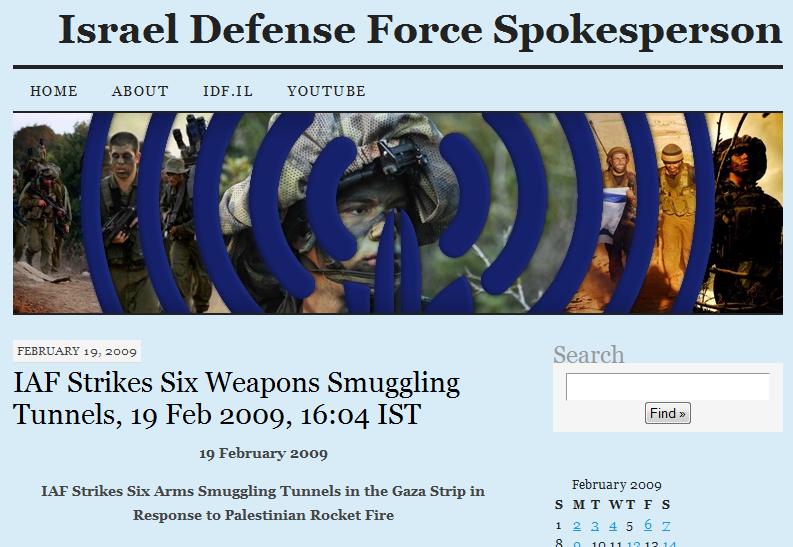 First, they broke an age old rule of effective propaganda or information operations: trust needs to be established. This is necessary both for genuine attempts at imparting reliable information and also for operations in deception.
If you are setting out to accurately try to tell the truth in an honest and open way then it’s far better to build up a reputation for doing so, before you have a major, highly contested conflict on your hands.
Launching a Youtube channel, blogs and Twitter feeds just prior to an invasion of Gaza automatically arouses suspicions of the nature and purpose of these new communication outlets.
Airstrikes over the Gaza Strip began on the 27 December 2008. The IDF Spokesperson blog started the day before with a list of rockets fired into Israel. The Youtube channel was launched on the 29 December 2008. And the Twitter feed looks like an afterthought, beginning on the 3rd January 2009.
It would have been far better to have started these new ventures months beforehand at a time when the only obvious purpose could have been legitimately claimed as being a desire to engage in the social media space.
Through accurate reporting on blogs, Youtube and Twitter, the IDF could have built up a reputation for trustworthy and credible information which could have been verified by other media outlets. When war breaks out, audiences might have been far less sceptical of the information provided on these new forms of media.
As it was, the sudden appearance of these new information channels on the eve of a conflict instantly suggested a serious IDF propaganda campaign.
Of course, a base of trustworthy information could also be used as a means of employing successful information deception. Although I’m not advocating this approach and am not suggesting this is what the IDF would do, it is plain that deception operations have long been used by militaries, and the militaries of democratic nations are certainly no exception.
If you have a reputation for being accurate and trustworthy, when you do decide to start twisting the truth (or blatantly lying) you are far more likely to be successful in achieving the necessary deception. (Though obviously this carries significant long term risks).
Execution
In addition to this failure, the IDF has simply grafted all the old ways of information campaigning into new formats, without any specific regard for the conventions of social media.
Calling a blog ‘IDF Spokesperson’ is a hark back to impersonal, corporate, official voices. Who is this IDF Spokesperson? Why should we believe him, her or them? The IDF Spokesperson sounds like a scary non-descript Orwellian voice telling us what to think.
At least Mark Regev, an Israeli government spokesman, who did lots of radio and TV interviews, has a human face (and voice) with which we might empathise.
This Youtube explanation of the bombing of the UN schools in Gaza also demonstrates a failure to understand social media.
The statement, and it is a statement, by Capt. Benjamin Rutland takes place in a washed out ‘non-place’ with the Israeli flag propped up against the wall. Why not ‘casually’ film it ‘somewhere’. I’d suggest where Capt Rutland works, though anywhere would be better and the whole style needs to be much more informal. Much more real, open, honest and genuine. (Even if the content is not real, honest or genuine).
And all approaches suffer from a lack of community engagement. Whether this is possible for military organisations is highly debatable. Can you imagine the response on the IDF Spokesperson blog if the comments were turned on!? But the point is that social media without the ‘social’ aspect is often highly uncompelling.
P.S. I have emailed the IDF on several occasions for comment on this piece but they have so far failed to respond.
P.P.S. Here’s an excellent look at various aspects of the social media battle waged during the recent conflict in Gaza.
Author Jaron Gilinsky explores the Help Us Win campaign, and the Israeli Defence Force’s use of Youtube. He also speaks to Gazan blogger, Sameh Habeeb, who became a one-man news agency.
]]>