
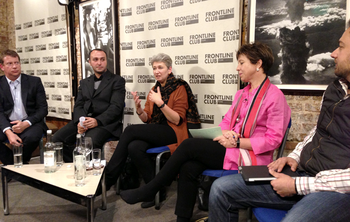
Dr Lynne Jones has been a psychiatrist working in conflict zones for over 20 years. From treating soldiers in the Bosnian war, to attending to families affected by the Haitian earthquake, or those who lost relatives in the Sri Lankan tsunami, Dr Jones is coming to the Frontline Club to discuss and share her experiences of working in some of the world’s biggest disaster zones. She will be discussing issues such as if there is a right approach to deal with mental health in humanitarian disasters, and is there a different way we approach mental health in crises in third world countries compared to developed ones? Dr Jones’ field diaries have been published in the London Review of Books and her audio diaries broadcast on the BBC World Service.

Joining this discussion is Dr Conor Kenny from Doctors Without Borders. Dr Kenny has been providing healthcare for some of the most vulnerable people in Europe. His first assignment began in Idomeni, a transit camp for refugees on the Greek border with the Former Yugoslav Republic of Macedonia. After residents of the Idomeni camp were evicted, Conor moved to Lesbos to work providing healthcare in specialised camps designated for the most vulnerable refugees on the island. The refugees here face a number of medical and psychosocial problems as a result of their extensive journeys that Dr Kenny has been treating.

Moderator – Rob Williams CEO War Child
Rob Williams is Chief Executive of War Child, the UK charity dedicated to supporting children affected by conflict. War Child delivers psychosocial support, child protection, education and livelihoods programmes in a range of countries affected by war including Central African Republic, Yemen, Iraq, Afghanistan, Jordan, and The Democratic Republic of Congo, helping children who have been abused, abducted, displaced or separated from their families. Previously in relief and development Rob has worked for Save the Children, the British Red Cross and Concern Worldwide in Africa and Asia leading country programmes and also managing emergency response. In the UK he has been, at various times, Deputy Children’s Commissioner for England, Chief Executive of Bliss – the premature baby charity, and Chief Executive of the Fatherhood Institute He is married with two children and lives in Cambridge.
Click on the link to see Dr Lynne Jones’ new book, Outside the Asylum: A Memoir of War, Disaster and Humanitarian Psychiatry
]]>This event is organised by the Overseas Development Institute (ODI).
On 23 October 1984, the BBC aired a landmark report on the famine in Ethiopia. Describing the crisis as a ‘biblical famine’, the report galvanised the public, spurred the UK government into action and prompted the creation of the infamous Live Aid concert.
Now 30 years on, is media reporting of today’s conflicts and disasters having the same effect on the public and has the nature of conflict and disaster reporting changed? How are journalists adapting to these changes?
How are humanitarian organisations working with media outlets to help generate interest and understanding of the crises affecting millions of civilians around the world?
Join the Overseas Development Institute (ODI) as they examine the current state of conflict and disaster reporting and how humanitarian agencies can work with the media to raise awareness and much-needed funds.
Chaired by Ben Parker who has worked in media and humanitarian response for over 20 years. He co-founded the IRIN humanitarian news service in 1995. As well as a reporter and editor, he has been an aid worker, most recently as head of UN’s humanitarian office in Syria in 2012, and as UN director of communications in Somalia.
The panel:
Juliana Ruhfus, senior reporter for the People and Power programme on Al Jazeera English, specialising in investigative work. Her journalistic work with Channel 4, BBC and now Al Jazeera has taken her to over 30 countries, including Somalia, Yemen, Haiti, Libya and Sri Lanka after the 2004 Indian Ocean Tsunami.
Marc DuBois was the head of Médecins Sans Frontières (MSF) UK from 2008–14. He has worked in the front lines of humanitarian crises for MSF in countries including Sudan and Angola.
Jon Snow, Channel 4 News anchor since 1989. During his career he has covered conflicts in countries including Iraq, Afghanistan, Eritrea, Ethiopia, Angola as well as the Haiti earthquake and the recent crisis in Gaza.
Eva Svoboda, research fellow in the Humanitarian Policy Group at the Overseas Development Institute. She has worked for various NGOs and the ICRC in emergencies in the Middle East, Africa and Asia.
If you are unable to attend you can watch the event live, to receive a reminder register here.
Photograph: isafmedia


Filmmaker Chloe Ruthven’s grandparents were aid workers in Palestine. Growing up, she avoided getting too involved in the subject, recalling how mention of it made all the adults in her life angry. Inspired by a book written by her grandmother about the aid projects in Palestine, Ruthven explores the effects of foreign aid and the potential damage the continued reliance may have for the future.
Along the way she meets Lubna Masarwa, a forthright Palestinian woman. She not only becomes her driver, guide and fixer, but also offers a rare insight into the complex cultural and political situation on the ground. Masarwa speaks frankly of her distaste and distrust of foreign aid, something that lies uneasy with Ruthven as she seeks to find the lasting benefits of the work her grandparents supported.
What begins as a quest to better grasp her family history, turns into an emotional account of two women trying to understand one another and a unique joining of the acutely personal and complexly political. Interviews with international aid workers, Palestinian project managers, Western volunteers, local farmers and videos of her grandparents at the time, illustrate the complexity of the situation.
Directed by Chloe Ruthven
Duration: 75′
Year: 2013
The conflict and humanitarian issues Syria faces is at the forefront of many peoples minds at the moment, this was reflected by the full house that gathered at the Frontline Club’s panel discussion, Communicating about Syria – A humanitarian perspective on 10th October.
Lindsey Hilsum, Channel 4 News’ International Editor chaired a panel which included Hicham Hassan from the International Commitee of the Red Cross (ICRC); Lyse Doucet, BBC Chief International Correspondent; Ben Parker, head of the UN Office for the Coordination of Humanitarian affairs (OCHA); and Fadi Haddad from the Mosaic Initiative for Syria.
Hilsum started things off by asking Doucet to set out the current situation in Syria, where over a million people are now displaced within the country, 50% of which are children.
There can be no doubt that when it comes especially to war we [journalists] take the side of the people. And sadly it’s ugly terrible bloody wars that drag on there’s a lot of people that are affected and Syria is no different…And of all those people that are stuck in the middle one of the other sad realities of the Syrian conflict is that most of them are children.
Parker, who was only in London by coincidence on a break from his post in Syria as head of OCHA then spoke about how the problems in Syria are unlike any he has faced before.
I’ve never in my career spoken less to journalists. It’s a very unusual situation; aid agencies want to talk to the media for three things: 1. Cash. 2. To make sure that the attention doesn’t go away, and 3. We also have advocacy, in the sense that we want the people with power to take a certain course of action. In Syria, none of these three really work. In terms of the course of action, nobody has the answer. And what is the course of action? Stop the violence? ok…We’re heading into unknown territory.
There’s normally criticisms that we’re too tight with journalists… but here I can’t help you [journalists] at all, I can say maybe you should check out that school, but you being associated with me makes your job even harder. The state of Syria feels that the humanitarian people need to be watched just as much as the journalists because they have the potential to delegitimise and confuse and be instrumentalised by hostile forces.
Hassan who is the Middle East spokesperson for the International Commitee of the Red Cross (ICRC) said that the humanitarian aid is not there to solve the problems in Syria:
A very good friend of mine said: “The solution in Syria is not humanitarian because the problem in the first place is not humanitarian; it is political so don’t you think you guys are there to solve the problems.” It is true, we are not there to solve the problem, humanitarian aid is just there to push the limit a bit more and a bit more and a bit more.
Haddad from the Mosaic Initiative for Syria who works directly with human rights defenders and NGOs inside Syria and neighboring countries, gave some insight into how he gets supplies to people in Syria by foot through Turkey, but how even that is getting more difficult.
I’ve been targeted now more than the Free Syrian Army, if they know that there’s a field hospital in a place, they will try to shut it straight away. It’s getting more stressful.
When you’re dealing with these groups you need a good relationship with the local community and this is where journalists have to help us, as they go inside they know these communities so our mission is to work in partnership with them and to work like a middle agent between the international NGOs and the people on the ground.
Melissa Flemming, chief spokesperson for the UN High Commission of Refugees (UNHCR) was in the audience and Hilsum asked her to give her take on the situation. She finished with a final thought about the displaced people of Syria, before the discussion was opened to questions from the audience.
They’ve all lost family and they’ve all got horrendous stories to tell and they’re living in places like Lazatri camp which is inhospitable because of the landscape…It would be like any one of you who is used to living in an apartment having a high standard of living, and from one day to the next having to pick up everything probably having lost a lot and run for your lives across the border and try to make a life for yourself in a tent.
Listen to Lyse Doucet talk about the current state of affairs in Syria:
Listen to Lindsey Hilsum talk about the different kinds of people who have been caught up in the Syrian conflict:
Listen to Fadi Haddad talk about the problems he faces when getting aid to the people who most need it in Syria, he also tells the story of one man he couldn’t get aid to quick enough:
Watch the full event here:
]]>The humanitarian situation in Syria has dramatically worsened over the past weeks and the plight of the Syrian people has drawn international attention and concern as well as condemnation of the Syrian regime. Access to the country for humanitarian organisations has been restricted by violence and insecurity that has killed five Syrian Arab Red Crescent volunteers and staff members in the past 12 months.
There is clearly an obligation for humanitarian agencies and journalists to share their perspectives on the humanitarian situation on the ground to ensure it is understood as clearly as is possible and decisive action can be taken. This must, however, be weighed by many actors against their own concerns of security, access and safety.
Join us to discuss the humanitarian efforts being made in Syria and the many challenges that are faced. How do journalists and humanitarian agencies share information in such a complex conflict situation? We will analyse the balance between openness and the ability to continue to provide vital assistance on the ground in a conflict such as that in Syria.
Chaired by Lindsey Hilsum, Channel 4 News’ International Editor and author of Sandstorm, Libya in the Time of Revolution,
With:
Hicham Hassan, the International Committee of the Red Cross spokesperson for the Middle East.
Lyse Doucet, BBC Chief International Correspondent.
Ben Parker, the head of the UN Office for the Coordination of Humanitarian Affairs (OCHA) in Syria.
Fadi Haddad, director of the Mosaic Initiative for Syria, a non-governmental, not-for-profit organisation working directly with human rights defenders and NGOs inside Syria and neighbouring countries.

For 25 years photo agency Panos Pictures has been covering stories the mainstream media won’t. The commercial arm of the development NGO the Panos Institute (now Panos London) has had photographers documenting history as it unfolds, with a focus on social and development stories globally.
“We like to poke around in corners other people don’t go,” said Adrian Evans, Director of Panos Pictures.
“Photography is the idea of ‘don’t look over there, look over here’, and we’re not afraid to take a stand.“We step aside from the main news and can pursue stories when they are not under the media spotlight. We cover stories we think are important.”
“In media terms, there is this attitude that once the UN goes in, everything finishes. I think staying longer in a place and covering the aftermath [is important]."After the war in Kosovo there was an orgy of violence.”
“It shows the passing of time, and how things are not being resolved in a quick way,” Testa explained.“In Kosovo everything has moved on, but for these mothers they are frozen. For the soldiers who killed [the missing] it only took a second, for the mothers, time has stopped.”
“With ideas of oil companies being corrupt and evil, to see it as a health remedy… well, a photograph can make you reassess your views.”
“Photographers are like little NGOs themselves, they have to be able to write proposals and go out there,” he said, adding that many photographers now look to displaying their work in galleries for a fee.
“Nowadays it’s not just about the photographs. It’s about who you’re working with and why.“We communicate to the world our interest, our passions, our desires. I’d like to think Panos does this.”
In this end of year debate, leading figures from the humanitarian world gather to discuss the main challenges to protecting and assisting people caught up in conflict and disaster. They will also explore prospects for principled humanitarian action in 2012.
]]>Third party event organised by Humanitarian Policy Group, Overseas Development Institute.
From the popular uprisings in the Middle East, to the intervention in Libya, and now the tragedy unfolding in the Horn of Africa, many of this year’s top stories have been dominated by humanitarian issues.
In this end of year debate, leading figures from the humanitarian world gather to discuss the main challenges to protecting and assisting people caught up in conflict and disaster. They will also explore prospects for principled humanitarian action in 2012.
Chaired by Jonathan Rugman, Channel 4 News foreign affairs correspondent.
With:
Sara Pantuliano, head of the Humanitarian Policy Group at the Overseas Development Institute;
Dennis McNamara, senior humanitarian adviser at the Centre for Humanitarian Dialogue;
Leslie E Norton, the director general of the Canadian International Development Agency’s International Humanitarian Assistance Directorate;
Manuel Aranda da Silva, director of Policy, Planning and Strategy, World Food Programme.

]]>
A special preview reading of Bang Bang Bang, which is coming to the Royal Court Theatre in October.
]]>But while Mathilde lets off steam with a photographer and a spliff, Sadhbh has her own encounter: tea with a smart, brutal young warlord she’s investigating. Or is he investigating her?
A special preview reading of Bang Bang Bang, which is coming to the Royal Court Theatre in October.
Writer Stella Feehily:
“We interviewed aid workers, doctors, human rights defenders, government advisers, journalists and photographers. In many organizations we found the majority of humanitarians to be female. The industry – and it is an industry – is buoyed by the benevolence of women.
Stella Feehily’s previous work includes Dreams of Violence (Soho), Catch (Royal Court), O Go My Man, Duck (both Out of Joint/Royal Court) and Game (Fishamble). She was a co-winner of the Susan Smith Blackburn Award in 2006 for O Go My Man.
]]>
By Gianluca Mezzofiore
A panel at the Frontline Club, chaired by Mark Galloway, director of International Broadcasting Trust, an educational and media charity which works on range of projects to promote media coverage of the developing world, discussed yesterday the problems linked with media and aid.
“We have ups and downs and a lot of criticism, but on the whole there’s a good relationship with the disaster emergency committee. We need each other,” said Fran Unsworth, head of BBC newsgathering, who added that the corporation had a responsibility to licence fee payers to provide the information they require for their lives.
“We have to be responsible to our audience, but not audience-led,” she said. “It is our challenge to make the complex stories interesting for them.”
Andrew Hogg, Christian Aid news/campaigns editor and former news editor of the Sunday Times and Observer, admitted that NGOs need media to raise money and to highlight issues. “The relations with media is healthy and functional only if it involves mutual responsibility,” he added. “There is a huge responsibility upon us, but also media has the responsibility to report on what we do in a fair manner.”
“The BBC documentary on aid agencies in Haiti which collected money but failed to deliver goods on the ground was interesting, but one-sided and created a deep impression in the public opinion,” Hogg said. “We deserve a proper scrutiny.”
Benjamin Chesterton co-founder of the production company Duckrabbit and the website A Developing Story, raised his concerns about media outlets relying too much on aid agencies. “When you a see a whole BBC photo gallery with aid agencies’ by-lines, instead of the photographer’s name, the independence of media is compromised,” he said. “Balance is fundamental, but we start losing it because aid agencies are too much on the grip of media.”
Unsworth replied that the BBC has no problems with aid agencies providing photos, as long as they are well-known and reliable. “There are strict policies about libelling,” she said. “It is not about giving credit to someone, but being transparent with our audience.”
Independent writer and consultant, Michael Green was director of communications at DFID from 2003 to 2007 and co-author of Philanthrocapitalism and The Road From Ruin. He expressed concern about the government’s policy on international aid and increasing the budget and commitments “despite the negative economic growth”
“Politicians should hear the public opinion’s voice,” he said. “There is a benign conspiracy among political elite to push aid ahead of public opinion.”
According to the EU barometer website 91 per cent of Britons still think it is important to help developing countries, but the percentage of people who thinks the government should give more aid has decreased from 50 per cent to 35 per cent since 2007.
A crisis of confidence is coming in the aid business. Part of the problem is how to engage people on these complicated issues. The other problem is with NGOs lobbying and campaigning. However, aid agencies are beginning to use online platforms, which give rich experience to the public and give them a chance to participate and engage with the NGOs. Like a shark has to stay alive, NGOs must communicate to propagate their brand.
Watch the video here:
]]>Download this episode
View in iTunes
By Antje Bormann
Broadcaster Sue Steward introduced Carol Allen Storey as one of the most fascinating photojournalists around. Carol Allen Storey’s photographic career started 10 years ago following a thorough rethink of a successful career in the fashion and beauty industry.
Photographs by Edmond Terakopian.
Carol Allen Storey documents the lives of women and orphans affected by HIV-AIDS in Uganda, Tanzania and Rwanda. She focuses on the stigmatisation of HIV-AIDS sufferers and the indomitable spirit that keeps them going against the odds. Her stunning, emotionally-charged images had the room completely silent as she explained the fate of each subject.
She told the story of a woman who single-handedly looks after 32 children, all of them her nieces and nephews whose parents have already succumbed to AIDS, who had contracted the virus while caring for them.
She also told the story of the ‘dustbin boys’, a gang of feral children aged seven to 14 who live off what they can find on rubbish tips and outside slaughter houses, who take drugs to relieve boredom and as they grow older slip into gambling. In contrast, the gang also adopted the 6-month-old baby of a sex worker who had died from AIDS and take turns looking after the little one.
There were stories of children who, once diagnosed with HIV, are made to wear a red badge, a sign that sets them apart from their healthy – or simply as yet undiagnosed – classmates. The children sometimes don’t even know why they are wearing the badge, why they are not allowed to play with the other kids in the school yard.
Alice Fay, HIV Programme development advisor for the charity Save the Children shed some light on how children are treated once they are diagnosed. Children may be diagnosed and treated for HIV but will not be informed of their diagnosis until they are at least 8 years old, she revealed.
There were a number of questions to Carol Allen Storey and Alice Fay from the audience about measures taken by African governments to get the problem of HIV-AIDS under control, with one person saying that it had to start with educating men.
]]>