When NATO troops withdrew from Afghanistan the Afghan National Army (ANA) took control of Helmand Province, an extremely dangerous region where attacks by Taliban fighters are the order of the day.
The directors of Tell Spring Not to Come This Year accompanied an ANA company during a year of frontline duty in Helmand. The soldiers are paid irregularly, there are not enough supplies and their equipment is substandard. Saeed Taji Farouky’s cinemascope images lend an epic dimension to the soldiers’ daily lives. The private moments and bloody battles feel like a metaphor for the fate of this war-torn country.
In off-screen interviews, the protagonists talk about their doubts, their hopes and their dreams. At the same time the film shows the absurdity of the conflict from the point of view of these Afghan soldiers, in a country whose government is fighting an enemy that even NATO troops did not succeed in defeating in almost thirteen years.
Tell Spring Not to Come This Year received its world premiere at the Berlinale in February 2015 and was awarded the Amnesty International Human Rights award and the Audience Award for best documentary.
Directed by Michael McEvoy and Saeed Taji Farouky
Duration: 87′
Year: 2015
On 25 February, a panel of experts convened at the Frontline Club for a discussion on the war in Afghanistan and its ongoing legacy. Chaired by BBC Afghanistan correspondent, David Loyn, the debate spanned the period from 11 September 2001 to the present day.

L-R: Mike Martin, Jawed Nader, David Loyn, Major General Jonathan Shaw and Jack Fairweather
Jawed Nader, director of the British and Irish Agencies Afghanistan Group (BAAG) who has worked with both the Afghan Government and Afghan civil society, began by commenting on his experience of foreign military intervention post 9/11. He said, “At the beginning we didn’t know what to make of it. We were upset that all these people were being killed, but then we also thought maybe Afghanistan is becoming important for the international community.”
Loyn asked Nader whether he thought war in Afghanistan was unavoidable. He responded, “I think it was inevitable, and in some ways we really wanted that war to take place. Afghanistan was in war for many years before that and we thought there would be no end to it, and then now a superpower was coming and we thought it would be a decisive war.”
On the subject of public support of the intervention, Loyn provided the audience with an American poll figure which conveyed the staggering shift in opinion. “At the time, 93% [of Americans] were in favour of the action, and last month for the first time Gallup recorded negative support for the war in Afghanistan.”
Jack Fairweather, former Baghdad and Gulf correspondent for the Daily Telegraph and currently fellow of the Centre for Middle Eastern Studies at Harvard University, commented on US strategy in the region. “They [the US] took a very stripped down view of what should be done. ‘Light footprint’ was the sort of catchphrase that was doing the rounds.”
The issue of aid was also discussed in depth, as multiple aid agencies flooded Afghanistan following the outbreak of war. Nader commented that “the aid agencies wanted to do good,” but also recognised that “there was an issue that the Taliban or the ordinary people will not be able to identify who were military personnel aids and who were aid agencies… The other issue was a lot of wastage of aid.”
Major General Jonathan Shaw, recently retired from the British Army after 32 years commanding operations in Iraq, Afghanistan and the Balkans, questioned “did we understand Afghanistan? The real problem is that we didn’t…the ahistorical nature of our approach was just remarkable.”
“I think we went into Afghanistan and Iraq in denial of the lessons of history, launching ourselves on an American crusade.”
Helmand was discussed in great detail, and was described as a “historical accident” by Lyon. “What the British decided to do was put in huge amounts of soldiers and very little aid and wondered why it upset the locals,” added Shaw.
“Prediction about Afghanistan is very difficult, especially if it’s about the future”. Jawed Nader at @frontlineclub
— Chris King (@DocChrisKing) February 25, 2015
Former British Army Office and pushtu-speaker Mike Martin, who served and undertook extensive research in Helmand during the war, commented on the damage inflicted in the province by UK and US military forces.
“Helmand seems to be a microcosm or a slightly extreme version of what happened elsewhere in Afghanistan…. We completely misunderstood what was going on… In Helmand what you saw was a civil war, it had nothing to do with the Taliban or the government. All of the Helmandis understood that we understood the conflict as a dichotomous good/bad government/Taliban…
“We made it worse: rather than clamping down on the violence we actually made it more violent.”
Shaw spoke on the relationship between the armed forces and Whitehall. “The problem is connecting the military instrument to the political objectives. The military were the wrong tool for the job… The military should have been support of the political plan.”
Nader then moved the discussion onto the West’s tendency to misinterpret the needs of Afghanistan.
“We compare Afghanistan with high standards, of European standards I believe, whereas Afghanistan should be compared with its regional countries,” he said.
Nader closed the debate with a hopeful view of the future of Afghanistan.”Today Afghanistan has changed in three main ways. One, Afghanistan is a better place to live, Second, Afghanistan is more diverse…And third, Afghanistan is more self aware, more critical.
“All of these positive changes would not have happened had you not gone to Afghanistan to topple a very draconian regime, the Taliban.”
Listen and watch back below:
url=https%3A//api.soundcloud.com/tracks/193024169&color=ff5500&auto_play=false&hide_related=false&show_comments=true&show_user=true&show_reposts=false” width=”100%” height=”166″ frameborder=”no” scrolling=”no”>
]]>Watch event here.
If you want to take part in further discussion about the impact of the War on Terror on our world today and how it might shape our future, come along to our FIRST WEDNESDAY SPECIAL: Changing world – conflict, culture and terrorism in the 21st century on Wednesday, 7 September.
The purpose of the invasion of Afghanistan in 2001 in the wake of the 9/11 attacks was ill-defined from the beginning, according to panelists taking part in a discussion last night that gave little grounds for optimism about the country’s future.
Asked by David Loyn, the BBC’s international development correspondent who was chairing the event when it was that the mistakes were made after the attacks on the Unites States of 11 September, 2001, the answer from Jean MacKenzie, senior correspondent for GlobalPost was: “September 12,”
The former programme director for the Institute for War & Peace Reporting in Kabul, said the major problem with the operation in Afghanistan was a lack of definition about what it was setting out to achieve:
“I think when we went into Afghanistan, the major problem with our invasion, or intervention, was that it was ill-defined as to scope, ill-defined as to purpose and we really had no clue what we were trying to accomplish there. The people who carried out the attack on the United States were not the Taliban and those who did, namely al Quaeda and Osama bin Laden had left by November 2001, said MacKenzie.
“They’re gone, we’re still there and we’re fighting [without knowing] who the enemy is, we don’t know how to define the enemy and we don’t know what the enemy is fighting us about, and I think our central mistake is to get involved with a war with a country that we don’t understand, with a goal that we never bothered to define.”
Malte Roschinski, a security consultant, political analyst and author who is based in Germany, said the “players” who drew up the December 2001 Bonn Agreement on the future of Afghanistan were not representative of the country because the Taleban were left out.
“We might not have liked them but they were the decisive actors in Afghanistan at that time,” said Roschinski, who as a journalist with AFP news agency reported from post-Taliban Afghanistan in late 2001.
He was also critical of the way that different countries took responsibility for different areas and of the German approach of institution building at the cost of providing security for the people:
“The international community never got around to creating a unity of action, which is obviously very important if you want to be successful. If eventually 44 countries are playing single ball games then you will not really come to decisive conclusion because you have 44 different strategies, as well as the civilian players, the development agencies.”
Frank Ledwidge, author of Losing Small Wars said it was “a matter of record” that it was “right within the purview” of al-Quaeda operators and Osama bin Laden that western governments, and the United States in particular, be drawn into wars in the Islamic world that they could not win.
Discussing Britain’s presence in Afghanistan’s Helmand Province, Ledwidge said a “very well informed” Helmand Plan put together by the SAS and well-placed Afghan civilians might have been successful, but had never been implemented:
“We went there looking to create a Belgium in Asia and right now, the truth is we’d be lucky to get a Bangladesh,” said Ledwidge, whose military record includes serving in the the Balkans conflict.
“Success and failure has to be measured against cost and the cost that we’ve sustained, the very least of which is national reputation, then military reputation, then the lives and limbs of our own soldiers and of Afghans and the money, I simply can’t draw a success from that.”
To come: What difference have counterinsurgency strategies made to the life of the Afghan people and in Iraq?
]]>
Vaughan’s new film, Blood and Dust, is below for those who didn’t catch it on Al Jazeera’s People and Power strand.
If you want to see it on a large screen we will showing it at the Frontline Clubon 6 March. Followed by a discussion about how war is represented by the broadcast media.
Vaughan writes:
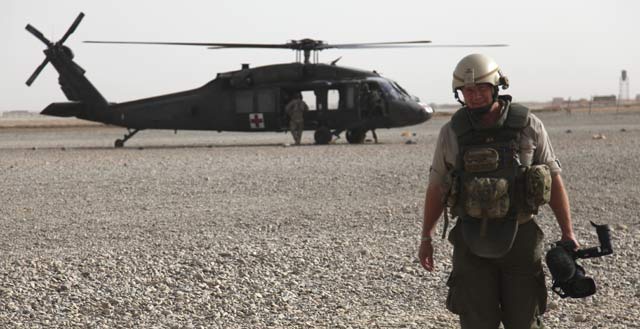
I have done a fair number of military embeds in Afghanistan over the last few years but was concerned that I hadn’t filmed the suffering of war, just its machinery.
This being a grevious ommission I went back last winter to film US army air ambulances, ‘Dustoff’ helicopters, flying over Marjah in Southern Afghanistan. The pictures are strong and show both US marines and Afghan civilians being lifted off the battlefield in equal numbers.
I have been pretty busy since returning from this trip last year, what with Julian Assange coming to stay and all that that means. It is very much thanks to the Al Jazeera documentary chaps, John Owen, Diarmuid Jeffreys, Neil Cairns and last but certainly not least because he did the video editing, Ross Birkbeck, that I got it out at all.
I have worked with Al Jazeera on this because I couldn’t find another news broadcaster in Britain that would show the film without cutting out the stronger images. I have huge respect for the way Al Jazeera as a broadcaster engages the world while many others appear to retreat from it.
]]>
A chapter I wrote . . .
So-called “embedding”, the term for the practice by which journalists have been allowed to accompany allied troops in the Iraq and Afghan wars, is not just a way for the military to manage information but is an unspoken compact with the media that helps sustain the conflicts themselves.
It is easy to find British journalists like myself who criticise the practice of embedding but jump at every opportunity to accompany British troops at war. Space with the British army is at a premium and so if you can get there you won’t face too much competition. Compared with other foreign trips it is relatively easy to acquire strong stories supported by exceptional pictures. One can win awards.
Embedding costs very little money. The military provide food and tents. The press can often use military communications and the British army will fly you out and back for free. As an independent video journalist, I should make a profit on an embed. The army will also lend you a flak jacket and helmet. Even better, the soldiers will protect you from danger and deliver excellent first aid if they don’t. The risks are less than they appear. Easy pickings really.
It’s not just me being careful with the pennies. News budgets are at an all time low and foreign news acquisition is increasingly priced out of reach. Reporting foreign stories is much more expensive than covering domestic ones. As news organisations have tried to realise their duty of care the cost of covering foreign conflicts has further increased. Reducing risk is very expensive, often requiring extra insurance, equipment and the retention of bodyguards or other safety personnel.
Most now rely on cheaper wholesale agency material and whatever they can source from locals or other non-media sources. This includes material filmed or reported by army combat camera teams and blogs by military press officers. There are too few sources of information and even fewer reliable ones. But agency material, being shared with competitors, doesn’t promote the news brand nearly as well as the correspondent or television network reporter, so the opportunity for a newspaper or broadcaster to get people out on an action-packed foreign story on the cheap can be irresistible.
Army management of news output
While it is true that journalists have been accompanying armies and navies in wars for at least 150 years, in the past the military has been better at denying access rather than using the press to get their message out. Allied forces are now very sophisticated in managing news output. The effort is well funded and employs many ex-journalists. Lots of reporters have no difficulty crossing over from journalism to PR, leaving a trade that seems to lose its calling as quickly as it loses its funding.
The sign on top of the British media office tent in Camp Bastion in Helmand, Afghanistan, says “Media Operations’. As soon as you walk through the door as a journalist you understand that you are a sort of target, albeit treated much more gently than the Taliban. It is not about public accountability. News management has become an integrated part of the war effort, aiming to maintain public support for the conflict nationally, while winning the information war abroad.
Embedded journalists are normally accompanied by press officers during their visits. Servicemen or women trained in press management. The stakes are high for the press officer as getting it wrong can ruin their military career. With the British army, both sides are guided by a publication called the Green Book that lays out the rules of the press embed. It was put together by the Ministry of Defence, but in consultation with media organisations. It delivers editorial independence for embedded journalists subject to the needs of operational security. It also includes the reasonable provision in my view that the names of casualties should not be revealed until their next of kin have been informed. The conditions set out in the Green Book are progressive when compared with the restrictions that the press experienced, say, in Northern Ireland in the 1970s and 1980s or the Gulf War of 1991.
When soldiers and journalists bond
Press officers normally work hard to help journalists get stories on their embeds, organising transport and interviews. It would be hard for most of the media to find their way around these battlefields without them and a good working relationship normally develops. Journalists often develop strong relationships with their subjects. Those bonds can be strongest during a tough assignment when discomfort is shared and embedding often puts reporters with frontline troops under stress.
Certainly, having journalists embedded into units where they can get to know soldiers and share their experiences rewards the military with friendlier reporting. But the primary control exerted by the military is through determining who actually gets embedded. Unfavourable reporting is not often rewarded with further opportunity.
The military cannot reasonably be expected to take all the journalists that might want to accompany them. Thousands of journalists descended on Kosovo in 1999 and Afghanistan in 2001. The numbers are far too great. There have been instances when more journalists have applied to go to outposts in Afghanistan than there are soldiers stationed there. But numbers are kept very low, particularly when the military are feeling sensitive about what is happening. Whole operations can go unreported by independent journalists on the ground.
During the recent Operation Moshtarak, in Helmand in February 2010, there were only about 10 members of the press with the whole British force in Afghanistan. The Ministry of Defence will often favour popular commentators, like Ross Kemp, over critical journalists, or try to develop a relationship with tabloid newspapers when it thinks that favourable coverage can be widely achieved.
Valuable pool places to regional newspapers
Valuable places are given to regional newspaper reporters who are less likely to be critical, often there to do soft stories on a military unit local to the paper. Even regional newspapers can afford to send correspondents on embeds. But journalists are not allowed to bring their own vehicles, and being compelled to rely on the military for logistics makes it impossible to access the local population independently. If the military don’t want you somewhere, you are unlikely to get there.
Unfortunately, even if American and European journalists could have all the access they wanted to the military, these days they would deliver less than we need from them. The news industry does not look like it did in the 1960s during the Vietnam war. Most war reporters these days don’t really know much about war, in the way that say, sports journalists know about sport. War reporters are rarely students of conflict nor are they
normally ‘defence’ correspondents who might need to develop a broader knowledge of military affairs.
Over the last two decades the news industry, particularly television news, has developed a culture that rewards the more self-obsessed operators, pushing them to lead their reporting from a personal perspective to make it more accessible to the audience. Reporting becomes as much about promoting the correspondent, the brand representative, as telling the story. As the industry gets starved of funds the reports get weaker and the branding stronger.
The military and their political masters believe that images of dead or wounded allied soldiers, particularly, have the potential to sap public support for the war at home. The lesson from the conflict in Somalia in 1993, when pictures of dead US soldiers being paraded around Mogadishu were shown around the world, was that such images also risk delivering a propaganda victory to the insurgents abroad.
Casualties – the most sensitive issue
This makes allied casualties the most sensitive issue after operational security to the military. With the British army you are prevented from filming dead soldiers and will only be allowed to film or broadcast pictures of wounded soldiers if you have their permission. There are obvious practical difficulties getting this sort of permission from soldiers who suddenly find themselves in agony and struggling to stay alive. Most soldiers say no if they are fit enough to address the question, which is not easy to ask in the circumstances. Doing so invites a negative answer, which of course is why the requirement is there in the first place.
In theory a cameraman or photographer is allowed to film first and ask questions later. But attempting it will seriously raise the pulse of your military minder and soldiers you hadn’t noticed before suddenly become remarkably poor at keeping out of the way of your shot. As a consequence, embeds rarely show the suffering of war but instead offer up a dramatic but sanitised version of it. One that most journalists sex-up to present themselves as well as possible and in doing so normally treat the domestic audience to comforting messages of heroism and military strength.
Limiting the public’s real understanding of the cost of the war in human suffering actually betrays those unfortunate young men who become its casualties. Many are teenagers and some lose multiple limbs. A public that is poorly informed is unlikely to show these men the compassion and respect that they deserve. For all the proximity of the journalists and the cameras, the reporting has been contained, serving to distance the audience from the reality of war and any great feeling of ownership of it. The wars merge into the background and go on and on.
The current Afghan war has lasted for longer than the US military engagement in Vietnam in the 1960s and appears to a significant number of clued-up observers to have no greater prospect of success. But the US and the British public remain firm. British reporting is heavily informed by the tragedy of dead servicemen coming through Wootton Bassett. But it is not an image the soldiers who come home unscathed identify with. They are mystified when those they meet feel sorry for them. They do not see themselves as victims in the way that the press portrays them. They want public empathy; they get – to their dismay – public sympathy.
Presenting war to fit the grand, Hollywood-esque narrative
It is easier to ignore a war if it is soldiered by hero-victims. But the soldiers are us. They are our professional killers who sometimes enjoy it. But we want more distance from it than that. So we manufacture something else that doesn’t seem to require us to take any responsibility. An eroded and underfunded news industry compresses, simplifies and pasteurises, presenting war to conveniently fit into a grand narrative that owes more to Hollywood than the real experience.
Perhaps all parties – politicians and the military, the media, campaigners for forces support groups like Help for Heroes and even the public themselves – have an interest in sustaining this comforting way of seeing it. But news management is a risky business. Though it might maintain a level of support for the war that support becomes more brittle for the deception.
Every now and then a particularly disturbing story breaks through that becomes more shocking for being unexpected and is amplified for running contrary to the narrative the nation is being fed. Faith in our armed forces is imperiled. On the whole, generals, admirals and air marshals have enjoyed considerable public respect in Britain since the 1930s. There are signs that this is eroding.
News management, or spin, creates cumulative damage to us all by undermining our trust in the institutions that engage in it and subverting the quality of our conduct more widely in society. We are paying for these wars with more than blood and treasure.
]]>This piece also went out on PBS Newshour. They ran it with few changes but here is the link to that version as well…I think the subtiles look nicer. I will be working on longer director’s cut this weekend and will link them here.
]]>They are now in Nadi Ali, in Helmand province, Afghanistan. I was there for a month, but my computer got waterlogged and so I haven’t posted anything to my blog from there so far. However, I am going to push out my material here over the next couple of weeks.
My first piece is about 2 Section of 6 Platoon, C Company, 1 Royal Anglians. They patrol out of Patrol Base Paraang on the southern edge of a village in Nadi Ali district called Kushal Kalay. They are tasked with keeping the Taliban out of Kushal Kalay so that other soldiers can more safely clear it of IED’s. The section commander is 22 years old.
The story was on Channel 4 News last Saturday evening. You can watch it above or follow the link. As Nico Pitney comments on the Huffington Post,
One hesitates to extrapolate much from one brief glimpse into the fighting in Afghanistan. But this clip does give some sense of why the world’s most advanced militaries are so challenged by these Taliban fighters. link
I plan to put up an extended version over the coming days. But next is another film going out on Channel 4 News, probably tonight, Thursday 18th February so keep watching this blog for more.
]]>
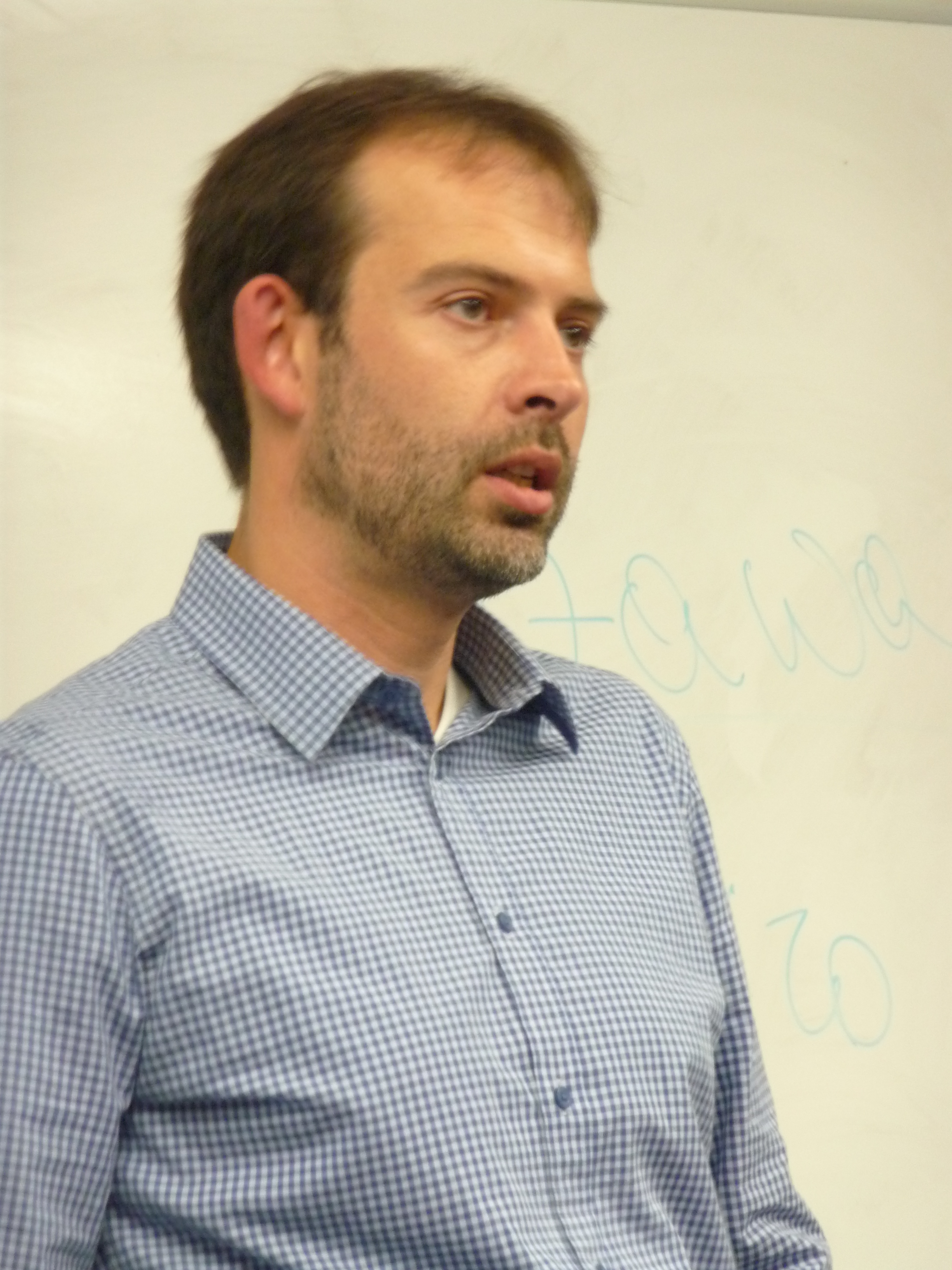 Grey was talking to the War Studies Department at King’s College London yesterday about his latest thoughts on the situation in Afghanistan having spent some time with 2 Yorks and the US Marine Corps.
Over the summer, Grey identified a change in approach in Helmand province. Previously British troops were going into villages, seizing control and then pulling out, unable to provide durable security. Now, he said, there is an acceptance that areas have to be held for the long term.
Troop levels in Helmand have increased significantly with the arrival of the US Marines, but Grey noted that the area of operations has also been extended.
As a result, he claimed there is still not sufficient troop density to succesfully implement the ‘clear, hold and build’ strategy. He suggests NATO will need extra troops just to hold the areas they now control.
Grey said the Afghan National Army (ANA) is improving but not at a rate that will enable them to take control of the country in the near future. ANA soldiers are very tired, he said.
As a journalist, it’s not really Grey’s role to come up with solutions. But he did offer a few thoughts on this topic.
He recognised that the British Army was adapting very quickly. Some soldiers, he met spoke of a transformation in culture. Grey identified the most important change as a recognition that the political aspect of the wider strategy could not simply be left to other government agencies like the Foreign Office (FO) and the Department for International Development (DFID). But this process of adaptation needed to continue and he wondered whether the pace of change was sufficient in the face of an enemy who was also adapting.
Grey suggested that greater openness and better information sharing might help in this regard citing John Robb’s notion of ‘open-source warfare’. Rather like open-source software hackers, the power of the insurgent lies in their ability to organise, share information and collaborate at much greater speed than their bureaucratic enemies.
He also wondered if there could be a ‘hippocratic’ formulation of counterinsurgency warfare, whereby one of the rules is ‘first, do no harm‘. Though quite how this would work is difficult to see given that Grey himself acknowledged that counterinsurgency operations are usually far less ‘fluffy’ than they can sometimes be reported. It is still about killing insurgents as well as building schools.
Even if the focus here is ‘do no harm to civilians’ that’s still problematic: the questions ‘who are Taliban?’ and ‘who are the civilians?’ are not always easy ones to answer. Grey said the official Afghan government and informal Taliban government often operate in parallel in Helmand.
Finally, Grey implied that security could only be achieved through the establishment of tribal security, whether that be through tribal security forces, or political deals with tribal leaders. (He’s not the only one advocating this position.) His support for an approach with a "lighter touch" is based on his belief that the current strategy could only lead to the garrisoning of the whole of southern Afghanistan.
]]>
I picked this up via Dr Ken Payne on the Kings of War blog, which gives me an opportunity to recommend his articles on conflict and the media – Media at War, and Waging Communication War.
]]>