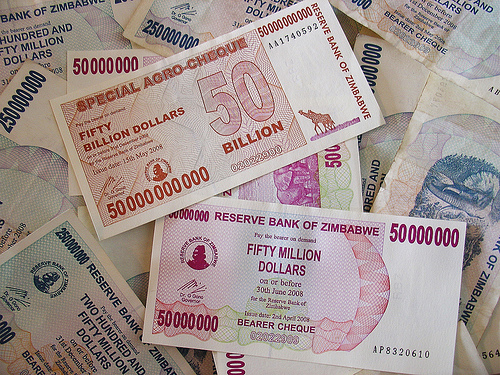
Writing in The Indypendent Alaina Varvaloucas and Jerry Guo describe the day to day work of journalists in the Zimbabwean capital Harare.
Magwenya himself secretly works as a stringer for CNN and has approximately 20 colleagues in Harare who do the same work for other major Western media outlets. Not only is he free to express himself in his dispatches however he likes, but he also gets paid by wire transfer in U.S. dollars, vital to purchasing groceries and other goods as the Zimbabwean dollar has become worthless.
But reporting for foreign news services is far from the ideal job. For a journalist in the land of chaos, the fear of being arrested is all too real, and the possibility of an arbitrary jail sentence — or even torture — is terrifying. Though most are accredited and are doing nothing illegal, independent journalists have been known to wind up injured, missing or dead. link
For my money, this is still the best post I have read about life in Zimbabwe and it comes from our very own anonymous Frontline blogger based in the country.
Photo of Fifty Billion Dollars by ZeroOne
]]>An undercover film shot in Zimbabwe by Shepherd Yuda, a prison officer, and smuggled out of the country has won the best news programme category in the Broadcast Awards announced last night. The film followed the story of vote rigging during the 2008 election,
]]>Zimbabwe: The Stolen Ballots, a world exclusive broken on the guardian.co.uk website in July last year and also broadcast on BBC2’s Newsnight, showed a Mugabe supporter getting prison officers to fill in their postal ballots in his presence.
The film was shot in Zimbabwe capital Harare’s central jail by prison officer Shepherd Yuda and smuggled out of the country by him. Yuda later fled the country with his family.
This is believed to be the first time a UK newspaper has won a Broadcast award. link
 Robert Adams, one of the original Frontline TV cameramen and a founder member of the Frontline Club, is on the road. For six months Rob, his family and some friends will be on the road in Africa. From their home in Harare they’ll head to Cairo, Cape Town and back to Harare and all points in between. The family are taking it in turns to write on the blog,
It’s a little after 7, on an overcast morning in Harare. I’m sitting on our balcony, looking down over a valley full of msasa trees and birds. It’s hard to imagine that just a few kilometers away, beyond the hills on the other side of the valley, the vast majority of the population of this country are living in stress and penury…
…I suppose I am acutely conscious that as our adopted homeland sinks into the mire, with hunger and cholera and inexcusable selfishness by our political leaders, we are about to embark on what must, to some, seem like an absurd extravagance. I have been quietly haunted, the past few months, by the contradiction between Zimbabwe’s decline and our expedition. link
Follow the family Adams on the Jangano 2009 blog. We talked to Rob some time ago about his work on the film, Shake hands with the devil, about the Rwandan genocide.
]]>There has been a huge amount of interest by the international community, diplomatic and media, and by the general public, in the Zimbabwe crisis in the past three weeks. Much of the reporting has been very good. Some has been extremely poor. All of us, pretty much without exception, were caught up in the euphoria in early April when it became clear that the MDC had swept the board, and Mugabe was "finished". Well, that was a mistake, wasn’t it?
It might be a good idea to start with the reasons why Mugabe is so unlikely to step down quietly. There are around 500 people for whose benefit Zimbabwe is currently run. Perhaps it’s a thousand. Certainly it is less than a tenth of a percent of the population. They are senior members of the ruling party, of the armed forces and security establishment, and a select few around those key members. Imagine, if you like, that Zimbabwe is a village, with a chief; a Dare, or council of elders; and a few hundred villagers.
There are then several thousand goats, and chickens, and head of cattle, and guinea fowl. And there are a few million stalks of maize, and soya, and Marula trees. The livestock and the crops are more or less disposable. The village can’t survive if there are none at all, but no individual goat or stalk of maize isnecessary to the well-being of the village.
On the other hand, all the five hundred inhabitants know each other, are connected to each other, and although sometimes there are falling outs, they all look after one another when necessary. This is not just an Orwellian metaphor. It is quite clear that the elite, the five hundred, or a thousand, have no more sense of responsibility to the people than a farmer does to his chicken, or his corn. Of course, he’ll look after it up to a point; but he’ll have no compunction about cutting its throat or taking a scythe tothe field if that’s what’s needed.
These five hundred, or a thousand, surround Mugabe. They are his entire constiuency. They ensure that he hears only two messages from his people: "The country will be colonised again if you don’t keep fighting" and "Everything is fine and everybody loves you." It’s a Potemkin State. There’s a lot of talk about the economy bringing Mugabe down. This pre-supposes that those in charge need to preside over what we would consider to be a functional economy. I don’t think this matters to them. They are quite happy to run an economy that is primarily based on subsistence agriculture.
Hungry peasants have always been Zanu PF‘s primary constituency. Aspirational middle class urbanites are always going to want freedom and a functioning economy. So these are the choices facing those who are not connected to the system; They can retreat to the villages, and pray there is enough rain and cow shit to grow a crop to feed their family. Or they can leave their families behind, and sell newspapers at the traffic lights in Jo’burg. Or work as a gardener in Botswana, or a taxi driver in Luton. Any way to earn real money, which they can then send backto keep their families alive.
There are two ways to do this. You can either send money through the banking system, pay a thousand Rand or Pula or Pounds into a bank account in Zim, and have your relatives withdraw it in Zim dollars (it is virtually illegal to draw – or own, or spend – foreign currency within Zimbabwe). If you use the bank, you will be reimbursed at a rate of 60,000 Zimbabwe Dollars (ZWD) to the Pound. The alternative is to use the black market, where the rate is better. A lot better. Two thousand times better, to be precise, this week. On the black market a pound fetches 120 million ZWD.
Unfortunately, the elite controls at least 75% of the black market in cash. So as long as they can take a hundred Rand, or a thousand Pounds, and exchange it for bundles of worthless paper that could easily be printed on a photocopier, they will get richer. The only way they can lose is if people refuse to accept Zim dollars, and insist on what we call "real money". The elite can stop this happening (they do stop this happening) by making it a criminal offence to own foreign currency. So if you want to buy a loaf of bread – currently 30 million ZWD you can either change at the official rate of ZWD 60,000 to the Pound, which means it costs £500, or you can change your money on the black market rate of ZWD120 million to the Pound and pay 25p for it – thereby keeping the elite in the manner to which they have become accustomed.
This works well for them, obviously. It works even better when they can go to the Reserve Bank and buy their US dollars for the official rate – in other words, pay one fifth of a cent for each dollar they buy. There’s not quite enough money in the Reserve Bank to go round, as the economy falters. But there’s certainly enough to pay off a loyal lackey with fifty thousand pounds to buy a new Mercedes every now and again – for which he pays £25. Yes, that is TWENTY FIVE POUNDS, for a new Merc. Tax free, of course. Just the promise of this possibility is enough to keep most of them quiet. Sorry. To keep ALL of them quiet.
The big multinational mining companies that run the Platinum mines and the Gold mines pay a royalty to the government – rumoured to be a million Poiunds a day, directly to the President’s office, for the Impala ZimPlats Platinum mine at Ingeze. That pays for Isreali communication intercept equipment and water canon, and Chinese AK 47 bullets and spare parts for the APC’s, and South African fuel for the President’s motorcade. A tiny bit of this also goes to schools and hospitals and fixing the roads and keeping Air Zim in the air and sewerage and electricity and everything else that a functioning state is supposed to provide forits people.
But it is a vanishingly small amount. Most gets poured into the trough. Even the hundred and fifty thousand percent inflation doesn’t interrupt this vicious circle. Prices increase at the rate the Zim dollar collapses. So though a loaf of bread was two hundred dollars fifteen months ago, and is now thirty million, it is still 25p in "real money". So long as the economy is kept alive by Zimbabweans in the diaspora earning "real money" and using the black market to get that money home to their dependents, the purchasing power of that diaspora income doesn’t really change. The relatives back home still get to buy the loaf of bread. The elite still get to keep the “Real Money”. The elite have had their snouts in the trough for so long that they have failed to notice the way the masses have turned against them.
So they have been as astonished this past three weeks by th
e surge of political dissent as those village farmers I referred to earlier would be if the field of corn rose up against them. It is inconceivable to them. For ten years ZANU PF loyalists have convinced themselves that the MDC and the democratic opposition was a creation of the British, the Americans, and the white farmers. Any black member of the MDC is a sell-out and an Uncle Tom.
Zanu have rigged the elections over the past few years, but they’ve never had to rig extensively, and they were pretty sure that this time they’d fixed the problem for good. Therefore they were absolutely flabbergasted when, three weeks ago today, the people of Zimbabwe rose up and threw them out. For three or four days they reeled. Emissaries were sent to Tsvangarai’s people, sounding out options for a government of national unity. Bob’s wife and kids left the country – probably accompanied by the families of most of the top leadership.
There were suddenly fewer new luxury 4×4’s on the road. Building worked stopped on the huge palaces going up around Borrowdale and Hogerty Hill. But then they rallied. It started, it seems, with a group of senior generals – what is known as the JOC – the Joint Operations Command, amusingly the same name given to the military/civilian crisis committee that ran Rhodesia during the Bush War.
Although Mugabe is probably immune from international prosecution, and therefore from domestic legal process, many of his senior military people are not. Mugabe can’t be sent to The Hague tribunals, because they are only for Sierra Leone and Yugoslavia. The International Criminal Court only has jurisdiction on crimes committed after the Court’s inception in 2002. So unless you count Murambatsvina, which was a disgrace but arguably not a Crime against Humanity, Bob is in the clear.
It is his legacy that he worries about, not his freedom. Since then, they have adopted a two-pronged strategy. On the one hand they are frantically stuffing ballot boxes in a secret location – probably within the military headquarters (which is still called "KG6" – though I suspect no one in the security establishment knows that this stands for King George VI, and was so named back in the fifties) in the hope that they can get enough false ballot papers in the boxes to avoid a re-run. And on the other hand, they have turned on their people.
They are aware that widespread killing is not going to be defensible, even among their allies in the Africa Union and beyond – China, North Korea, Iran, and Cuba, (though two MDC activists have been killed in the past week). China in particular has enough problems with human rights activists at the moment. But they are beating and brutalising and burning huts across the country to try to "encourage" people not to vote for the opposition should there be a run-off.
The MDC is utterly hamstrung. Never particularly good at showing courageous leadership when it is most needed, they have cowered and squabbled and acted like rabbits caught in the headlights of a juggernaut. We think Morgan is in exile, though he hasn’t admitted it yet. The MDC has argued that any sign of public dissent will be used by the regime as an excuse to declare a state of emergency, and smash them down. But this is what is happening anyway. Had the MDC brought a hundred thousand people out onto the streets at the beginning of April, we would probably have a handful of martyrs, and a new government. But they had neither the courage, the wit, or the organisational skill to move when there was a chance. Now they cannot get more than three people together without the police and army descending on them. I fear that the moment has passed.
My fear at the moment is that Mugabe and his cohorts are looking at the examples of Burma, China, and North Korea, where over the past fifty years there has been a brutal suppression of democratic popular dissent, coupled with Maoist "back to the land" socio-political policies, and the hegemony of the one-party state.
And despite all these states being roundly condemned for these policies by their neighbouring states and by the international community, they have all survived. It is forty years since Mao’s "Great Leap Forward" led to the deaths of millions through starvation, imprisonment and the criminalisation of free thought. Yet thirty years after Mao died, the Communist party he founded is still in unchallenged power, opposition activists are routinely jailed and beaten, and Mao’s picture hangs in every government office and school. But it is Burma that is probably the best parallel.
In 1988 the military dictatorship which had been in power since 1962 was confronted by a popular uprising against economic collapse and political repression. The military dictator Nhe Win crushed the rebellion with great brutality, and in 1992 felt sufficiently confident to hold an election, which was won by the democrats under Aung San Suu Kyi. This was not the Generals’ preferred outcome. So instead of respecting the result they threw all the opposition leaders in jail – where they mostly remain today – retroactively rigged the result, declared a state of emergency, and have ruled brutally and largely unchallenged ever since.
The outburst of protest in September last year was crushed, several hundred were killed, and despite a little ritual hand-wringing the world turned it’s back. That, I believe, is the calculation that Mugabe and his senior ministers and generals are making today. They reckon that if they can get over this current "inconvenience" they will be able to re-engineer the country to make it a Zanu state for ever – at least in political terms, where "forever" is the next five decades.
What I find most frightening is that already the opposition and elements of the international community are subsiding back into apathy. Already I am hearing people saying, "Well, you know, he’ll get away with it this time, but he won’t last forever, and there’ll be another chance in five years." There won’t be. If he doesn’t go, there will not be another chance.
There will not be another election in five years time unless Z-PF is the only party contesting. There will be no MDC – everyone who opposes Zanu-PF will be in jail or in exile. This is not a game of football. I think we should all remind ourselves this, everyday. There is a rapidly narrowing window of opportunity. This month. Perhaps next. After that, the country will be stolen from us for good.
]]> 7am – Umwinsidale, Harare
Arrived at the polling station, a large marquee in a field between the Redale petrol station and the local police outpost, just after 7am to find a short queue of about 10 people waiting to vote. Loitering outside was a chap wearing a yellow jerkin which read Regional Faith Observer but when asked he turned out to be a Zimbabwean national.
A further seven unidentified people, supposedly observers, sat side by side along a bench outside the entrance to the tent with a man posted at the doorway, calling in the voters one at a time and checking their Zimbabwean ID cards before allowing them inside.
Inside along the left-hand wall of the marquee there was another row of six or seven people sitting on a bench watching events, while at right angles to them were set a group of six desks or tables placed side by side. The polling officer at the first desk looks up the voter’s name on the electoral register, checks it matches the person’s ID card and then underlines the name.
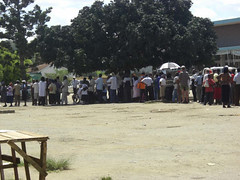
At the second desk the voter collects a presidential ballot paper which the polling officer folds in half as an example. At the third desk the voter collects the ballot for the Senate elections, at the fourth, the ballot for the parliamentary elections and at the fifth the ballot for the council elections. At the sixth desk the voter is asked to dip the left little finger into a pot of pink ink.
At right angles to the desks (now on the third side of the square of the tent iare set three cardboard booths, about six feet high, in which the voter can mark each ballot paper with a cross. Once this is done, the voter emerges with four ballots folded in half, all slightly different in colour ready to put in their individually-marked ballot boxes, where there is another official to confirm that each paper is put in the correct box. The four ballot boxes are Perspex and transparent, each clearly marked.
On the way out of the tent was a desk with another man, purpose unknown. There was no uniformed policeman inside and the one patrolling outside did not enter when a disabled lady (arms foreshortened from thalidomide) entered. Although this lady (Sandy) has on previous elections been on the electoral roll for this ward and has always voted in this place, she was told her name wasn’t on the roll and she must go elsewhere. She tried to complain to the observers both inside and outside the tent, but no-one paid any attention or took any note of her complaint.
So the voting process at this polling station appeared entirely in line with international standards for a free and fair vote albeit that at least one voter feared being disenfranchised from the absence of her name on the electoral roll. However, as another voter commented: this isn’t where the rigging takes place, it’s the count and the tally which need the closest scrutiny.
]]>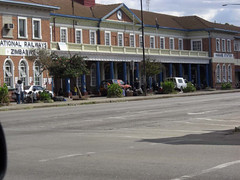 For a short while today I was a billionaire. I changed US$100 at a rate of 40 million Zimbabwean dollars (ZD) to the US dollar. In Zimbabwe everyone is a millionaire some of the time.
I couldn’t have changed more, even if I’d had room in my rucksack because apprehension about the outcome of tomorrow’s elections has people queuing in their hundreds outside banks to draw whatever they can. As a result there is little liquidity for the black market dealers out on the streets.
It went quickly – 500 million ZD for a meal, 100 million ZD for a bottle of beer, nearly 1 billion for a pair of leather sandals. Easy come, easy go.
The meal had been pretty spectacular – a lamb curry at Amanzi, one of Harare’s best restaurants out on Enterprise Road as you head east away from the city centre. Not just because of the quality of the food, which was excellent, but because of the live music and party atmosphere in which it was consumed.
It was a respite from the rumour mill, from the seesaw between hope and despair that all Zimbabweans feel as the hours tick by and the moment comes when the people can have their say.
Outcome already fixed
The trouble is that so many are convinced that their votes will not count in the usual way because the ‘Harmonised 2008 Elections’ are already rigged in Zanu-PF and Robert Mugabe’s favour.
“There is more excitement than in 2005 and that is down to Simba Makoni’s entry into the presidential race,” Pastor Rifa told me. “The only way to dislodge the tyrant is for all the opposition to unite and when the MDC split people were so disappointed they weren’t even sure it was worth registering to vote.”

“But then Makoni declared – and voter registration in this constituency went up by 45% in a single week. Maybe he can’t win, maybe he will split the vote, but the thought that as a former Zanu-PF insider he will know how to beat Mugabe has given people renewed hope.”
Does he share that hope that Mugabe can be defeated? “Personally I believe the election has already been rigged before a single vote is cast. BUT if there is an overwhelming vote for the opposition maybe it will be too difficult to cover up.”
Pray for us
For Linda, the situation can hardly be worse. A supporter of the Arthur Mutambara faction of the MDC in Bulawayo, she has been out on the stump campaigning for Simba Makoni.
“My children are grown and gone. But last year a family came by to visit us, just as you are now. The two children were here playing in the garden as we spoke under the shade of the tree. I went to arrange some cool drinks and when I came back the parents had left, leaving these children that you see here now, with us.”
Linda and her husband are getting on in years, have no employment and no pension.
Her husband was a Zipra fighter in the second Chimurenga and so was targeted during the Gukurahundi repression of 1982. He showed me the scars from the beatings that nearly cost him his life.
They have long had reason to fear and loathe Robert Mugabe but had become disillusioned with the failure of Morgan Tsvangirai to find a strategy to oust him.
“But this time, God willing, it will happen. Change has to come, life is too hard here. Please pray for us that this time we can make it so.”
Lessons of the past decade
Electoral officials have traditionally called on teachers to act as polling officers during elections but this year it’s been a source of contention as the new rules require everyone to vote in their home town where they are registered. It has meant that anyone deployed outside their home town would in effect be disenfranchised.
Justin Moyo is so determined to cast his vote he chose not to volunteer as a polling officer this year. He has been on strike for weeks, tempted back by President Mugabe’s offer of a 4.5 billion ZD raise then frustrated when it turned out to be only 1.2 billion in the pay cheque.
“Not everyone even got that much. So even though we are supposed to go back to work for the start of the new term on April 29th, I think some teachers won’t go back then and we will be on strike again.”
“I think this time it will be tough for the old man, because he has never won a free and fair election.”
Then he frowns and asks if I think the election will be free and fair. I answer with another question – what was it like in previous elections?
“We know the old man stole the election in 2000, 2002 and 2005 but we have to believe that this time, it just might be different.”
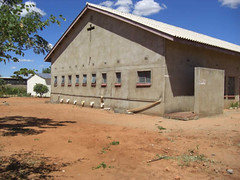
I go to the house of the fourth, and least known, candidate in this presidential election, Pastor Langton Tawungana, who lives in Mkhosana township, a high-density suburb of Victoria Falls.
The pastor isn’t home, in fact he is away in Harare, his wife says.
Mrs Tawungana is on her way to work and doesn’t have much time to talk about her husband’s candidacy.
Does he have prior political experience? “No”. Has he any experience of public administration? “No”. Not even at local level, in the town council? “No”. Has he ever been a member of any political party? “No.” So why is he standing?
“He felt a calling from God. He says the situation in Zimbabwe is crying out for heavenly intervention and that he was called upon to do something.”
So has he been campaigning hard? “No he has done no campaigning.”
And with that the interview is over. So I drive to Pastor Tawungana’s church. On the trees outside are posters for his rivals, Morgan Tsvangirai and Simba Makoni and in their shade lies a broken down van, its tyres flat.
]]>