As the eighth and final leader of the Soviet Union, Mikhail Gorbachev is one of the 20th Century’s most defining politicians, a figure equally defined by the vision of transparency that led his efforts to expand and restructure his nation, and the lost potential left in the wake of the USSR’s disintegration. Nearly three decades since his removal from power, the 87-year-old Gorbachev sits down with Herzog for a series of exclusive one-on-one conversations on his remarkable life and legacy, at a time when the former President finds himself more removed than ever from the defining ideologies of Russian leadership.
The film is both a riveting documentary and deeply humanising portrait filled with unforgettable archive plus interviews with key political players from the last thirty years. As Herzog explores the conditions of Gorbachev’s unlikely rise to power and subsequent achievements through a surprisingly candid and friendly rapport, his ever-present themes soon emerge to shape a timely study of the unstable and temporal nature of those in the world’s most powerful positions.
“With Mikhail Gorbachev… Werner Herzog has finally met his match.” – Indiewire
The screening will be followed by a Q&A with co-director André Singer and producer Svetlana Palmer chaired by journalist and producer Carol Nahra.
Speakers:
André Singer is a filmmaker and anthropologist. He worked for Granada Television in the 1970s on World in Action and A Disappearing World. In the 1980s for the BBC he founded the documentary series Fine Cut (which later became Storyville) where he worked as either a Commissioner, Executive or Producer with many leading filmmakers including Jean Rouch, Fred Wiseman, D A A Pennebaker, Bob Drew, Mike Grigsby and Vikram Jayanti, and where he first linked up with Werner Herzog by commissioning Lessons of Darkness. He has played a role subsequently on fourteen of Werner’s films including being Producer on Into the Inferno, The Wild Blue Yonder and Fireball. More recently as an Executive Producer and through his company Spring Films in London, Singer worked on Josh Oppenheimer’s Oscar nominated films The Act of Killing and The Look of Silence. As a director he was awarded the RTS, Peabody and an Emmy for his 2015 Holocaust film Night Will Fall and in 2017 completed the anti-nuclear film Where the Wind Blew which won the Raven Award for best feature documentary at DocUtah. His current film as co-director with Herzog is Meeting Gorbachev which will be launched in the UK in November to coincide with commemorations of the fall of the Berlin Wall in 1989. As an anthropologist he was President of the Royal Anthropological Institute of Great Britain and Ireland between 2014 and 2018 and is currently a Professorial Associate of SOAS.
Moderator: Carole
]]>
Free societies crumbled in the decade after World War II, when Stalin took much of Eastern and Central Europe, and in a single-minded fashion, dismantled the existing institutions to build totalitarianism.
This period provides the subject for Pulitzer Prize-winning author Anne Applebaum’s latest book Iron Curtain, which she discussed with journalists and columnist for The Times, Oliver Kamm before a sold-out audience at the Frontline Club on Monday 21 January.
“Why did anybody go along with totalitarianism?” she wondered before starting the book.
“Describe the scene for us,” Kamm began.
“It’s hard,” Applebaum answered. After the war, “the level of physical destruction…you had absolutely flat cities…totally destroyed transportation systems…economies that didn’t function – at all.”
“One of my most interesting interviews…was with a Polish writer… He was a Stalinist [at first], and he described that to me… Everything his parents had told him, and everything his schools had taught him, turned out to be wrong… The army failed. The government failed society collapsed… And that caused a kind of break in his mentality… he said…’you know, maybe the opposite is true. Maybe the communists are right’.”
Applebaum described what followed:
“You had no good choices. You couldn’t just decide to be a freedom fighter and stand up for democracy. I mean, you could, then: A. You would be arrested. B. Your wife would be arrested. C. Your child would get kicked out of college. D. Your mother would be thrown out of the hospital. Because the State had control over so many aspects of society, people had really very bad and hard decisions to make.”
But not even Stalin, totalitarianism’s maestro, couldn’t pull it off.
“The idea is that everyone will become convinced. They will be re-educated…and there will be no opposition… But somehow, it never works…[Even] at the very height of Stalinism in 1951 or ’52, they never actually made it.”
Yet for four decades, the Soviet bloc lived, and its unraveling still boggles Applebaum.
“It all seems so implausible to me. I mean: how did it happen? How can you explain it? Why did Gorbachev do what he did? Why did he just give up that enormous empire? Nobody was making him do it… Really, it could have gone on a lot longer.”
In much subtler shades, it has – under Vladimir Putin.
“He does care a lot, pretty inexplicably, in fact, about Pussy Riot,” Applebaum said. “There is a direct line from Putin to [Yuri] Andropov,” Soviet Ambassador to Budapest during Hungary’s rebellion 1956, and head of the KGB in the early 1980s.
“Putin came of age in Andropov’s KGB… He remembers ’89. He was taught by Andropov, who remembers ’56… The kind of treatment that dissidents or artists got in the Soviet Union in the first half of the ‘80s when Andropov was in power was almost as severe as in Stalin’s time… What was the conclusion? … all of these little groups who you thought weren’t important…you can let them go, [but] it can all unravel, and you can have an armed rebellion.”
Watch the full discussion here:
]]>
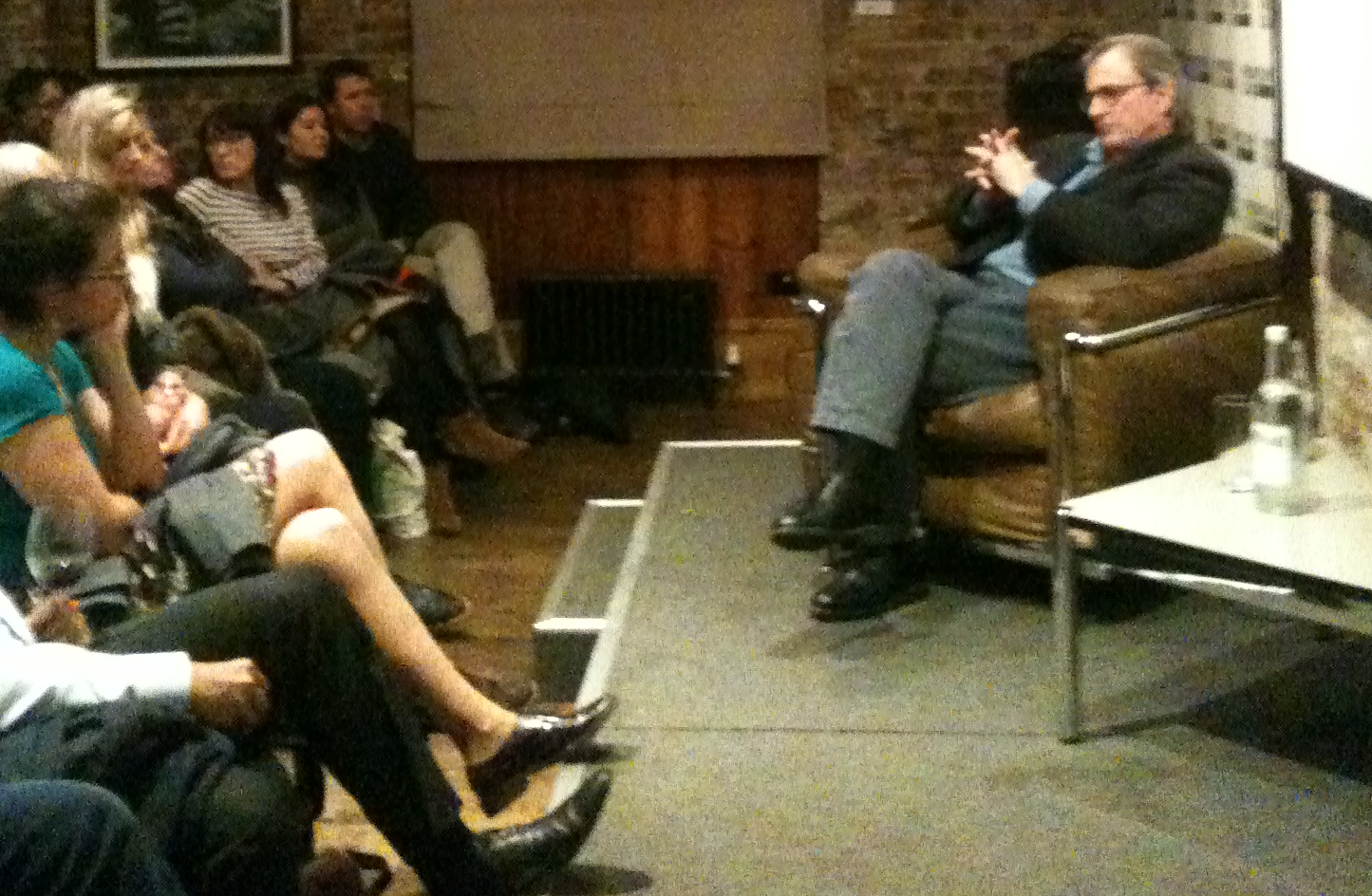 "He was there!" Director Thomas O’Connor said of English author and journalist Graham Greene (1904-1991), the subject of his documentary Dangerous Edge: A Life of Graham Greene, which was viewed by a full house at the Frontline Club on 1 October.
"There, you know, for 70 years, from one place to another, in these hot spots."
Greene – whether meeting with the Pope, giving a speech to Gorbachev’s Kremlin, conversing with Latin American rulers, or journeying in the 1930s through the hinterlands of Mexico or Liberia – had his finger on the very pulse of the 20th century: its crimes of foreign policy, the inner angst of its inhabitants.
In his own life, Greene left his wife and two daughters early on, indulged in drugs, prostitutes and affairs, suffered from bipolar disorder, and fought powerful suicidal urges, often admitting to his own yearning to die.
"Dear Vivien," he wrote to his wife, "the fact that must be faced, dear, is I have been a bad husband. You see, my restlessness, moods, melancholia, even my outside relationships, are symptoms of a disease, not the disease itself. Unfortunately, the disease is also one’s material. Cure the disease and I doubt whether a writer would remain."
"He was a tremendously courageous writer and journalist," O’Connor reflected, sharing that a driving motivation to make the film was that he "worried about journalism [today]," that future generations would lack voices as brave and voluminous as Greene’s.
"Some writers write their novels," O’Connor said, "and then every once in a while a letter to the Editor. Greene had a whole book of letters to the Editor!"
His eyes searing with intelligence and sensitivity, Greene asked readers to see more deeply into the world around them. He challenged the injustices of big business, globalization, Soviet totalitarianism, and British and American interventionism.
"I would go to any lengths to put my feeble twigs into the spokes of American foreign policy," Greene wrote.
His 1955 novel The Quiet American paired the damage done by a naive American idealist with that by a cynical English journalist like himself, both living in Saigon and desiring the same Vietnamese woman. The work so touched a nerve that, as O’Connor highlighted, even George W. Bush could not help mentioning it in a 2007 speech to American war veterans.
O’Connor wished Greene had been alive to challenge the narrative that led to the latest invasion of Iraq.
]]>"We still need writers," he argued, "as [Greene] famously said, ‘with a sliver of ice in their heart,’ and willing ‘to be a piece of grit in the state machinery.’"
By Nicole Hunt
Here’s a special two-week roundup of big international events planned over the holiday period. While we can’t predict tsunamis, terrorist attacks, or sudden political change, we can give you a heads up on the big stories that are sure to go ahead.
Following last week’s Commonwealth of Independent States and Gorbachev resignation anniversaries, Boxing Day formally marks the 20th anniversary of the dissolution of the Soviet Union. The Soviet parliament voted the USSR out of existence on 26 December, 1991.
Indian anti-corruption activist Anna Hazare has pledged to begin a public fast on 27 December to coincide with an extended session of the Indian Parliament scheduled to debate a new anti-corruption bill. The Jan Lokpal Bill was drafted earlier this year after a five-day hunger strike by Hazare prompted nationwide protests.
Former Egyptian President Hosni Mubarak’s trial resumes on 28 December after a long hiatus to allow lawyers for the families of victims to challenge the trial judge and venue. The challenges were rejected on 7 December, so the trial starts back up today before Judge Ahmed Refaat.
The funeral for North Korean leader Kim Jong-il takes place on 28 December. If the usual military displays and the public mourning since Kim’s death are anything to go by, it’s sure to be a spectacular event.
North Korea’s mourning period officially ends on 29 December, and will be marked by a gun salute, three minutes of silence nationwide, and the simultaneous sounding of the horns of all trains and ships in the country.
31 December marks the deadline issued by the Tripoli Council for the city’s residents to hand in any weapons they may be holding on to. The move is part of a push to disarm the city, which has been plagued by gun battles between rival militias since the declaration of liberation.
The controversial ban on bullfighting in Catalonia, which was approved on 28 July, 2010, comes into effect on 1 January. Catalonia is the first region in mainland Spain to outlaw the sport, which it has done on the grounds of animal cruelty.
There are two big polls scheduled for 3 January. Iowa Republicans gather statewide to kick-off the selection process for the Republican presidential nominee. The race has been and remains unpredictable; recent polls have alternately shown Mitt Romney, Ron Paul or Newt Gingrich leading in the Hawkeye State. Voters seem unable to settle on any particular candidate and there are no signs of this changing in the next 10 days.
Meanwhile, Egypt’s nine remaining provinces take their turns at the ballot box following two earlier rounds in the country’s other 18 regions. Preliminary results from the earlier rounds indicated strong support for the Muslim Brotherhood, but the full make-up of the People’s Assembly won’t be known until later this month.
The African National Congress kicks off three days of celebrations on 6 January to celebrate the party’s 100th anniversary. The ANC was founded in 1912 to help further the rights of South Africa’s black population, and first came to power under Nelson Mandela in 1994. President Jacob Zuma delivers the Centennial address on 8 January.
]]>