Confounded by global warming and in search of an affirmative politics that links ecology with social change, Matt Hern and Am Johal set off on a series of road trips to the tar sands of northern Alberta—perhaps the world’s largest industrial site, dedicated to the dirty work of extracting oil from Alberta’s vast reserves. Traveling from culturally liberal, self-consciously “green” Vancouver, and aware that our well-meaning performances of recycling and climate-justice marching are accompanied by constant driving, flying, heating, and fossil-fuel consumption, Hern and Johal want to talk to people whose lives and fortunes depend on or are imperiled by extraction.
They are seeking new definitions of ecology built on a renovated politics of land. Traveling with them is their friend Joe Sacco—infamous journalist and cartoonist, teller of complex stories from Gaza to Paris—who contributes illustrations and insights and a chapter-length comic about the contradictions of life in an oil town. The epic scale of the ecological horror is captured through a series of stunning color photos by award-winning aerial photographer Louis Helbig.
Seamlessly combining travelogue, sophisticated political analysis, and ecological theory, speaking both to local residents and to leading scholars, the authors propose a new understanding of ecology that links the domination of the other-than-human world to the domination of humans by humans. They argue that any definition of ecology has to start with decolonization and that confronting global warming requires a politics that speaks to a different way of being in the world—a reconstituted understanding of the sweetness of life.
Chair
Presenter for the BBC’s ‘One Show’, and columnist for the Observer, Lucy Siegle has focussed on social and environmental justice in her reporting for a number of years. Lucy has extensive experience in humanizing environmental science, from climate change to consumer energy use. In 2004, she created the paper’s Observer Ethical Awards (OEAs), dubbed the Green Oscars, which have been running for over eight years. She is a regular columnist for the Observer and contributes to Radio 4’s ‘Today Programme’.
Speakers
Matt Hern lives in East Vancouver on səlil’wətaʔɬ (Tsleil-Waututh), Skwxwú7mesh (Squamish), and xʷməθkʷəy̓əm (Musqueam) territory, with his partner and daughters. He is co-directs Solid State Industries and has co-founded and directed many other community projects. He currently teaches with multiple universities, and continues to lecture globally. Matt’s books and articles have been published on all six continents and translated into thirteen languages.
Am Johal is Director of Simon Fraser University’s Vancity Office of Community Engagement. He is the author of ‘Ecological Metapolitics: Badiou and the Anthropocene’ (Atropos Press, 2015) and is co-author with Matt Hern (with contributions from Joe Sacco), of “Global Warming and the Sweetness of Life: A Tar Sands Tale.” (MIT, 2018). He is the co-founder of UBC’s Humanities 101 program and is an associate of SFU’s Centre for Dialogue and SFU’s Institute for the Humanities. He previously served as co-chair of the Impact on Communities Coalition, as a board member with the Vancity Community Foundation, the Or Gallery, the Vancouver City Planning Commission, the Downtown Eastside Neighbourhood House and many other organizations.
]]>But rapid urban growth is a challenge for cities everywhere – from the effects of climate change and natural disasters to mass migration, urban sprawl, pollution and lack of affordable housing.
During an evening of film screenings and discussion, we explore these tensions and what solutions can be found to make cities places that leave no one behind and that are a joy to live in for everyone.
The evening will begin with the screening of two recent films made by PLACE, the Thomson Reuters Foundation’s website covering land and property rights stories around the world.
Film 1 – Falling Freetown
“Falling Freetown” looks at Freetown, the capital of Sierra Leone in the wake of last year’s landslide that claimed the lives of about 1,000 people, a disaster many said was waiting to happen due to poor urban planning combined with rapid migration, deforestation, and freak weather events linked to climate change.
Watch the trailer here: https://vimeo.com/266505415/4f76fbd4df
Film 2 – Urban Nomads
“Urban Nomads” looks at the challenges facing Mongolia’s herding community and the mass migration from rural areas into the capital Ulaanbaatar as climate change and socio-economic changes force people into the city.
Watch the trailer here: https://vimeo.com/266537726
A panel discussion with urban experts will explore the themes raised in the films and discuss solutions that turn these challenges into opportunities for cities. The filmmakers will also be available to answer questions.
Chair
Astrid Zweynert is an award-winning journalist, editor of PLACE and social media specialist. Astrid drives coverage and production of Thomson Reuters Foundation’s global news services covering humanitarian crises, human rights and social innovation for the foundation’s website and the Reuters global newswire.
Speakers
Sarah Colenbrander is a Senior Researcher on urban issues at the International Institute for Environment and Development (IIED). Her areas of expertise include financing urban infrastructure, urban governance for inclusion and sustainability, and climate and energy policy in urban areas. She is also Global Programme Lead and Senior Economist at the Coalition for Urban Transitions, a network of research, government and private sector organisations. In addition to academic publications, she has contributed to World Bank, New Climate Economy and UN Environment reports and is Associate Editor for the journal ‘Environment and Urbanization’. She is also a guest lecturer at the University of Oxford, University College London and University of Manchester.
Anna Locke – Head of Programme of Agricultural Development and Policy at ODI (The Overseas Development Institute). Her work focuses on land governance and large-scale investment, biofuels and food security. She has in-depth experience working on market-led agriculture, analysing and advising on how to develop agriculture to promote sustainable growth and reduce poverty, based on principles of competitiveness, market access and inclusiveness.
Euphemia Sydney-Davies is a Sierra Leonean fashion designer and founder of the Sydney-Davies label who is passionate about ethical and sustainable fashion. Instead of outsourcing work to India or China, she set up a small tailoring workshop in Freetown, where she trains local men and women how to make garments for her clothing ranges. After the mudslide Sydney-Davies went home to help her people and raised funds in the UK, where she is based, to assist those most affected. She remains in touch with those who lost everything in the disaster and is critical of the government’s handling of the crisis.
Charles Landry is an author, speaker and international adviser on the future of cities. He is best known for popularising the Creative City concept. Its focus is how cities can create the enabling conditions for people and organisations to think, plan and act with imagination to solve problems and develop opportunities. He has chaired multiple urban innovation juries including The European Capital of Innovation Award – iCapital, New Innovations in the Creative Economy (N.I.C.E.) and Actors for Urban Change. He is a fellow of The Robert Bosch Academy in Berlin.


]]>
On Tuesday 21 April, the Frontline Club hosted a panel to discuss the water crisis in Brazil and the world’s largest green area, the Amazonian rainforest. Chaired by Andrew Mitchell, chairman of the Scientific Exploration Society, the event was the second in a series entitled ‘Exploration of the Frontline,’ a collaboration between the Scientific Exploration Society and the Frontline Club that aims at bringing together journalists, explorers and academics for an evening of informed debate.

l-r: Andrew Mitchell , Sue Cunningham, Nixiwaka Yawanawa, Peter Bunyard, Dr Friederike Otto, Rogerio Simoes
As Mitchell detailed, Brazil is currently suffering a staggering water crisis, despite the fact that it holds approximately 12% of the world’s fresh water reserves, four fifths of which are in the Amazonian river basin.
“In Sao Paulo you have a city of 22 million people facing chronic droughts, a situation unique in the history of Brazil,” Mitchell said. This drought is largely the result of wide-scale deforestation, and of changes to the ecosystems in the Amazonian area, hundreds of miles north of Sao Paulo, Rio de Janeiro, and Brazil’s coastline.
Sue Cunningham, an author and photographer with more than 20 years of experience in Brazil, illustrated the consequences of the massive deforestation that she had been witness to during a 2007 expedition on the Xingu river in the heart of the rainforest. Travelling by boat and small planes, the group visited 48 different tribes living along the river.
“When you fly over the forest, you can see when the pollution happens from a pristine river to a contaminated river,” said Cunningham, showing an aerial picture of the polluted Xingu where mercurial refuse had caused a significant change in the colour of the water.
Nixiwaka Yawanawá, a member of the Yawanawá tribe currently working with Survival International to raise awareness about the Amazon and the rights of tribal communities, showed the Frontline Club audience a video of the latest flood that had hit his indigenous community in the Brazilian state of Acre.
Up to 80% of the villages and settlements of the Yawanawá community were swept away. “We never thought that this would happen,” said Yawanawá. “One of our shamans, and they usually are the oldest people in a tribe, he said that in one hundred years we have never seen this kind of flood. Everyone was very shocked and surprised, but we have to carry on.”
@SES_explore @frontlineclub @Survival Great event on water crisis in Brazil.Local impacts but truly global problem! pic.twitter.com/iHEqU0J0lx
— Peter Kohler (@P_Kohler) April 21, 2015
The task of explaining the meteorological dynamics of the issue was assumed by panelists Peter Bunyard and Dr Friederike Otto.
Peter Bunyard, founder of The Ecologist, explained the role of trade winds that flow from Africa and the Atlantic over the Amazonian basin. These winds create a mechanism called the ‘biotic pump’, a natural phenomenon that influences the climate of the entire Latin American region, from Panama to Patagonia.
Otto, a senior researcher at the Environmental Change Institute, University of Oxford, linked the occurrence of drastic climate events such as droughts, typhoons and hurricanes to longterm climate change and the consequential rise in temperature of the planet. “This is a longterm change, and all of these events play together.”
Rogerio Simoes, a Brazilian journalist based in London and former head of the Brazilian Service at the BBC World Service, explained that the rising population of Sao Paulo was a major game-changer in environmental terms.
“Brazil just cannot cope with the population growth,” said Simoes. “According to the latest census in Brazil, there are 11.6 million people living in slums, illegal slums.”
Simoes finished by adding that the short-sightedness of Brazilian politicians was leading to a worsening of the situation. For example, the governor of Sao Paulo state, Geraldo Alckmin, repeatedly denied any issue of water shortage during the 2014 election campaign, at a time when the main water reservoir was at just 7.2% of its total capacity.
]]>
by Sam Bavin
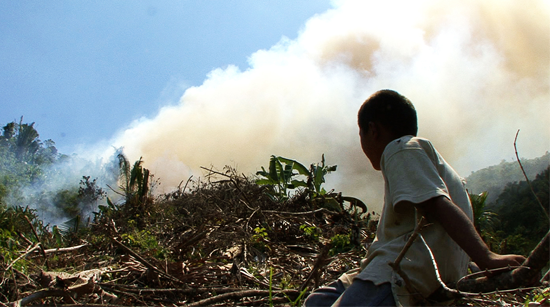
Up In Smoke, from director Adam Wakeling, is screening on Mon 25th July at Frontline. The film follows revolutionary ecologist Mike Hands across the globe as he attempts scale back slash and burn agriculture – one of the biggest contributors to global warming and deforestation in the world today.
Wakeling’s first feature length offering effortlessly combines Hands’ scientific research with the trials of Honduran slash and burn farmers Faustino and Aladino – one of which has already adopted Hands’ pioneering technique ‘alley cropping’, the other waiting to be convinced.
Encompassing both the life and death struggle of impoverished farmers who can’t afford to risk adopting a new farming method and our driving need to change the fate of our planet’s endangered rainforests, the film plays out Hands’ struggle to get people to understand his revolutionary method and the pressures that prevent its implementation.
Up In Smoke’s dramatic, globetrotting path finally leads to the Copenhagen Climate Summit in 2009 where Hands’ attempts to draw international attention to a truly global issue reach their climax. Not to be missed, Wakeling’s film is a bold address of the complex moral questions about saving the planet for future generations as well as protecting the livelihoods of those living today.
More details about the screening are here. There will be a Q&A after the film with Director Adam Wakeling and Ecologist Mike Hands.
]]>By Mariah Hamalainen
“We are facing a complete collapse of ocean ecosystems, globally”, said Professor Charles Sheppard at the Frontline Club on Wednesday evening during a panel discussion on the state of the world’s oceans.
The oceans have been exhibiting the effects of global warming since the late 1970s and a quarter of all coral reefs have died but there has been little awareness of the crisis among the media and the public in general until recently.
High-profile campaigns including Hugh Fearnley–Whittingstall’s Fish Fight and Project Ocean at Selfridges are encouraging people to take a look at the state of the oceans and what can be done to reverse the evident collapse of this delicate ecosystem.
The panel discussion – chaired by Guardian’s environmental correspondent Fiona Harvey – took the audience through many aspects of the destruction of this vital resource: Overfishing; pollution; climate change and global warming; overpopulation; greedy multinational fishing companies; destruction of coral reefs.
“Half of the humanity lives within a hundred kilometres from the ocean” professor Sheppard said. Although millions of people derive their livelihood directly from the oceans, little is done to stop the destruction.
“We in Britain don’t [yet] directly see the problem. We have Tesco’s between us and the environment.”
Greenpeace’s Richard Page shed light on some of the positive developments on the ocean front, as well as what needs to be done to safeguard the future of the global waters;
“The single most effective tool against ocean destruction is the creation of marine reserves” he said.
He also called for the media to play their part in mobilising the public;
One of Greenpeace’s victories was the moratorium on whaling. This could not have been done without the media; when people saw the pole being stuck on a whale it had an immediate impact. The media has an incredibly important part to play if we are to save our oceans.
The panel strongly agreed that consumer power cannot be underestimated:
“Change in demand from consumers would have a huge impact” Dr Alex Rogers said.
Lobbying for policy changes, demanding that the fish we eat is from sustainable fisheries, and reducing the overall impact we have on the planet are all steps towards the right direction.
As Professor Sheppard said: “If we manage the oceans well, it is food for free”.
]]>