Kalashnikovs, dilapidated cities and drone destruction gripped the audience at an overflowing screening of In the Hands of Al Qaeda on Monday 4 February at the Frontline Club. Award-winning journalist Ghaith Abdul-Ahad and producer Jamie Doran were on hand after the screening to answer questions on Yemen, al Qaeda and the making of their latest film.
The Yemeni Ambassador to the UK was also at the Club so questions on government policy,and even visa requests, were often redirected to him.
Abdul-Ahad explained how factionalised domestic politics in Yemen enabled al Qaeda’s existence within these divisions, thriving on the distrust and mutual hatred of the north and south. He said:
“The tribesmen – the separatists – they’re armed and had the capability to kick al Qaeda from the region but they have an apathy towards the state. ‘Why do we do the job of the government, we hate them, we don’t like them, they stole our land.’ This is what they say.”
He added that to persuade reticent southerners, al Qaeda would say:
“‘Look at the government, they brought the Americans, look what they’ve done [with drone strikes].’ . . . It’s this triangle of a love-hate thing – everyone is hating everyone.”
Al Qaeda’s exploitation of the north-south political divide goes even further. They even began an unusually pragmatic campaign to win popular support. Abdul-Ahad said:
“They brought an engineer and he connected a small village to the main grid that was going to Ja’ar, because for a long time they had to pay a bribe to get connected. They allowed UNICEF to go into the schools. . . . They were working on this hearts and minds kind of programme with the people.”
Al Qaeda filled the void left by the state drawing support from the southern population. Doran explained the importance of the southern political situation and how they tried to incorporate this extra dimension into the international version of the film.
“There is a tremendous frustration in the south that their cause is not aired publicly. You rarely hear, unfortunately, about Yemen at all in the news. Normally it’s a US drone strike.”
Abdul-Ahad said the strikes themselves become a huge part of the problem:
“The drones will kill al Qaeda people who will probably have a direct impact on the security of the United States, but for every guy, every [innocent] man killed in south Yemen, you will have 10 people joining al Qaeda. . . . It’s absurd, these whole 10 years we are still recycling these post-9/11 scenarios.”
Asked about the situation for women in al Qaeda-held territory, especially as the film’s camera operator was female, Abdul-Ahad’s reply highlighted the need to use development to tackle security issues.
“You free – you fix – the society yourself, you spread education, you work on girl’s schools. Yes, al Qaeda comes with their own ideology, but there are problems that exist in our society that have to be dealt with by a non-security, non-military solution.”
The Yemeni Ambassador in the audience fully agreed:
“There is another means to fight al Qaeda, not only in Yemen, in the whole war: poverty, taking care of the youth, education, education, education. This is very important.”
In the hands of Al Qaeda premières on Thursday 7 February, on PBS America (Sky channel 166, Virgin Media channel 243).
]]>Featuring interviews with the main protagonists from all sides, award-winning journalist Ghaith Abdul Ahad travels into the heart of Yemen’s radical heartland. He provides a first-hand report of how members of Al Qaeda in the Arabian Peninsula (AQAP) have taken advantage of turmoil in the country, imposing their rule on areas of south Yemen in a first ever attempt to establish its own state.
In Ja’ar, a town with a population of over 100,000, the Al Qaeda administration has abolished taxes, provided free water and electricity and installed sewage pipes. Their trucks distribute water to villages and Bedouin settlements. People living in the desert on the outskirts of town have said the jihad had connected their village to the electricity grid for the first time in their lives.

Reporter Ghaith Abdul-Ahad
Directed by Safa Al Ahmad
Duration: 52′
Year: 2012
This screening is in partnership with PBS America available on Sky channel 166 and Virgin Media 243

These past few days have been littered with tales of misery coming out of Somalia. On June 7, a Radio Shabelle journalist shot dead, the fifth journalist killed this year. Ahmed Omar Hashi, was also shot but survived. Hashi called Frontline blogger David Axe from his hospital bed asking for help. David is trying to raise the $1,500 needed to get his friend out of the anarchic capital to relative safety. Local journalists are understandably frightened,
“We are in a very difficult and dangerous situation. We are being forced to choose between reporting on what is happening and our lives,” Hamdi Kadiye, an executive member of the National Union of Somali Journalists (NUJOS), told IRIN.
The killing on 7 June of the Radio Shabelle director Mukhtar Mohamed Hirabe has added to pressure on journalists in the capital.
“All we do is cover the story. We don’t side with any group, but the fighting groups want to silence us to make sure no one hears or sees the suffering they are causing,” she added. link
All this after an unusual glut of foreign reporters reporting from Mogadishu, Puntland and elsewhere in recent weeks. The Guardian’s Ghaith Abdul-Ahad reported from “one week in hell”, our own Ruud Elmendorp spoke to people in and around the capital, Ross Kemp reported off the coast for Sky News, and Jeffrey Gettleman for the New York Times in Garoowe. Any casual observer of Somalia current affairs might think the place was pretty messed up, but a synch to report from. Wrong. Foreign journalists are kidnapped, but it’s the local journalists who are most at risk and who don’t have the relative comfort of an exit visa and a flight ticket to sanity.
Yet it’s they who continue to work day in day out. Even if nearly 30 journalists said it’s time to put the pens down earlier this week, they’ll soon be back on the streets. I really don’t have the words for how brave these journalists must be. Via Reuters journalist Barry Malone I discover the work of one of these incredibly brave folk working in impossible conditions, Abdi Sheikh, who today reports on the illegal arms trade,
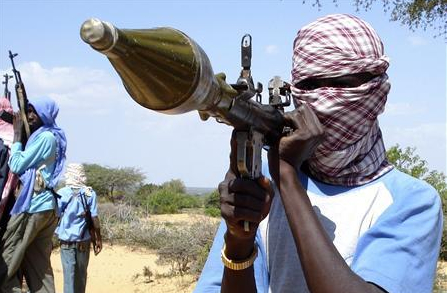
Sitting on a mat at home between taking orders for arms on his two mobile phones, Osman Bare gives thanks for the riches flowing from Somalia’s war.
“I have only been in the weapon business five years, but I have erected three villas. I have also opened shops for my two wives,” said the 40-year-old, one of about 400 Somali men operating in Mogadishu’s main weapons market.
“Peace means bankruptcy for us.” link
Please follow his instructions on this blog post if you can help Frontline blogger David Axe raise the money to help Radio Shabelle journalist Hashi get out of Mogadishu.
Photograph by Mowlid Abdi for Reuters
]]>