
Monday 11 March
On Monday, a two-day referendum on the political status of the Falklands Islands wraps-up, with the results due that evening. The referendum is largely symbolic, since the islanders overwhelmingly favour retaining their status as an Overseas Territory of the United Kingdom. The Argentine government, predictably, has already said it considers the poll a farce and it that it will continue to pursue its claim to sovereignty regardless of the outcome. Expect some chest-beating in Buenos Aires.

Also Monday, the US and South Korea are scheduled to begin an annual joint military exercise called Key Resolve. The exercise, which runs until 21 March and involves about 13,500 troops from the two nations, comes at a particularly tense time in the peninsula following the 12 February nuclear test in North Korea and the subsequent tightening of UN sanctions against the secretive communist state, which were approved on 7 March.
Monday is also a big day at the UN Human Rights Council session taking place in Geneva. Reports on North Korea, Syria, Myanmar (Burma) and Iran are all due to be considered on Monday. There is a press conference with the Commission of Inquiry on Syria scheduled. It follows the announcement last week that the number of refugees from the conflict has surpassed the million-person mark.
EU Foreign Ministers are also due to meet Monday, with Syria a particular focus. Joint UN-Arab League Special Envoy for Syria Lakhdar Brahimi will brief ministers at a lunch before the meeting.

Tuesday 12 March

Russian President Vladimir Putin, meanwhile, will host the leader of the breakaway Georgian region of Abkhazia for talks in Moscow. He is also due to meet today with the Armenian President Serzh Sargsyan who is making his first visit abroad since securing re-election last month. This choice of location for the trip is a clear affirmation of the close – and geo-politically significant – ties between Yerevan and Moscow.
Finally Tuesday, IMF Managing Director Christine Lagarde is scheduled to arrive in Algeria where she will pay a three-day visit.
Wednesday 13 March
On Wednesday, British Foreign and Defence Secretaries William Hague and Philip Hammond will be hosting their Russian counterparts Sergey Lavrov and Sergei Shoigu for talks in London, the first talks in this ‘2+2’ format. Syria is likely to be high on the agenda, although cynics might suggest the UK has little influence over Russia in this, or any, regard. Another topic that may be discussed privately is the ongoing inquest into the murder of Alexander Litvinenko (a procedural hearing in that inquest takes place on Thursday).

Finally, in the United States the Senate Armed Services Committee is scheduled to hold what is expected to be a highly emotive hearing on sexual assault in the military, with three of the witnesses giving testimony at the hearing being victims of abuse themselves.
Thursday 14 March
EU leaders will descend upon Brussels again on Thursday for their second meeting of the year, and the first since the Italian elections that failed to produce a clear victor and threaten to derail what was looking like a significantly more positive year for the region. It will also be UK Prime Minister David Cameron’s first opportunity to meet with counterparts since his Chancellor George Osborne failed to extract any significant concessions on the proposed cap on bankers’ bonuses that is scheduled to take effect in 2014.

Finally, Russian President Vladimir Putin will hold talks with the Palestinian leader Mahmoud Abbas in Moscow. Russia currently holds the rotating presidency of the UN Security Council and has said it wants to make progress in the Middle East Peace Process a priority of its presidency.
Friday 15 March
The Italian parliament is scheduled to reconvene on Friday following the elections held at the end of February. Discussions on possible coalitions will begin in earnest the following week – likely on 21 March – hosted by outgoing Italian President Giorgio Napolitano. Many fear further elections later in the year are inevitable.
Friday also marks two years since the start of the Syrian uprising which has since descended into a horrific bloodbath which the international community appears powerless to stop.
Weekend

Saturday also marks the deadline for Israeli Prime Minister Benjamin Netanyahu to form a coalition, after he was forced to seek a two-week extension on March 2. Although both Israeli and US officials have issued public declarations suggesting a failure to form a government would not imperil the visit the following week by Barack Obama, others are not so sure.
Finally, as noted earlier, the 12th National People’s Congress closes in Beijing, with votes on draft resolutions and a closing ceremony, marking the culmination of the once –in-a-decade leadership transition in China.
Some images courtesy of Vasily Smirnov / Shutterstock.com
]]>By Nicole Hunt
Though it’s sometimes difficult to keep track of which Silvio Berlusconi trial is currently in court, Monday sees the resumption of the most infamous of his four cases, in which he faces charges for abuse of power and paying for underage sex. The Italian Senate has approved a motion to move the case from Milan’s court to a special minister’s court, but the case remains in Milan while the Constitutional Court mulls the Senate’s request.
The Council of Europe Parliamentary Assembly opens, with more attention than usual being paid this time around. On Tuesday, the Assembly debates a motion that would recommend taking action against pre-natal sex selection in Europe, particularly in Albania, Armenia, Azerbaijan and Georgia, where the ratio of girls to boys in the population is dropping. On Thursday, Palestinian Authority President Mahmoud Abbas addresses the assembly.
Following a meeting of Eurogroup Finance Ministers on Monday, all EU Finance Ministers convene in Luxembourg on Tuesday, with the focus, as with many things this week, squarely on Greece. Discussions are also expected on an EU financial transaction tax, after the European Commission published proposals last week.
In direct response to the austerity measures being so closely watched by the European Finance Ministers, Greek public sector workers hold a 24-hour strike on Wednesday, calling the cuts ‘barbaric’. A general strike is also planned for 19 October.
Meanwhile, in Brussels, German Chancellor Angela Merkel attends the weekly meeting of the European College of Commissioners. At NATO headquarters, NATO Defence Ministers hold a regular meeting to discuss operational issues, with Libya topping the agenda.
Former Bosnian-Serb Army Commander Ratko Mladic is back in court in The Hague on Thursday. Since his last appearance on 25 August, Mladic’s lawyers have requested the names of all 7,000 victims of the Srebrenica massacre as part of their opposition to the indictment.
In Johannesburg, the African National Congress’ disciplinary committee resumes hearing the charges against controversial youth leader Julius Malema, who is accused of interrupting an ANC Officials meeting alongside three other men. Malema faces separate charges of bringing the ANC into disrepute and sowing divisions within ANC ranks, which will be heard separately once this case has concluded. It’s currently scheduled to last two days, but has already been delayed several times.
Friday is, oddly, both the 10 year anniversary of the beginning of the War in Afghanistan and also the date for the announcement of the winner of this year’s Nobel Peace Prize in Oslo. Anti-war activists hold mass demonstrations in London and Washington on Saturday, while the Peace Prize will be presented to the winner on 10 December.
Archbishop Desmond Tutu celebrates his 80th birthday and a year since he stepped down from public duties. Three days of celebrations are being held in Cape Town, and a new biography is being released to mark the day.
Spanish ‘indignant’ activists who have marched 1500km from Madrid are scheduled to arrive in Brussels on Saturday to hold a demonstration against unrepresentative politics. The protesters, who are joined by counterparts from across Europe, plan to hold a week of events, culminating in a large rally on 15 October.
Two elections take place on Sunday: voters in Poland elect 460 members to their lower house and 100 members to their upper house of parliament, while in Cameroon voters elect their president for the next seven years. Incumbent Paul Biya is only the second president since independence in 1960, and has held the post since 1982.
The Archbishop of Canterbury Rowan Williams is in Zimbabwe on Sunday, making him the first high-profile UK official to visit the country since 2001. The visit is part of a three-country pastoral tour which also includes Malawi and Zambia. Williams is expected to meet with President Robert Mugabe, and is scheduled to hold a special service for members of the Anglican Church who have not joined a splinter movement set up by the former Bishop of Harare.
]]>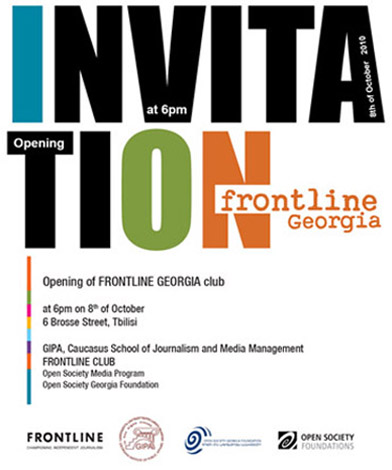
Surprising but welcome news spread on Facebook today. The Frontline Club is apparently opening up at the Georgian Institute of Public Affairs (GIPA) in Tbilisi, Georgia. In what appears to be an evolution of their own club, the new initiative promises to follow the remit of the Frontline Club in London.
Media club that aims to serve as a politically-neutral venue for journalists, public officials, students, intellectuals come together in a dialogue over media, social, political and cultural issues.
The Frontline Club is no stranger to GIPA with fellow blogger Guy Degen paying a visit in April last year during the opposition protests. I’ve also presented albeit with my Global Voices Caucasus editor hat on.
Hopefully the new club will also provide myself and others a venue with which to present our own work in areas such as the use of new and social media tools in cross-border communication and media projects too.
Unfortunately, I’ll be fixing for National Geographic as of tomorrow and so cannot attend the opening on Friday. Nor can the Frontline Club’s man in Georgia, Matthew Collin, as he’ll be in Istanbul. However, I’m looking forward to paying a visit when I next visit Tbilisi. It’s very much a welcome development not only for Georgia, but also for the region itself.
]]>The US webmag Gawker recently published a video survey of Army recruitment videos from around the world. The most entertaining was this ad for the Ukrainian Army, which basically promises young men that they will score with the girls if they drive a big tank and fondle their gun barrel suggestively enough (although the clip itself looks remarkably like a spoof). What was missing from the survey, however, was this classic ad for the Georgian Army (see above), which links military service to the country’s ancient Christian warrior traditions.
Here in Georgia, the authorities are rather fond of making promotional videos, with specially-commissioned, zealously patriotic songs to accompany them, such as this recent police recruitment advert. The biggest-budget Georgian promo of all time, however, looks set to be Hollywood veteran Renny Harlin’s forthcoming action movie about the war with Russia in 2008, Georgia. Those wondering which angle the film will take on the controversial conflict should bear in mind that the film was co-produced by an MP in Mikheil Saakashvili’s government, who was then promoted to a ministerial role after the film wrapped.
]]>
Since working on my own project using new and social media to counter local media bias in terms of reporting on Armenia-Azerbaijan relations and the still unresolved conflict between the two estranged neighbours over the disputed territory of Nagorno Karabakh, it’s been quite a roller coaster of a ride. If in late 2008 it seemed unthinkable to have open communication between Armenians and Azerbaijanis via blogs and social networking sites such as Facebook, it is now nothing unusual at all — or at least for those willing to use these new tools to circumvent restrictions on traditional forms of communication.
Although there are still some potential problems which might arise in the future depending on the political situation within either country, and especially in the area of privacy and personal security concerns, the potential is very definitely there. Of course, as a recent meeting with journalists and new media specialists in Armenia highlighted, many who could personally and professional benefit from taking such moves are still hesitant and even resistant to the idea, but for a new breed of young, progressive and open individuals in both countries, the possibilities have been eagerly embraced. It was this point that I made at a recent conference at the U.S. Institute of Peace in Washington D.C.
The event, Blogs and Bullets: Evaluating the Impact of New Media on Conflict, had quite an illustrious assortment of participants, of which I was glad to be among.
[…] on 8 July, a half-day conference, Blogs and Bullets: Evaluating the Impact of New Media on Conflict was held at the U.S. Institute of Peace in Washington D.C. Co-sponsored by George Washington University’s Institute for Public Diplomacy and Global Communication, the first and last of three panels included Alec Ross, Senior Advisor for Innovation to the U.S. Secretary of State, Ethan Zuckerman, Global Voices co-founder and Senior Researcher at the Berkman Center for Internet & Society, Marc Lynch, Director of the Institute of Middle East Studies at George Washington University, Colin Rule, Director of Online Dispute Resolution at eBay, and Adam Conner from Facebook.
Also present on the second panel were bloggers and journalists such as Global Voices’ Mialy Andriamananjar and Hamid Tehrani, Global Voices Caucasus Region Editor Onnik Krikorian, Raed Jarrar, Nasseem Tarawnah, and Golnaz Esfandiari. The panels were followed up by a private experts working group also involving Berkman and Global Voices’ Jillian York and representatives from the World Bank and the U.S. Department of State among others. link
During my stay in the U.S. there was also interest in the use of new and social media in the context of Armenia and Azerbaijan, as well as for specifically empowering alternative and otherwise marginalized voices, from quite a few major international organizations. So, upon my return to Armenia it seemed timely to finally push a pilot project for Global Voices Online, a major citizen media portal for which I’m Caucasus Regional Editor, recently discussed in open sessions at the organization’s summit in Santiago, Chile. Last week, based on over two years work in this area, I’m glad to report that Caucasus Conflict Voices went online.
The special coverage also builds upon Global Voices’ monitoring of citizen media during the August 2008 war between Russia and Georgia over the breakaway region of South Ossetia.
Strategically situated between Russia, Turkey and Iran, the South Caucasus is a key area of importance for the international community. A bridge between East and West, as well as a new and significant conduit for oil and gas, the region is also one of the most volatile.
In the early 1990s separatist movements in Azerbaijan and Georgia saw bitter inter-ethnic fighting turn into full-scale war when the Soviet Union collapsed and Armenia, Azerbaijan and Georgia declared their independence.
Nearly two decades later, conflicts over the disputed territories of Abkhazia, South Ossetia and Nagorno Karabakh might be frozen, but lasting peace remains elusive. There are also fears that fighting might break out once again, especially as the region remains riven by ethnic rivalry and a bitterly disputed history.
Such concerns were highlighted in August 2008 when Russia and Georgia fought a short war over the breakaway territory of South Ossetia. Meanwhile, with skirmishes frequent on the contact line between Armenian and Azerbaijani forces, some analysts also fear a new war over Nagorno Karabakh as negotiations continue to falter.
Aside from the lack of political will, many analysts argue, societies in all three countries are not being engaged or prepared for peace.
Yet, with media in the region often resorting to propaganda and misinformation (Download Report), few opportunities exist for objective reporting or moderate voices on the conflict to be heard. Because of this, Global Voices has set up this special coverage page. It will also cover the increasing use of new and social media in cross-border peace-building initiatives. link
Hoping for great things from this special coverage, especially as the use of new and social media tools increases in the region, so please take the time to keep an eye on the page set up at:
http://globalvoicesonline.org/specialcoverage/caucasus-conflict-voices/
]]>
Last year arguably saw unprecedented attention on the use of mobile phones for content creation in some shape or form. Whether SMS updating crisis mapping platforms such as Ushahidi, using Twitter to update followers on breaking news, or simply to use as video cameras, in a sense there was plenty to demonstrate their worth as a news reporting device.
Frontline Club blogger and professional video cameraman Guy Degen even used one in Africa as well as to record and stream live short reports of last year’s opposition protests in Tbilisi, Georgia. Indeed, it was enough for me to purchase the same model of phone as he used then, a Nokia N82, to put to use in another country making up the South Caucasus — Armenia.
First off, as a professional photojournalist, checking out the Nokia’s photo capabilities was a must and although never going to replace a traditional camera, it was pretty impressive for a phone. In fact, so good was it that I even forced myself to use it for non-commissioned shooting such as the student protests outside the Iranian Embassy in Yerevan as well as test reporting in the regions.
In fact, I started using the phone more and more to shoot photos and videos as well as tweet to my followers on Twitter notes which could also be later used as source material for articles and blog posts. True, it will never be used for professional work where getting an image counts, but I do try to double up shooting on a DSLR with also sending out images immediately from phone.
For example, during last year’s municipal election in the Armenian capital, even low light shots weren’t much of a problem and images could be sent direct from phone with accompanying tweets. I also stumbled upon one party election campaign without my usual camera gear and had no choice but to shoot with the phone. Another time a scuffle with police was live streamed.
The results were not bad. And although shooting with a DSLR, Twitter was at least also used extensively to allow people to follow field work for a recent personal project to report on ethnic Armenian-Azerbaijani coexistence in Georgia. I’ve also used the phone to update followers when out and about fixing for the likes of Al Jazeera English, BBC, and The Wall Street Journal.
And it’s not just Guy or myself that are impressed by the potential for phones to be used as reporting tools, especially in economically depressed countries where the media is not developed enough such as Armenia and Georgia. Indeed, there’s even a whole site — http://www.mobileactive.org — which evangelizes their use for a multitude of purposes.
It was therefore a nice surprise to tun into Prabhas Pokharel, one of the Mobile Active team, at the Global Voices Citizen Media Summit held earlier this month in Santiago, Chile. Prabhas has already made a few blog posts on some of the issues raised at the summit regarding mobile phones which seem appropiate to quote and link to here.
Mobile phones have already played a signifcant role in advancing citizen media around the world. They were instrumental in helping capture photos and videos on the streets of Tehran during 2009 protests that followed the elections there. A video captured during that time even won a prestigious journalism award. Mobile phones technology has been used in Namibia to enable more people from around the country to express their views in one of the country’s largest newspapers. In the US, day laborers have been using MMS messages to blog about their daily lives. In South Africa, citizen journalists use SMS, MMS, and other phone-based technologies to submit content and commentary to a local newspaper. In India, mobiles are being used to enable both reporting and news dissemination in local languages. Many more examples exist.
These examples only scratch the surface of what is possble with mobile phones in independent and citizen media with room for exploration. […]
[…]
Mobiles are also interesting for individual bloggers and reporters. In conversations I had with bloggers, I realized that most don’t see their mobile phones as potentially helpful devices in normal reporting work. One blogger who had had used his mobile phone to stream live video and take pictures of protests was the exception rather than the rule. Our discussions managed to identify at least three distinctive advantages mobile phones have over traditional multimedia capturing devices: (1) they are always in our pockets and therefore always accessible (2) when there is a data connection, they allow instant uploading and live coverage and (3) they allow reporters to capture multimedia in more situations, by being lighter to transport, and appearing more innocuous in situations like protests. link
Indeed, I was at one of the breakout sessions that Prabhas led and made some brief notes, tweeting them from phone to put together as a short summary later rather than noting them down traditionally. Since then, Prahbas has put together a more comprehensive post on some of the discussion generated and examples given.
I agree that SMS is a decidely imperfect technology, but it can increase access to information. Those who have access to twitter and SMS are different populations. When the same popoulation has access to Twitter and SMS, Twitter may be preferable as a medium that is cheaper and can include more information such as links. However, there are many more who have access to SMS but not Twitter. SMS can be a powerful tool by itself for these people. […]
Global Voices Caucusus editor and photojournalist Onnik Krikorian echoed this when he pointed out that technologies like SMS and Twitter increase the number and kinds of people that can comment in the public sphere.
[…]
Krikorian described how he uses live video streaming services like Qik. Such services have made it very easy for journalists and citizen journalists to provide live coverage of events–all you really need is a data connection. No longer do journalists or citizens wanting to provide live coverage need complicated and costly equipment. Krikorian also covered p
rotests in Armenia using his mobile phone as his only camera. He pointed out that using the mobile phone as a camera allowed him to blend into the crowd and not be noticed as a journalist. His phone was good enough to act as his only camera–one photo he had taken on a Nokia N82 was published in the UN World Food Programme’s magazine.[…]
Of course, we need to be careful in our discussions and not lump together increased information access via SMS and voice-based technologies with live video reporting (modern handsets and speedy data connections) that are only accessible to the technological elite.
But, that said, mobile phones provide a set of technologies that offer advantages at different levels. The simplest of technologies, SMS and voice, are limited but powerful because they are widely accessible and can often reach populations that are hard to reach otherwise.
With modern handsets and data connections, mobile phones also provide reporters and citizen journalists with capabilities they have not had before. Citizen journalists and reporters can cover events and news live using video, photos, or Twitter, and pass innocuously as part of a crowd when taking footage at sensitive events. link
Anyway, I totally agree with Prabhas’ comments and belief in phones as being some kind of mobile reporting kit with the potential to disseminate information, including images and video, in real-time. So, for anyone else out there interested in pushing the limits for such a cost-effective and versatile tool I’d really recommend browsing the Mobile Active web site.
Of course, as you might expect given the nature of their interest, they can also be followed on Twitter.
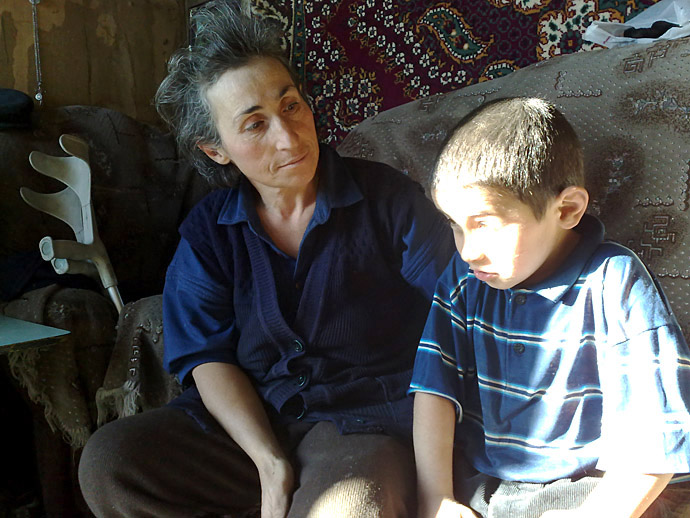
Photo: Vulnerable family, Gyumri, Shirak Region, Armenia © Onnik Krikorian / Oneworld Multimedia 2009 (shot on Nokia N82)
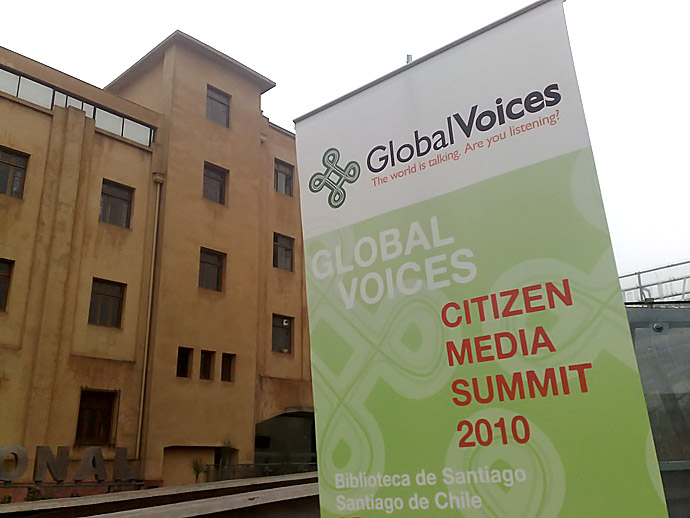
Top Photo: Global Voices Citizen Media Summit, Santiago, Chile © Onnik Krikorian / Oneworld Multimedia 2010 (shot on Nokia N82)
]]>
Tbilisi, Georgia, and a conference on using social media for social change. Nothing new in that for many people reading this blog, perhaps, but low Internet penetration thanks to high costs and slow connections makes the situation somewhat different in the South Caucasus. A 4 mb/s connection in Georgia, for example, costs around $19 per month. In Armenia, a 256 kb/s connection costs $35.
However, as connections improve and prices drop that will eventually change and especially in Georgia where connection speeds are the fastest and cheapest in the region. Azerbaijan is also experiencing a huge surge in Internet use while Armenia looks set to soon benefit from $4 million in U.S. Government funding for "alternative media resources."
In addition to the conference, where Arzu Geybullayeva and I once again presented on the use of new media in Armenia-Azerbaijan conflict transformation (see slide show above), there was also a Social Innovation Camp where participants from Armenia, Azerbaijan and Georgia worked together to realize ideas as online projects to achieve social change.
Anna Keshelashvili worked hard on the main arrangements for the camp and particularly on the Georgian side while I engaged in outreach on the Armenian side, and not least because both of us had participated in a camp in Bratislava last year. In particular, my encouragement of environmental activist Mariam Sukhudyan to submit an idea worked wonders.
Her project, Save The Trees, won the jury prize and is already online. Other ideas from Armenia, Azerbaijan and Georgia constructed by teams mainly comprising members from all three countries are here. Anyway, great event and a great time was had by all. Read more about the camp here and my own social media project on conflict transformation is here.
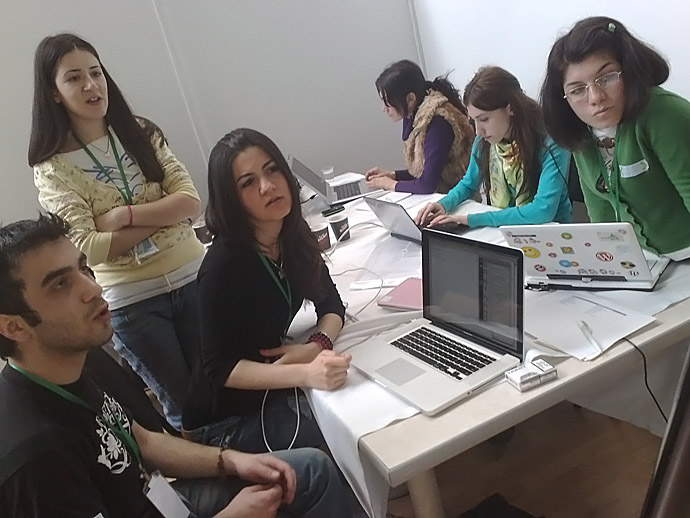
Photo: Social Innovation Camp Caucasus, Tbilisi, Georgia © Onnik Krikorian / Oneworld Multimedia 2010 on Nokia N82
]]>Georgians, of course, are sometimes quick to blame their old enemy for anything that goes wrong. But there’s certainly a sense that, with the electoral defeat of Viktor Yushchenko in Ukraine earlier this year, and now the death of Lech Kaczynski, this country has lost two of its closest international allies, and is feeling a little more alone than it has done for a while.
]]>The video below is Russia Today’s report on the biggest (non)-story so far this year:
]]>
With the conflict in the disputed territory of Nagorno-Karabakh still unresolved, journalists and civil society activists in Armenia have few opportunities to meet with their Azeri counterparts, and vice versa. But increasingly, blogs and social networks offer new possibilities for dialogue across a cease-fire line in place since 1994. Other online tools offer immediate audio and video communication between the two countries, free from monitoring or interception.
If adopted as general practice by journalists and activists, such tools could represent a revolution in cross-border cooperation.
For this final segment in our multimedia series for Transitions Online on overcoming stereotypes in the South Caucasus, I interviewed Arzu Geybullayeva, an Azerbaijani political and regional analyst, about her work on civil society, women’s, and cross-border issues using new media tools. It was a rare direct conversation between Yerevan and Baku, conducted with the voice-over-Internet service Skype.
Educated in Azerbaijan, Turkey, the United States, and the United Kingdom, Geybullayeva worked as an Azerbaijan analyst for the Berlin-based European Stability Initiative until December 2009. Since then she has been a political officer with the National Democratic Institute in Baku. She also writes for a variety of online publications, including the recently launched Women’s Forum.
I first contacted Geybullayeva in late 2008 via her blog, Flying Carpets and Broken Pipelines, and remained in contact through online services such as Twitter and Facebook. We met face-to-face last September in Telavi, Georgia, to make a presentation on new and social media for Armenian, Azerbaijani, and Georgian youth activists.
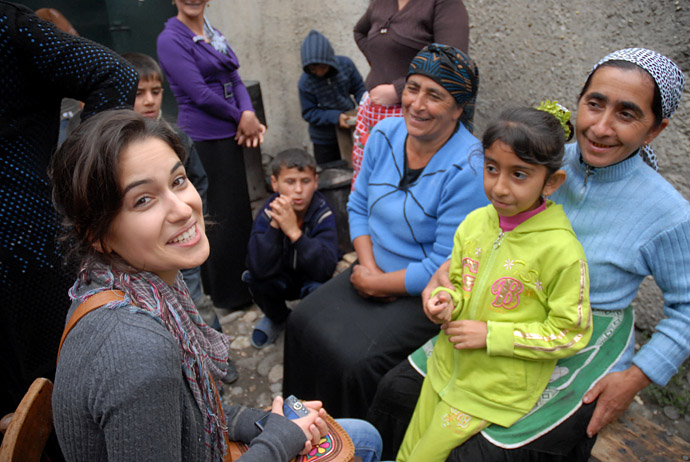
We also visited the nearby, ethnically Azeri village of Karajala and posted photographs, accounts, and multimedia presentations on our blogs, a trip that became the forerunner of this project.
You can listen to the podcast on the player below or download it here.
Meanwhile, Transitions Online has set up a project page here and there are also blog posts here. The main site for all phases of the project is here. I’ll also be co-presenting with Arzu Geybullayeva at the Social Media for Social Change conference in Tbilisi in April.
Photo: Arzu Geybullayeva in Karajala, Georgia © Onnik Krikorian / Oneworld Multimedia 2009
]]>