Once a year, the world’s leaders descend on New York for the UN’s blue ribbon event, the cumbersomely-titled UN General Assembly’s General Debate.
This year, the build-up has been dominated by the Palestinian Authority’s planned bid to become the 194th member of the UN, following South Sudan’s incorporation earlier in the year.
Notwithstanding any last minute deals, Palestinian Authority President Mahmoud Abbas will personally submit the application to Secretary-General Ban Ki-moon on Friday, September 23, after Abbas has delivered his speech to assembled leaders.
Indeed, Friday’s session is set to be a cracker, since it also features Israeli Prime Minister Benyamin Netanyahu’s speech, in which he must surely address the issue. And yet while the Palestinian membership-issue is grabbing all the headlines, there’s plenty of other highlights.
Ahead of the formal UNGA opening today, there was a high-level meeting on Libya yesterday, the first since the UN formally recognised the Transitional National Council as the official representative of Libya last Friday.
US President Barack Obama met privately for the first time with TNC Chairman Mustafa Abdel Jalil, and held separate summits with President Hamid Karzai before he returned to Aghanistan to join the mourning of the assassinated leader Burhanuddin Rabbani.
Tuesday also saw French Foreign Minister Alain Juppe host a ministerial-level meeting of the so-called Deauville Partnership, a G20-offshoot dedicated to supporting fledgling Arab democracies.
The Debate kicks off today with an address by the Brazilian President, the first for Dilma Rousseff since she took office in January and no doubt a welcome relief from domestic troubles.
A notable absence, though, is Russian leader Dmitry Mevedev, who has chosen to delegate responsibilities this year to Foreign Minister Sergey Lavrov.
In the afternoon South Africa’s Jacob Zuma will be speaking. On Thursday morning, Mahmoud Ahmadinejad gives his traditionally polemical speech (who can forget last year, when he alluded to the 9/11 attacks being a conspiracy). British Prime Minister David Cameron also speaks that session.
Highlights from the afternoon session on Thursday include an inaugural address by newly-elected Peruvian President Ollanta Humala, an address from ageing despot Robert Mugabe, and also remarks from Turkish Prime Minister Recep Tayyip Erdogan, whose star is in the ascendancy amid Turkey’s role in the Arab Spring.
On the sidelines that day, UN Secretary General Ban Ki-moon is hosting a UN High-Level Meeting on Nuclear Safety and Security, likely to focus significantly on lessons to be learned from the crisis at Japan’s Fukushima Daiichi plant back in March. Friday, as we’ve seen, is all about the Palestinian-membership issue.
But in the morning there is also a first-time address from new Japanese Prime Minister Yoshihiko Noda , who is expected to put in appearance also at the nuclear safety meeting. That afternoon South Sudanese President Salva Kiir – who meets one on one with President Obama earlier in the week – will give his country’s address for the first time since it became member number 193 last July
Sadly, one of the traditionally more entertaining speakers – Venezuela’s Hugo Chavez – is not expected to make the journey to New York this time, as he is recovering from a fourth round of chemotherapy for cancer discovered earlier in the year.
]]>By Nicole Hunt
This week is filled with high-profile trials and judgements around the world, kicking off on Monday with six big-name hearings, including several former world leaders: ousted Egyptian President Hosni Mubarak, his sons and former Interior Minister Habib Al Adly are all on trial over protester deaths in Cairo; former French President Jacques Chirac’s corruption trial resumes in Paris; former Icelandic Prime Minister Geir Haarde’s trial for negligence over the country’s banking collapse starts in Reykjavik; former Slovenian Prime Minister Janez Jansa’s ‘Patria’ corruption trial begins in Ljubljana; Rwandan opposition leader Victoire Ingabire goes on trial in Kigali for promoting genocide; and Sizwe Mankazana, who was driving the car which crashed and killed Nelson Mandela’s great-granddaugther on the eve of last year’s World Cup faces the court in Johannesburg.
The focus is on austerity in Europe on Tuesday, as Italy braces for a general strike over debt-cutting measures proposed by Silvio Berlusconi’s government.
In Berlin, the German government begins a four-day debate of its 2012 budget. Wednesday’s general debate with Chancellor Angela Merkel coincides with the country’s Contitutional Court’s decision on a constitutional challenge to a May 2010 law guaranteeing the maintenance of Greece’s financial stability and solvency, authorising up to €22.4bn in loans.
In Algiers, the Algerian government hosts a two-day conferennce on regional security, focusing on the threat from Al Qaeda in the Islamic Maghreb.
Back to the Paris courts on Thursday, where the verdict is expected in the trial of disgraced fashion designer John Galliano, who is accused of hurling anti-Semitic abuse at a member of the public in February.
Meanwhile, a hearing is scheduled to formalise the extradition of former Panamanian leader Manuel Noriega, who was convicted of money laundering last summer and sentenced to seven years in prison. He is expected to be sent back to Panama, where he has been sentenced in absentia to 60 years in prison for human rights violations committed between 1983 and 1989.
G7 Finance Ministers begin a two-day meeting in Marseille on Friday. Officials from the EU, IMF and World Bank also attend to discuss issues ahead of the IMF/World Bank annual autumn meetings later this month.
The Rugby World Cup kicks off in Auckland with New Zealand v Tonga. The tournament runs until 23, October.
Greek Prime Minister George Papandreou delivers his annual economic address at the Thessaloniki Trade Fair on Saturday. Unions and activists plan to hold demonstrations outside the fair, protesting against the government’s austerity measures.
Sunday marks the 10th anniversary of the 11 September, 2001 attacks on the United States. President Barack Obama and former President George W Bush are among those attending a memorial service at Ground Zero, which begins at 8:40am EDT to mark the time the first plane hit the North Tower of the World Trade Centre.
While all eyes are on the US, Guatemalans will quietly elect a new President. A planned bid by Sandra Torres, ex-wife of current President Alvaro Colom, was ruled unconstitutional. The couple divorced to enable Torres to run, hoping to circumvent a law that ruled the President’s spouse ineligible.
]]>The first half of the evening at the Royal Institution of Great Britain, considered the role of technology in the Egyptian revolution and the panel resoundingly downplayed the role of Facebook, Twitter and even the Internet.
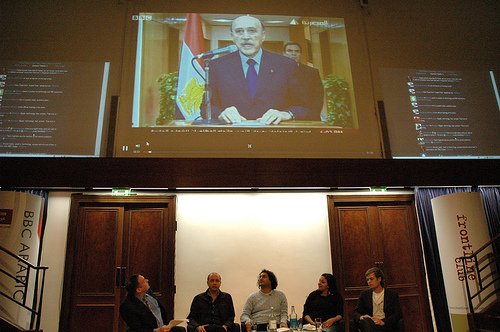
"I guess [the] audience could tell we didn’t really want to talk about media and tech rather we wanted to talk revolutions"
Above is a preview of Vaughan Smith’s dramatic new film BLOOD AND DUST recording life and death with an American helicopter medevac unit in Southern Afghanistan.
‘These Medivac teams, US military air ambulances, are amoungst the only soldiers that go to war to save lives and they are very good at it.’
See BLOOD AND DUST on this week’s PEOPLE&POWER on Al Jazeera English from Wednesday, February 16, at the following times GMT: Wednesday: 2230; Thursday: 0930; Friday: 0330; Saturday: 1630; Sunday: 2230; Monday: 0930. http://bit.ly/eJOYcN
Vaughan’s description of making the film:
I have done a fair number of military embeds in Afghanistan over the last few years but was concerned that I hadn’t filmed the suffering of war, just its machinery.
This being a grevious ommission I went back last winter to film US army air ambulances, ‘Dustoff’ helicopters, flying over Marjah in Southern Afghanistan. The pictures are strong and show both US marines and Afghan civilians being lifted off the battlefield in equal numbers.
I have been pretty busy since returning from this trip last year, what with Julian Assange coming to stay and all that that means. It is very much thanks to the Al Jazeera documentary chaps, John Owen, Diarmuid Jeffreys, Neil Cairns and last but certainly not least because he did the video editing, Ross Birkbeck, that I got it out at all.
I have worked with Al Jazeera on this because I couldn’t find another news broadcaster in Britain that would show the film without cutting out the stronger images. I have huge respect for the way Al Jazeera as a broadcaster engages the world while so many others appear to retreat from it.
More to follow, including a link to the film online for those that miss its broadcast. Vaughan
]]>As part of an attempt to catch up, I’ve just been reading Jeff Jarvis, Jay Rosen and C.W. Anderson on the renewed argument over "Twitter revolutions". The role of Twitter in revolutions was first debated in 2009 with reference to Moldova and Iran and has been inevitably resurrected in light of the events in Tunisia and Egypt.
The overarching point these authors make is that the debate has become rather futile with various people pointing out that Twitter does not cause revolutions – an argument that nobody has made.
In 2009, I was critical of the use of the term ‘Twitter revolution’ by the news media for the political protests in Moldova. I felt the use of this phrase and some of the specific roles that were attributed to Twitter in news articles did not aid our understanding of what was happening in Moldova.
It also hindered our understanding of what Twitter was actually being used for and lumped together a variety of Internet tools under the term ‘Twitter’ – which I didn’t think was helpful either.
In that spirit, what follows are a few notes on what we might have learnt from events in Moldova, Iran, Tunisia, and Egypt about the specific role of Twitter and other social media sites. Hopefully, it provides a starting point for understanding some of the implications of social media for politics.
The role of social media tools
1. Spreading ideas and initial organisation
Twitter, Facebook, etc play an important role prior to a revolution (or protest/uprising etc) in spreading ideas and information. They help connect organisers, activists and opposition groups and link these people to others who may be sympathetic to the cause or might even support direct action.
In Egypt, it appears that where previously Egyptians were fearful of rising up against Mubarak’s repressive regime, social media played a role in making people aware that there were others who would join them if they made a stand. Facebook, Twitter (Moldova – Odnoklassniki too) are very useful organisational tools at this stage enabling initial action to take place in a coordinated fashion.
2. Attracting the attention of the international news media
Tweeting about your revolution attracts attention from news media. There is something of a Twitter revolution in breaking news occurring. News organisations are increasingly aware of news and information mediated on Twitter, which they are using as a primary global news wire.
As a consequence, protests that might not have gained media attention or the same amount of media attention in the past now do so. (In Iran, Twitter users pressurised CNN to cover the story using the hashtag CNNfail).
Given the news media’s attention to Twitter, there do not need to be huge numbers of people tweeting. It is sufficient to have a relatively small number of people tweeting your revolution who will inevitably be picked up by the media.
The combination of satellite television and the Internet thus drastically reduces the time it takes for news and information of your revolution to spread to all parts of the world.
3. Facilitating an international support network
Skype, Facebook, email, Twitter etc allows diaspora in other countries to communicate easily with those protesting in homeland. This also helps create more media coverage particularly in situations where the diaspora can mediate the message of the revolution to news organisations in English rather than the local language. It also provides an international support network for protesters.
4. The importance of YouTube in providing imagery
Rather obviously, YouTube is useful for documenting video of demonstrations. It enables "ordinary citizens" to provide potentially iconic images from the revolution (E.g. Neda Soltan, in Iran). Journalists can use videos shot by protesters to refute state-media imagery and the government version of events.
The use of YouTube, and other video-sharing websites, encourages TV broadcasters to keep running the story because they have access to pictures. Government initiatives to stop the story being covered by blocking journalists’ access are significantly undermined and arguably counterproductive, as the news media rely increasingly on the protesters media content rather than producing their own.
5. A shift in power?
The ability of protesters to publish their own media content immediately to a potentially global audience is emerging as a powerful weapon to combat more traditional applications of power and control such as state violence and censorship.
Limitations and problems
1. How useful is social media at the site of a protest?
In Moldova, at least, Twitter was not used as an organisational tool at the site of demonstrations where mobile phone access and Internet connections were blocked and organisation was generally choatic or nearly non-existent. But according to this BBC infographic it appears bloggers were updating from Tahrir square’s much more organised camp. Further comments on differences between Moldova and Egypt welcomed.
2. The clampdown on Internet access
All social media tools are inevitably less useful when the Internet or individual websites are blocked by a government. This triggers a subsequent struggle over the control and distribution of information online. Opposition groups can attempt to circumvent lockdowns by using proxy servers or relaying information by other means to people who subsequently post their material online.
In Egypt, sustaining the protests and media coverage of them required other forms of communication – word of mouth, landlines, international broadcast media, etc.
3. Representative of the situation ground?
Social media is not necessarily representative. In Moldova, there was more sympathy for the Communist party away from the capital among people who were not using social media. But in the case of Egypt, what was being said on social media sites appeared to reflect a much broader swathe of public opinion.
4. A government can deploy the same tools against the protesters
A government can use the same Internet tools to target protesters, organise crackdowns, spread their own message, and disinformation (See Iran in particular). Perhaps there is currently a window of opportunity whereby governments are less tech-savvy and more heirarchical compared to opposition groups.
That might change as governments necessarily adapt their structures and practices to the new information environment, but for some its already too late. Censorship of Internet tools is more likely to be successful for governments if established over a longer period of time (e.g. China) rather than in a desperate response to a crisis (e.g Egypt).
5. Can loose leadership structures consolidate gains?
It could be argued that the loose leadership structure of protests organised through social media (althou
gh I’m not convinced it will always hold true) leaves questions over whether initial gains can be followed up. Will a movement that was united behind Mubarak being forced from power be able to maintain that unity moving forward? It will certainly be interesting to see how the revolutions in Tunisia and Egypt develop.
by DAVID AXE
U.S. Army and Congolese army doctors render free medical care at a clinic in Kinshasa, as part of the Medflag ’10 exercise.
]]>by DAVID AXE Kinshasa — Corrupt and impoverished, Congo doesn’t have much in the way of emergency services. Wrecked cars become semi-permanent urban art installations on the side of the road. When fires break out, it can take hours for anyone to respond. MONUSCO, the U.N. peacekeeping force, has been forced to put out some fires for the Congolese.
Colonel Gilbert Kabanda, the Congolese army’s surgeon general, painted a grand picture of U.S.-trained Congolese medics deploying across the country in up to 11 specialized emergency medical companies, shifting easily between combat tasks and mitigating mass-casualty incidents and natural disasters. But it’s more likely that the Congolese medics will wind up just playing EMT in Kinshasa. Kyala Hubert, one of the medics attending the Medflag ’10 training, said he looked forward to applying his new American-taught litter-handling skills … in responding to traffic accidents.
Maybe the U.S. government should have sent a bunch of traffic cops and ambulance drivers, instead of soldiers.
]]>by DAVID AXE
Kinshasa — A free health clinic was one of the culminating events of the U.S. Army-led "Medflag ’10" training exercise in the Democratic Republic of Congo. While American instructors trained up Congolese medics, U.S. and Congolese officials oversaw registration of civilians to attend the clinic. The civilians lined up before a board of Congolese officers and described their condition and the treatment they hoped to receive. If they were lucky, their names were added to the list.
Many of those who didn’t make the list were unhappy. Others had more pointed complaints, as depicted in my video report.
]]>by DAVID AXE
Kinshasa — Soft power can be tedious, exhausting, frustrating. A hundred U.S. Army doctors and medics are in Kinshasa, Democratic Republic of Congo, to train several hundred medics from the Congolese Forces Armees de la Republique Democratique du Congo. The Americans’ idea: to leave the Congolese more capable and more professional than how they found it, hopefully contributing to slowly increasing stability in this troubled Central African country. But even these modest goals are easier said than done. For starters, Congo is hot, remote and under-developed. Plus, there are huge language and technological barriers between the Americans and Congolese, as depicted in my video report above.
]]>by DAVID AXE
Kinshasa — Colonel Gilbert Kabanda, the surgeon general of the Forces Armees de la Republique Democratique du Congo — the Congolese army — is a tiny man, barely more than five feet tall. But he has a big speaking voice. On September 6, he took the stage at the opening ceremony for the combined U.S. Army-FARDC medical training event "Medflag." The audience included hundreds of Congolese and American doctors and medics.
Medical training, Kabanda explained, lies at the heart of the army’s relevance. For a modern army should be more than a killing machine, he insisted. "In addition to the principal mission of defense of the national territory, the other mission of the army is to participate in the economic, social and cultural development and protection of the people."
American assistance will, in theory, help the FARDC help the Congolese people. Everyone’s a winner. "There’s nothing bad about this story," U.S. Army Lieutenant Colonel Todd Johnston, Medflag commander, told me before Kabanda’s speech.
Not so. For as Kabanda repeatedly stressed, the army’s primary mission is defense — that is, combat. And military medics’ first job is to support the combat troops. Especially in Congo’s rugged east, FARDC combat brigades represent one of the greatest threats to the population and the country’s nascent democracy. "Since its creation in 2003, the FARDC has been one of the main perpetrators of documented sexual violence in Congo," Human Rights Watch reported. The FARDC also oversees illegal mining operations that keep the land’s wealth out of the people’s hands. In helping improve the FARDC — even its medical capabilities — the U.S. risks making the FARDC a more powerful enemy of the Congolese people.
At the opening ceremony, Samuel Laeuchli, the deputy chief of mission at the U.S. Embassy in Kinshasa, described FARDC personnel racing to help out in the aftermath of a tragic July tanker explosion that killed some 300 people in remote Kivu. After Medflag, Congolese medics might be better equipped to assist survivors of such disasters. But they will also be better equipped to patch up and keep healthy the tens of thousands of Congolese troops raping and pillaging across this Texas-size jungle nation.
]]>