 So the Liberal Democrats want to
 scrap, replace, consider replacing…hang on a minute, let’s find the manifesto…"commit not to replace the Trident nuclear weapons system on a like-for-like basis" if they are voted into office.
And I would be very surprised if the Trident issue fails to make an appearance in tonight’s leaders’ debate. After all, it marks a clear policy distinction; Labour and the Conservatives have both said they would renew Trident.
Or does it? The Liberal Democrats have been at pains to point out that they would not scrap Britain’s independent nuclear deterrent but they have not given much indication of what they might replace it with.
So I thought I’d investigate whether better options than Trident might be available.
Before we get going, it might be worth laying out what the Trident system is and why there is talk of replacing it.
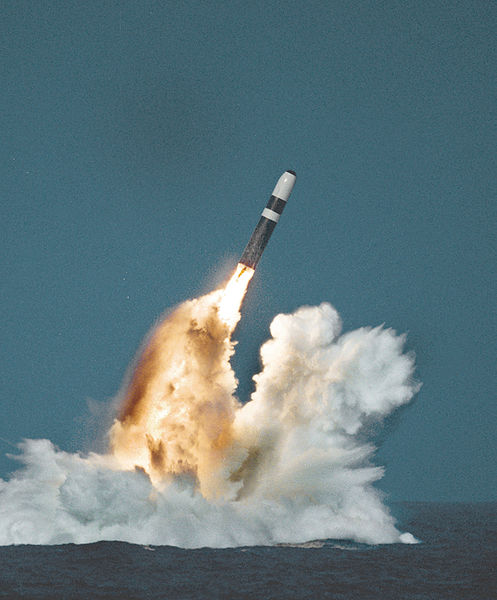
The name Trident refers to the Trident D5 missiles used in the system. The missiles are carried by four Royal Navy Vanguard-class ballistic missile submarines operating continuous at sea deterrent patrols.
The first of these submarines was launched in 1992 and has a shelf-life of 25 years, although it is hoped it will last until 2022 and possibly longer. Similarly, the Trident missiles would need to be modernised if they are to last beyond 2020. That means decisions have to be taken as to whether Britain should replace the submarines and extend the life of the missiles.
The Government published a White Paper on the issue in 2006. These are the alternatives that were considered and why they were rejected:
1. Large aircraft equipped with cruise missiles.
This option was rejected "primarily because of vulnerability to pre-emptive attacks" and the procurement cost involved in buying new aircraft. New cruise missiles would also have to be purchased. (Trident missiles are of the ballistic variety).
2. Silo-based with adapted Trident missiles
Housing a weapons system on the UK mainland was also partially ruled out due to their vulnerability to attack. At the risk of stating the obvious the paper noted that silos "are immobile" and "impossible to conceal". Whereas in the US, you can disperse separate silos across thousands of miles, in the UK one nuclear attack could potentially knock out numerous silos all at once. The silos would also be expensive to build.
3. A surface ship with Trident missiles
This option was rejected because a surface ship is easier to locate, track and attack, whether by sea or from the air. A submarine is far more elusive.
4. Abolish Britain’s nuclear deterrent
This was quickly rejected by the Paper, and apparently also by the Lib Dems although they also say "it cannot be eliminated". Confused? Yes, so am I. The Green Party have said they would dismantle nuclear missiles if you want to vote for outright disarmament.
5. The Raider CS 35 (Sorry, I may have made that up)
The overall conclusion was that renewing Trident was by far the most cost-effective option. It is much cheaper than air or land based systems and equivalent in cost to the surface ship option but with better strategic capabilities.
Of course, a government White Paper is unlikely to be the last word on any issue. Which brings us to the Liberal Democrats own paper on the alternatives entitled ‘Policy options for the future of the UK’s nuclear weapons‘, where you might expect to find the cheaper option everybody has been missing clearly spelled out. Unfortunately, I was disappointed.
Here the Liberal Democrats effectively rule out significant changes to the Trident system and instead propose some tweaks. Namely, the possibility of ending continuous at sea deterrent patrols, and using a modified Astute submarine that carries fewer missiles.
There is one proposal – ‘virtual deterrence’ – that would be a clear departure. This would mean the UK would declare that it was still a nuclear weapons state but would "decommission all or a portion of the current Trident system". This seems highly problematic to me. Confusion over whether a country has or hasn’t got nuclear weapons doesn’t seem too helpful. (See Iraq).
In any case, this is all talk and not a commitment to any of these particular paths.
It seems the Liberal Democrats might not actually have formulated any policy that is radically different from Labour and the Conservatives except on one particular point: they just want to talk about Trident in the imminent Strategic Defence Review.
This is Paul Ingram, the Executive Director at the British-American Security Information Council, over at Arms Control Wonk:
"They are looking for a small ask, that the issue be considered within the long-awaited Defence review promised by all major parties contesting the election…Beyond this, don’t expect anything substantial from the Lib Dems, as they will likely be spending what political capital they have after any indecisive election looking for deals on electoral reform."
So a request to Sky News tonight for some clarification: please ask Mr Clegg what he would replace Trident with.
Photo: Wikimedia, Public Domain

Note: This post will be cross-posted at Talk Issues soon.
]]>
You might have done if you live in a constituency with specific military or defence industry links.
Dorset South, for example, includes Bovington Army camp and the MP for South Ribble notes that his constituency in Lancashire is at the heart of Britain’s defence industry.
Otherwise you might not have done.
But the Chairman of the Defence Industries Council, Mike Turner, thinks all potential MPs should be talking about defence. He argues that "practically every Parliamentary constituency has a connection to the defence and security industry".
Of course, the Defence Industries Council, comprised of Britain’s leading defence company CEOs, is keen to point out how important the sector is to Britain’s economy.
The DIC says the sector employs over 300,000 people in the UK and is responsible for £5 billion of export sales each year. (Which is an interesting figure because the UK Trade and Investment Department valued defence export sales at £4 billion in the financial year 2008-9).
Unfortunately for the DIC, the public do not seem to place the same value on defence and security when it comes to voting in this election. Which means politicians probably haven’t spent much time talking about it.
According to MORI opinion polls conducted in February and March defence policy is not at all that important to voters. I picked up these figures from an interesting post on the UK Defence Forum blog.
When MORI asked what is the most important issue affecting the country 55% said the economy, with only 14% citing defence, foreign affairs, and terrorism.
In a survey conducted between 19th and 22nd March, 32% said managing the economy was the most important issue when they were choosing which party to vote for. Only 3% regarded defence as the most important.
I’d be interested to hear from those 3%. Who are you? And who will you be voting for?
If you’re not sure what the parties’ policies on defence are you could do far worse than start with this analysis of the Labour and Conservative manifestos on the Kings of War blog. The Liberal Democrats defence policy can be found here.
(This is another post for Talk Issues. Apologies to regulars over the sparse blog offering on digital media and war reporting recently. I’m currently looking at blogs in the Gaza crisis in 2009 so time for my own blogging is a little short. I have a great post in my head about Wikileaks and Iraq and war reporting and journalism and the like…which hopefully I’ll extract from head to paper one day soon.)
]]>