Gabon is headed to the polls for the West African country’s first real election since the rise of Omar Bongo as president some four decades ago. Bongo died in June, as one of the world’s longest-serving heads of state, and now will be replaced.
Gabon, a major oil producer and one of the wealthiest and most stable African nations, is an important base for Western military and humanitarian operations. But the country balances atop a fragile oil-and-lumber mono-economy that has enriched a few, while leaving some 30-percent of the people in poverty. Gabon represents a unique set of problems: delicate stability, relative wealth and a sudden plunge into true democracy. Cross your fingers.
(Video: David Axe)
]]>
Operation Continuing Promise in Latin America is just two years old. So is Africa Partnership Station. But already, the Navy is re-configuring to double or triple the number of these smart-power operations it supports. It might seem like naval smart power came out of nowhere, to dominate planning overnight.
But Continuing Promise grew out of Admiral James Stavridis’ long career thinking about new uses for naval forces. And Africa Partnership Station is actually a clever evolution of a program dating from the 1970s. In that decade, the Navy launched its “West African Training Cruise,” aiming to visit major regional allies once every five years or so. “That’s not a way to build partnerships,” said Lieutenant Commander Chris Servello, an APS planner aboard Nashville. “We need to be down here more often.”
In 2005, 6th Fleet Vice Admiral Harry Ulrich — Stavridis’ intellectual twin for Africa — decided the Navy needed to boost its operations along the continent’s western coast. His choice of vehicle was a seemingly odd one. Ulrich tapped the repair ship Emory S. Land, pictured, for a four-month deployment, delivering trainers and maintainers to several African nations. Land helped fix African navies’ old boats and give sailors refresher training. Servello called it a “test case” for Africa Partnership Station. “It was well received.”
Next, 6th Fleet began expanding on the concept, sending frigates and amphibious ships to drum up interest in deployment’s like Land’s. In 2007, the Navy formalized what Ulrich and Land had pioneered, and Africa Partnership Station was born.
(Photo: Navy)
]]>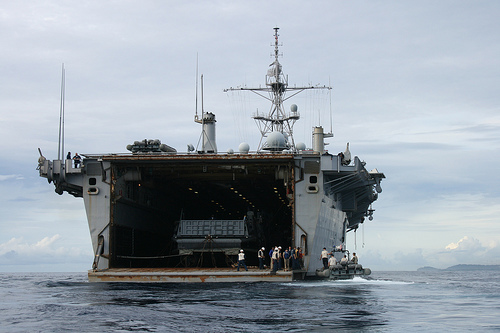
USS Nashville lost a day’s work in Libreville, Gabon, last week, when upon arriving in the West African capital, the crew discovered that the 40-year-old Nashville wouldn’t fit at the city’s tiny pier. Instead, she anchored a mile offshore, and used her boats to ferry people (see video).
The issue was less Nashville’s sheer bulk — 570 feet long, 17,000 tons displacement — than her draft. The 40-year-old gator’s bottom is only 20 feet underwater, but she needs extra clearance to suck seawater for her old-fashioned steam-generating boilers. The crew told me a modern ship, with a gas-turbine power-plant, wouldn’t have such problems.
Which raises the question: Is Nashville, and any ship like her, the right platform for Africa Partnership Station? Lieutenant Commander Chris Servello said amphibious ships, in general, make good foundations for these soft-power missions, for they are “non-threatening” and can carry lots of stuff. But Commodore Cindy Thebaud said it’s possible to be too big. “Many of the navies and coast guards with which we work are very small and easy to overwhelm,” she said. She strongly hinted that smaller vessels, perhaps better suited to really shallow waters, are the way to go.
Fortunately, the Navy’s on it. The next iteration of Africa Partnership Station, this summer, will be anchored on Swift, the 300-foot-long catamaran, drawing only 11 feet. The Navy has only two catamarans in service, but will add at least 10 in coming years.
(Photo: David Axe)
]]>
They’re born to poor, single mothers and set loose to fend for themselves on the streets of West Africa’s cities. Snapped up by criminal gangs, these children are smuggled across borders and sold into slavery as farmers, laborers or even prostitutes.
USS Nashville‘s teams deployed in Libreville today, a day late. (The crew had discovered that, contrary to expectations, the vessel drew too deeply to dock at Libreville’s humble port, hence the delay.) First stop: Centre Arc-en-Ciel, a Catholic school in downtown Libreville where kids freed from slavery are cared for and, hopefully, re-united with family. Nashville‘s doctors and nurses did some quick check-ups, pictured, while Seabees fixed toilets, light fixtures and doors.
Africa Partnership Station doesn’t normally address human trafficking, but the U.S. embassy in Libreville had requested this brief visit, and Nashville‘s people were able to throw something together. Just goes to show how flexible APS can be. Needs arise that the host nation can’t address on its own, and APS steps up.
(Photo: David Axe)
]]>
I arrived in Libreville after yet another, epic, two-day series of flights. It feels like I’ve spent half of the last five years in seat 42J, sandwiched between a gassy fat guy and a crabby 6-year-old girl. I was in a bad mood. On a layover in Paris, the Navy had dropped me an email saying that the itinerary we’d forged for my visit to USS Nashville was null: instead of the 10-day embark we had planned, I was now being offered only three. So I had to change my air reservations. It wasn’t cheap.
To think, I used to enjoy travel.
At the Libreville airport, there was a man from the U.S. embassy waiting for me, although I hadn’t even told the embassy I was coming. The embassy had reserved a room for me in the luxury Le Meridien hotel, he said, although of course I’d be paying for it. Never mind that I had already made my own hotel reservations, at the rival Laico. I said thanks, but no thanks. Still, I accepted a ride from the man. We passed a Gabonese air force base crowded with C-130 and C-160 transports.
I met a man from a U.S. scientific foundation, here to pick up an ocean climate sensor being transported by Nashville. He told me his foundation had donated several such sensors to various West African countries during this phase of Africa Partnership Station. He or one of his staffers always meets the sensor at its destination to help facilitate the hand-over.
He said he loved Gabon, and it’s not hard to see why. Unlike many African countries, Gabon is actually clean. No piles of garbage in the street. No beaches littered with plastic and sharks’ body parts — I’m looking at you, Kenya. It’s safe. People are out jogging on the sidewalks. There are even tourists. Tourists! Eat your heart out, Chad.
Of course, that’s just Libreville — and the nicest part of the city, at that. It’s not for no reason that Nashville is calling at this country. Gabon might be better off than many African nations, thanks to its oil reserves and stable (albeit corrupt) government, but it’s still poor by our standards, and badly in need of a hand up.
At the Laico, I just managed to negotiate a lower rate by name-dropping the U.S. embassy, before falling fast asleep with the lights and one shoe still on. Nashville was due to arrive at Libreville in the morning, and I intended to be pier-side when she did.
The only benefit to the luxury hotels is the lavish free breakfast. I gorged on eggs, sausage, tomatoes, mushrooms, dates, figs, toast and coffee. An email arrived from Nashville: scratch the new plan, the old plan is back on, but pushed back one day. (Turns out Nashville doesn’t fit in Libreville’s small port — at least that’s the rumor.) One way or another, we’d meet up tomorrow. I would have to spend another $300 changing my air tickets, again, but that’s okay. I need the full 10 days to do APS right. I switched to a cheaper hotel for my second night in the city. The receptionist seemed to think my bad French was cute.
Walking along the city’s coastal highway, I glanced left and glimpsed Nashville‘s haze-gray shape, barely visible a mile or more out to sea. All that potential, in such a tiny package.
(Photo: me)
]]>
Due to the global recession, the six-nation Central African Economic and Monetary Community — Cameroon, Central African Republic, Chad, Congo Republic, Equatorial Guinea and Gabon — is anticipating economic expansion of just 2.8 percent in 2009, versus 4.4 percent last year. That’s not bad, considering Germany could contract by as much as 7 percent, and the U.S. by around 3 percent.
But the apparently positive figures are misleading. Even at the best of times, these countries — many of them former French colonies — suffer some of the worst rich-poor divides anywhere. Four-percent growth does not mean that everyday Gabonese, for example, are any better off than they were a year before. The region’s oil (pictured), gold and timber is making the tiny ruling class fabulously wealthy, and seeding resentment deep in the hearts of working people.
At the height of Gabon’s oil boom in 2006, 40 percent of the population was unemployed, and 70 percent lived below the poverty line. Those figures have not improved.
“The rampant poverty is set against a per-capita GDP more than three-times higher than the sub-Saharan average, a paradox that is not lost on politicians opposed to the country’s president, Omar Bongo, West Africa’s longest-serving head of state,” IRIN reported.
The French police found that Bongo and his family owned some 33 luxury properties in France, including a $24-million villa in Paris, according to AFP.
“Our leaders live in style, parading with cars and big villas while the country is left utterly helpless,” said Vincent Ndomba, who works at the Gabonese Treasury.
Last month Paris froze nine of Bongo’s French accounts, containing millions of dollars, over a legal dispute filed by a French citizen who says he had to pay hundreds of thousands of euros to have a relative freed from Gabonese jail.
In a couple weeks, the U.S. Navy amphibious ship Nashville will visit Gabon to deliver free training and humanitarian assistance, a service Bongo’s government requested, despite the country’s strong growth compare to the U.S. I’ll be joining Nashville in the capital of Libreville.
While Gabon remains fairly violence-free despite the country’s social ills, that’s not always the case in such troubled countries. In nearby Chad, for instance, the same economic disparities have fueled one of Africa’s most persistent civil wars.
(Photo: via Univ. of Oklahoma)
]]>