
Monday 11 February

Further pre-trial hearings in the case of alleged 9/11 mastermind Khalid Sheikh Mohammed and his four co-defendants resume on Monday and continue all week at Guantanamo Bay in Cuba. At the last session, held at the end of January, it emerged that proceedings were being censored by figures outside the courtroom. The judge overseeing proceedings, Colonel James Pohl, subsequently ordered the release of the transcript of the censored section of proceedings.
Finally, Egypt marks the second anniversary of Hosni Mubarak stepping down as President following unprecedented protests in the Arab world’s most populous state. Two years on, the turmoil in Egypt continues with little prospect of an end in sight.
Tuesday 12 February
On Tuesday, all eyes will turn to the United States, when President Barack Obama delivers his State of the Union address. Of note too is the fact that this year the Republican response will be delivered by Florida Senator Marco Rubio, described on a recent Time magazine cover as the ‘saviour’ of the GOP.
Also in the US, UN High Commissioner for Human Rights Navi Pillay will address a Security Council meeting on the protection of civilians in armed conflict, where she is likely to highlight the plight of Syrians.

Finally, France’s National Assembly is due to begin consideration of a banking reform bill, which would increase oversight of banks and aims to curb risky trading activities. Critics argue the proposed reforms concede too much to banks and fall short of lofty campaign rhetoric about getting tough on banks.
Wednesday 13 February
On Wednesday, it is EU High Representative Catherine Ashton’s turn to address the UN Security Council at a session discussing cooperation with the EU. She may well discuss the upcoming talks on Iran’s nuclear programme, now scheduled for 26 February in frosty Almaty, Kazakhstan.
In Moscow, meanwhile, the head of the state-run arms exporter Rosoboronexport, Anatoly Isaykinis, is scheduled to hold a press briefing at Russia’s Foreign Ministry. He may face questions on Russian arms sales to Syria.
Finally, Turkey’s European Affairs Minister Egemen Bagis will be in London addressing a RUSI/Open Europe discussion.
Thursday 14 February

Also on Thursday, a slew of interesting economic data is scheduled to be released. Highlights include fourth quarter GDP data for Germany, Japan, Italy and Greece, as well as a flash estimate for the whole EU area.
Friday 15 February
On Friday, Russia will host G20 finance ministers and central bankers for a meeting in Moscow, attended by IMF Managing Director Christine Lagarde.
In the US, President Barack Obama will hold talks with Italian President Giorgio Napolitano, where they are likely to discuss the upcoming Italian elections, scheduled for 24-5 February. At the moment, it seems likely Italy’s next premier will be Pier Luigi Bersani, of the centre-left Partido Democratico.
Saturday 16 and Sunday 17 February

Voting also takes place in Cyprus, where eleven candidates are seeking to replace President Demetris Christofias. If no clear winner emerges, a run-off will take place on 24 February. Cyprus is seeking a bailout from the EU and IMF, however this is highly unlikely to be finalised until after the elections.
Lastly, environmentalists are scheduled to hold a major rally in Washington DC. Particularly focused on opposition to the proposed Keystone XL pipeline which would transport Canadian oil, including oil gleaned from controversial tar sands, into the US.
Some pictures courtesy of Telekhovskyi / Pablo Hidalgo / Shutterstock.com
]]>By Nicole Hunt
After a false start on 9 February and another postponement on 15 February, euro zone Finance Ministers are using their regularly-scheduled meeting on Monday to discuss whether to release the next tranche of Greece’s bailout loan in light of the new austerity measures approved in Athens last week. Ministers are also expected to sign the Treaty for the European Stability Mechanism, so that the ESM can take effect from 1 July, six months earlier than planned.
Inspectors from the International Atomic Energy Agency begin their second visit to Iran in as many months to meet with Iranian government officials. The visit comes on the heels of Iran’s 15 February announcement that it had inserted domestically-produced nuclear fuel rods into its reactor, raising western concerns about the progress of its nuclear programme.
Monday also marks the one year anniversary of the beginning of protests in Morocco, one of the more peaceful campaigns of the Arab Spring movement. There have been rumblings of protests to mark the anniversary by members of the February 20 Youth Movement unhappy with the speed of democratic reforms.
Just over a year after the beginning of considerably less smooth protests in Yemen, which saw nearly 2,000 people killed by the time a power-transfer agreement was brokered in November 2011, Yemenis go to the polls to officially approve the transfer of power from long-time President Ali Abdullah Saleh to Vice President Abdu Rabu Mansour Hadi. Hadi runs unopposed as the consensus candidate for the country’s major parties, and will lead the country through a transition period before further elections can be held.
Chinese Vice President Xi Jinping, who has been tipped to replace President Hu Jintao in the leadership shuffle this autumn, continues an overseas jaunt that has seen him visit the US and Ireland with a short trip to Turkey to meet with President Abdullah Gul. The meeting could be a bit tense, though, as Turkey have been vocal proponents of international action on Syria, while China recently joined Russia in blocking a UN Security Council resolution condemning President Bashar Al Assad’s regime.
The Committee to Protect Journalists launches its annual Attacks on the Press report right here at the Frontline Club.
The Pakistani Supreme Court Commission investigating the so-called ‘memogate’ incident sits again on Wednesday, hoping to finally hear testimony from Mansoor Ijaz, the man responsible for revealing the existence of the memo in an FT op-ed. Ijaz has failed to appear before the Commission on three previous occasions, citing safety concerns, and has been allowed to record his testimony from the Pakistani High Commission in London this time around.
Megaupload founder Kim DotCom (aka Kim Schmitz) is back in court in New Zealand, this time to face his first extradition hearing, having been twice denied bail since being arrested in January. DotCom is fighting extradition to the US on suspicion of ‘running an international organised criminal enterprise allegedly responsible for massive worldwide online piracy’.
London hosts the International Conference on Somalia on Thursday. Ministers from around the world convene to discuss piracy, protection of ships in the Gulf of Aden, Islamic extremists, the causes of conflict and instability in Somalia, and how to support surrounding countries. Kenya hosted a regional conference on 9 Febraury as part of preparations, while Foreign Secretary William Hague visited Somalia on 2 February, becoming the first UK Foreign Secretary to do so in 20 years.
Following his much-publicised preliminary hearing in December, Private First Class Bradley Manning returns to Meade, Maryland for a formal arraignment hearing, the first step in his eventual court-martial for allegedly passing information to WikiLeaks.
Tunisia hosts the first Friends of Syria meeting on Friday, with confirmed attendees including US Secretary of State Hillary Clinton, French Foreign Minister Alain Juppé and Turkish Foreign Minister Ahmet Davutoglu. The meeting is reminiscent of the Libya Contact Group conferences that were organised as the campaign against Muammar Gaddafi intensified there, though the first LCG on 13 April, 2011 came just two months after the protests in Libya began; the Friends of Syria will meet as the Syrian protests approach their one year anniversary.
G20 Finance Ministers and Central Bank Governors hold their first meeting of the year in Mexico City on Saturday and Sunday. As always these days, the European debt crisis is likely to be high on the agenda, though ministers will also be discussing a $500bn increase in IMF funding to help the Fund cope with the demands of the crisis. Mexican Finance Minister Jose Antonio Meade said earlier this month that a consensus on the funding was ‘unlikely’ this month.
Normally-quiet Sunday is actually a day of big decisions this week, though some are considerably bigger than others. In Los Angeles, the Academy of Motion Picture Arts and Sciences announces their Oscar-winning choices.
In Senegal, voters decide who will be the country’s President for the next seven years, or at least who will take part in a second round runoff. Incumbent President Abdoulaye Wade’s candidacy was approved by the Constitutional Court last month, despite protests from his opponents that he should be ineligible for a third term. Senegal’s constitution limits leaders to two presidential terms, but Wade argued that since the term limit was introduced after he’d already been elected the first time, it shouldn’t apply to his first term.
Finally, Syrian President Bashar al Assad announced on 15 February that the country’s constitutional referendum, not expected until March, would take place on Sunday. The new constitution would allow for changes to Syria’s electoral system, which currently reserves the majority of parliamentary seats for supporters of Assad’s Baath party.
]]>By Nicole Hunt
IMF, European Central Bank and EU officials are scheduled to arrive in Athens on Monday to conduct a week-long assessment mission of Greece’s debt-reduction measures. Everyone will be hoping the troika visit goes better this time around than it did in September, when officials left Greece for nearly a month amid rumours of disagreements with their Greek counterparts.
Following controversial elections last year which were marred by allegations of electoral fraud,Liberian President and Nobel Peace Prize winner Ellen Johnson-Sirleaf is inaugurated for her second term.
UN Secretary General Ban Ki-moon and Chinese Premier Wen Jiabao are among speakers at the opening day of the World Future Energy Summit in Abu Dhabi. Wen’s speech is part of a six-day Gulf tour to discuss energy interests, which began in Saudi Arabia and wraps up in Qatar.
On Tuesday, China’s National Bureau of Statistics holds its first economic press conference of 2012, discussing China’s growth in 2011 and releasing the country’s most recent GDP figures.
In Washington, President Barack Obama meets with King Abdullah II of Jordan. Discussions are expected to focus on the Israeli-Palestinian peace process, as Jordan has recently played host to a renewed round of discussions.
Embattled Spanish Supreme Court Judge Baltasar Garzon, who was suspended from his Supreme Court post in May 2010 amid allegations that he had overstepped his authority by investigating Franco-era disappearances despite a 1977 amnesty, goes on trial for allegedly ordering illegal wiretaps in the 2009 Gürtel case.
Attention turns once again to the EU debt crisis on Wednesday, as President Nicolas Sarkozy hosts a jobs summit in Paris, where it is rumoured that he will announce the end of the 35-hour work week. In London, Prime Ministers David Cameron and Mario Monti meet for the first time since Monti took over from Silvio Berlusconi last year.
The US Department of Defense has until Wednesday to comply with a request from the UK Government to transfer Yunus Rahmatullah to British custody so that he can be tried or released. Rahmatullah was captured by British forces in Iraq in 2004 and handed over to US forces before being rendered to Bagram Prison in Afghanistan where he has since been held without charge. The Government’s request was made in response to a writ of habeas corpus issued by the Court of Appeal.
The Arab League’s monitoring mission to Syria is expected to conclude its work on Thursday and issue a report into the situation in the country. In response to the report, the Arab League is expected to decide whether a strengthened mission must return to the country, or whether other action needs to be taken against President Bashar al Assad’s regime.
Mexico hosts the first G20 event of its presidency as Deputy Finance Ministers gather in Mexico City for a two-day meeting. The Deputies will lay the groundwork for a Finance Ministers’ meeting at the end of February.
As European banks face a deadline to submit their plans to raise some €115bn in capital on Friday, President Nicolas Sarkozy, Chancellor Angela Merkel and Prime Minister Mario Monti meet to discuss the new EU fiscal stability treaty ahead of an EU summit at the end of the month.
Meanwhile, the troika review missions in Greece and Ireland are expected to finish, with the troika likely to issue its assessment of Ireland. The Africa Cup of Nations kicks off in Bata, Equatorial Guinea on Saturday. The first match sees Equatorial Guinea face off against Libya; the final is held in Libreville, Gabon on 12 February.
The Africa Cup of Nations kicks off in Bata, Equatorial Guinea on Saturday. The first match sees Equatorial Guinea face off against Libya; the final is held in Libreville, Gabon on 12 February.
Republican candidate hopeful Mitt Romney is hoping to follow up success in the Iowa Caucuses and New Hampshire primary with a win in the South Carolina primary. The South Carolina vote is an open primary, which allows Democrats and Independents to participate in the vote. Since 1980, the winner of the South Carolina primary has always gone on to win the Republican nomination.
The week closes with two European elections. Croatia holds a long-awaited referendum on EU accession following the signing of an accession treaty on 9 December. If accession is approved in the vote, Croatia will officially join the European Union on 1 July.
Finland holds the first round of its presidential election, with a potential second round scheduled for 5 February if necessary. Incumbent Tarja Halonen isn’t eligible for a third term, and her Social Democrat Party’s candidate Paavo Lipponen has been dwarfed in recent polls by the National Coalition Party’s Sauli Niinisto.
]]>By Nicole Hunt
The week starts off with a bang as humankind hits a big milestone on Monday – the UN is marking the day as the moment the world’s population surpasses seven billion people.
A deadline set by the Arab League two weeks ago for Syrian President Bashar al Assad to open dialogue with the Syrian opposition council expires. Syria risks expulsion from the regional bloc over concerns at the rising death toll from nine months of action against anti-government protesters, which has already topped 3,000.
With Cannes off-limits to all but world leaders, the traditional anti-G20 rally is being held in Nice on Tuesday. The demonstration kicks off a four-day ‘alternative summit’, with many of the world’s biggest NGOs expected to be in attendance.
The two-day London Conference on Cybersecurity begins in London, with Foreign Secretary William Hague, US Secretary of State Hillary Clinton and Wikipedia founder Jimmy Wales all scheduled to speak.
Turkey hosts the Istanbul Conference for Afghanistan on Wednesday, focusing on security and cooperation in the heart of Asia; Pakistani President Asif Ali Zardari and Afghan President Hamid Karzai are among those attending. While the Conference could have been lost in the build up to the G20, Karzai’s expected announcement of the next areas where Afghan security forces will take control from NATO is bound to keep it in the headlines.
Of course the G20 itself kicks off on Thursday, though it wouldn’t be surprising if many of the European leaders involved are quite sick of seeing each other – for some, this will be their third meeting in 12 days.
While the G20 leaders are discussing the world’s financial problems, the European Central Bank’s Governing Council will be holding the first of its two meetings this month. The meeting is the first chaired by former Italian Central Bank Governor Mario Draghi, who replaces Jean-Claude Trichet as ECB President on 1 November.
The Hajj pilgrimage to Mecca begins on Friday. The five-day festival has in recent years attracted nearly two million foreign pilgrims, making it the largest pilgrimage in the world. Muslims who have the means to make the journey are required to do so at least once during their lifetime.
The Mars500 simulated mission to Mars ‘returns’ to Earth at the Institute of Biomedical Problems in Moscow. The crew members have been in an isolation chamber for 17 months, even performing several simulated spacewalks during their journey.
Italy’s Partido Democratico holds a pro-democracy, anti-Berlusconi rally in Rome on Saturday. The opposition party is using the occasion to launch its proposals for the reconstruction of the world’s economy and an alternative to Silvio Berlusconi’s embattled government.
In Cape Town, the Russell Tribunal on Palestine, an international tribunal investigating Israeli complicity in human rights abuses against Palestinians, opens its South African evidence session, with opening remarks from Archbishop Desmond Tutu and an address from Winnie Madikizela-Mandela.
The week closes with two Central American elections. In Guatemala, Otto Perez Molino of the Partido Patriota faces off against Manuel Baldizon of the Libertad Democratica Renovada party in a presidential run-off. Molina won 13 per cent more of the vote in the 11 September first round election.
Meanwhile, in Nicaragua, incumbent President Daniel Ortega is eligible for a second term following an October 2009 decision by the country’s Supreme Court that removed constitutional obstacles that would have prevented him from standing again. Voters also elect members to the country’s parliament.
]]>By Nicole Hunt
The two men charged with the April 2010 murder of South African white supremacist leader Eugene Terre’Blanche go on trial in Ventersdorp on Monday. Chris Mahlangu and an unnamed teenager are accused of killing the leader of the Afrikaner Weerstasbeweging (AWB) party over a wage dispute.
EU Foreign Ministers meet in Luxembourg, with Syria expected to be on the agenda after a UN Security Council resolution condemning Syria was vetoed by Russia and China last week and Syrian opposition members officially formed a National Council.
Liberians go to the polls on Tuesday to elect their president for the next six years. Ellen Johnson-Sirleaf, who became Africa’s first female leader when she was elected in 2005, is hoping to win a second term.
A verdict is expected in the corruption trial for Ukrainian opposition leader Yulia Tymoshenko in Kiev, who is accused of ‘misspending’ some $280m during her time as Prime Minister.
In New York City, alleged Russian arms dealer Viktor Bout’s trial for selling weapons to Colombian rebel group FARC gets underway.
The European Commission presents its 2011 enlargement package in Brussels on Wednesday, which includes a formal favourable opinion on Croatia’s accession and a much-awaited opinion on Serbian accession following the arrest earlier this year of alleged war criminals Ratko Mladic and Goran Hadzic.
The European Central Bank, the Bank of England, the Swiss National Bank and the Bank of Japan hold the first of three unlimited US dollar auctions, which were announced last month and are designed to flood the financial market with dollars to support banks through the EU debt crisis. Two more auctions are planned for 9 November and 7 December.
On Thursday, Ivorian President Alassane Ouattara pays his first visit to the country’s troubled western region since taking power in May following months of post-election violence and a power struggle with former President Laurent Gbagbo. Violence has continued in the west, where suspected Gbagbo loyalists are thought to be conducting armed raids over the Liberian border.
In France, journalist Tristine Banon publishes her book Le Bal des hypocrites, detailing her accusations of attempted rape against former IMF managing director Dominique Strauss-Kahn.
G20 Finance Ministers and Central Bank Governors begin a two day meeting in Paris on Friday, with the EU debt crisis expected to be high on the agenda.
In Dublin, the OECD publishes its latest Economic Survey of Ireland. The last edition was published in 2009, so there should be plenty of new material given the country’s economic woes in the interim.
The Chinese Communist Party’s Central Committee begins its annual gathering on Saturday. The meeting is seen as a key part of the power handover that should see Xi Jinping replace Hu Jintao as President next October.
Elections are held in Oman to name the 83 members of the country’s lower house of parliament, the Majlis al Shura, a consultative assembly which was granted legislative and regulatory powers in March as the Arab Spring spread across the region. The upper house is still appointed by the monarchy.
France’s Socialist Party holds the second round of voting in its presidential primaries on Sunday, choosing the person who will go up against Nicolas Sarkozy in the 22 April presidential election. Dominique Strauss-Kahn had been a favourite to win the party’s candidacy before he was charged with sexual assault in May; despite the charges being dropped, he opted not to run.
It’s also Blog Action Day, which encourages bloggers worldwide to post about the same topic in hopes of driving collective action and sparking global discussion. This year’s theme is food, with the date chosen to coincide with World Food Day. Around 5,600 bloggers from 143 countries participated in last year’s event, which focused on water.
]]>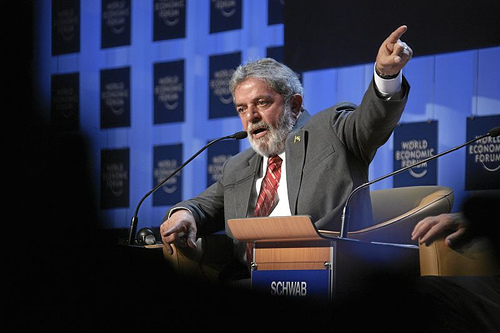
The President Luiz Inácio Lula da Silva announced today that Brazil will lend 10 billion dollars to the International Monetary Fund. The money is part of a $1.1 trillion package agreed at the end of the G20 summit in April to boost international financial institutions, international trade and economies that are struggling with the economic crisis.
Lula told Reuters agency that the deal was settled with the Treasury Minister Guido Mantega on Tuesday. According to Lula, the action will give Brazil the "moral authority" to demand changes "much needed" in the IMF and other multilateral organisms.
Lula advocates for a stronger voice for the emerging economies in organizations such as the IMF and World Bank in order to make them truly multilateral.
The negotiations had been going on for some time. At the G20 meeting, Lula had said he wanted to be the first Brazilian president to be able to lend money to the IMF. "Don’t you guys think it’s very ‘chic’ for Brazil to lend money to the IMF?", he asked reporters.
In 2005, Brazil paid off its $5.5 billion debt to the IMF two years ahead of schedule.
Photograph of President Luiz Inácio Lula da Silva by World Economic Forum
]]>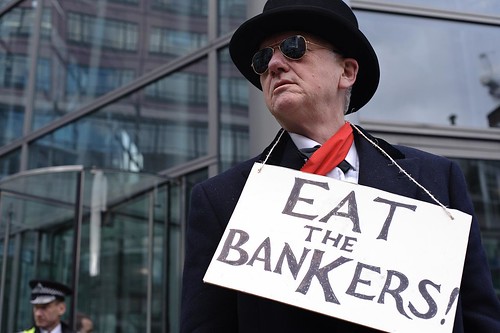
The furore over police attitudes to protesters and police during the G20 protests in London at the start of this month rages on, with clear sides beginning to emerge in the debate.
If the police had hoped the focus on their tactics would abate as the dust settled on the protests, the death of Ian Tomlinson and the almost daily emergence of videos showing the rough treatment of journalists and photographers has hasd the exact opposite effect.
Two journalists whose work documenting protest I highlighted here before the protests, photographer Marc Vallee and film-maker Jason N Parkinson, are at the forefront of the evidence-gathering.
Several of Parkinson’s videos have been published by The Guardian online. While he put himself into the melee to document the protest, the strict policing meant he also came away with plenty of footage of police advancing on the assembled press, with occasionally violent results.
Read the rest of this post on Adam’s blog.
]]>
The furore over police attitudes to protesters and police during the G20 protests in London at the start of this month rages on, with clear sides beginning to emerge in the debate.
If the police had hoped the focus on their tactics would abate as the dust settled on the protests, the death of Ian Tomlinson and the almost daily emergence of videos showing the rough treatment of journalists and photographers has hasd the exact opposite effect.
Two journalists whose work documenting protest I highlighted here before the protests, photographer Marc Vallee and film-maker Jason N Parkinson, are at the forefront of the evidence-gathering.
Several of Parkinson’s videos have been published by The Guardian online. While he put himself into the melee to document the protest, the strict policing meant he also came away with plenty of footage of police advancing on the assembled press, with occasionally violent results.
On his blog this weekend Parkinson wrote that he had suffered three days of concussion after being hit repeatedly over the head by baton-wielding police. He also claimed to have been jabbed in the kidney by a police medic.
The rest of the day panned out as most protest journalists imagined, hence many experienced photographers and video people using the now mandatory improvised safety equipment – helmets and arm and leg padding – something in itself that says a lot about policing these days. Others were not so ready for the brutal onslaught brought down into the streets by the infamous Metropolitan police force and the notorious black-clad, storm-trooper unit, the Territorial Support Group (TSG).
Writing on the Guardian’s Comment is Free blog, Vallee points out that those journalists and photographers caught on the frontline were only doing what they felt was right and necessary:
At the same time it is important to note that many media workers, at some risk, went to work over these two days to document what was taking place. With the wholesale cutting of picture rates and jobs in the media due to the recession, the internet, mismanagement or in my view a mixture of all three, it was no surprise to me that the press were under huge pressure not only to come up with important and stunning pictures and footage but also to make sure this content got sold.
The left-leaning Guardian and its sister Sunday newspaper, the Observer, are natural homes for this kind of debate. But while those papers have led the reporting, the death of Ian Tomlinson catapulted the issue of police tactics onto a wider stage. Newspapers of all political stripes are now reporting and debating the issue.
Today’s London Evening Standard quotes a former top Scotland Yard commander’s withering view of modern polciing:
Officers are trained to be on guard against attack, to regard every situation, no matter how seemingly benign, as a threat situation. The lesson is that the public are your enemy. That mindset appeared to dominate the G20 protests.
And the conservative Daily Telegraph, no friend of protest movements, points to a key change in public attitudes in an editorial calling for a “new broom” at the Metropolitan Police:
Significantly, middle-class opinion now regards the police with intense suspicion. Most British citizens are law-abiding; but the middle classes break fewer laws than any social group and have traditionally reposed enormous trust in the country’s police forces. Not any more.
Photographers and film-makers, by the very nature of their work, will more often than not find themselves caught in the middle of unfolding and unpredictable events in the years to come.
The ever-blurring lines between the “professional” and “amateur” photographer/journalist appears to be confusing the police, who are flailing and flapping much like newspaper owners seeking a revenue model in the internet age.
I admit it must be confusing, in the midst of an event, trying to distinguish between all those full-time pros and interested voyeurs.
Why doesn’t someone draw up some guidelines, maybe invent a press card? Oh, hang on…
UPDATE: Great minds appear to think alike. Alastair Campbell has also found himself pondering this subject today, and makes a plea on his blog for balance in coverage of this issue. His point is fair and valid – the police are today’s favoured targets. But I stick by my point – officers and commanders seem bewildered by the changes happening on the streets in front of them and how the nature of protest and media coverage is changing.
]]>I’m currently waiting for 2,383 queued tweets on a #G20 search of Twitterfall (and later I realised that I need to keep it ticking over at 4 tweets per second to keep the queue down). I hardly need to say you can also track #G20 here and here.
Twitter has been comprehensively integrated into mainstream media coverage.* Here’s an inevitably incomplete run down of how Twitter has been used to tell the story.
1. Twitter and Liveblogging
Sky News and The Times are both using CoverItLive. Sky have added reporters’ pictures which is a nice touch. They have decided to disable comments, whereas the Times is frantically trying to publish them all.
The Times admitted they were struggling to keep up:
Joanna Geary: Sorry Dozi, we’ve had a sudden surge of comments coming through. I’m not sure I’m going to be able to publish them all. I will try my best.
Joanna Geary: No censorship going on here guys. Just one comments editor trying to keep pace with all your great comments!
The only comments that might be rejected are those that would be offensive (swear words) and those that break the law (defamation, incitement to violence).
UPDATE 4.10pm:
There were also difficulties with mobile phone batteries:
Joanna Geary: It is true that a couple of our reporters have run out of battery on their phone (they have been reporting since 9am. We do have others still in the field and some filing stories in the office. I will be linking as soon as they have finished.
The Guardian has a liveblog including embedded audio and video. They have a separate page for Twitter updates from their reporters. Matthew Weaver is using audioboo.fm to provide audio snippets. UPDATE: And here’s the Guardian’s Google map.
The BBC continues with the live text commentary approach that they’ve used for past events such as the attacks on Mumbai. They’ve also produced an interactive map.
UPDATE: The Financial Times has a dedicated G20 Twitter account.
But not everybody’s impressed with Twitter’s extensive use.
"@chilesl: anyone else finding the Guardian’s #g20 ‘reporting’ via #twitter distinictly annoying? http://tinyurl.com/d5x663"
2. Twitter sources
Journalists are now well aware, or should be well aware, of how to use Twitter to provide information and eyewitness accounts to enhance their coverage of events. Here’s the work of BBC News Online journalist, Ana Lucía González, which includes numerous shout outs for interviews and information like this one:
"@unslugged Hi from BBC, we would like to quote your tweets on our website, is this OK? We’d also like to speak to u. Pls DM me. Thank you!"
@unslugged later apears in the BBC’s live text commentary:
"Unslugged tweets: It’s like Tiananmen Square out there. Except the rioters brought their own tank. Read Unslugged’s tweets."
3. Twitpic Fail
Twitpic went down some time in the afternoon (reported by Sky News liveblog at 2.10pm), presumably due to the sheer volume of photos being uploaded. It does seem to have recovered at around 3pm. New competitor Tweetphoto was only too happy to point out its temporary demise.
UPDATE: More on a similar theme by Kate Day at the Telegraph.
*Today, this newspaper apparently converted it’s whole operation to Twitter-style updates from staff and trusted communities.
]]>