How to send stories by carrier pigeon, when to run when you are under fire and the best way to brush off tweets were amongst titbits of information from Alan Cowell’s discussion of his new book ‘The Paris Correspondent.’
Cowell has long been a correspondent with the New York Times, and before that worked for Reuters. This is his third book.
In discussion with Charles Glass, freelance writer and former chief Middle East correspondent with ABC News in Beirut, Cowell says that reporting and producing news has changed for good. The book’s two male protagonists grapple with the fast pace of this change in the news industry. Cowell reads an excerpt:
“News men and newswomen were going down with the ships on which they had once sailed the kindly oceans of expense account lunches, five-star hotels and mortal peril. Print, that great, gorgeous messy alchemy of ink and hot type and whirring reals of paper and working stiffs in stained overalls was expiring, but not quite finished.”
And as Cowell suggests, there is no reason not to reminisce a little about how things used to be:
“I remember in N’Djamena I was doing an interview with [President] Goukouni Oueddei… you had to go across the river to Cameroon to be able to find a phone… and on the bar there, there was a direct dial telephone… located next to an ice bucket where there was always a fresh bottle of champagne…”
“And there was also a curfew… and you had to be poled across the Chari River in a dugout canoe. And I remember saying to President Oueddei, “I’m sorry I’m going to have to cut this short because I have to catch the last pirogue before curfew.”
Those times have gone, says Cowell:
“If you say ‘Is that a more pleasant way of earning a living than slaving over a computer screen all day trying to bat off tweets like mosquitoes?’ Then yes, sure. But we can’t turn the clock back and what we have to do now is… bringing the standards and the values that have always made newspapers sell, into this new era.”
It was in Zimbabwe reporting shortly before independence, that Cowel was able to hone his carrier pigeon sending techniques. With no way to send his stories back he was given a huddle of “cooing carrier pigeons” by the last white mayor of Bulawayo and the last editor of the Bulawayo chronicle.
“…we didn’t know exactly how we were supposed to cope with them and he said look, Sid said “you hold the birds legs between those fingers, you put your thumb over the neck, you give it a little kiss and whisper something nice to it, then you loft it up to the air… And you write the story on a 30 packet of Madison cigarettes – there was a small bit of tissue paper inside and you could write 400 words of spidery script on it.
It is hard to avoid the feeling that news has definitely changed.
]]>By Charlotte Eyre
Original and innovative content will remain the keystone of the news industry as the media machine progresses, David Carr said in a discussion with Richard Gizbert on Monday.
Watch the event here.
Rupert Murdoch’s positive contributions to the British press as well as the negative effects of his influence were discussed by a Frontline Club panel on phone hacking last night.
Although some of the panelists concluded that the positives might even outweigh them, the negatives are “awfully negative”, said chair Jon Snow, presenter of Channel 4 News.
Ever since the phone hacking scandal exploded earlier this month after the revelation that the News of the World hired an investigator to hack into murdered schoolgirl Milly Dowler’s phone, Rupert Murdoch’s influence has been unanimously decried.
Much reflection on the value of a reportedly dying empire has followed.
Panellist David Banks, a former Daily Mirror editor who also spent 14 years working for News Corp, said:
He begat a whole generation of journalism that we may not approve of. He pushed boundaries. I can divorce Rupert Murdoch from his power base. I rather like the man.
Without Murdoch quality papers like the Times and the Sunday Times would not exist today, added panellist Toby Young, a journalist for the Spectator and Daily Telegraph Snow pointed out the role Murdoch played in promoting premiership football and bringing satellite TV to millions of homes.
However, Jane Martinson, women’s editor at the Guardian, who until recently was media editor, said she Murdoch should not be discussed in extremes:
Rupert Murdoch as a bogeyman has not been the case for some years. [But] I wouldn’t go as far as to say the man is a saviour.
After many years in thrall to the Murdoch empire politicians finally called both Rupert and his son James Murdoch to account last week. Martin Moore, director of the Media Standards Trust and founder of the Hacked Off campaign, said politicians felt able to speak against Murdoch only after the revelations about Milly Dowler emerged.
When we went with the Dowlers to see the party leaders. They were remarkable, dignified … You could see the leaders [more] emboldened than they were before. They believed it was wrong and they had the public behind them.
The panel also discussed what had created the culture that led to widespread illegal activity. David Banks said the disappearance of the old, grey-haired editor-in-chief with a pipe and a strong moral code had resulted in a more reckless culture:
It is no coincidence that the last four or five editors of the Sun have all come from the showbusiness route. They have been quite young. No ethical background. No sense of someone behind them saying, ‘you can’t do that’.
In response to the panel’s comments about tabloid newsroom culture, James Anslow, a fomer News of the World employee who was in the audience,said the phone hacking scandal had surprised him.
“The idea that this is a culture that has been infected is hyperbole. I know of no ‘don’t ask, don’t tell policy’,” he said.
The role of press regulation has come under much scrutiny as a result of the phone hacking revelations. However, there was concern about the future of newspaper journalism if statutory regulation moving towards statutory regulation would be detrimental to journalism, argued Toby Young:
If journalism becomes wholly professionalised it becomes much harder to speak truth to power. We are not going to have quite such an energetic, rambunctuous media.
But Martin Moore said rather than statutory regulation a more “concise privacy law and first ammendment-style defense” should be developed. Such a stronger public interest defense would embolden journalists and solve the problem of what do when private or sensitive information is published online.
Review by Rebecca Omonira-Oyekanmi
]]>
Data helps journalists paint a more compelling and complete picture – but only if they can interpret and present that data effectively. That was the message from journalists with extensive experience of the benefits, challenges and pitfalls of data and journalism at the Frontline on Wednesday.
If you couldn’t make the event, you can watch the whole thing here:
The Guardian’s Datablog editor Simon Rogers dismissed accusations that using data isn’t proper journalism: “None of the stuff we talk about is particularly new, it’s the way we do it and the tools we have that are.”
He described how Guardian readers helped analyse thousands of documents on MPs’ expenses and how the paper has gradually developed new ways to visualise data, such as the 92,000 documents on the Iraq and Afganistan wars released by Wikileaks.
Times programmer and editorial developer Julian Burgess showed how computer code can be used to present data as diverse as the body mass index of Playboy playmates and pager messages sent from the World Trade Center on 11 September 2001. He recommended free tools such as Google Docs or MySQL that can be used to work data into stories.
These tools can be used by journalists to tackle data themselves, but programming is still reliant on the quality of the data, he said. “Things are often very easy with programming, or impossible practically.”
David McCandless, writer, designer and author of the Information Is Beautiful blog, emphasised the use of design in moulding data to tell a story. Well-designed visualisations can not only present data appealingly, but can also highlight interesting links that might go unnoticed, he said.
As an example, he showed how a simple graph showing peaks in news coverage of violent video games coincides with the anniversary of the Columbine school shootings.
Michael Blastland, a freelance journalist and creator of BBC Radio 4’s More or less programme, closed the session on a cautionary note by highlighting the dangers of not interrogating official data or questioning its creation. He cited the use of a single test result – in a sample of 1,500 – as the basis for estimating that three million people in the UK were affected by the Winter vomiting norovirus bug. He also described how valuable sources of data such as the Office for National Statistics often involve huge margins of error.
Finding your data is tough, knowing what kind of data you are finding is even harder. But I think you do need to know what data does, how it behaves and how it misbehaves in order to start making sense of it and start doing some of the wonderful things that my colleagues have been showing us how to do.
This event was part of our On The Media series, in association with the BBC College of Journalism. The next in the series is on 12 October and asks what the future holds for TV journalism in a connected age. More details and ticket booking here.
]]>Google’s online dominance puts it at the heart of forces undermining the traditional news publishing industry.
But a Frontline Club panel on Google’s relationship with publishers on Wednesday focused on the wave of technological change behind the search giant that means the industry must "innovate or die".
If you couldn’t be there on the night, you can watch the whole thing here:
Trinity Mirror’s digital content director Matt Kelly said that newspapers were "blinded" by the internet’s ability to expand readership, but they are confusing reach with audience.
He said building an engaged audience of returning readers was far more important than attracting "transient" site traffic from Google, and can deliver higher ad revenues.
I’d much rather have one click from Twitter than a 100 clicks from Google because it means that somebody said ‘check this out, this is fun this is good’. We built [gossip site] 3am.co.uk deliberately to perform badly in search engines.
Google UK’s head of PR and communications and former Newsnight editor Peter Barron conceded that Google may not have cooperated effectively with publishers in the past. However, he blamed what Kelly referred to as an "arrogant" approach on the company’s rapid expansion – which outstripped its ability to recruit enough staff, something the firm has now corrected.
Barron also challenged the assumption that Google is opposed to charging for content: "There is a lot of mythology that we stand for everything must be free on the web – that’s not the case. There are lots of great things on the web that people pay for all the time."
PaidContent:UK editor Robert Andrews said he admired the "ballsiness" of Rupert Murdoch’s paywall experiment, but he said everyone is asking: "What is Rupert Murdoch’s plan B?" He said there was every chance that papers in their current form could be wiped out by what was essentially a broad economic shift.
There was no great ball newspapers dropped when moving online. This was just a different medium, and newspapers had no divine right to come and dominate it.
Wired and Press Gazette columnist Peter Kirwan stressed that papers may only be saved by switching to an online model where operating costs match the reduced income from switching from print ads to online: "The possibility of a digital-only business is starting to open up."
]]>How have Facebook, Twitter and blogs changed changed grassroots politics? This was the question tackled at the club on Tuesday, at an event moderated by Deborah Bonello, founder of Mexicoreporter.com and video journalist for the Financial Times.
If you couldn’t be with us for this event, you can watch the whole thing here:
Sunny Hundal, editor of Liberal Conspiracy, cited social media scrums such as the Twitter campaign following Jan Moir’s comments in the Daily Mail about Boyzone singer Stephen Gately; complaints over a BBC World Service messageboard asking if homosexuals should be executed and the campaign to stop Rod Liddle becoming editor of the Independent as examples of how social media can be used to mobilise support on an issue.
But Mike Harris, director of the Libel Reform Campaign, said that these were "quick wins": "Social media is very effective in short term campaigns but it hasn’t converged around a single nexus in the longer term," he said. "I’m concerned that the power of the quick win comes to dominate."
His suggestion that social media would only "come of age" when campaigns were influencing the detail of legislation was disputed by Benjamin Chesterton of Duckrabbit who argued that "It goes far beyond minutiae of policy – therer are so many things beyond politics and policy that people are getting involved in."
Sina Motalebi, of BBC Persian TV, was imprisoned for 23 days in Tehran’s Evin prison and released after thousands of people signed an online petition argued against reducing "social media to our political expectations". Responding to the suggestion that Western media had over-hyped the impact of Twitter in the protests following last year’s Presidential election, Motalebi said:
]]>I don’t think it was unsuccessful in Iran.I know some Iranians are disappointed and are asking this fast-moving buzz, did it change anything? It has: it brought the exclusive power away from the media. I don’t think it can change a government but it can change some of the characteristics of a society and open things up for people whose day job is to create change.
“PR has always been the get-out for journalists who want to make more money,” said Martin Veitch who is due to join Bite Communications. “Those who wanted to drink more would become journalists instead.”
This arguably outdated vision of the intrinsic differences between journalism and PR is what promted Frontline to set up last night’s event, chaired by former Times media editor Dan Sabbagh and based around the question: ‘Is journalism becoming more like PR?’
Yet panellist Drew Benvie, managing director and of digital PR agency 33 Digital, takes a different view. He argued that with social and media interaction changing drastically faster than most industries can assimilate, the future of PR is to bypass journalists and feed targeted information directly to the consumers that no longer have an interest in traditional news outlets.
But are we really crossing the line between traditional news reporting and PR-style propaganda? Ian Burell, media editor of the Independent, recognised that times are also changing on the journalists’ side. “Twenty years ago I wouldn’t dream of taking a call from a PR company, now I can’t do my job without them.”
There was a feeling of disappointment amongst journalists and academics, who recognised the need to churn out the stories as fast as possible to beat – or at least match – the competition and satiate the consumers’ bottomless desire for new information 24 hours a day. But has this led to a detriment in the quality of news reporting?
Darren Waters, who has worked for the BBC and is now Managing Director of Monument PR said:”It’s heartbreaking to see people read your stories, because they don’t.” He argued that focus groups show how people read the first three paragraphs and then move on to another story, making the quality of the writing less important than the volume of stories.
PR people in the audience were unsurprisingly shunned more than once by the journalists, with comments such as “it’s disgraceful that journalists share a stage with PR people” or “public relations is just a fancy name for propaganda”. But ultimately, the image of a journalist sitting in an ivory tower, basking in his own noble glory was shot down by comments suggesting that the real issue is whether journalism is becoming more like PR, and not vice versa.
A final show of hands proved that over half of the audience believed that PR and journalism were indeed merging, and it was generally considered to be a good thing that PR companies are now recruiting renowned journalists such as Richard Sambrook to help them to communicate with the press, but at the same time, we want the press to not listen.
Ian Burrell said: “Journalists need to be beholden only to their reader.” Let’s just hope there’s still a reader out there.
]]>Journalists need skills other than subbing and writing: they need to fill a niche and to stop being afraid of dealing with money.
And with the new Lib-Con government finally and conclusively shutting the door on the idea of giving over public funds to support innovative multimedia regional franchises (Independently Funded News Consortia, or IFNCs) – they might need those entrepreneurial skills sooner rather than later.
That was the general feeling at last night’s Frontline Club panel discussion entitled “On the media: What now for local and regional media in the UK?”
On the panel were Richard Hooper, former deputy chairman of Ofcom and chair of the IFNC selection panel; Alex Connock, CEO of the multimedia production companany Ten Alps; Jon Slattery, freelance journalist formerly of Press Gazette, and Marc Reeves, editor of The Business Desk and formerly editor of the Birmingham Post. The panel was chaired by the Frontline Club’s Patrick Smith.
The discussion began with the local media industry’s perennial problem: regional advertising revenue is drying up almost faster than we can sack journalists and nobody can offer up a business model to revive TV and newspapers.
The panel took place only hours after culture secretary Jeremy Hunt confirmed the government would market test the roll-out of nationwide “super-fast” broadband connections instead of the £47 million-a-year IFNC progreamme.
Local news isn’t covered unless there’s a rampage or Notting Hill involved, but you could have had IFNCs getting together covering those if the funding hadn’t been axed.
Hunt argued that although the IFNC bids had merit, they risked turning the regional media into “subsidy junkies and Richard Hooper said he agreed with him that the solution might lie in relaxing media ownership regulation.
Marc Reeves, whose employer thebusinessdesk.com is set to make £1 million in revenue this year, said that the answer doesn’t lie in subsidies, but rather in niche content and good sales people:
I’m surprised there isn’t more specialised, focused journalism such as sport or arts and leisure…the problem is, hyper-local (journalists) are really rubbish at being hyper-local salespeople
Later, I caught up with Reeves on the subject of niche content and job creation. Here’s what he said:
Suffice it to say, there’s still much to chew over when it comes to solving the problem of failing regional media. Until we resolve that one, however, here are a selection of tweets from the evening to give some food for thought:
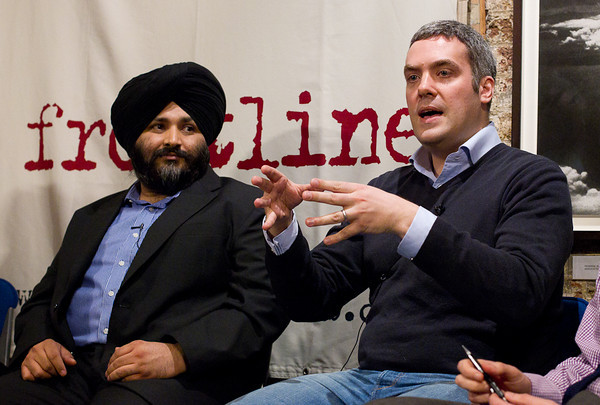
One way to boost newspaper revenues as print circulation and advertising revenues fall through the floor is to charge readers to read stuff online. The only problem is: will a generation that has grown up with free news content – that believes in a free web – cough up for it?
One man who hopes so it Gurtej Sandhu, digital director of Times Newspapers, which next week launches paid-for, fully paywalled online versions of The Times and The Sunday Times (see previews here) after many months of preparation.
He joined a panel at a Frontline event on digital media, mobile and paywalls on Wednesday to defend – in the face of some serious audience scepticism – The Times’ new strategy, and by proxy parent company News Corp’s tough line on the value of journalism and news.
If you couldn’t make it to the club this time, you can watch the whole thing here.
Also check out paidContent:UK’s two reports, this interesting blog post from William Owen at Madebymany.co.uk from the evening and the lively chatter on Twitter.
Update: Also have a read of this fascinating post from Ruth Gledhill of the Times and the views of Adam Tinworth, from business publisher Reed Business Information.
"We’re one of the first general [interest] newspapers to do this," says Sandhu. He said that The Times – which has just laid off around 10 percent of its editorial staff (via Guardian.co.uk) through voluntary job cuts – is "in a position where we have to do something". Some papers have tried the paywall route and turned back, such as the New York Times which charged for its online comment section and built up some 250,000 subscribers only to bring the paywall down after complaints from columnists and readers. They chickened out when they should have held firm, says Sandhu:
I think the New York Times blinked when they shouldn’t have done. It was 250,000 people, that’s a significant amount; they didn’t really fail… The ad market boomed and suddenly they felt the revenue they could generate from the ad market was far more substantial."
He also had a few words for The Times’s free content-loving rival Guardian News & Media: "The sense is that people are downloading the Guardian iPhone app and not buying the newspaper edition – it’s not an insignificant number and they only pay for it once." Having said that, Sandhu isn’t that bothered whether people read Times content via the print, desktop or mobile versions – as long as they pay. "We’re starting a journey… will it matter in the long run whether it’s a digital edition, mobile or newspaper? It’s all readership to us."
And the loss of readers that will come from lowering the credit card drawbridge on Times Online? Sunday Times editor John Witherow reckons (via paidContent:UK) that as many as 90 percent of readers could go elsewhere. Sandhu: "We don’t see that as a permenent postition; we believe we will generate more revenue through doing this."
I recommend checking our video from about 1 hour 10 minutes to get a feeling of just how hostile our audience was to the paywall plans. Perhaps it’s not the most representative focus group, but if this was a flavour of what people think, the plan could have a rocky road ahead.
Also on the panel was Marybeth Christie, head of product developement at FT.com – a business that has met with some success charging readers of news and data, albeit a highly targeted professional, business audience. Some 126,000 users happily part with £170 and more for breaking news, company data, the Lex column and the use of the FT’s mobile apps (including, yes, the iPad). "The advantage of the metered model is that we know what our users want," she said. "Those that find it most useful, our more engaged users, don’t mind paying because they like us."
Pushed by moderator Steve Hewlett to reveal how many corporate subscribers FT.com has – a market consumer papers like The Times won’t be able tap in nearly the same way – she said it was "less than half". And does a paywall hurt advertising? Not at all: "It has not hurt our ad revenues, quite the opposite. Because we have so many registered users, we now have more data on them and we can pass that on to advertisers."
Ewan MacLeod, editor and founder of Mobile Industry Review has first-hand experience of going from free to paid-for. His well-respected site for mobile industry professionals regularly clocks up 250,000 readers a month, sometimes as many as one million, and in March last year it was "bought out" by another company (I covered the story for PCUK) and went subscription-only for the steep price of £1,000 a year. "How many subscribers did I get? None. Nada. Not one," says McLeod whose site is now free-to-air again.
Here’s a flavour of what people were saying on Twitter:
Did you know all our events are available on our free podcast? iTunes link
]]>
 By Ewan Palmer
By now it’s unlikely that journalists want to hear any more about how their industry is in turmoil. So how about suggesting ideas to sustain the craft: is the future in freelancing? Does it lie in entrepreneurialism?
From employment to self-employed
Working for yourself is an obvious solution for the thousands of journalists who have lost their jobs over the past two years – if you can’t find work then make it yourself.
Some people have been able to do this like journalism and technology site 10,000 Words – creator Mark S Lucie has since released his own book. The main problem is that this kind of online publishing requires a whole new range of skills.
But the problem is: there are more freelancers around now than ever before which makes standing out all the more difficult. Whereas before, the pitching to an editor skill or winning an elevator pitch was vital, this is no longer enough.
Extra multimedia skills – video, audio, photography – may at first appear to put some people off, as well as the daunting thought of trying to earn a living entirely off your own back.
Show me the money
On top of all that, journalists must also now think like entrepreneurs and answer the question: "How will this make money?"
Some journalists have created their own start-ups or hyperlocal sites. These sites are either run independently by people who used to rely on their paychecks from the mainstream media or by students who are already realizing how difficult finding a traditional job in the industry will be.
The only way these sites will work if they can offer the audience a true niche, the kind that a mass media outlet like a printed newspaper can’t provide. But hyperlocal sustainable? Can advertising revenue aimed at a certain postcode really be enough?
We’ll be discussing all this and more at the Frontline Club on Tuesday April 6, at an event specially for freelance journalists. There will be a discussion on the trials and tribulations of becoming a freelancer, as well as advice for going solo from a our panel of experts Adam Westbrook, Anne Wollenberg, Deborah Bonello and John Brazier. Book tickets here now.
Pic credit, via a Creative Commons licence: sarah_sosiak.
Update: Please find below a link left by Mr Graham Holliday about his start up in Rwanda, and how he doesn’t care about whether it makes money.
http://www.beta.frontlineclub.com/blogs/frontline/2010/03/journalism-doesnt-pay-so-what.html
]]>