On Wednesday 22 October, the autumn issue of Index on Censorship magazine launched at the Frontline Club. The magazine’s editor, Rachael Jolley, introduced the issue and handed over to author and columnist, David Aaronovitch, who chaired the accompanying debate on the future of journalism.
Aaronovitch initiated the discussion by asking each panellist to speak individually on the future of journalism before inviting the audience to partake.

Rachael Jolly (right) gives an introduction and speaks briefly on the Index on Censorship magazine launch.
Aaronovitch described the title of the debate, Will The Future of Journalism Mean We Are Better Informed?, as “gorgeously optimistic”.
Richard Sambrook, professor and director of the Centre for Journalism at Cardiff University and former Director of BBC World Service, suggested that we will be better informed “if we want to be”. The panel and the audience returned repeated to this theme that we now have access to more information than ever before, but also have to be more discerning about the source of that news.
In our technology-led society, it is becoming increasingly difficult to differentiate journalists from citizen reporters. And Raymond Joseph, former editor of the South African Sunday Times, who joined the panel via Skype from South Africa, said that we must ask numerous questions before trusting a source: “How do you know? Who do you know? What do you know?”
“Today you need to be platform agnostic,” Joseph continued. “You need to separate news from the noise.”
While everyone agreed that Twitter was a powerful journalistic tool that journalists couldn’t afford not to use, Sambrook also took to task how we define journalism. He debated whether “any expression in the public space is journalism”, and concluded that “just because you heard something doesn’t make it journalism . . . it is raw information”. It is what you do with it that matters.

From left: David Aaronovitch, Amie Ferris-Rotman, Rachael Briggs and Richard Sambrook.
Rachel Briggs, Director of Hostage UK, said that the public is also beginning to lose trust in the media and this is somewhat due to people being “fed up with the way . . . the media is so mediated”.
Media sources are also unwilling to invest in hiring local reporters in other countries. “Foreign reporting still relies unfortunately on the . . . model of the white saviour, often male,” said Amie Ferris-Rotman, former correspondent for Reuters in Afghanistan and Knight Journalism Fellow at Stanford University. But she also revealed the startling statistic that the “British media has 40% less international coverage than it did 30 years ago.”
Aaronovitch said that “[news] organisations become almost completely disconnected from abroad” as they do not know or understand information to the same extent as local journalists.
A panel of young and future journalists joined the experts with fresh ideas. Priyanka Mogul, Journalism and Human Rights student at Kingston University, said that with the huge amount of information available, at least it is “becoming impossible to be someone who doesn’t know what is going on”.
Jodie Ginsberg, CEO of Index on Censorship, commented on the youth panel:
The @Index_Magazine launch youth panel on #futurejournalism has been fabulous – insightful, optimistic and challenging
— Jodie Ginsberg (@jodieginsberg) October 22, 2014
You can watch the event and listen again here:
]]>
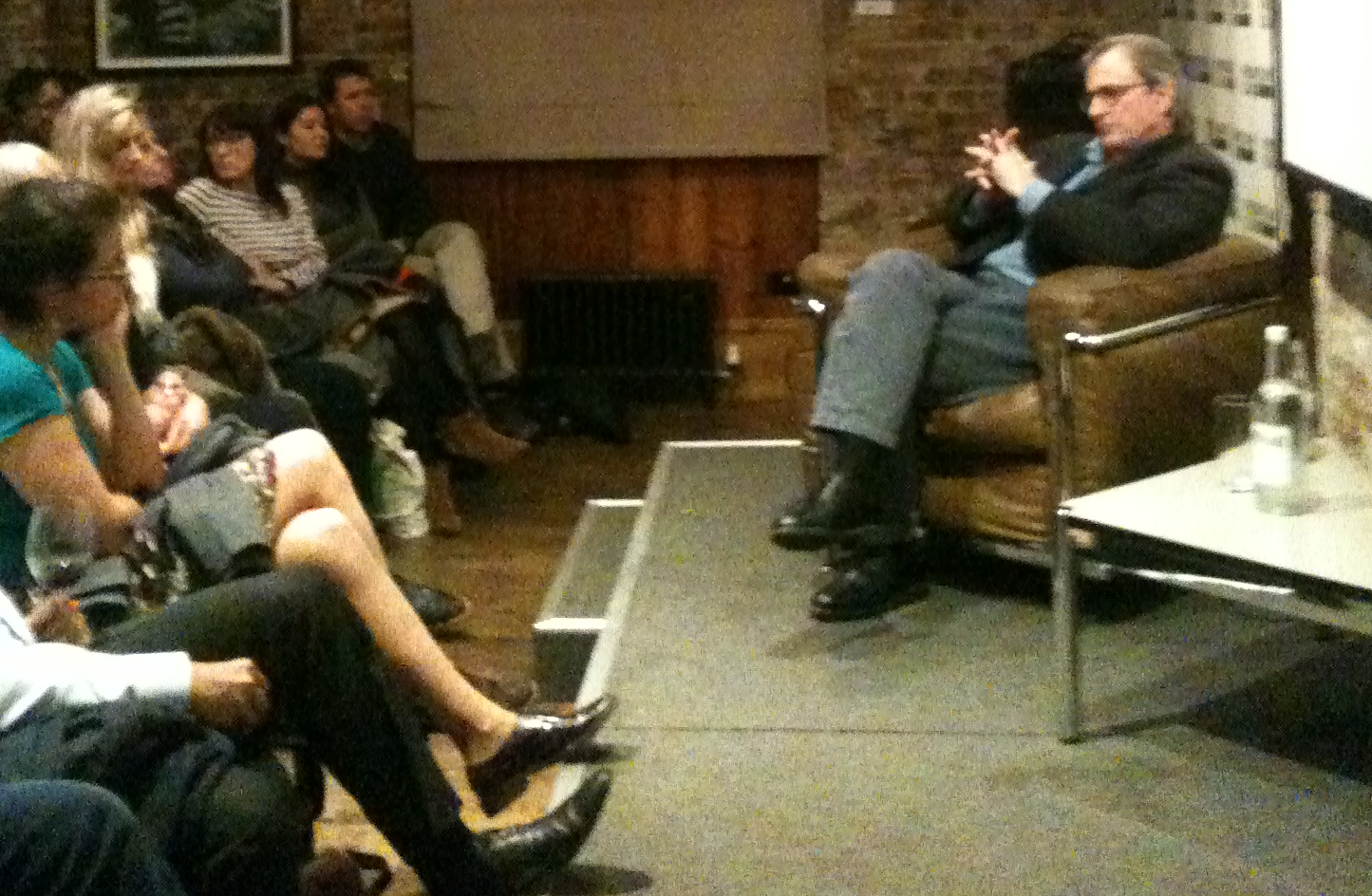 "He was there!" Director Thomas O’Connor said of English author and journalist Graham Greene (1904-1991), the subject of his documentary Dangerous Edge: A Life of Graham Greene, which was viewed by a full house at the Frontline Club on 1 October.
"There, you know, for 70 years, from one place to another, in these hot spots."
Greene – whether meeting with the Pope, giving a speech to Gorbachev’s Kremlin, conversing with Latin American rulers, or journeying in the 1930s through the hinterlands of Mexico or Liberia – had his finger on the very pulse of the 20th century: its crimes of foreign policy, the inner angst of its inhabitants.
In his own life, Greene left his wife and two daughters early on, indulged in drugs, prostitutes and affairs, suffered from bipolar disorder, and fought powerful suicidal urges, often admitting to his own yearning to die.
"Dear Vivien," he wrote to his wife, "the fact that must be faced, dear, is I have been a bad husband. You see, my restlessness, moods, melancholia, even my outside relationships, are symptoms of a disease, not the disease itself. Unfortunately, the disease is also one’s material. Cure the disease and I doubt whether a writer would remain."
"He was a tremendously courageous writer and journalist," O’Connor reflected, sharing that a driving motivation to make the film was that he "worried about journalism [today]," that future generations would lack voices as brave and voluminous as Greene’s.
"Some writers write their novels," O’Connor said, "and then every once in a while a letter to the Editor. Greene had a whole book of letters to the Editor!"
His eyes searing with intelligence and sensitivity, Greene asked readers to see more deeply into the world around them. He challenged the injustices of big business, globalization, Soviet totalitarianism, and British and American interventionism.
"I would go to any lengths to put my feeble twigs into the spokes of American foreign policy," Greene wrote.
His 1955 novel The Quiet American paired the damage done by a naive American idealist with that by a cynical English journalist like himself, both living in Saigon and desiring the same Vietnamese woman. The work so touched a nerve that, as O’Connor highlighted, even George W. Bush could not help mentioning it in a 2007 speech to American war veterans.
O’Connor wished Greene had been alive to challenge the narrative that led to the latest invasion of Iraq.
]]>"We still need writers," he argued, "as [Greene] famously said, ‘with a sliver of ice in their heart,’ and willing ‘to be a piece of grit in the state machinery.’"
I never thought about making money when I set up Kigali Wire. From the beginning it has always been an experiment and it remains so. I never thought about making money when I shot my first photojournalism essay – which is in dire need of an editor’s hand… forgive me, it is my first bash at the medium. And I never think about money when people use my stuff. So, why am I thinking about money now?
Because, I reckon I stand to make more money on by-products than I (probably) ever could from straight journalism. Since doing the photojournalism essay, I’ve received the following enquiries:
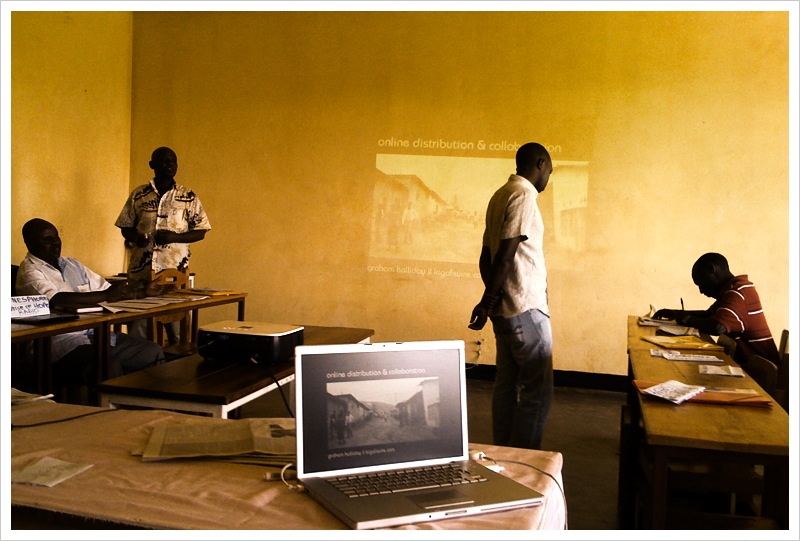
– 5 invites to give paid talks – that’s me above, about to give one of them in Kigali.
– interest from a major newspaper in commissioning an edit of the piece.
– interest from a couple of NGO’s about doing similar photojournalism pieces on a commission basis.
That’s almost $2,000, even if the latter two don’t come off. All the tools I use are cheap. All the digital tools I use are free or low cost.
I’m beginning to hope think it might be sustainable to do the stories I want to do, in the way I want to do them, if I keep in mind that by-products are the only earner. And if I get more creative in what by-products I come up with.
This is something Vaughan and I have talked about loads over the years – maybe one day we’ll unveil our world-beating chip van model for the future of journalism... And I’d say this kind of thinking is at the core of what the Frontline Club stands for.
Of course, this isn’t new, but – in these utterly grim times for old media – thinking along these lines might offer a glimmer of hope for any would-be freelance journalists out there. And it deffo plays into the whole how to be a foreign correspondent thinking some of us talked about recently. To make this work best, I reckon you still need to…
go somewhere cheap. And odd. The odder the better. link
Photo taken from my personal Flickr account
]]>| Daily Show Full Episodes |
Political Humor | Newt Gingrich Unedited Interview |
The Daily Show take a tour of the offices of the New York Times. If you want to know what’s black and white and red all over… watch the video above.
]]>
Andrew Stroehlein, Communications Director for the International Crisis Group, wrote a great piece on his Covering Crisis blog on the Reuters AlertNet site. He has very kindly agreed to let us post it on the Frontline blog. He raises a lot of points about under-reported stories, things we regularly cover here and discuss at length at the Frontline Club,
We’ve all watched the cutting of foreign news budgets for so long that we’ve become almost numb to it. Another bureau cut here, another three correspondent posts dropped there — drip, drip, drip — the dwindling capacity of overseas news gathering is constant background noise. Or ever-increasing silence, perhaps. But now we’ve come to two situations that show us what the world will be like when there are no foreign correspondents left.
The first is Somalia, where the utter inanity of foreign news coverage in the West, particularly in the US, knows no bounds. Amid deafening hero-worship and chest-thumping, the US media machine was so proud that a new president with the world’s largest military at his disposal can kill a couple lightly armed thugs that few seemed even able to grasp the most basic fact of the situation: piracy is symptom, not the disease, and lawlessness off the coast of Somalia will continue as long as anarchy is allowed to continue on land. If only a tiny fraction of the Western media ruckus of recent weeks could be dedicated to Somalia itself, then international political attention might start focusing on the roots of the problem.
But the danger on the ground makes Somalia extremely difficult to cover for foreign journalists, so we’re stuck with stories of tangential importance, written like Hollywood film scripts from editorial offices thousands of kilometres away. Some outlets, like the Independent in the UK, are sending reporters to the refugee camps in Kenya so at least the story of the enormous human cost of the Somali conflict is known. Most others are at best tagging on a sentence or two at the end of their stories, pointing out that Somalia is a failed state. However, discussion of the international community’s political options is pretty rare, leaving an endless loop of despair: Somalia’s been a failed state for so long, the world cannot imagine it any other way — even if it results in piracy and growing extremism that threaten us, not to mention great human suffering among the inhabitants
The other example of a crisis unfolding mostly not before our eyes is Sri Lanka, where over the past few months the situation in the north east has become incredibly desperate for some 150,000 civilians trapped in an ever-shrinking "safe zone" between their government that is shelling them and the cult-like LTTE rebels who shoot them if they try to escape. Today, as my colleague writes, "A mass slaughter of civilians will take place Tuesday at noon. And everyone knows it." Once again, foreign correspondents are unable to cover the story, this time because the government is not allowing them in to the region.
Some Western media are trying to cover this deteriorating situation, and in particular, the UK and other European countries have been running some shocking new video of the victims. BBC World Service radio has been keeping it generally high in the news order. But try to find this enormous catastrophe on American TV… Good luck.
Instead of any of these issues of political relevance and deep humanitarian concern, Americans get coverage of would-have-been obscure UN conferences, which are supposed to seem interesting because they are boycotted. Or, more likely, they get ratings-hungry hate-rants against creeping socialism and indignation at blatantly astroturfed "tea party" tax protests.
Too bad Al Jazeera English is not available on most living room screens in the US, and people there have to choke down the endless rotting fish heads of celebrity news or the same tiresome group of ignoramuses shouting at each other in a studio — both the cheapest forms of filling air time after a test card.
What ties all this together is ignorance of foreign affairs in news media due to a lack of correspondents on the ground. In the current cases of Somalia and Sri Lanka, mind you, the obstacles to reporters covering the stories are larger than normal budgetary issues of staffing cuts abroad. But the point is these situations show us what it’s like when Western news organisations — for whatever reason — do not have long-serving correspondents on the ground: when they have no eyes and ears following the situation directly, understanding the complexities and able to report more deeply than "hero saved" or simply ignore it all together.
A respected staffer in a field bureau is able to call the editor back home and say, "there’s something big going down here", "in all my years here, I’ve never seen anything like this before", and "this is news; we need to cover this". Without anyone making that pitch internally, the chance of missing out is always going to be greater.
And so with these two crises, we now understand what it will be like when the last foreign correspondent collects her last month’s salary and turns out the lights in the last overseas news bureau. We’ll get superficial coverage of issues that are actually hugely important, we’ll miss real threats to our own security, and we’ll miss mass murders in progress. link
Head over to Andrew’s original post to read the comments too
]]>
Writing on the Foreign Policy blog Thomas E. Ricks suggests we should start reading newspapers like reporters. His simple, but misguided, point is that we should simply follow the writers we like, look for the bylines we know and love, read those articles and pretty much ignore the rest of the paper. Here’s his take,
OK, so it’s not How to Make Love Like a Porn Star. But the secret of reading a newspaper like a reporter is to pick stories by bylines. I’ve mentioned, for example, that I will read anything Anthony Shadid of the Washington Post writes about Iraqi politics, or life in Iraq. Another go-to reporter is C.J. Chivers of the New York Times. I’ve never met him, but I keep an eye out for his reporting from Afghanistan. link
I have favourite writers, I have favourite publications, but I can’t imagine scouring for bylines of the egos I most like to stroke from within the pages I most like to turn. And I’m not sure I know any other reporters who do that. While my journey might start at a particular news organisation, it rarely ends there and normally ends up somewhere I’ve never heard of before. The only way to read the news like a reporter these day should be with RSS, keywords and custom search engines. That doesn’t appear to be the norm yet which is why I enjoy teaching this course so much. Byline driven news reading…?? no thanks.
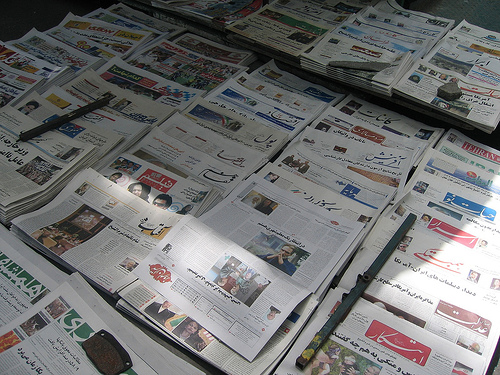
Photograph of Tehran newspapers by birdfarm.
]]>
How does the Internet affect the work of a foreign correspondent? That’s the question Andrew Stroehlein, a journalist and Communications Director for the International Crisis Group, discusses on the Reuters AlertNet blog. Andrew draws together a lot of current thinking and makes the point that it’s often impractical for a foreign correspondent to work effectively and monitor the Internet for relevant chatter about the story at the same time. He quotes Roger Cohen in the New York Times,
"You hear a great range of views about what you are writing, and some of those views can be exciting or interesting or lead you in new directions in terms of what you write and subjects you choose. My hesitation is that this is a temptation to somehow write into that noise and stir it further and be in the noise because it’s fun being in it, which I think can be a distraction."
In the 1990s, Mr. Cohen chronicled, in person, the horrors that accompanied Yugoslavia’s dissolution. Today, correspondents doing such work can find their time being sucked away by the profusion online of viewpoints and images and tweets from the scene, which multiply and demand attention. But keeping abreast of the Internet chatter is not the same as bearing witness.
"Instead of looking at a Bosnian village or hillside or being in a room with a group of concentration-camp survivors or bereaved women," Mr. Cohen said, "you would have just been staring at a screen and dealing with the rage of the Serbian diaspora in Munich or Los Angeles." link
This a definite problem. Journalists on the ground possibly with a shoddy Internet signal, no signal at all, no time to use the Internet, busy doing the job of journalism are still able to report effectively. The question is, what are they missing out on? Is there anything out there that could help the story along, a contact, a blog post, a source on Twitter?
Let’s be honest, most journalists are still a very long way from having the skills needed to filter the Internet in any meaningful, efficient and targetted manner. Google Alerts is about as sophisticated as it gets in my experience. There are three options ahead as I see it.
a) journalists are required to learn these skills and use them.
b) they are given a custom RSS feed for the particular story they are working on and are required to follow it as they would email.
c) the job of monitoring and filtering the Internet is done ‘back at base’ by someone else who only forwards the important stuff to the journalist in the field.
A major part of really understanding how the Internet works and how to use it as an integral part of journalism involves getting into the culture of it. And that culture is not for everyone. However, if a very unscientific poll of all the online journalism trainees I’ve trained over the years is anything to go by each one finds something of interest, something they decide to stick with and explore and incorporate into their work. That might be a blog, Twitter, a social network, RSS, social bookmarks or even Yahoo Pipes. In my experience, journalists only stick with something if they can learn it quickly and find it genuinely useful almost immediately. In an effort to help the sceptical, here’s a special offer for the first three commenters below.
If there’s a particular beat, a place, a niche topic you cover in your work and want to see what the Internet can deliver, but are not quite sure how to go about it, leave a comment stating exactly what it is you want to follow and I will create a custom RSS feed for you with the proviso that you get back to me to tell me if it is of any use, if it helps you in your work, if it took you down a path you might have otherwise missed.
Meanwhile, if you work for the BBC and are at TV Centre next Wednesday at 1.30pm I’ll be giving a talk on Twitter for journalists.
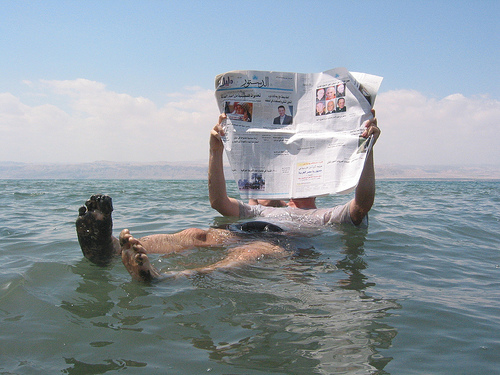
Photo Dead Sea Newspaper by Inju
]]>foreign reporting and the growth of web-based citizen journalists and
the effect on coverage of international news and human rights issues” Taking part are,
Loren Jenkins, Foreign Editor, National Public Radio, Sherry Ricchiardi, Senior Writer, American Journalism Review and Professor, Indiana University School of Journalism, Patrick Meier, Research Fellow, Harvard Humanitarian Initiative and Bob Dietz, Asia Program Coordinator, Committee to Protect Journalists. link
The discussion took place at George Washington University on December 10, 2008. You can download an MP3 of the 1 hour 16 minute discussion at the Princeton University website.
]]>Global Post, a new online news agency, is set to launch on Monday, January 12. The site claims it has 60+ foreign correspondents ready to report from 40+ countries in text, pictures and video. They plan to begin by trying to answer the question: “What does Obama mean to the World?” Charles Sennott, a Frontline Club member, heads the enterprise as Vice President and executive editor. He previously headed up Boston Globe’s Middle East and Europe bureaus.
According to this article in The Phoenix, the global news outlet pays its correspondents $1,000 per month and gives them a 48% share in the company. Global Post aims to make cash by syndicating to online and print news outlets including the Huffington Post along with charging an annual $199 subscription which allows access to extra content not available for the general hoi polloi.
The journalists are “veteran foreign reporters” and the work they do for Global Post will form “a piece of their portfolio, not their whole portfolio”, according to Sennot. The veterans include,
Edward A. Gargan, the former Times reporter and author of China’s Fate and The River’s Tale: A Year on the Mekong, who’s based in China; Matt McAllester, the former Newsday foreign correspondent and author of Blinded by the Sunlight: Surviving Abu Ghraib and Saddam’s Iraq (detailing his own detention in the infamous prison), who’s covering the UK; Josh Hammer, who ran five foreign bureaus for Newsweek and is reporting from Germany; and Seth Kugel, the former Times travel columnist, who’s based in Brazil. GlobalPost also has several thematically focused correspondents — including Stephan Faris, author of Forecast: The Consequences of Climate Change, from the Amazon to the Arctic, from Darfur to Napa Valley, who’s covering (natch) global climate change, and Mark Starr, former Newsweek Boston bureau chief, who’s writing a global-sports column. link
All of which sounds very promising. Especially during these times marked by the demise of the foreign correspondent and the increasingly desperate measures some news outlets are going to to get their foreign news.
If this comment on Frontline blogger Alex’s blog is anything to go by, it appears Global Post also plan to feed blogs into their online offering (Update: as many as 350 blogs). John Whilpers, Global Blog coordinator, is out to find as many blogs as possible to fill the site out with freely available content. Which is where I have a bit of a problem with Global Post: their approach to bloggers – which was earlier described to me as “scatter shot”.
It’s not that difficult to find an email address for Alex, or a Skype or Twitter handle or mobile number come to that. Just Google him. It just looks kinda lazy to dump a comment on a blog and expect a response in this way. More than that, it looks kinda rude when you realise you’re one of at least 69 who’ve received the same message.

In fact, click on any of those search results and I’ll wager you’ll find a name you can Google, an email address you can email, a Twitter handle you can follow etc. all within one minute. Any of which would be a far less clumsy first point of contact than a copy and paste comment. While the global news reporting aims and online focus has to be commended, I think Global Post need to rethink how they go about engaging bloggers. This approach smacks of spam. And no-one likes spam…
UPDATE: It seems like I’m not the only one who finds this approach at odds with the blogosphere.
UPDATE: Mark Glaser over at Mediashift takes a closer look at Global Post and talks to some of the reporters,
While GlobalPost might have no legacy infrastructure, the leading lights of the site have more legacy media experience than online savvy. That could cause problems for a new media startup that will live its life online. link
Mark plans to look over the site next week and report back, so do I.
UPDATE: Chris O’Brien has more at the Next Newsroom blog,
]]>“I’ve covered cops, courts, war zones, huge stories,” Sennott said. “I’ve never done a start-up. I’ve never been so busy in my life. But I’ve never been so excited about an opportunity to try to build something.” link
This could make a good Christmas read. The Media Re:Public report on the future of media in the digital age is published just in time for the holidays and it’s free to download. As Ethan says,
My friend Persephone Miel came to the Berkman Center more than a year ago to take on a challenging question: What’s the future of journalism in a digital age? This is the sort of question research centers love to take on – thorny, complicated, and very important. link
You won’t find all the answers in the report, but you will find some good pointers and thought provoking ideas.
]]>