Illustration by Chris Riddell
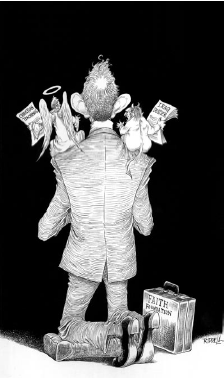
Tony Blair is busy outing himself as a man of God. Which is immediately ironic after all that time during which Blair refused to “do God” – as his media manager Alastair Campbell informed us. Since leaving Downing Street, Blair has used the G-word with a mixture of the fervour and regularity of a Jehovah’s Witness knocking on your front door, and the calculated spin of a Labour campaign. And this is not the result of a road-to-Damascus conversion since leaving office in June 2007, or a public-relations campaign to promote his retirement toy, the Tony Blair Faith Foundation. While the Foundation plans to use religion to solve the problems of the world, Blair lectures at the Yale Divinity School, preaches from pulpits including that of Westminster Cathedral, and gives a drip-drip-drip of interviews during which he acts coy before divulging more details about how Jesus was his guiding light when he was Prime Minister. His Christian faith had been “hugely important” to him while in office, he told the BBC in 2007. And more recently – ironically in an edition of New Statesman guest-edited by Campbell – Blair intoned: “My faith has always been an important part of my politics.”
All of which offers an invitation to take him at his word, rather than simply allowing the former British Prime Minister, now banker and aspirant global statesman, to wrap himself and his record in a comfort blanket of moral oneupmanship. How does the Blair legacy compare with the New Testament that the one-time leader was always apparently dipping into? And was the architect of New Labour inspired by Jesus, or did he come to imagine that he understood the mind of God rather better than his saviour?
Hiding the light of his faith under a bushel while Prime Minister does, of course, offend against the basic rule of Christianity, which was born as a missionary faith and still encourages believers to evangelise. “Go,” Jesus tells his apostles, “and make disciples of all nations; baptise them in the name of the Father and of the Son and of the Holy Spirit, and teach them to observe all the commands I gave you…” Contemporary Christianity concedes that there are different ways of doing this. You can set an example by your words or your deeds. So if, post-resignation, Blair is majoring on words, while in office he seems to be saying that God was in the detail. Moreover, he would surely contend that in the particular circumstances of late-20th-century Britain – officially Protestant but with strong leanings towards secularism and scepticism – to start waving his crucifix around, would not have been appropriate. He would, as he put it in a BBC interview, have been taken for a “nutter”.
Fair enough, up to a point, though Blair’s desire to be all things to all men was always both his greatest strength and his greatest weakness. But as the Anglican Bishop of Rochester, Michael Nazir-Ali, pointed out at the time of Blair’s ‘nutter’ remark, if the New Labour Prime Minister was genuinely following the dictates of a highly developed religious conscience when in 10 Downing Street, it might have led to a more constructive social policy at home and principled policies abroad.
Christianity, of course, comes in 57-plus varieties, so the first thing to establish is quite what sort of Christian was Prime Minister Tony Blair. Nazir-Ali is a bishop of the Anglican Church of England, the denomination he officially espoused during his premiership. However, a key part of Blair’s running confession since resigning has been to suggest that his reception into the Catholic Church in 2007 was a formality, a public acknowledgment of something he had been living out in Downing Street. This impression is reinforced by third-party revelations. In December 2008, his former spokesman Lance Price told Radio 4 that as early as 1998, his boss had asked him to “squash” a report that he had told the Catholic Archbishop of Siena that “in my heart I feel more of a Catholic”. Blair explained it to Price by saying: “I don’t discuss my Catholicism with anybody.” So it is reasonable to deduce that the correct yardstick for measuring Blair’s God-inspired deeds as Prime Minister is Catholicism.
Long before he became premier, Blair had been attending Catholic services and receiving communion with the blessing of his local priest, but without ever joining the Church of Rome. The impression given subsequently was that he was doing so to please his cradle-Catholic wife, Cherie, and to maintain a united front once they had decided to raise their children as Catholics. But this now looks like a smokescreen in the light of Blair’s post-resignation remarks on faith. If going to mass and communion was only a question of pleasing Cherie, why were the couple married in an Anglican church? And, as she has hinted, he was more devoutly Christian than she was when they met, and it was he who encouraged her, rather than the other way round, to build on the cultural Catholicism that came with her childhood and upbringing in Liverpool, at the same time he was constructing his own hybrid of politics and religion.
Once Blair was Leader of the Opposition, his hitherto-unnoticed practice of taking communion started making headlines. In 1996, shortly before his first landslide election victory, he received a letter from Cardinal Basil Hume, reminding him that as an Anglican he could not join the rest of his family at the altar rails to receive the bread and wine, since the Catholic understanding of Eucharist is different from that of other Christian faiths. For his first years in office, Blair appeared to take this on the chin and was to be seen going to mass in the Cardinal’s Westminster Cathedral, but not taking communion. After 9/11, security concerns ruled out such trips, and a Catholic priest would come on a Sunday to Chequers or No 10 to say a private mass for the Blair family. The clerics concerned have always refused to comment on suggestions that, behind closed doors, the Prime Minister once again started living the sacramental life of a Catholic in pectore – “in the heart or chest”, a phrase usually used by the Roman church for bishops secretly appointed in communist lands whose status had to remain a mystery for reasons hardly applicable to Blair.
If he was unofficially our first Catholic Prime Minister since the Reformation, Blair’s reception into the Church by Cardinal Cormac Murphy O’Connor was a question of tying up the loose ends from a decision made long ago. In such a scenario, Blair’s delaying formal conversion until after he had left office was a typical bit of realpolitik, sacrificing his own religious sentiments on the altar of public prejudices. It is intriguing, though, to ask if Blair’s delay in coming out as a Catholic was because he didn’t want the teachings of the Catholic Church to be used against him as Prime Minister.
In 2003, Blair made the defining decision of his premiership, joining his fellow, more overt, Christian George W. Bush in taking Britain to war in Iraq. In a rare name check for the Almighty, he told television interviewer Michael Parkinson in March 2006 that God would be the judge of the invasion as a moral decision. Parkinson asked if Blair had prayed before committing British troops to Iraq. “Well, I don’t want to get into something like that,” Blair replied, as if suddenly remembering what Campbell had told him. The implication, though, was that h
e had indeed been on his knees seeking divine guidance (or blessing), and this has only been borne out by everything that has been said since.
Jesus is equivocal on war. “Put your sword back,” he tells one of his followers when he is arrested, “for all who draw the sword will die by the sword.” But earlier he tells a crowd: “do not suppose that I have come to bring peace to the earth: it is not peace I have come to bring but a sword”. Blair has enjoyed a close friendship with Cardinal Murphy O’Connor. But the Archbishop spoke on behalf of his fellow bishops in 2002 when he said that governments had a “moral responsibility” to avoid war with Iraq, and “the need to avoid war is a cornerstone of Christian teaching”. O’Connor was not alone. Every church and denomination in Britain and the USA, apart from the extreme rightwing Southern Baptist Church in America, vociferously opposed the war. The leadership and congregation of President Bush’s United Methodists pleaded with and petioned its member in the White House not to go to war. More of the putting away the sword, then, than drawing it.
If Christ’s statement did still leave Blair with wriggle-room to reconcile the war with Catholic morality, Pope John Paul II left no leeway at all. The ageing Polish pontiff warned repeatedly and passionately in the run-up to the US-UK invasion of Iraq that a pre-emptive strike would be wrong and a “defeat for humanity” that couldn’t be morally or legally justified. “Violence and arms can never resolve the problems of man,” he said. The conventional Catholic “just war” theory – rooted in the New Testament’s ambiguity and teaching that war, in some circumstances, could have a positive moral purpose – didn’t apply to Iraq, he added. Indeed, throughout his long pontificate, this Pope showed a marked disinclination to “just-war” criteria in any conflict. He was, for instance, a lonely voice on the global stage in 1991 in damning the first Gulf war. The “just war” theory was first set out by St Augustine in the 5th century, in the light of the invasion of Rome by the Barbarians.
There are four criteria: the damage inflicted by the aggressor on the nation or community of nations must be lasting, grave and certain; all other means of putting an end to it must have been shown to be impractical or ineffective; there must be serious prospects of success; and the use of arms must not produce evil and disorders graver than the evil to be eliminated. The current catechism of the Catholic Church, the 800-page rulebook approved by John Paul II in 1992 as a guide to good Catholic living in the modern world, adds a note to this final point: “The power of modern means of destruction weighs very heavily in evaluating this condition”.
This anti-war stance is therefore the mainstream of Christian theology and of current interpretations of Jesus’s teaching. Blair is utterly out of step. So, does this give the lie to all his high-and-mighty talk about faith influencing his decisions? Here is probably the most important judgment he made in office – and the most calamitous for his political and moral standing – and he is lining up against the Pope. Well, not quite. There is a group of American “theocons”, admired by the Methodist George W Bush, though they are largely Catholic.
They are led by George Weigel of the Ethics and Public Policy Center in Washington, and since the mid 1990s had been arguing that a “preventive war”, as they termed it, could be justified by Catholic just-war conditions. In Iraq they saw a perfect case for the application of their own take on the “just war”. Weigel is an influential fi gure in world Catholicism and wrote a bestselling biography of John Paul II. But on Weigel’s efforts to label the invasion of Iraq a just war, the two parted company. Weigel attacked the church’s “presumption against war”, which, he claimed, had infected Catholicism since the second world war.
In a 2002 lecture on Moral Clarity in a Time of War, given to the Catholic University of America Law School, he argued that true just- war theorists “did not stigmatise first resort to force because their concern was with responding to injustice… and [thus] did not define just cause in terms of self-defence”. In the influential Catholic journal America, Weigel wrote in 2003 that “classic just war thinking begins with moral obligations… the obligation to defend the peace of order in world affairs”.
The words carry a familiar echo. Once Blair had stopped talking about nonexistent weapons of mass destruction, his only justification for the invasion was the moral one: defending peace and order by pre-emptive regime change. This defence rested heavily on the Weigelian argument: the world and Iraqi people would be better off without Saddam Hussein. Though subsequent events have shown the invasion violating not one but all four just-war criteria – as John Paul II predicted in rebutting Weigel and the theocons – Blair might just argue that he was not entirely out on his own in Catholic terms in choosing to commit British forces to this unpopular conflict. But he was out on a limb – as John Paul II himself would have made clear to him when Blair visited the Vatican in February 2003 and lobbied on behalf of the planned invasion. The Pope refused to budge an inch in his opposition to Blair’s war. Catholic social teaching is sometimes called its “best-kept secret”. Yet it is the very core of Jesus’s teaching in the gospels. “I tell you solemnly, in so far as you did this to one of the least of these brothers of mine,” he predicts his father will say on the Day of Judgment, “you did it to me.” The Catholic Code of Canon Law, its rulebook, makes plain that this must shape how each of us interacts with our neighbour.
Good Catholics, it says, “are also obliged to promote social justice and, mindful of the precept of the Lord, to assist the poor from their own resources”. Throughout the cold war, Catholicism tended to try to position itself as a “third way” between capitalism and communism. When Pope John Paul II visited the United States in 1995, he confounded and irked his hosts by suggesting that neither capitalism nor the ideology he had devoted his life to overthrowing in Poland was compatible with Christianity.
Four years earlier, after the collapse of the Soviet Union, John Paul II had produced one of the keynote encyclicals of his papacy, Centesimus Annus. It contained some of the warmest words a Catholic leader had ever uttered in modern times about wealth creation, though it balanced them with warnings about respecting workers’ rights. At first glance, it might be taken for a blueprint for Blair’s economics: the light hand of regulation and cosying up to business. On his approach to the banking and business sectors, however, Blair was out of step with both the political left and the Polish pope.
“The church acknowledges the legitimate role of profit as an indication that a business is functioning well,” John Paul wrote in Centesimus Annus. “When a firm makes a profit, this means that productivity factors have been properly employed and corresponding human needs have been duly satisfied. But profitability is not the only indicator of a firm’s condition. It is possible for the financial accounts to be in order and yet for the people, who make up the firm’s most valuable asset, to be humiliated and their dignity offended… In fact, the purpose of a business firm is not simply to make a profit, but is to be found in its very existence as a community of persons who i
n various ways are endeavouring to satisfy their basic needs and who form a particular group at the service of the whole society.”
The Pontiff had tough words about politicians’ role as regulators of a market economy: “Economic activity, especially the activity of a market economy, cannot be conducted in an institutional, juridical or political vacuum. On the contrary, it presupposes sure guarantees of individual freedom and private property as well as a stable currency and efficient public services. Hence the principal task of the State is to guarantee this security, so that those who work and produce can enjoy the fruits of their labours and thus feel encouraged to work efficiently and honestly. The absence of stability, together with the corruption of public officials and the spread of improper sources of growing rich and of easy profits deriving from illegal or purely speculative activities, constitutes one of the chief obstacles to development and to economic order.” “Easy profits deriving from… purely speculative activities”.
These words in some ways sum up Blair’s economic legacy, now shown to have created a gap between the richest and poorest greater than at any time in Britain since before the boom of the 1960s. For the duration of his time at No 10, there is no evidence that he made any attempt to warn or even gently remind those who were making easy profits from purely speculative activities that they were walking a tough moral line. Instead he invited them to dinners and awarded them honours, the bankers and financiers who we now know to have been breaking the backs of the poor, and whose ranks Blair has now himself joined. “My faith has always been an important part of my politics” begins to ring a little hollow. Jesus may have been equivocal about war, but he was very clear when he said (Matthew 19:24) that “it is easier for a camel to pass through the eye of a needle than for a rich man to enter their Kingdom of God”.
The party line now is that the cause of the present distress is a global problem, and that Blair, Brown et al cannot shoulder the blame. But distinguished Catholic theologians locate responsibility closer to home. “While there are many proximate causes of the current financial crisis,” says Dom Christopher Jamison, Benedictine Abbot of Worth, “the ultimate cause is ethical. We can now see that the financial services industry was both over-regulated and unethical, a lethal combination.” Far from Blair’s view of his premiership at a time when there was a strong moral and religious undertow to public policy, Jamison sees a climate where “public morality has become rule and law compliance [with] the term ‘moral’ so debased that it is usually connected to ‘moralizing’, a pejorative term to describe people sticking their noses into other people’s business”. While it would be naive to expect Prime Minister Blair to act in imitation of Christ and drive the usurers out of the modern-day temple, it is not unreasonable to wonder that he might have exercised more caution in personal dealings with the money-lenders while in office. For Catholicism has long abhorred usury. In the 13th century, one of its greatest thinkers, Thomas Aquinas, wrote: “Now money… was invented chiefly for the purpose of exchange: and consequently the proper and principal use of money is its consumption or alienation whereby it is sunk in exchange. Hence it is by its very nature unlawful to take payment for the use of money lent, which payment is known as usury…”
Medieval principles that have no place in the current world? Well, not according to the current Catholic catechism: “Those whose usurious and avaricious dealings lead to the hunger and death of their brethren in the human family indirectly commit homicide, which is imputable to them.” In his ‘Concordance’ to the Bible of 1737, the Anglican Alexander Cruden spoke with uncanny clarity to the present when he wrote: “The law of God prohibits rigorous imposing of interest or exacting it, of a return of a loan without regard to the condition of the borrower, whether poverty occasioned his borrowing, or a visible prospect of gain by employing the borrowed goods” – in other words, it is sinful to get rich on interest on loans to people who are skint – the premise of the system, underwritten by Blair, which brought about global financial disaster.
His resignation as Prime Minister has allowed Blair, he has himself claimed, finally to be his own man in terms of a public reconciliation of his work and his religious beliefs. “Religious faith,” he writes in The New Statesman, “could help guide and sustain the era of globalisation, lending it values, and, in bringing faiths and cultures to a great understanding of each other, could foster peaceful coexistence”. Sounds good.
“All leaders, whether of religious faith themselves or not, have to ‘do God’.” So, do as I say, not as I did. To his warning on usury, Aquinas attaches guidance on how to repent: “just as man is bound to restore ill-gotten goods, so is he bound to restore the money which he has taken in usury”. Not much sign of that.
But there is a temptation to see Blair’s post resignation activities as attempting to make good his legacy and use his new-found freedom to live out more clearly the religion he now publicly professes. His Faith Foundation wants to harness the power of the world’s religions to end rather than start conflicts. And his work in the Middle East as a peace envoy arguably shows him, in a religious sense, as seeking some sort of redemption for the damage he caused to the region. In Catholic terms, this retirement activity – especially since it is patently so pointless, as he has no credibility left with Arab leaders – might be counted as him doing his penance.
But the peace-envoy role comes with a salary as well as a hairshirt, and an award in May 2009 of $1m by the Israeli Dan David Foundation for “his exceptional leadership and steadfast determination in helping to engineer agreements and forge lasting solutions to areas of conflict”. Few are sure what Blair’s contribution to peace in the region amounts to, despite rental of an entire storey of a beautiful hotel in East Jerusalem, apart from a proposal to build a special road for tourists to Bethlehem – the last thing needed in the West Bank, already a maze of special roads. Blair’s laureate preceded the carnage in Gaza by a matter of months.
Peacemaking, however, is not Blair’s main source of income, to which should be added a reported £2.5m from American investment bank JP Morgan (Blair’s conversion having done little to quench his appetite for easy profits from usury and speculation), £2m as an adviser to the Swiss insurer Zurich, £4.5m for writing his Downing Street memoirs, and an income of an estimated £200,000 per speech on the international lecture circuit (though some of his talks are unpaid). And in February he announced his latest venture, Tony Blair Associates, a “commercial partnership” that will advise paying and non-paying clients on matters of economics and politics. It promises to be a nice little earner. All of which brings us to the final intuitive problem with Blair’s attempts to cloak himself and his legacy in a religious imperative. He just doesn’t quite look like, sound like or act like a man of God. He simply doesn’t fit any of the stereotypes of Godliness. There is the whiff of money that hangs over him: the houses with million-pound-plus price tags, the lavish holidays in villas with Silvio Berlusconi and the Bee Gees, and accumulation of advisory roles.
My Christian Br
other teachers would have condemned it as vainglory. Moreover, there is Blair’s failure, in all his endless talk about God, to accept that he may have got anything wrong in the past. It is all very well trying to indulge in a little self mortification by being a peace envoy destined to fail in the Middle East; but in Catholic theology, you have to confess the sin first and then do the penance.
Please subscribe to the Frontline broadsheet. It is only £15 a year including postage for four issues.
]]>Harold Macmillan called it “the family silver”; the post-war Labour leader Ernest Bevin called it something different, but in the same spirit, the welfare state; and for centuries it had been known as the common wealth – some sense of national asset, belonging to the country and the people. Until three decades ago, the notion of family silver and common wealth informed the social fabric, so that certain industries and services were regarded as integral to the responsibilities of state: the essential infrastructure, railways and public transport, water, gas, electricity, health, security and the resources that produced energy, some keystone industries such as coal and steel.
They were seen as something for which those elected by the people were responsible for providing and managing for the people, not as means of fabulous wealth for the few which the people were meant to underwrite. Until, that is, the looting of Britain. “First, all the Georgian silver goes,” Macmillan told the Tory Reform Group in November 1985, “and then all that nice furniture that used to be in the saloon. Then the Canalettos go.” How bitterly quaint but irrevocably lost they sound now: the National Coal Board, British Steel, British Rail, the Gas Board, the Water Board.
And this is not nostalgia: this is to lament the loss of something precious to this country, to a smash-and-grab. The looting began with Margaret Thatcher. It continued with John Major, was enthusiastically embraced by Tony Blair, is keenly inherited by Gordon Brown and will be carried on by David Cameron. It has been seamless, with no party-political colour, for all the ersatz and meaningless distinctions the media, think-tanks and what Ivan Illich called “the knowledge stock” seek to establish between politicians and parties. Looting is the product of national hubris as well as seamless ideological zeal between 1979 and the present, for it has no parallel on the continent of Europe from which Britain is arrogantly detached, and its legacy is plain to see: the IMF and OECD put Britain clear bottom of the league of world recession- proofing, more vulnerable than any other nation to the ravages of unemployment, and economic decline. The philanthropist billionaire George Soros adds that Britain itself, never mind the banks, will need a bail-out – Soros, the man who made a billion dollars by speculating against sterling in 2000, just as Blair and Chancellor Gordon “Safe Pair of Hands” Brown were boasting of the currency’s impregnability, against the perils of conjoining the whimsical fortunes of the euro, then worth 60p.
In the present round of bank bail-outs, Britain’s will have cost the taxpayer the equivalent of 19% of the total turnover of gross domestic product, by far the highest in the G20. The US taxpayer has been sent a bill of 6.3% of GDP; the French, 1.5%. Meanwhile, the super-rich whom Labour rewarded – created, even – with its version of the looting of Britain count their blessings, bonuses and benefits, including Blair, Brown and their cronies, while the cosmetic “re-regulation” comes way too late.
At the G20 in London, President Obama could say that “the United States certainly has some accounting to do with respect to a regulatory system that was inadequate” and helped cause the crisis, because he is talking about the Bush administration. Brown could not, because he would be talking about himself and his predecessor. Margaret Thatcher was of course the foremost ideologue of looting with regard to manufacturing industry and the family silver and common wealth. The first looting, from 1981, was of British Aerospace, National Freight, Sealink, the airports and Jaguar cars. But the big adventure was the flotation of British Telecom from 1984, at almost £4 billion the biggest privatisation in British history and intended to epitomise the forging of a nation of mini-capitalists, just as Alistair Darling wants now to create “a nation of bankers” – with about as much effect.
The result is an arrogantly overpriced telephone service that operates as close to a monopoly as is legal, keeping its wretched customers listening for hours to the following payment options before being transferred to Mumbai or Hyderabad. Thatcher famously proceeded to the pitheads of the coal industry, for which she hired Ian Kinloch MacGregor from the Amax corporation of America, who had successfully broken the back of the US coal miners’ union (though unlike Britain, the US kept a coal industry), and British Steel.
The shipyards, markedly Cammell Laird and Vickers, and car factories – Rover, Rolls-Royce – followed. So Birkenhead, Belfast and Tyneside are graveyards while Vigo thrives; Renault and Citroën are troubled but remain French; Saab, Scandia and Volvo, Swedish; BMW, Audi and Mercedes, German – while not a single car of the few still made in Britain is British. Lancia-Alfa- Romeo-Fiat emerges as another matter altogether – a powerhouse which will not only remain Italian, based in the quintessential European manufacturing city of Turin, but also deal with overcapacity by engulfing Opel, GM Europe and Vauxhall, to the cost of British jobs.
In his famous speech, Macmillan called the sale of British Telecom and British Gas that of “the two Rembrandts still left”. The privatisation between 1986 and 1990 of public utilities – gas, water and electricity – which were split into regional companies before full-blown “competition”, has a special irony. Not only did it lead, logically, to the highest domestic utility bills in Europe by far, but it also led to money flowing from British households to state-run French and German companies, which had quickly and sensibly spotted an easy and lucrative way to buy up British utility-providers such as Thames Water and London Electricity in order to subsidise their rates at home.
EDF (Eléctricité de France) even needs to use a cosmetic British name, whether supplying homes or buying up the nuclear power industry. The fault is not French or German but British, with the almost comic twist that those who most fervently advocated selling off utilities were equally fanatical in their Euroscepticism and insistence on what they called “independence” from Europe – as they still are, as the still ‘little England’ Conservatives prepare for power. Tell Sid, indeed. Thatcher had the sense to see that even by her standards, some things were wisely left in the state sector – such as railways, a natural infrastructural monopoly, and British Energy, whose long-term liabilities involved the running and decommissioning of nuclear power stations. But with the decadent corporate boardroom government of John Major came the wholesale and thoroughly fl awed privatisation – at a bargain price – of a railway network that had been the pride of Europe, for immediate and corrupt gain of individuals close to the cabinet: a brazen lunacy unthinkable on the continent. British Rail valued the track and stations floated on the stock exchange in 1996 at £6.4 billion – and they were sold for £1.8 billion.
The result, utterly predictable, is manifest: a once magnificent railway system has become a national disgrace, of enor
mous financial benefit to those who bought it and claim to run it with silly slogans such as Love Every Minute (Virgin) and Transforming Travel (First). Transformed it they have, with every hateful minute costing the taxpayer more than British Rail did. Britain now suffers the shocking embarrassment of having by far the worst, and by even further the most expensive, railway service in Europe – the trains inefficient, sporadic, lurching, filthy, cramped and crowded, and in some cases taking longer to reach a destination, if at all, than they did during World War One. While in Europe, superfast TGV trains and sturdy iron horses, operated by dedicated expert railway managers paid by the state, carry the people reliably, speedily and at fractions of the British fares.
By way of a postscript in the present, when railway companies complained about the rigour of law insisting that to have 10 out of 100 passengers standing constituted overcrowding, Labour, instead of telling them to shut up and put on more trains, simply changed the law so that 30 passengers – or “customers”, as they now are – per 100 standing is acceptable on a British train. Yes, Transforming Travel. This is but metaphor, because after victory in the 1997 election, Tony Blair’s Labour accepted the orthodoxy of looting – even with a majority of 179 – and continued the sacking of national assets, so that the transition from a Conservative to a Labour epoch was without interruption or even interregnum.
One of the flagship projects of the new Chancellor, Gordon Brown, was unthinkable anywhere else in Europe or even the US: privatisation of the capital city’s metropolitan subway system Not to a single company, but to three giant consortia who would be assured the windfall of a 30-year guaranteed contract. The so-called PPP that followed was so complicated that it cost the taxpayer £500m in lawyers’ and accountants’ fees alone. The very personal politicisation of the process by Brown scuppered any hope there might have been of any tangible improvement to the Tube: current upgrades to the system merely paper over cracks at vast cost.
The result is plain to see: while civic owned, subsidised European metro systems whiz about in relative silence for an average fl at fare of a euro (half that on Madrid’s wonderful system), London suffers Europe’s worst, lurching subway service to the sound of cacophonic announcements about never finished “planned engineering works”, while the profits, lavish bonuses and pensions pile up for Brown’s friends at Tube Lines and Metronet. The Blair-Brown doctrine continued Thatcher’s belief that manufacturing was nothing to do with Britain, worshipping instead at the temple of quick money. “Service industries” and, above all, financial services were to be the bedrock of the economy, the bankers unleashed to make as much money as they could thanks to Brown’s fanatic belief in deregulation.
He constantly lambasted European countries for not following his lead and that of the USA, but they stuck with what Labour saw as their archaic regulation. European governments were chastised by British and American politicians and self assured newspaper columnists and told to “liberalise” (as the jargon put it, offensively to liberalism) their economies and state assets – ergo, to loot them too, for quick money.
Europeans of all political colours were sceptical about extreme deregulation of financial markets and total de-industrialisation, prudently seeking to hold onto what was possible in a global economy. The results, again, are now plainer than ever: Europeans are better weatherproofed against recession than basket-case Britain. The pound, so jealously guarded from the euro by Blair’s false promises and Brown’s Europhobia, stumbles around at levels not witnessed for decades.
Britain’s zealous belief in unleashing banks and bankers puts the UK bottom of the IMF’s league table for recession proofing – with all the social cost that comes with that in an already belligerent, fragmented, depressed and unpleasantly boorish society – while politicians of astounding mediocrity and inexpertise blather on about how all this is global, affecting everyone equally, which it is not. At least, not until countries with more mature policies pay the price for American and British greed. The European soccer championships in Austria and Switzerland last year were a metaphor: a gathering of 16 teams and two million fans for a feast and festival of football. But Britain was not there. Any more than it is among the nations of the Schengen treaty, whereby 400m Europeans travel across 25 countries without a passport – from Lisbon to Ukraine, from Palermo to Helsinki.
Why, even the big football teams have been sold off: Manchester United, Aston Villa and Liverpool to Americans, Chelsea to Russians, Manchester City to Arabs, and Arsenal about to go, while Fiat owns Juventus, Berlusconi owns Milan (for better or worse, but at least he is Italian), European Champions Barcelona owns itself and the fans own Real Madrid – the metaphor intact.
Both the looting itself and the style, culture and lexicon of management in the looted industries and services offends those who work for and still care about them. Relegated to mere cash cows, they are seen by government and managerial bosses as no different from a processed-food business, so that anyone devoted to railways or health finds it hard if passengers and patients become “customers”; and librarians do not like having their job description changed to “managers of Info Centres”.
No lesson learnt, Labour last year co-opted none other than Gerry Grimstone to its Treasury team. This assistant secretary under Margaret Thatcher from 1982 to 1986 is back, two decades and 20 privatisations later. Next, after the Royal Mail (which even Thatcher shrank from looting, after a call from Her Majesty), come the Ordnance Survey and Royal Mint, so that even the pound can be Made in China.
Britain has since 1981 been the laboratory for a free-market experiment that not even the USA would undertake (Reagan was determined to retain American industries such as automobile manufacturing as far as he could, as Obama is now). A British experiment in which deregulation, privatisation, “downsizing”, “outsourcing”, and cutting red tape were supposed to set the country on the road to growth and prosperity. But it has instead taken the country to ruin.
Even in the good days, growth was no faster than in the ’50s, ’60s and ’70s, and it has been slower. Living standards have risen more slowly, and the fruits of growth have been spread more unevenly. The argument that nationalised industries and services would be made more efficient and cheaper by being sold off is a hollow, sick joke. If the idea was that privatisation would stop a drain on the public purse, that of the railways merely increased the subsidy from £900m, in the year before Major sold them, to £2 billion two years later. Hardest of all to swallow is that Britain’s standing at rock bottom in the IMF table was utterly predictable on grounds of the most basic general knowledge.
But with their arrogance and doctrinal fanaticism, Labour’s market dogmatists – with their own personal financial interests in mind – ignored the obvious, and ploughed on towards the public abyss. On regulation and greed – the cult of which Gordon Brown now laughably claims to combat with the man who personifies greed and spin, Lord Mandelson – Brown has now to bleat the exact opposite of everything he has been preaching for years as a friend of the City, while pretending not to. The safe pair of hands was a foo
l all the while that his vast apparatus of quangos, civil servants and economic advisers conjoined and justified the smash-and-grab, squeezing every last penny they could get from the taxpayer to fund their folly, with no end in sight.
And here comes the twist. For while all the things that should remain among the responsibilities of state, and still do in most of Europe – infrastructure, transport, fairly priced utilities, post and pensions – are looted, a massive and costly renationalisation is under way of exactly what society does not need in the public sector, in addition to the billions spent on the banks and bankers. RBS, Lloyds Banking Group, Northern Rock and Bradford & Bingley are now firmly under government control, while the taxpayer is expected to underwrite toxic loans to the tune of hundreds of billions of pounds.
Cabinet members and Downing Street spin doctors point the finger at their erstwhile friends the bankers, even as the Labour government increases the tax burden on the average citizen. And an unapologetic Brown, steward of the economy for the past 12 years, maintains his position as Britain’s unelected Prime Minister – because in Looted Britain, the buck is passed on like a baton but never stops at the top.
]]>FRONTLINE: A BROADSHEET aims to be a high-quality, quarterly publication, in some ways radical; in others resurrecting traditions lost from the British market.
FRONTLINE will address major events and themes in international and domestic British politics, culture, conflict and lifestyle.
FRONTLINE will be political, but party-politically-allergic, irreverent and iconoclastic in equal measure.
FRONTLINE will offer international coverage in the best traditions of the Frontline Club and its membership, which includes some of the most esteemed reporters in the world.
FRONTLINE has been put together by a team of Club members whose work is entirely voluntary.
Annual subscription for £15 inc. postage. Please email broadsheet@www.beta.frontlineclub.com for further inquiries.
]]>
The quarterly Frontline Broadsheet is coming. It’s high quality. It’s printed – and yes I do mean on paper, we’re doing this the old fashioned way – and it’s subscription only. To find out more send an email to broadsheet@www.beta.frontlineclub.com with the word BROADSHEET in the subject header. For blog readers and Twitter followers, here’s a taster of what to expect,
Peter Stanford on Tony Blair’s Catholicism
Muzamil Jaleel on Pakistan’s ï¬ght against Jihad.
The future for peacekeeping in Kosovo
Julian Cardona, photo essay, on fear and death in Mexico
Martin Bell on the return of British sleaze
Clive Stafford Smith on Anglo-American torture
David Hoffman on the police and databases
Baroness Susan Greenï¬eld issues a warning
George Sotiropoulos behind the Greek protests
Ed Vulliamy on Italian artists ï¬ghting the Maï¬a
John Carlin and his Hollywood coincidence
Robert Fox questions Gergiev’s political allies
Simon Freeman: the demise of football managers
Comic strip GOBAMA: Frontline’s resident president by Stephen Daly.
Illustrators and photographers include Chris Riddell, Shirley Hughes and Clara Vulliamy, David Hoffman, Tom Stoddart, Julian Cardona.
I for one, can’t wait… I’ll have more on this next week.
UPDATE: There’s the beginnings of a facebook group.
]]>