Created in 1989 by a small group of young British men and women, Frontline News Television was a pioneering international news agency for freelance video journalists that was 20 years ahead of its time. The agency closed in 2003, by which time half of its camera-people had been killed while filming around the world.
FNTV founders Peter Jouvenal and the Frontline Club’s Vaughan Smith, in conversation with BBC World Affairs Editor John Simpson, will tell the thrilling story of the agency with clips from the footage they and their colleagues recorded on the front line.
Frontline’s cameramen and women were the first to pick up small format, consumer, cameras. Their successes included securing the first western media interview with Bin Laden, the first film of the stinger missiles that altered the course of the 1980’s war in Afghanistan, key footage of the Romanian revolution, the only uncontrolled footage of the ground conflict in the first Gulf War and footage of the Kosovo conflict that led to British and NATO involvement. The dramatic story of the agency is told by David Loyn of the BBC in his book, recently published in paperback, Frontline: Reporting from the World’s Deadliest Places.
This event is free to attend but please register in advance by clicking the "book" link above. The event has been made possible through a grant from the Heritage Lottery Fund with which the Frontline Club Charitable Trust is currently digitising and cataloguing 1,000 hours of FNTV footage.


Participants will have the chance to be involved in the digitisation and cataloguing of the Frontline News Television Archive, participate in the organisation of summer events about Frontline News Television and help run and edit interviews with former members of the agency and the families of those who died in their work. The most committed volunteers will be given training in oral history taking and have a chance to conduct some interviews themselves.
With footage from the late 80s to the present day, Frontline’s video archive is a unique treasure trove of cutting-edge journalism from the front lines of Afghanistan, the Former Yugoslavia, the Gulf War and the Romanian revolution. The story of Frontline News Television is told in the BBC’s David Loyn’s book Frontline: Reporting from the World’s Deadliest Places.
Here is short video cut from interview and archive footage that was made for an exhibition earlier in the year. Interviews were conducted by volunteers who had worked on the footage.
Volunteers are asked to commit two days a week to the project. Lunch is provided.
For more information visit:
http://www.beta.frontlineclub.com/blogs/theforum/2011/05/frontline-television-news-archive.html
Dates: June – September 2012 (flexible start and end dates)
Deadline for applications: 15th June- earlier applications welcomed
Candidates must have at least a basic knowledge of the history of the late 20th century, an interest in journalism and good communication and research skills.
To apply, email a CV and short covering letter to Will Spens: william.spens@www.beta.frontlineclub.com

So, chaired by Richard Sambrook, we are pulling in many of the events attendees and other parties to properly think through the ideas that came up before re-presenting them. We will look for workable refinements on duty of care issues, consider how safety training might cover new threats, study how freelance insurance could deliver and think how best to launch a safety ‘Kitemark’ for freelances. We aim to report at the end of September.
It is clear that the Frontline Club can play a collaborative role in promoting workable ideas on news safety. Our relationship with practitioners, the club’s members, and our history in freelance journalism places us in a unique and complimentary position to other bodies that promote news safety, like INSI or the CPJ.
To inform the 8th May meeting I sent out survey to freelance photojournalists, video journalists and newspaper stringers. Below are links publishing the results.
The Frontline Club Freelance Safety Survey is the first survey of its kind. Freelances play an ever-increasing role in gathering the news, their importance to journalism is unlikely to diminish but their voices are rarely heard on issues like news safety. It is clear that they need to be.
In 1989, when Peter Jouvenal, Rory Peck and Nick della Casa and I launched the Frontline News Television agency, we were completely dependent on the established news industry to purchase and publish our work. This is changing, particularly for photojournalists who increasingly fund their work elsewhere, viewing the established industry as a partner or outlet rather than an employer.
Personally, I believe that freelances have become journalism’s great hope. For as long as I have been in news they have complimented the mainstream output and with most overseas bureaux a thing of the past they help fill widening gaps.
At Frontline News Television we learned from the news industry. We weren’t welcomed by it, but we soon realised that to be accepted we had to subscribe to journalism’s ethics and did so fully. The survey tells us that today’s freelances will do the same thing now on safety and since freelances mentor each other good practice can be spread.
In the survey I ask freelances the question, “If the Frontline Club launched a representative body for independent journalists, cameramen and photographers would you support this and continue to contribute your opinions?”, 90.7% of respondents indicated “Yes, wholeheartedly”, 8.8% said that ‘It was a good thing but they wouldn’t participate” and only 0.5% that this “Was not interesting”.
While we consider it how to best deliver on this mandate, the Frontline Club will continue to gather freelance views and present them as helpfully as possible. I am personally convinced that an industry recognised ‘Kitemark’, won through demonstrating a professional approach to news safety and the promotion of the highest freelance reporting ethics will serve freelances and journalism well.
This link publishes Frontline Club Freelance Safety Survey 1, showing the comments by those who left them.
Freelance Safety Survey 1 – Full
The following three links illustrates where answers between photojournalists, video journalists and newspaper stringers are significantly different.
Freelance Safety Survey 1 – Photojournalists
Freelance Safety Survey 1 – Video Journalists
Freelance Safety Survey 1 – Newspaper Stringers
N.B. In the interests of openness I am happy to receive requests to audit this survey. Note that I have removed respondents where I was satisfied that they had no actual experience working in conflicts.
]]>
This time last year, when we witnessed uprisings in Tunisia, Egypt and Libya, Shaimaa Khalil’s curiosity took her to the streets of Saudi Arabia to investigate what was happening in one of the world’s richest oil-producing countries.
The resulting documentary, An Arab spring in Saudi?, is a study of the authoritarianism of the Saudi government and was screened last night at the Frontline Club in front of a captivated audience.
While the ‘Day of Rage’, advertised on popular social networks saw many Arab countries in the grip of mass protest, the demonstrations in Saudi Arabia were much more muted in comparison: security, helicopters and media outnumbered the fearful protesters.
But why the difference? As one interviewee in the film put it:
“If people have everything, why would they want to revolt? They have stability and unity."
However not all Saudis are of the same opinion. A victim of injustice, featured in the film, is Khalid whose son is autistic and yet has no support from the government.
As the film ended asking the question: ‘Where is Khalid?, the same thing resonated on everyone’s mind.
"He is in prison, half an hour after his drive home from his interview with BBC Arabic, he was arrested. I tried to keep in touch with his family. They have tried to block his Facebook page to prevent us from knowing about his whereabouts. His health is not in very good condition and he is deteriorating," Khalil said.
Another audience member asked: "Why did he choose to do what he did?"
"The situation is fluid and tense at the same time. He was a 40-year-old teacher and it was more of a personal motive than a political one. There was no institution for his son’s education and he was frustrated, " Khalil said.
One asked her reasons for making the film:
"I was curious to find out what the people wanted for their country…when I would sit at the majlis in Jeddah and meet fellow young bloggers in a coffee shop, I saw a stark difference between what the young Saudis want and how complacent the elders and tribal leaders were."
Khalil recalls the filming experience being daunting at times:
"Women on the street talking to people is seen as antagonistic."
On several occasions her own personal safety was at stake because of her Egyptian passport:
"If you are carrying a Western passport, its relatively easier," she said.
On being asked about Khalid’s families’ thoughts, she said:
"They just want to see him again. When he went to prison, his wife was expecting another child so he has not yet seen his newborn; it’s eleven months now."
Several questions were raised on the possibility of an uprising, and foreign intervention:
“From what we have seen to date, there isn’t a consensus with the general public, and if the Saudis want reform, it has to come from internally. People who are demanding change are not necessarily the ones who are suffering financially. It’s not only about the money, because how much can you do with it? They genuinely feel in this day and age they are left far behind than most other countries."
]]>
No one who attended last night’s discussion at the Frontline Club on the safety of journalists was under any illusion that the issue was not an important one, but few there could have anticipated that it would be so topical.
News of the death of Sunday Times journalist Marie Colvin, a regular at the Frontline Club, and French photographer Remi Ochlik in a shelling in Homs has shocked and saddened the journalist community.
The reports of the respected journalists’ deaths came after the Committee to Protect Journalists released their annual report highlighting the risks journalists take in order to shed light in dark places.
Attacks on the Press was presented by CPJ executive director Joel Simon, alongside a panel including Colin Pereira, head of safety and security at ITN; Maziar Bahari, a journalist who was detained in Iran in 2009, and chaired by award-winning journalist Jenny Kleeman, who has been working with Channel 4’s Unreported World since 2007.
The report outlines the impact the events of 2011 had on news crews all over the world, with hundreds of journalists being imprisoned, censored, supressed and exiled around the world.
“How can you protect journalists when they are close to the action? A certain amount of risk is inevitable, but we have to embrace it. Information is important, valuable, and sometimes it is worth taking a calculated risk for,” said Simon.
It plays a pivotal role in our lives.
“You can’t control the risks – but you can control the people you send,” added Pereira. “But like any machine we get very tired. Our resources are depleted. What is becoming apparent to major broadcasters is that the real risk is not [having] foreign news crews parachuting in to countries, it’s the local journalists.”
Last night, CPJ casualty figures for 2012 stood at six. Last year, over forty journalists were killed. These figures lie in stark contrast to the two journalists killed in World War I.
The terrain journalists cover has changed. From being seen as neutral observers bearing witness to events, they are increasingly being targeted in a bid to silence unfavourable reports against governments.
The tumultuous events of 2011 has seen ‘crackdown’ become a buzzword among press freedom organisations. In Egypt, where documenting the unrest can be seen as highly damaging to the regime, journalists have reported being targeted and attacked. In Iran, threats by the government have extended to the harassment of journalists’ family members.
The panel believed one of the reasons the number of journalists killed has rocketed over the past years is because of a reigning culture of impunity.
“Governments think they can get away with kidnapping, murder and targeting,” said Bahari.
“Frontline news gatherers are increasingly local, online and freelance journalists, and are victims of violence and repression because they work without the same support that journalists with media organisations have,” said Simon.
He urged media organisations and support groups to come together to fight censorship or information and the reigning culture of impunity.
“We need to create a global coalition against censorship, a community of global citizens. [Censorship is] something I feel is an emerging threat and needs to be challenged.”
]]>
By Nicky Armstrong
Half way through the film the ripple effect that war has on journalists and the stresses that leak out from being present at such horrific moments in people’s lives are laid bare for the audience to see. The question of morals, as well as dealing with your own problems and family life back home seem to be put to the back of the reporters minds; the job in hand is their only real focus at the time. But these problems cannot be ignored, and the psychological cost of covering a war really becomes apparent.
PTSD (Post Traumatic Stress Disorder) is a repetitive premise throughout the film. The reality of dealing with war once you are out of combat is a different task all together. When producer Anthony Feinstein was asked if every journalist suffers from Post Traumatic Stress Disorder his answer was no, but the reality is that journalists, and indeed soldiers have a much higher risk of suffering from PTSD than the average person – the way each individual journalist deals with the trauma is different. It was made clear by the journalists in the film that they seek no sympathy for their troubles, after all these are their decisions, but this does not stop the overwhelming feeling of guilt that comes with the job. As mothers and fathers, with families back home, it is hard to withhold emotion when witnessing events where they are faced with the dilemma of ‘report or help’.
The film shows that a recurring side effect from reporting is that most of the journalists seem to suffer from nightmares, “it is not a normal nightmare, it is impounding and insisting,” and many use drink to block out the memories. It seems that journalists learn to cope with these intrusive thoughts, but not all are successful.
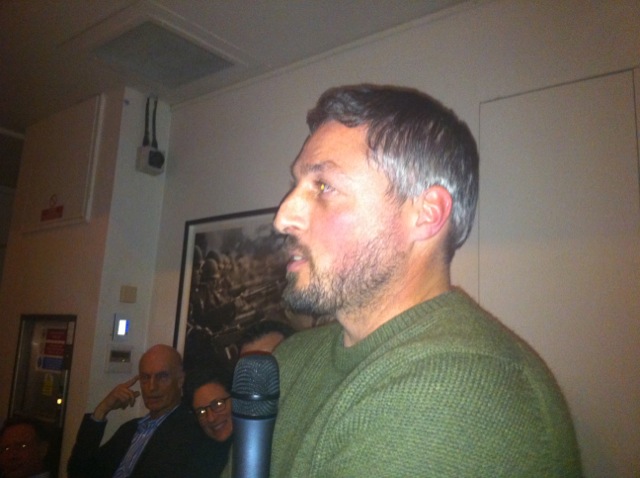
Why do you do it? Was the key question asked of Finbarr O’Reilly, a Reuters reporter featured in the film and present at last night’s screening; “I don’t enjoy being scared” he stated, and certainly the loss of friends such as Tim Hetherington has shifted his focus and left him questioning his future. But the truth is these pictures need to be taken, and as one reporter said in the film “you will never feel as alive as when you are staring death in the face.”
It seems that news agencies are finally recognizing the stresses of reporting in combat and that PTSD is a very real phenomenon among combat journalists that is starting to lose its stigma and is being accepted as reality. The nature of war reporting has changed over the years, journalists put themselves in highly volatile environments and many pay for it with their mental health and in some cases even their lives. Under Fire: Journalists In Combat is a film that addresses these issues.
]]>
Interestingly, condemnation of Berlusconi’s media involvement was not wholesale. Paolo Mancini, professor at the University of Perugia said:
“Everyone here will expect me to say one thing but I don’t think Berlusconi is controlling the media. It’s overstated.”
“Berlusconi tried to limit freedom of journalists but he did not succeed because there was the opposition press, particularly the print media,” agreed Gianpietro Mazzoleni, University of Milan academic. “RAI 3 constantly make shows that have continued to alert people against Berlusconi.”
Mattia Bagnoli, UK correspondent at the Italian news agency ANSA opposed:
“I must say he controlled much of the Italian media for a long time. We are not talking about news here but we are talking about culture and reality shows. What’s on television is a reflection of what he projects on to Italian people to enjoy life.”
“He had control in the media not only through television but also through print in the form of advertising through his company Mondadori,” he added.
As with all modern European countries, most Italians depend on television for their source of news and information. So was Berlusconi clever in choosing his medium?
Marco Niada, a former London bureau chief of the political and financial Italian daily Il Sole 24 Ore, said:
“He knows many Italian people don’t read. He thought without imposing too much influence through papers he could control them through TV. However, he started to be defeated by technology. He was still stuck to terrestrial TV and social media started to take over.”
It didn’t take long for the lurid saga of Berlusconi’s bunga bunga parties to surface. An Italian documentary director in the audience, pointed out coverage of the scandal in mainstream Italian TV media was poor, saying most people relied on the internet. Meanwhile a reporter from the Financial Times in the audience defended the Italian news output:
“Don’t make the Italian media sound clandestine. La Repubblica went all out to cover the scandal extensively for days.”
Bagnoli added, “As an Italian news agency we are obliged to cover it impartially and we did.”
The discussion swiftly moved into the future of Italian media, now that Berlusconi is gone. Bagnoli and Mazzoleni weren’t entirely optimistic, as they feel many of the Italian MPs are still linked to Berlusconi.
“Mario Monti is here just to bring the country back from default. They need to rewrite the constitution for RAI,” said Bagnoli.
“The Monti factor is crucial at this point,” said Mazzoleni. “We don’t know about the future but we can guess, Monti will take the opportunity to reform RAI but he will be cautious.”
Coming back to the question of press freedom, Hewlett asked whether a more liberal Italian media is possible in five years. Niada said, “The worst enemies of press freedom are journalists themselves, it will take more than five years.”
As the Leveson Enquiry uncovers more evidence of press corruption in the UK, these words may ring true for the British and Italian news industries alike.
]]>
Up to 346 journalist, cameraman, and fixers were killed in Iraq following the 2003 invasion.
Award winning journalist, Nikos Megrelis spent three years researching the deaths of media professionals during what was one of the bloodiest wars in history. Shooting vs Shooting tells the stories of journalists and media workers who died doing their jobs.
Megrelis investigates the deaths of two cameramen, Jose Couso and Taras Protsyuk during an attack on the Hotel Palestine on 8 April, the tragic events that resulted in the death of Al Jazeera correspondent Tareq Ayyub, the killing of ITN journalist Terry Lloyd and his interpreter, Hussein Osman outside Basra and of cameraman Mazen Dana outside the Abu Graib prison and the Al Qaeda branch execution of Italian journalist and blogger Enzo Baldoni.
With archive material, the film also features interviews with Peter Arnett, John Pilger, Michael Massing, Anthony Shadid, Chris Cramer, Kevin Sites, Philip Knightly, Aidan White, and Giuliani Sgrena.
Awards
Thessaloniki Documentary Film Festival 2011, Nomination For Best Film Award – Al Jazeera Film Festival 2011, Cinema City International Film Festival Novi Sad 2011, Best Documentary Award – Kazan International Muslim Film Festival Russia 2011
Running time: 73 minutes.
2011
]]>Last year was the year of the freelance foreign correspondent. The tumultuous events of 2011 gave freelance journalists unprecedented access to breathless, breaking news stories in the Arab world – unlike Iraq and Afghanistan, where embedding restrictions applied, freelancers were free to travel and compete on the frontline.
With the increasing attraction of becoming a foreign correspondent, last night’s Frontline Club event brought together four freelancers working in ‘Arab Spring’ countries in a workshop for budding international reporters.
Chaired by BBC Radio 4’s Paddy O’Connell, the panel consisted of Tom Finn, a journalist based in Sana’a, Yemen; Portia Walker, who covered Yemen and the war in Libya; James Longman, who worked with rebels in Syria; and Ruth Sherlock, who has spent last year chasing the Arab Spring.
PREPARATION
Body armour, Hostile Environment training and sufficient funds aside, there is little room for techno-phobes when it comes to freelancing. The long list of ‘killer’ equipment for a freelance journalist includes a smartphone, adapters, satellite equipment and a computer with a camera – as video is quickly becoming as important as writing.
“There are two really useful things a journalist can have – a Kindle, because you’ll get bored, and a converter which plugs into a cigarette lighter in a car, so you can charge anything,” adds Walker.
She, like many journalists, found the hard way that if batteries run out copy can’t be filed on time.
Being web-savvy is also essential. A thorough knowledge of software like BGAN and Tor can save time and lives, but common sense is also key.
“In Syria, one of the main reasons you are captured is to get information on people you’re working with. Keep your passwords safe,” Sherlock advised.
THE STORY
Finding an original angle can be difficult with other journalists around.
“Go to places that aren’t the biggest news story, because all the freelancers will be there. When news breaks where you are – which it will – it will force you to think of more creative ways to getting a Western reader to read,” said Finn.
“Make yourself the go-to person. Before you go to a place it’s about making the right contacts,” added Longman.
Having the right contacts – usually, relying heavily on the local population and not being afraid to liaise with fellow journalists and fixers – is key to becoming a successful correspondent, as well as knowing the country you are working in.
“If the story is really big and you are at the beginning of the game, bigger names can help. But keep your independence. I got the edge as a freelancer by being with the local community. Don’t underestimate the kindness of locals on the ground,” Sherlock said.
“You have the duty as a journalist to learn the language of the country you are living in,” added Finn.
PITCHING
According to Finn, pitching should be short and to the point.
“Get them excited, and keep it simple. An editor of the Guardian once told me, ‘let your tweets breathe’. Remember, you have a limited space to say things,” he said.
WHAT NEXT
“Don’t start with ‘I’m going to be a foreign correspondent.’ Start with ‘this country is interesting’. Have a point of view, and have a niche,” said Finn.
The freelancers agreed that anybody can buy equipment, but few are passionate enough to see it to the end. The glamorous ideal of being a foreign correspondent parachuted in and out of warzones is dead – instead, journalists have to be prepared to be in it for the long haul and push past setback after setback.
]]>“You’ve got to know your story inside out. Develop a real passion about a place. Overcome your shyness, and just go for it,” added Walker
View in iTunes
Watch the event here.
By Helena Williams
In a year where 100 journalists have been killed so far while trying to tell the story, and as the media’s coverage of events rocking the Middle East have been brought into sharp relief, it seems high time to examine the delicate relationship between ensuring the safety of journalists and being able to break the story first.
“Libya has been a very traumatic year for journalists, especially for freelance journalists. We lost three good friends,” said Inigo Gilmore, an award-winning freelance journalist who has worked in conflict zones across the Middle East, Africa and Asia.
“No one even imagined Libya would turn to this. How could we [journalists] predict what would happen on the frontline?”
Last night’s talk at The Frontline Club, ‘Reporting Conflict: Competition, pressure and risks’ highlighted the risks that journalists out in the field and news editors back in London face while attempting to break news to an increasingly demanding audience.
Chaired by former BBC executive Vin Ray, and with international editor for ITV news Bill Neely, head of international news at Sky News Sarah Whitehead, and BBC’s world news editor Jon Williams sitting on the panel alongside Gilmore, the debate focused on the difficulties of conflict reporting from opposing sides of the industry – both those commissioning journalists to go to the frontline, and the journalists themselves.
Neely, who has worked in numerous conflict zones, was adamant that the first and constant pressure of covering war did not come from newsrooms in London, but rather from the competitive nature of journalists who want to go and get the story.
The old pressures from the newsroom no longer exist, said Neely, who argued that journalists now travel to hotspots on a voluntary basis.
Journalists have to be savvy while out in the field – the rule is “don’t stay anywhere for longer than 20 minutes in a warzone,” he said – but it is also up to the editors to monitor the situation.
“Over the past 10 years editors in London understand that it’s people on the ground who have to make the decision not to go those 100 metres up the road.”
Whitehead, whose Sky News teams were hailed for their remarkable coverage from Tripoli’s Green Square during the fighting in Libya in August this year, agreed:
“You’re not there and you have to make sure they [the journalists] can make the decision. This year has been one of the most extreme and dangerous that I’ve known.
“This year I have taken people off air who have been in the middle [of reporting]. One afternoon, when a team was watching a fire fight in Tripoli, snipers opened up behind them and I pulled them off air and asked what their exit route was.
“You have to be there to be the stops if they are taken over by the story.”
While the BBC and other news organisations were criticised for failing to get equally dramatic coverage of events unfolding in Libya, Whitehead insisted that a lot of her team’s reporting was down to luck.
“[Sky News] was at the right place at the right time, and in the right frame of mind. They didn’t know where they were going to end up. A lot of people made other decisions and it was the right decisions for them.”
Williams, who has also had his fair share of managing journalists in hostile environments, said: “Risk must outweigh return, but it is a very fine balance. It’s a difficult call to go forward, and it’s just as difficult to go back. If you have the balls to go back because you don’t think it’s safe I take my hat off to you.”
Neely added: “It’s risk and reward. You have to ask yourself, ‘is it really worth that extra shot?'”
“War reporting is a mixture of judgement and luck – but you can be unlucky. For those 100 journalists this year, for one reason or another, their luck ran out.”
]]>