But rather than refer the country to its Ministerial Action Group, which deals with persistent or serious violations of the Commonwealth’s values, the 54-member body is responding to international concerns by training the country’s journalists in human rights reporting.
The move is part of a programme of constructive engagement being pursued by the Commonwealth Secretary-General’s office, which it said is producing practical outcomes.
Richard Uku, the Director of Communications and Public Affairs at the Secretariat, said there were “no discussions around relocating the 2013 CHOGM” and that “preparations remain underway” to hold the summit in Colombo as planned. Furthermore, referral to the action group, reserved for members out of step with Commonwealth principles and values was not the first option in such circumstances, Uku added.
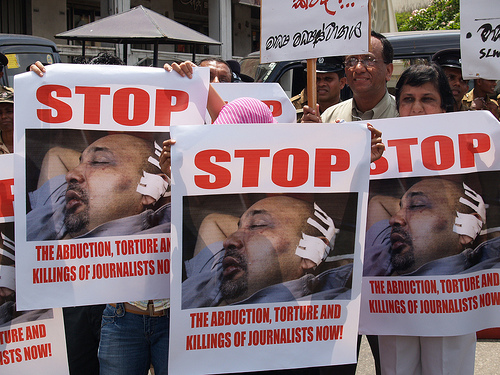
Journalism remains a dangerous profession in a country that had seen the death of one editor, Lasantha Wickrematunge, and attacks on other reporters, the most recent on 15 February, where a journalist looking into corruption was shot and seriously wounded.
Human Rights Watch and the International Crisis Group have also called for Sri Lanka’s referral to the Commonwealth Ministerial Action Group (CMAG) over its delay in implementing the 2011 Lessons Learned and Reconciliation Commission (LLRC) report. Both organisations recently published reports detailing alleged human rights abuses, including sexual violence, and worries over the independence of the judiciary.
The LLRC, signed by President Mahinda Rajapaksa, promised greater autonomy for the Tamil population following its comprehensive defeat of the Liberation Tigers of Tamil Eelam (LTTE) by Sri Lankan armed forces in 2009.
The UN estimated that between 40,000 and 70,000 civilians died during the final stages of the war, and recently new photographs have emerged that appear to show the execution of a 12-year-old boy, the son of a Tamil Tiger leader. The images form part of a documentary called No Fire Zone, released to coincide with the UN Human Rights Council (UNHCR) meeting now taking place in Geneva. A Sri Lankan army spokesman said the country had been a repeated victim of “lies, half truths, rumours, and numerous forms of speculations”.
What happens next?
The US is sponsoring a resolution at the UNHCR meeting, backed by the UK, expressing concerns of continuing human rights violations and threats to judicial independence, one year after both countries backed a similar move.
Desmond Tutu, Nobel Peace Prize laureate, and Mary Robinson, former Irish president, together described the situation as a ‘test’ for the Council. In a jointly written article for The Times of India, they said:
“Other crises have flared in the past year: Syria and Mali . . . rightly feature high on the Council’s agenda. The case of Sri Lanka offers a different test: of the Council’s ability to hold governments accountable when global attention has turned elsewhere.”
UK Foreign Office minister Alistair Burt said in a twitter Q&A last month that Sri Lanka should “live up to its commitments as a Commonwealth member”. His words drew an angry response from journalist Frances Harrison, who covered the country for four years as a BBC correspondent.
“It is shocking if the Commonwealth Heads of Government meeting takes place in Colombo – it sends a message that this is a club of countries that cares not a fig about crimes against humanity,” Harrison said.
Harrison, author of Still Counting The Dead, criticised both the LTTE and the Sri Lankan army in her book for alleged abuses of international laws governing conflict.
Meanwhile Indian diplomats must calculate whether to risk upsetting Colombo by backing a strong US resolution or incur the ire of Tamil Nadu politicians by ignoring their demands.
The Commonwealth Secretariat is engaged in a ‘partnership’ that includes support for the Human Rights Commission of Sri Lanka, and is, according to Mr Uku “exploring options to provide technical support to the HRCSL in staff training; expanding training of police personnel on human rights obligations; enhancing the training of journalists on human rights reporting; bolstering capacity to be involved in national reconciliation processes; and strengthening capacity to investigate human rights abuses”.
However, the Commission’s independence is unclear – according to the 1996 Act of Parliament that established the body, the chairman is a Presidential appointee.
A UK Foreign Office spokeswoman added that no decision has yet been made on attendance at the forthcoming Commonwealth meeting, saying that while the LLRC left a number of gaps and unanswered questions, the UK expects the Sri Lankan Government to implement its recommendations ‘in full’.
]]>Speaking at yesterday evening’s Frontline Club event on the pressures of reporting conflict, Jon Williams said officials at the Foreign Office were concerned that they could not guarantee the safety of journalists on the ground.
Williams playfully described the advice as “very generous”, but said broadcasters told the Foreign Office that they would “accept responsibility” for having their journalists report from dangerous locations.
Williams also claimed there were “lots of hints from the British” that BBC Correspondent Jeremy Bowen’s interview with Colonel Gaddafi in February “really wasn’t very helpful”.
NATO officially took control of all aspects of the military campaign in Libya on 31 March although British, French and US airstrikes had begun on 19 March two days after UN Resolution 1973 had been passed.
The resolution called for a no fly zone and measures to protect the civilian population from Colonel Gaddafi’s forces.
]]>
The Red Cross and the UK Foreign Office launched a campaign this week looking at the Geneva Conventions some 60 years on. Of particular interest to Frontline Club members and blog readers is the question of how to protect of journalists,
It is important that the media are able to report the true picture of a conflict situation. But this often involves journalists putting themselves in dangerous situations.
The Geneva Conventions already clearly define the protection journalists are entitled to in their capacity as civilians within the conflict. This was re-emphasised in the First Additional Protocol of 1977.
But how can we ensure that journalists are protected? link
Photo: Protest against abduction and assault of journalist Keith Noyahr taken by Free Media Movement.
]]>