Food Chains examines the relationship between the policies of corporate supermarket chains and the working conditions of American farm labourers who pick the produce that is distributed across the nation. Featuring Eric Schlosser, author of Fast Food Nation, and actress and advocate Eva Longoria, this award winning documentary exposes the horrific abuses farmworkers face and reveals the forces behind that exploitation: the $4 trillion global supermarket industry.
The film tracks the Coalition of Immokalee Workers, an intrepid and highly lauded group of tomato pickers from Southern Florida, as they battle the giant Floridian grocery chain, Publix. Their story is one of hope and promise for the triumph of morality over corporate greed – to ensure a dignified life for farmworkers and a more humane and transparent food chain.
Food Chains was nominated for a 2015 James Beard Foundation award for food journalism.
Directed by Sanjay Rawal
Producer: Eric Schlosser
Executive Producer: Eva Longoria
Duration: 86′
Year: 2014
Food is on the agenda this year. The recent horse meat scandal has left many people questioning where their food comes from, and in the lead up to the G8 summit a coalition of aid agencies has launched The Enough Food For Everyone IF campaign.
With extreme weather leading to failing harvests and rising food prices, food security is one of the biggest problems facing governments today. The IF campaign has highlighted four areas that they believe can help tackle hunger: aid, tax, land and transparency.
One billion people go to bed hungry every night and two million children die from malnutrition every year. We will be joined by those involved in the campaign and others to break down the problems with our food system and ask what can be done to fix it.
Chaired by Paul Vallely, a leading writer on development, he is associate editor of The Independent where he writes about ethical, cultural and political issues. He has previously reported from over 30 countries and was the Africa correspondent for The Times. He has written a number of books including Bad Samaritans: First World Ethics and Third World Debt, Promised Lands and he ghost-wrote Bob Geldof’s autobiography, Is That It?.
The panel:
Paul McMahon has worked as an advisor on sustainable food systems to environmental charities and UN agencies. He co-founded and now helps run SLM Partners, a business that invests in sustainable agriculture. He is the author of Feeding Frenzy: The New Politics of Food.
Mike Lewis leads ActionAid UK’s policy work on tax in the developing world. He was previously a UN sanctions investigator and member of the UN Panel of Experts on Sudan. He has a background in NGO research on tax, financial transparency, human rights and the role of business in conflict.
David Bull joined UNICEF UK (United Nations Children’s Fund) as Executive Director in 1999 and since the the charities income has trebled. He has travelled to scores of countries to advocate for children caught in conflict or in silent emergencies.
Mary Creagh is Labour MP for Wakefield and Shadow Secretary of State for Environment, Food and Rural Affairs.
]]>Can the world feed itself? When the food system began falling apart in 2008, rich countries started buying up and leasing fertile tracks of the developing world. In 2009 alone, nearly 60 million hectares – an area the size of France – was purchased or leased in Africa.
In Land Rush directors Hugo Berkeley and Osvalde Lewat look at the situation in Mali where 75% of the population are farmers, but rich, land-hungry nations like China and Saudi Arabia are leasing land in order to turn large areas into agribusiness farms. American sugar developer Mima Nedelcovych’s wants to deliver change through his ambitious scheme, Sosumar. Unlike some of his competitors he considers the involvement of the local communities as key to the project’s success. However, many in the community remain unconvinced and see the plantation as nothing short of a neo-colonial outpost.
As Mali experiences a military coup, the developers are scared off – but can Mali’s farmers combat food shortages and escape poverty on their own terms?
Directed by Hugo Berkeley & Osvalde Lewat
Duration: 58′
Year: 2012
]]>

The Frontline is a busy place – and though some might slow down during the summer months it’s as exciting as ever at Norfolk Place and we’ve got some great events and plans for the coming months. Here’s what’s going on:
The finest food and wine
We pride ourselves on serving the best food made from the finest homegrown ingredients from the Frontline’s own Norfolk farm – check out the latest menu here to see what’s cooking. As always, food can be ordered in our members’ club room.
And for a special treat, why not join us for a food and wine tasting evening with wine expert Malcom Gluck on thursday 15 July – all the details and the mouthwatering five-course menu can be seen here.
Weekend openings
To make the most of the long nights, the club room is now open and serving food on Saturdays, so get in touch to book your table now
Great debates
Our unique series of talks and panel discussions continues throughout summer: coming up are fascinating talks on Iran, US politics and the Israel/Palestine conflict, with many more to be announced soon. Keep checking Frontlineclub.com/events and subscribe to our weekly email newsletter (sign up here) to stay up to date.
And our series of fantastic film screenings continues apace too, including Sergio, which tells the story of a Brazilian United Nations diplomat killed by an explosion in Iraq.
You can catch up on any events you miss at our Forum blog and our podcast on iTunes.
Coming soon: the Liberation season
In the coming weeks the club will kick off a season of talks and film screenings centred around the themes of human rights, civil liberties and protest. Watch this space…
]]>
Ozone is a quiet place these days. Ever since the US embassy in Khartoum warned its citizens to avoid places where expats tended to gather there have been fewer white faces here at the world’s best coffeeshop on a roundabout. Ozone is a particular target apparently.
People are on tenterhooks waiting for the International Criminal Court to issue an arrest warrant for Omar al Bashir. Will the government kick out NGOs? Will it make life more difficult for the UN? Will there be anti-Western demos?
No-one really knows. There seems to be a degree of embarrassment that the international contingent overreacted last July, when the ICC prosecutor presented his evidence to the judges. Non-essential staff were brought back from Darfur, dependents sent home and anyone with a hatch battened it down. In the end precious little happened. The government tested the water with a few unsourced or arm’s length comments and that was that. So this time everyone is talking about “business as usual” and wondering when the indictments will come. Staff at the US embassy have a sweepstake running on the date.
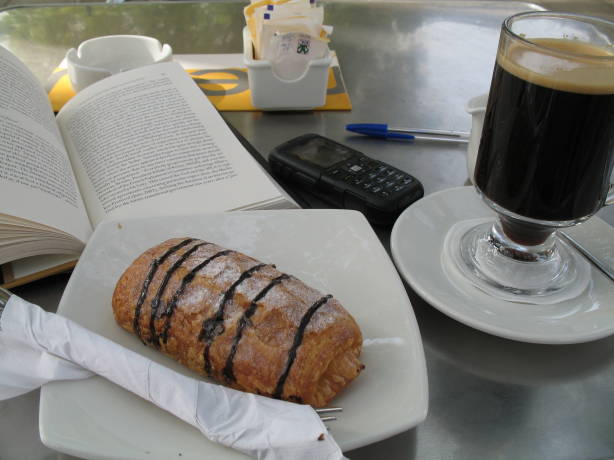
In the meantime, Ozone is quiet and the chocolate croissants remain sublime.
Ozone is a quiet place these days. Ever since the US embassy in Khartoum warned its citizens to avoid places where expats tended to gather there have been fewer white faces here at the world’s best coffeeshop on a roundabout. Ozone is a particular target apparently.
People are on tenterhooks waiting for the International Criminal Court to issue an arrest warrant for Omar al Bashir. Will the government kick out NGOs? Will it make life more difficult for the UN? Will there be anti-Western demos?
No-one really knows. There seems to be a degree of embarrassment that the international contingent overreacted last July, when the ICC prosecutor presented his evidence to the judges. Non-essential staff were brought back from Darfur, dependents sent home and anyone with a hatch battened it down. In the end precious little happened. The government tested the water with a few unsourced or arm’s length comments and that was that. So this time everyone is talking about “business as usual” and wondering when the indictments will come. Staff at the US embassy have a sweepstake running on the date.
In the meantime, Ozone is quiet and the chocolate croissants remain sublime.

So Friday saw me in Kisumu, on the shores of Lake Victoria, and I’m a great believer in the Catholic/Luo tradition of taking fish for my lunch on such occasions. OK so it wasn’t exactly Superfish, or as tastable as Omdurman’s fish breakfast, but the tilapia wasn’t bad and the batter was pretty crispy. That said, I wasn’t so keen on the curry paste under the batter. The Blue Band margarine on the vegetables was also a bit of a disappointment. But it was fish and chips. And that has to be a good thing.
]]>
In his tiny one-room shack in a Kenyan slum, John Kilonzo and his family are the new faces of urban poverty – squeezed by rising food prices and trapped by disease. Hunger is stalking Nairobi’s shanty towns just as it stalks the parched pastures of the north and the overcrowded farmland of the west.
“Things are very expensive at the moment,” says John, wheezing with Tuberculosis, the medieval disease that clings on to the destitute in the 21st century. His surname means “big noise” in his tribe’s language, but it’s all he can do to whisper. “I go to the market when I have money. I buy whatever food I can with the money I have.”
That means buying in bulk to get a better price. Where once 200 shillings (about £1.50) would see him come home with 16 cabbages, these days he is lucky to buy six. His wife is out at a neighbour’s “borrowing” maize meal to make ugali, the staple of Kenyan life. One of his sons appears at the door with a bowl of beans donated by another friend. It is 3pm and no-one – not one of his six children – has had their first meal of the day.
His family suffered badly in Kenya’s post-election violence. John is from the Akamba tribe, who became targets of opposition supporting thugs when their big man, Kalonzo Musyoka, sided with President Kibaki. The family’s house was burned down and they lost most of their possesions, including a TV. It is a reminder that – despite appearances – life in the slums was often bearable for families seeking work in Nairobi. That was before mobs went on the rampage and the cost of living began rising rapidly.
Things have slowly begun to ease for Kenya’s urban poor. Fuel prices are creeping down as the global credit crunch puts brakes on growing economies – but the fear is that developed countries will now cut back on aid as they watch their revenues decrease. For now though the credit crunch seems rather like a bad joke when viewed from the narrow, muddy alleys of Mathare.
“We feel bad and bitter that we don’t get any food when we know that people outside the cities are being given food,” says John. “Here I don’t see anything getting any better.”


For much of the 1980s I simply refused to smile. My country was being wrecked by Thatcherism, the pits were shut down and four million people were thrown on the scrapheap. The least I could do as I caught the bus from Royal Tunbridge Wells to my school (best A-level results for any Brit state school in my year, incidentally) was to scowl. Having fun would have let down my comrades. Made no difference it turns out. And the miners never even thanked me.
I was reminded of my stance by a thread on the excellent Pyjama Samsara blog, where Vasco – an Aussie aid worker – is threatening to adopt a diet of ugali and githeri in sympathy with Kenya’s hungry following a decadent night of cheese and wine…
Last night, I looked at the price tag on the box of camembert. 310 Kenyan shillings, or about USD5. Then I realised with some embarrassment that it was about the same as a day’s wage at the minimum wage in Kenya. But many people earn less. The groundsman at our block of flats only earns 200 shillings per day.
Predictably it has generated a fair few comments. It’s the sort of thing that we expats spend a lot of time discussing – usually during the wine and cheese course at a dinner party. House girls, shamba boys and ayahs are all discussed by people claiming to be liberals but having no awareness of the language they are using.
My own response has been sharpened by a conversation with an aid worker friend. When I expressed mild surprise that a woman living alone needed a live-in servant housekeeper, she pointed out that the housekeeper needed the job to afford her housekeeper.
But possibly the best thing I have read on this sort of topic recently is Michela Wrong in the New Statesman, who has that startling habit as a columnist of making me see familiar questions in a totally new way. Recently she was writing about a young western woman who asked whether she was doing the right thing in visiting Rwanda…
I suspect she was simply giving expression to classic western liberal unease over the gaping north-south divide. Even before flying in, she could imagine what it would feel like to be sitting in her Land Cruiser, a carefully moisturised, well-fed, urban white woman, watching a skinny Rwandan peasant hoeing his plot in the sun. He would probably be sweating, the kids would certainly be snotty, and someone would probably beg for money. And she cringed.
The conversation confirmed an opinion that has crystallised over the past few years: if, as a westerner, you are going to visit Africa, the earlier in your life you do it, the better. By the time you are in your twenties, your head is so stuffed with preconceived opinions, mostly of the ethic ally self-flagellating variety, you can barely see, let alone interpret, what is going on outside you.
To be honest I’ll never get used to people opening gates for me, saluting in car parks and carrying my bags. The amount of money I spend on dinner (not to mention catfood – for my cat) is obscene compared with average salaries. But eating ugali and githeri doesn’t actually change anything other than assuage guilty feelings developed by growing up comfortably middle class. And it would put the nice waiters at Java and Tamarind out of business. Yes, I know that’s a convenient excuse – but just ask the miners that I failed to save.
]]>
Among many of the titbits of useful advice I picked up as I worked my way through Britain’s regional newspapers was one that has caused me no end of trouble. “Rob,” one of the old hands at The Herald (I should point out this is a Scottish national paper – not a British regional paper) said, “The stories that you don’t write are just as important as the stories you do write.”
The job of a journalist, he went on to explain, is to sift through the assorted rubbish that arrives each day and work out what is true, what is important and what is news. Everything else could be passed over with a dismissive, “The Scotsman might do this tomorrow but frankly it’s bullshit,” to the news editor.
Sound advice. But it has been causing me problems as a freelancer sitting several thousand miles away from the foreign desk. The issue is that a quiet word in the ear of my foreign editor that such and such a story is rubbish, doesn’t stop some hotshot writer from London bigfooting me or another freelancer offering said story to the desk. Often the first I’ll know about it is reading my own paper online.
I raise this now because I deliberately haven’t written about the “impending famine” in Ethiopia. Charities have been taking journalists on junkets to view stick-thin children and talking up the crisis in terms of global warming and natural disasters. This was not enough for me. If I was going to write about an Ethiopian hunger I wanted to discuss the country’s expensive wars in Somalia, Ogaden and Eritrea, its abuse of human rights in Ogaden and its denial of drought. That was the way the to do the story properly.
Meanwhile a steady stream of wannabe Michael Buerkes was filing stories such as this, in my own paper:
Surprisingly, when The Times visited the region, the fields were alive with maize and most afternoons a warm rain fell. “Here the problem is acute,†said Jean de Cambry, the emergency co-ordinator for Médecins Sans Frontières in southern Ethiopia. “It is very surprising and very strange, because everything is so green. But food stocks at household level are empty or close to empty.â€
Or this imaginative way of producing a famine story in the LA Times:
They call it the green hunger. Four-foot cornstalks sprout from rain-soaked earth, and wind billows fields of teff, the staple Ethiopian grain. Goats and cattle are getting fat on lush grasses — but the children are still dying.
Each time these stories appeared I would call colleagues to ask whether it was time to go to Ethiopia. Each time they said not yet – including one TV reporter who had just filed a harrowing account of children starving, but had to admit it wasn’t really as bad as all that. A day’s filming was canned because the area was too green.
So it wasn’t a massive surprise when I received the following press release from the Irish aid agency Goal:
Ann Bourke, one of the most experienced of GOALâ€
s field personnel, reported with optimistic news from Ethiopia today. Ann stated that the interventions of aid agencies such as GOAL, and fact that it has started to rain have had very beneficial effects on the famine in Ethiopia. Although it is too early to be sure, indications are that a major famine may have been adverted.
This is clearly great news for the people of Ethiopia. And it is still early days. And maybe it was the reporting and PR work by charities that averted a crisis. But at a time when fundraisers complain about compassion fatigue could it be another example of journalists putting their critical faculties to one side in favour of reporting a worst-case scenario peddled by NGOs with an interest in collecting cash? Did we jump when they cried wolf? I wasn’t the only Nairobi-based reporter who decided not to go to Ethiopia, only to see a colleague based on another continent file an “Ethiopia Starves” piece.
It all reminds me of another piece of advice I picked up at The Herald, where the editor was fond of shooting down stories in conference with a terse: “That might be what they say, but is it true?”

The biotech debate has been rumbling along nicely in Africa recently. A couple of days ago William Ruto, Kenya’s agriculture minister, said he planned to allow the planting of genetically modified crops as the best way to improve yields. Then this morning the UK’s former chief scientist, Professor Sir David King, warns that environmental activists are preventing Africa from feeding itself by turning the continent against biotech.
“I’m going to suggest, and I believe this very strongly, that a big part has been played in the impoverishment of that continent by the focus on nontechnological agricultural techniques, on techniques of farming that pertain to the history of that continent rather than techniques that pertain to modern technological capability. Why has that continent not joined Asia in the big green revolutions that have taken place over the past few decades? The suffering within that continent, I believe, is largely driven by attitudes developed in the West which are somewhat anti-science, anti-technology – attitudes that lead towards organic farming, for example, attitudes that lead against the use of genetic technology for crops that could deal with increased salinity in the water, that can deal with flooding for rice crops, that can deal with drought resistance.â€
Africa has long been looking for its own version of the Green Revolution. Professor Sir David is not the first to suggest that modern biotech has a role to play in reducing Africa’s hungry. And I spent the weekend visiting one project that could well turn out to become a model for the continent…
A yellow revolution is sweeping through the poverty-riddled farmsteads of the Central Kenyan highlands. Neat rows of coffee bushes that once dominated the landscape are being replaced by 21st-century biotech farming techniques – tissue-culture bananas.
The farmers I met in Central Province couldn’t have been happier with their new bananas, citing improved productivity and profits. But they had been sceptical at first and needed convincing that they weren’t having GMOs foisted upon them.
But the impression I came away with was that the technology was only part of the solution. As well as raising banana plants that had been cultivated in the lab, Africa Harvest and Technoserve, the two organisations behind the project, had ensured that farmers were using the most effective farming methods available – growing their trees in manure and mulch-filled trenches – and that they had a product that could be marketed.
All the farmers I met could list a dozen different wonder crops that had been touted as the latest way of feeding Kenya and making big profits. Each time they ended up with piles of avocados, maize, pineappples that they couldn’t shift.
This time they are organised into loose co-operatives that cut out the middlemen – the bane of African agriculture.
Moses Kinyanjui Kangethehas has already ripped up his coffee plantation to make way for the new crop. “Coffee will go just like other things have disappeared,†he said. “Bananas are here to stay.â€
Biotech has its place in modern agriculture. But it is not the only answer. As an undergraduate in the Department of Genetics at the university where Professor Sir David earned his bread and butter, I remember learning how much of India’s Green Revolution was a mirage. It relied on huge inputs of fertiliser and pesticides, turned agriculture into a series of monocultured crops where disease could prosper and simply stored up problems for the years to come.
Biotech – including GMOs – carries risks, both environmental and social (increasing reliance of farmers on agribusiness for example). But the question has to be whether that risk is worth taking. Unfortunately the debate is dominated by voices that have adopted a different ethical framework, and taken an absolutist position. For them, no GMOs should be used ever, under any circumstances.
This was once my position too. But now it seems absurd to rule out technologies that could offer an escape from hunger and poverty for millions of people. Unfortunately too often it seems that the debate is driven by ideologies formed in the west where the modern notion of the left is assumed to equate with being green. What happened to notions that economic development and technological progress could empower ordinary working people? Such views seem unfashionable now, dumped in the mid-late Twentieth Century. But maybe that’s where the debate within Africa today.
Anyway, that’s an aside. I’m still sceptical that GMOs and modern technology will feed Africa. Kenya for example is hungry because of decades of corruption, lack of proper leadership and a refusal to invest in crucial infrastructure. Those problems need to be tackled first. Without that, technological fixes can go only so far. But it is desperately selfish for affluent Westerners who view poverty through the filter of the Sunday colour supplements to rule out the use of cutting edge science in the battle to end world hunger.
Keeping Africa stuck in the stone age is bullshit. But if you’re into organic farming I guess that’s the point.