A Byline Event – join us for a screening of a unique film which explores the role of Cambridge Analytica in the Brexit vote and election of Donald Trump, followed by an update on recent developments with the pioneering Observer journalist Carole Cadwalladr, since her story broke two months ago. We are also joined by director Thomas Huchon and CEO of Byline Peter Jukes.
Donald Trump became the 45th President of the United States by winning three key states, a victory engineered by an ultra-conservative faction that quietly mapped its way to power using fake news, lies and psychometrics.
This explosive documentary follows the money to the reclusive multi-billionaire Robert Mercer, who bought Breitbart News and funded the effort while inserting Steve Bannon into the presidential campaign as its manager. Using data of millions of Americans acquired from Facebook, Google, banks, credit companies, social security and more, Cambridge Analytica, another Mercer-owned company, used tactics honed during the UK’s Brexit campaign to identify voters deemed “most neurotic or worried,” whom they believed could swing for Trump. In the days before the election, using “dark posts,” a little-known Facebook feature, they deployed highly manipulative and personalized messages that could be seen only by the user before disappearing.
In the darkness of the web, democracy was trumped by data.
As this is a third party event, tickets available through EventBrite
Run Time: 1 hr 15 mins
]]>https://soundcloud.com/frontlineclub/the-trade-off-individual
Privacy of the individual, secrecy of the state and national security have been in sharp focus in past weeks due to the leak of material from the US’s National Security Agency (NSA).
It has been revealed that under the so-called Prism programme millions of phone calls have been gathered and Internet use has been monitored on a massive scale. In the UK there are suggestions that the Government Communications Headquarters (GCHQ) has also accessed the material.
The chairman of the Intelligence and Security Committee, Conservative MP Sir Malcolm Rifkind, told BBC Radio 4’s Today programme “in order to protect the public that does require, as President Obama said in Washington, some intrusion on privacy in certain circumstances”. The murder on 22 May of Drummer Lee Rigby reignited calls for the draft communications data bill to be re-examined.
As the debate about individual privacy, state secrecy and national security continues, we will be joined by a panel of experts to ask whether it is possible to strike a balance. Are we moving towards a surveillance state or is the idea of online privacy a myth?
Chaired by Mark Urban, diplomatic and defence editor for BBC Two’s Newsnight. He is the author of several books including Big Boys’ Rules: The SAS and the Secret Struggle Against the IRA, The Tank War and Task Force Black: The explosive true story of the SAS and the secret war in Iraq.
The panel:
Sir Malcolm Rifkind is MP for Kensington and chairman of the Intelligence and Security Committee. In 1990 he became Secretary of State for Transport and in 1992 Secretary of State for Defence. From 1995-97 he was Foreign Secretary. He was re-elected as a Member of Parliament in May 2005 for Kensington and Chelsea. He was elected as Member of Parliament for Kensington in May 2010. He served as the Shadow Secretary of State for Work & Pensions and Welfare Reform until December 2005.
John Kampfner is adviser to Google on freedom of expression and culture. He is an author, broadcaster and commentator specialising in UK politics, international affairs, media and human rights issues. Previously he served as chief executive of Index on Censorship from Sept 2008 until March 2012 and was editor of the New Statesman from 2005-2008. He is the author of a number of books including, most recently, Freedom For Sale.
John Naughton is a senior research fellow at CRASSH, emeritus professor of the public understanding of technology at the Open University, vice-president of Wolfson College, Cambridge and an adjunct professor at University College Cork. He is director of the Wolfson Press Fellowship Programme and a well-known newspaper columnist, writing the Observer’s Networker column. He is author of a well-known history of the Internet A Brief History of the Future and most recently From Gutenberg to Zuckerberg: what you really need to know about the Internet.
Helen Margetts is the director of the Oxford Internet Institute (OII), a department of the University of Oxford investigating individual, collective and organisational behaviour online. Her research focuses on digital governance and politics, investigating the dynamics of online relationships between governments and citizens, and collective action on the Internet. She is the co-author of Paradoxes of Modernization: Unintended Consequences of Public Policy Reform; The Tools of Government in the Digital Age; and Digital Era Governance: IT Corporations, the State and e-Government. She currently holds an ESRC professorial fellowship entitled The Internet, Political Science and Public Policy, is editor-in-chief of the journal Policy and Internet and sits on the Advisory Board of the Government Digital Service in the Cabinet Office.
]]>New tools were used to disseminate traditional military messages with little regard for a new online culture of communication.
How times have changed.
Nearly four years later, the IDF’s social media strategy is much more sophisticated, offering online audiences regular and engaging updates on the progress of Israel’s military activities in Gaza – Operation Pillar of Defense.
Comparing 2009 with 2012: YouTube and Twitter
The differences are striking. In the 2009 post, I included a link to this YouTube video:
As I noted at the time, this bland ‘press statement’ delivered by Capt. Benjamin Rutland takes place in a washed out ‘non-place’ with the Israeli flag propped up against the wall. Not exactly engaging content.
It’s a far cry from the IDF’s most recent YouTube videos which now include short, snappy infographic explainers:
And dramatic images of “precision strikes” in which the viewer is on-board with the missile, transported to a video-game like first person perspective:
(These videos offer a compelling illusion – apparently taking the viewer closer to the conflict, but at the same time distancing the viewer from the human cost as airstrikes appear to primarily affect buildings, infrastructure or only the most ‘evil’ of enemies.)
Back in 2009, Twitter was mainly used as a way of linking to exceptionally dry updates on the IDF Spokesperson blog which were often written in impenetrable military jargon. On both the blog and the Twitter feed there was little evidence of the IDF trying to influence, drive and engage in the conversation around the conflict.

Now the IDF Twitter feed is being written in plain English. What’s more, the IDF is using hashtags (#IsraelUnderFire), encouraging Twitter users to retweet their content and creating imagery that the IDF believe will be circulated by online communities.
It is also posting all manner of facts and figures and commenting on the issues which might affect the outcome of the battle for public opinion.
From 2009 to 2012: The IDF’s social media learning curve
In 2009, Noah Shachtman revealed in Wired just how ad hoc the planning for the social media element of the information war had been during Operation Cast Lead, describing the IDF’s YouTube campaign as “off-the-cuff” – a last-minute idea by a group of “twenty-something” soldiers.
Shortly after Operation Cast Lead, the IDF’s Twitter fell silent for 179 days and only began updating again in August 2009. In December, Haaretz reported that a new media unit would be set up to engage online audiences on Facebook, YouTube and Twitter.
In the three years since then, the IDF has clearly revisited its approach to social media. According to Reuters the Israeli foreign ministry invested $15 million dollars in social media in 2010 and although the IDF was still learning it was notable that their YouTube channel was beginning to attract the attention of news journalists by the time of the Gaza flotilla raid in May 2010.
A ‘behind-the-scenes’ TV report demonstrated how the online presence of IDF Spokesperson was updated by a fully operational “New Media desk” by 2011.
Communicating conflict: The blurring boundaries
The 2012 online media campaign for Operation Pillar of Defense is undoubtedly a significant ‘improvement’ in Israel’s attempt to communicate their version of the conflict using social media tools. But challenges remain.
In particular, the use of Twitter more explicitly blurs an already blurred boundary between psychological operations and public information campaigns.
In the last few days, the IDF has addressed all manner of online audiences with its Twitter feed.
Some updates are probably designed to be picked up by journalists – announcing the onset of the airstrikes via Twitter rather than in a news conference was an interesting departure, but hardly surprising given the widespread adoption of Twitter by journalists at media organisations.
A tweet on Sunday was even more obviously directed at journalists:
Advice to reporters in #Gaza, just like any person in Gaza: For your own safety, stay away from #Hamas positions and operatives.
— IDF (@IDFSpokesperson) November 18, 2012
The IDF’s Twitter feed is also trying to leverage an active online community which is supportive of Israel’s goals by producing content which can be disseminated online through retweets on Twitter and sharing on social networks. Other content, such as the YouTube explainers, can be seen as an attempt to convince sceptics of Israel’s military operation.
These activities might all fall into the remit of public information campaigns, but at the same time the account is being used for purposes which could be viewed as a function of psychological operations.
One IDF tweet issued a warning to Hamas operatives and as Stuart Hughes pointed out on the BBC’s College of Journalism blog the IDF’s Twitter account has attracted the attention of Hamas’ military wing, the Al-Qassam Brigades.
It is no longer unusual for a war of words on Twitter to accompany armed confrontation. (See also: ISAF Media vs the Taliban and the Kenyan Army vs Al Shabaab.)
Communicating messages successfully to different audiences in the same space is problematic, particularly when the ‘audience’ can write back. Critics have argued that the IDF’s Twitter feed is a distasteful addition to an immoral military campaign. The Now Lebanon blog, for example, headlined a post with the title: ‘IDF cheerily live-tweets infanticide‘.
And the unanswered question is this: what difference, if any, will the IDF’s more coherent approach to social media make?
A template for the future?
It is perhaps too soon to make a judgement, but the IDF’s social media campaign in support of Operation Pillar of Defense might prove to be a template for future information operations online as militaries attempt to influence a more fiercely contested informational battlespace.
In 2010, Lt. Gen. W. Caldwell, Dennis Murphy and Anton Menning published an article in the Australia Army Journal in which they suggested that the US military could learn from the IDF’s use of social media.
I think they were wrong then in relation to the Gaza conflict in 2009, but they might have subsequently been proved right by events in 2012.
]]>
In Iran it is reported that the government are building a national intranet that adheres to Islamic values and is isolated from the World Wide Web, in the UK the government is proposing a communications bill that will see an increase in monitoring of emails and social media by the police and intelligence agencies'.
With companies' interests lying in the commercial gains of data and governments' in the ability to monitor populations, join us as we ask to whose hands internet governance should be entrusted.
]]>
In Iran it is reported that the government are building a national intranet that adheres to Islamic values and is isolated from the World Wide Web, in the UK the government is proposing a communications bill that will see an increase in monitoring of emails and social media by the police and intelligence agencies’.
Authoritarian states have long seen the freedom of the internet as a threat and have tried to restrict it, but recent develops suggest a move towards increased tracking and control of what the public do and see online across the world.
With companies’ interests lying in the commercial gains of data and governments’ in the ability to monitor populations, join us as we ask to whose hands internet governance should be entrusted.
Chaired by Kirsty Hughes, the Chief Executive of Index on Censorship – an international freedom of expression non-governmental organisation. Previously she has worked at Chatham House, IPPR, the European Commission and most recently she was head of Global Public Policy and Advocacy at Oxfam and Senior Associate Fellow at the Centre for International Studies, University of Oxford. Twitter: @IndexCensorship
With:
Birgitta Jónsdóttir MP, a member of the Icelandic Parliament for The Movement and chairperson of the International Modern Media Institution. She has worked as a volunteer for various organisations including WikiLeaks, Saving Iceland and Friends of Tibet in Iceland. Prior to becoming an MP she has been an activist, writer, first icelandic woman to work as web developer and publisher. Twitter: @birgittaj
Jacob Appelbaum, an accomplished photographer, software hacker and world traveler. He works as a developer for The Tor Project and trains interested parties globally on how to effectively use and contribute to the Tor network. He is a founding member of the hacklab Noisebridge in San Francisco where he indulges his interests in magnetics, cryptography and consensus based governance. He was a driving force in the team behind the creation of the Cold Boot Attacks; winning both the Pwnie for Most Innovative Research award and the Usenix Security best student paper award in 2008. Additionally, he was part of the MD5 Collisions Inc. team that created a rogue CA certificate by using a cluster of 200 PlayStations funded by the Swiss taxpayers. The “MD5 considered harmful today” research was awarded the best paper award at CRYPTO 2009. Twitter: @ioerror
Karl Kathuria, an independent media technology consultant, specialising in Internet distribution and streaming media. Prior to this, he spent over 10 years at the BBC, managing the distribution of World Service Internet content to a global audience. In this role, he faced the challenge of delivering news content into countries where censorship is prevalent. As a result of these efforts, he was invited to the Munk School of Global Affairs in Toronto to work with the Citizen Lab team in 2011 on an independent research project. During this period, he studied the effects of the BBC’s content distribution strategies in China and Iran, and made recommendations for the propagation of circumvention software into these markets. His current projects include working with Psiphon Inc., the Canadian provider of network software aimed at preserving security, privacy, and access to content that may otherwise be blocked.
Dr Ian Brown, associate Director at the Cyber Security Centre and Senior Research Fellow at Oxford Internet Institute (OII). His work focuses on public policy issues around information and the Internet, particularly privacy, copyright and e-democracy. He also works in the more technical fields of information security, networking and healthcare informatics. He has consulted for the US Department of Homeland Security, JP Morgan, Credit Suisse, Allianz, McAfee, BT, the BBC, the European Commission, the Cabinet Office, Ofcom, the National Audit Office and the Information Commissioner’s Office.
]]> Allen subsequently complained to the British Army indicating that Wilson should be "disciplined".
 ]]>
By Nicole Hunt
All eyes will be on newly-elected French President François Hollande and the euro zone this week, kicking off with a meeting of euro group finance ministers in Brussels on Monday ahead of a wider ECOFIN meeting on Tuesday. Hollande has previously talked about renegotiating the EU stability treaty, but with his government not quite officially in office yet, the mood at the meetings is likely to be somewhat uncertain.
Gulf leaders gather in Riyadh for the annual Gulf Cooperation Council summit on Monday, with Syria and Iran likely to feature prominently on the agenda. The leaders of Bahrain, Kuwait, Oman, Qatar, Saudi Arabia and the UAE are also expected to discuss proposals for a political federation that would see the group share foreign and defence policies, according to Saudi Foreign Minister Prince Saud al Faisal.
In Vienna, Iran begins two days of talks with the International Atomic Energy Agency (IAEA). The talks follow IAEA visits to Iran in January and February this year, and come ahead of the resumption of P5+1 discussions in Baghdad on 23 May.
Tuesday is the big day! Hollande is sworn in as President at the Elysée Palace in Paris in the morning, and one of his first orders of business will be to fly to Berlin to meet with Chancellor Angela Merkel. Meanwhile, France’s national statistics institute releases preliminary figures for quarterly growth, job creation and labour activity, which will give the new president a better idea of the current state of the economy. On top of that, Greek, German and euro zone first quarter GDP figures are also out.
If anyone doesn’t feel like discussing European economic prospects, they might be interested to know that Germany’s other favourite subject is also in the news, as the Kiev Court of Appeal holds a hearing for jailed opposition leader Yulia Tymoshenko. Tymoshenko was sentenced to seven years in prison after being convicted of abuse of power in October; she also faces a separate trial for embezzlement, which resumes in Kharkiv on 21 May. Ukrainian President Viktor Yanukovych, meanwhile, is expected to be in Moscow to attend an informal meeting of the Commonwealth of Independent States, hosted by new President Vladimir Putin.
In Nairobi, United Nations Development Programme administrator Helen Clark launches the first African Human Development Report, which focuses on food security on the continent.
Wednesday’s Hollande-story-of-the-day: the new President chairs his first cabinet meeting, at which he’s expected to announce a cut in his own salary, as well as those of his ministers. The cabinet won’t be the only ones earning less money in France, as Hollande is expected to work quickly to introduce one of his most popular election pledges: a 75% tax on earnings over €1 million.
Aside from that, there’s a lot happening in Dutch courts. The Assen District Court is due to rule on a petition filed by the public prosecutor to dissolve and ban the Martijn organisation, which lobbies for the social acceptance of sexual relationships between adults and children.
At the International Criminal Tribunal for the Former Yugoslavia in The Hague, former Bosnian Serb Army Commander Ratko Mladic goes on trial facing 11 counts of criminal responsibility and superior criminal responsibility for genocide, complicity in genocide, persecution, extermination, murder, deportation, inhumane acts, inflicting terror upon civilians, cruel treatment, attacks on civilians and taking hostages.
Over at The Hague’s special trial chamber for the Special Court for Sierra Leone (which otherwise sits in Freetown), a sentencing hearing takes place for former Liberian President Charles Taylor, who was convicted of crimes against humanity on 26 April. Following submissions from both sides, Taylor will be sentenced on 30 May.
Thursday is looking relatively quiet, so far. The official Handover Ceremony for the Olympic Torch takes place at the Panatheanic Stadium in Athens, following an eight-day torch relay around Greece, with Mayor of London Boris Johnson and Princess Anne among those in attendance.
In Chicago, NATO spokesman James Appathurai is due to participate in a debate with Andy Thayer of the Coalition Against the NATO/G8 War and Poverty Agenda. The debate is part of NATO’s efforts to ‘reach out’ and ‘exchange views’ with activists, who have planned a week of protest events ahead of the weekend summit.
The two-day G8 Summit begins at Camp David on Friday, with US President Barack Obama playing host. The meeting is Hollande’s big international debut, but one person he won’t be meeting there is Putin, who has opted to skip the summit and send Prime Minister Dmitry Medvedev in his place.
Facebook is widely expected to launch its stock flotation on Friday, following a cross-country roadshow to drum up interest – which has been either weaker or stronger than expected, according to various sources. The company has been valued at up to $100 billion, and is reportedly making around $11 billion in shares available in its first offering.
The Queen is hosting a jubilee lunch for other sovereign monarchs, which normally wouldn’t be notable to anyone besides royal-watchers, but the potential guest list has come under scrutiny as of late. King Hamad of Bahrain is rumoured to be among the invitees, despite ongoing human rights and security issues in the country, which have been criticised by the Foreign Office.
The G8 Summit continues on Saturday, when we can expect the final communiqué to be released , but otherwise it’s looking like another quiet day. Baby Milk Action holds its annual Boycott Nestlé demonstration at the company’s Croydon headquarters, protesting against ‘aggressive’ and ‘unethical’ marketing of baby milk formula in developing countries.
Most of the G8 leaders will make their way from Camp David to Chicago on Sunday for another two days of meetings, this time to discuss NATO. Since the G8 Summit was moved from Chicago, preventing any large protests from getting near the meeting, the biggest demonstrations are also scheduled for Sunday.
Three elections taking place on Sunday: a presidential vote in the Dominican Republic, where Danilo Medina and Hipolito Meja are vying to replace Leonel Fernandez Reyna, who is stepping down; a runoff in the Serbian presidential election, which saw incumbent Boris Tadic narrowly beat his main challenger Tomislav Nikolic on 6 May; and the runoff votes for the municipal elections in Italy, following the first round of voting on 6-7 May.
Finally, Google’s annual top-secret Zeitgeist Conference takes place in London. According to a leaked schedule obtained by Forbes in April, speakers include former US President Bill Clinton, Google chief executive Eric Schmidt, Independent chairman Evgeny Lebedev, former French Foreign Minister Bernard Kouchner, Channel 4 News presenter Jon Snow, BBC’s Paul Mason, and, er, Annie Lennox and Arsène Wenger.
]]>Questions have been asked on topics ranging from the Taliban’s negotiations with the United States to their position on educating girls.
The Taliban banned girls from schools while they were in power, although there were reports in January 2011 that they had ended their opposition to education for women.
The number of girls in school has risen to 2.5 million since the Taliban were ousted in 2001, according to the government and aid groups.
The questions on the forum are being answered by Taliban spokesperson Zabihullah Mujahid, who blamed a lack of funding for girls’ schools that were run in accordance with Islamic tenets.
In response to another question, he indicated that the Taliban monitors Facebook, YouTube and media reports.
]]>
Seeing as we’re coming to the end of the year I thought I’d pick out a few of the ‘best’, ‘most interesting’, ‘memorable’ or simply ‘random’ links on various topics from among the 530.
In this post, I’ve selected from those that are also tagged ‘war reporting‘.
1. Sebastian Junger remembers Tim Hetherington
In April, photojournalist Tim Hetherington was killed while reporting from Misrata in Libya. Colleague and friend Sebastian Junger reflects on his life and death:
"That was a fine idea, Tim—one of your very best. It was an idea that our world very much needs to understand. I don’t know if it was worth dying for—what is?—but it was certainly an idea worth devoting one’s life to. Which is what you did. What a vision you had, my friend. What a goddamned terrible, beautiful vision of things."
2. Libya conflict: journalists trapped in Tripoli’s Rixos hotel
"It’s a desperate situation," [the BBC’s Matthew] Price told Radio 4’s Today programme. "The situation deteriorated massively overnight when it became clear we were unable to leave the hotel of our own free will … Gunmen were roaming around the corridors … Snipers were on the roof."
3. War, too close for comfort
Simon Klingert talks to some people on a train about his life as a photojournalist:
““So have you ever seen someone die?” It was about two minutes into our conversation when the question had popped up. The question. Not that I minded though. After all, it seems like a natural question to ask when you tell people you’re trying to make a living as a war correspondent and it dawns on them you actually like what you are doing..”
4. The hazards of war reporting from behind a desk
BBC journalist Alex Murray reflects on reporting the conflict in Libya from his computer screen:
"But the war has been very close to me, too close sometimes. Viewing them [videos from Libya] in a corner of the newsroom on a screen with nobody else sharing the experience at that moment is a dissociative experience. The process of analysing it, effectively repeatedly exposing myself to the same brutal events, does not make it easier."
5. Image of the child of fallen soldier trends on Facebook
I typed ‘Afghanistan’ into the Kurrently search engine one day and noticed that this photo was being passed rapidly around Facebook in the United States. I find the photo jarring and unsettling: the artificial neatness of a homely, yet staged photograph here represents the tragic consequences of a chaotic, complicated and distant battlefield.
]]>"The ability to communicate to groups of people easily and on a regular basis is more powerful than previous incarnations of ‘word of mouth’ technologies."
Click here for more on the BBC College of Journalism website…
]]>The first half of the evening at the Royal Institution of Great Britain, considered the role of technology in the Egyptian revolution and the panel resoundingly downplayed the role of Facebook, Twitter and even the Internet.
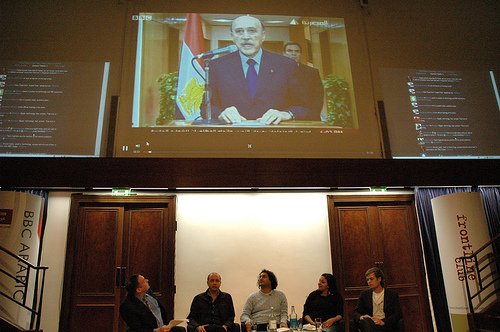
"I guess [the] audience could tell we didn’t really want to talk about media and tech rather we wanted to talk revolutions"