
Bill Emmott and Annalisa Piras following the preview of their new film, The Great European Disaster Movie
“We are in an aeroplane, and we don’t know who is driving the aeroplane. We are in a storm and we don’t know what is happening to us…”. This was the idea that Annalisa Piras wanted to entertain in her new film, The Great European Disaster Movie, which previewed at the Frontline Club on Friday 23 January.
The film combines a fictional narrative, set in a dystopian future without a European Union, with interviews and analysis to demonstrate how both the political and financial union is gradually pulling itself apart. The film will be aired across Europe by eight different broadcasters, a feat Piras described as her “impossible challenge”.

Bill Emmott
Whilst the film was first and foremost an analytical exploration of the current problems that Europe faces, Piras said she felt that something more was needed to engage audiences in the subject.
“The attempt was to experiment a little bit with fiction, with graphics, with other elements in trying to make very complex issues such as the European Union crisis available possibly to a wider public than the one normally interested in reading The Economist or the Financial Times,” she said.
At the heart of the film was an attempt to understand why the European project was slowly falling apart, both economically and politically. Bill Emmott, the film’s executive producer, described it as two different battles: one fought in the head and one fought in the heart.
“The difficulty for the European Union is that so much of what it’s done is stopping you self harming, stopping you subsidise your steel or stopping you have trade barriers… So there’s too much ‘no’ in Europe, and what really the opportunity needs to be is the ‘yes’,” said Emmott.
The film was well received by the audience, with particular praise for the way value was placed on social and identity issues in Europe, rather than exclusively on economic problems.
However, a number of those present questioned the film’s strong pro-European stance. One audience member commented:
“It was ideologically and intellectually highly loaded. You have a number of prominent journalists, intellectuals… all very explicit and putting the case very clearly. And against that you have a very narrow-minded councillor from Margate who is scared of foreigners.”

Annalisa Piras
“We thought if we went into trying to give both sides of the arguments for all these very complex issues we wouldn’t have survived. We would have died in the process,” Piras responded.
“What interested me was to make a provocation… To make it entertaining, to make it scary, to push people to think about this scenario. The tragedy about the current debate is that this [apocalyptic] scenario is never evoked”. In doing this, Piras hoped the film would make viewers consider the potential unintended consequences if the European Union were to dissolve.
The discussion also focused on how much of an impact a partial dismantlement of the Eurozone would have on the economy as a whole. Some commented that a Greek exit would allow both Greece and the rest of Europe to flourish, whilst others predicted economic disaster.
“I think that opportunity and hope really need to be at the heart of what the argument has to be,” said Emmott. “That an open Europe, a Europe that’s connected, that a Europe that’s cooperative has provided, and will in the future provide, opportunities and hope for the people. That’s the argument from the heart surely.”
There was also criticism of the argument that a Europe without the European Union would slide back into war. One member of the audience described this idea as “the old bogeyman” of Europe. However, Piras was confident that this argument had a legitimate place in the film.
“I think that Ukraine is proving that, the fragile peace in the Balkans is proving that. We wanted to finish with the Balkans because we thought that remembering that only twenty years ago people were actually massacring each other on the borders of Europe… They remember the blood and they see Europe as a solution to not going back to the past,” she said.
Asked why the film did not feature comment on the current threat that Russia poses to Europe, Piras commented that she wanted the film to be an introspective analysis on Europe, without too much focus on external developments.
“The film at the end wanted to concentrate more on us, the Europeans, what we think we should do about what we have built in the last 60 years… The attempt was to make a very provocative, intense and strong film about who we are now in Europe, we Europeans, and what we want to do in the future.”
Follow Annalisa Piras and Bill Emmott on Twitter for updates on future screenings of The Great European Disaster Movie.

Bill Emmott and Annalisa Piras
]]>

Monday 4 March
Monday will see the long-awaited opening of the Al Sweady inquiry, examining the circumstances surrounding a 2002 incident in Maysan province, Iraq, involving British security forces. Following a firefight on 14 May at a vehicle checkpoint known as Danny Boy, a number of Iraqis were taken to UK detention facility, Camp Abu Naji. There is a dispute over how many Iraqis were killed in the firefight, but the following day the British soldiers returned 20 bodies to the Iraqi authorities. There are accusations that several of the Iraqis may have died while in custody.

Meanwhile, eurozone finance ministers will meet in Brussels on Monday, with a bailout package for Cyprus high on the agenda now that elections there have been completed. The politics of a financial aid package are complicated by the fact that Cyprus is home to significant amount of Russian money, which many suspect is being laundered on the island.
Finally Monday, the posthumous trial of whistleblowing lawyer Sergey Magnitsky on tax evasion charges is scheduled to resume. Magnitsky died aged 37 in prison in November 2009 as he awaited trial. Critics suggest the charges were trumped up in retaliation for Magnitsky’s role in exposing an alleged $230m fraud that was linked to a Russian Interior Ministry official.
Tuesday 5 March
On Tuesday, the once-a-decade political transition that will see Xi Jinping formally appointed China’s President will reach its final stage when a two-week session of the National People’s Congress opens in Beijing.

Lastly, elections are scheduled to take place in the Federated States of Micronesia. Refreshingly, all candidates are non-partisan, since the country has no formal political parties.
Wednesday 6 March
On Wednesday, in Brasilia four of Brazil’s five main unions are scheduled to start a march to protest sluggish growth and to call for labour market reforms.
In Cairo, the once-high-profile trial of NGO workers charged with working for “illegal” civil society organisations will continue. The case disappeared from mainstream coverage once the 19 American citizens accused in the case were allowed to return to the US last March.

Finally, Israeli President Shimon Peres will be in Brussels on Wednesday, where he will meet with Herman Van Rompuy.
Thursday 7 March
On Thursday, British Foreign Secretary William Hague will host a Friends of Yemen meeting in London co-chaired by representatives from the Yemeni and Saudi governments. Other members of the grouping include Gulf Co-operation Council, G8 member states, the UN, EU, Arab League, IMF and the World Bank.
In finance, both the Bank of Japan and the European Central Bank are scheduled to announce interest rate decisions.
Finally, in Brussels, Irish Taoiseach Enda Kenny and European Commission President Jose Manuel Barroso are scheduled to speak at a conference on the future of Europe, titled Europe 2020.
Friday 8 March

Following his 9 January sentencing, jailed businessman Christopher Tappin is due to begin serving a 33-month sentence relating to the sale of batteries used in Iranian missiles. He entered a guilty plea on 1 November 2012 to one count of aiding and abetting the illegal export of defence articles. Tappin may be allowed to serve his sentence in the UK; however a final ruling from the US Bureau of Prisons remains pending.
Lastly. the US will on Friday release its latest monthly unemployment figures, provoking the usual blame-game between Democrats and Republicans.
Weekend
On Saturday, nine policemen, including the former head of Port Said Security Directorate General Essam Samak, are among the remaining 54 defendants due to be sentenced over the 1 February violence at a match between Al Masry and Al Ahly football teams, which saw 74 Al Ahly supporters killed. The civilian defendants face charges of premeditated murder, while the police face charges of aiding the attackers. On 26 January, the court handed down 21 death sentences in connection to the incident, sparking widespread violence.

Finally, Sunday is the deadline for US special forces to leave Wardak province following President Hamid Karzai’s announcement on 24 February that they must leave over allegations of torture and murder. Previous such deadlines issued by Karzai have subsequently been revised.
Images Courtesy of Featureflash / ID1974 / Shutterstock.com
]]>
A round up of world news in the week ahead from journalist resource ForesightNews.
Monday 21 January

Barack Obama delivers his second inaugural address on Monday, the climax of a day of festivities in the US capital following his re-election in November. The need for further action to stem gun violence is all but certain to feature, as well as the ongoing economic challenges facing the United States.
In Brussels, meanwhile, eurozone finance ministers are scheduled to meet, with current president of the grouping Jean Claude-Juncker expected to pass leadership to the Dutch Finance Minister, Jeroen Dijsselbloem.
Finally, India’s Supreme Court is expected to issue its ruling in the controversial Niyamgiri bauxite mine case. The bauxite extracted would be used in an aluminium refinery run by mining conglomerate Vedanta Resources but critics say it will cause untold damage to the Niyamgiri Hills, which are in Orissa state.
Tuesday 22 January

Israeli’s go to the polls in parliamentary elections in which Prime Minister Binyamin ‘Bibi’ Netanyahu and his Likud party is all but certain to secure enough seats in the Knesset to retain power. The campaign has been notable for the rise of Naftali Bennett and his hard-right Jewish Home party.
Meanwhile, Germany’s Angela Merkel and France’s François Hollande will lead celebrations of the 50th Anniversary of the Elysée Treaty. A joint cabinet meeting of the two countries will be held, as well as a joint session of France’s National Assembly and the Bundestag. Expect much focus on the future of the European project.
Japan’s Central Bank, which is under pressure from Shinzo Abe’s government, concludes a two-day monetary policy meeting on Tuesday. Observers anticipate an easing of policy and possibly a doubling of the inflation target to 2%.
Finally, Tuesday marks the 40th anniversary of one of the US Supreme Court’s most well-known, and controversial, decisions: Roe v Wade.
Wednesday 23 January
Some of the world’s most influential business figures will gather in Davos from Wednesday at the World Economic Forum. While health is formally the major theme of this year’s gathering, the US economic outlook and the future of the euro will no doubt be major topics of conversation among the attendees.
In Moscow, Russian Foreign Minister Sergey Lavrov is due to address domestic and foreign journalists. Again, although ostensibly a reflection on Russian diplomacy in 2012, questions are more likely to focus on future affairs, especially in as regards the Syria conflict.
In the United States, outgoing Secretary of State Hillary Clinton is scheduled to address the House Foreign Affairs and Senate Foreign Relations Committees on the September attack on the US consulate in Benghazi in Libya, delayed from December. This will almost certainly be her final testimony before she leaves the post (her nominated successor, Senator John Kerry, is due to have his confirmation hearing on Thursday).

Lastly, Jordan holds elections which the country’s Muslim Brotherhood has vowed to boycott.
Thursday 24 January

As mentioned above, Senator John Kerry will appear before the Senate Foreign Relations Committee on his nomination to be US Secretary of State. He will be questioned on the full gambit of US foreign policy priorities, particularly Israel, Iran and Syria. North Africa also expected to be a significant area of questioning.
Also in US affairs, Senator Dianne Feinstein, author of a ban on assault weapons that expired in 2004, will introduce legislation to once more ban the sale of assault weapons and high-capacity magazines.
In Addis Ababa, African Union Foreign Ministers are due to begin a two-day meeting, with the current conflict in Mali likely to be a key point of discussion, in addition to events in the DR Congo, relations between Sudan and South Sudan (a special meeting on this is scheduled for Friday), as well as unrest in the Central African Republic.
Finally, in Strasbourg, the European Court of Human Rights holds its annual briefing for the media.
Friday 25 January
The Czech Republic holds a run-off in its presidential election, with Foreign Minister Karel Schwarzenberg squaring up against former Prime Minister Milos Zeman.

Egypt, meanwhile, marks two years since the protests began that ultimately led to the downfall of Hosni Mubarak.
Also, US Treasury Secretary Tim Geithner is scheduled to step down. His designated successor, Jacob Lew, has yet to be confirmed. Lew’s unusual signature has attracted much attention.
Saturday 26 January
The top US diplomat on North Korea, Glyn Davies, arrives in Tokyo for talks with counterparts. This is the final destination on a trip that also sees him travel to Seoul and Beijing to discuss the secretive communist state. His visit comes amid reports the DPRK is planning to test another nuclear device.

Saturday is also Australia Day and Republic Day in India.
Sunday 27 January
Leaders from the African Union begin their two-day summit. Again, Mali, the Sudans, DR Congo, Somalia and Algeria all likely to be discussed.
Finally, Bulgarians are due to take part in the country’s first referendum since 1989. The issue at stake: whether to approve the construction of a new nuclear power plant.
Images courtesy of
]]>
A round up of world news in the week ahead from journalist resource ForesightNews.
By Jasper Wenban-Smith, international editor of ForesightNews.

Eurogroup finance ministers, after finally reaching an agreement on the latest €43.7bn disbursement to Greece last week, reconvene Monday in Brussels. Discussions are likely to include a significant focus on the planned establishment of an EU banking union from the start of next year. Also likely to feature are the proposed restructuring of the Spanish banking sector and creation of a ‘bad bank’ there later in December. A meeting of all 27 finance ministers from the EU follows on Tuesday.
At the International Court of Justice in The Hague, oral arguments open Monday in the long-standing maritime dispute between Chile and Peru. The case was filed with the court back in 2008 by Peru, which is seeking access to the rich fishing waters currently controlled by Chile. Arguments run until December 14.

Russia’s President Vladimir Putin, meanwhile, is due to arrive in Istanbul on Monday for talks with Turkish Prime Minister Recep Tayyip Erdogan. The visit was initially planned for October but was delayed after Turkey grounded a commercial airliner travelling from Moscow to Syria on the suspicion it was being used to ferry arms to Bashar al Assad’s regime. Turkish frustration with Russia’s perceived intransigence at the UN over Syria is likely to come up in talks between the pair.

The ongoing violence in Syria is again likely to feature when NATO foreign ministers meet in Brussels on Tuesday and Wednesday. The meeting follows a Turkish request to the grouping, made last month, for Patriot missiles to be placed on its border with Syria. The planned exit from Afghanistan is also expected to feature heavily, and is likely to involve a briefing from General George Allen, who was recently in hot water over his involvement in the surreal FBI investigation into threatening emails that led to David Petraeus’ bombshell resignation as head of the CIA.

Also on Tuesday, German Chancellor Angela Merkel is due to address her Christian Democratic Union party conference in Hanover, as Germany begins the ramp up for general elections due next September.
On Wednesday, Thais will celebrate the 85th birthday of King Bhumibol Adulyadej.
Meanwhile, in Beijing, Japan and North Korea are due to begin a second round of talks after they met last month for the first time since 2008. Discussions will likely include the abductions of Japanese citizens by Pyongyang in the 70s and 80s as well as the DPRK’s nuclear programme. The meeting comes ahead of elections this month in both South Korea and Japan, with some speculating North Korea may be considering its second missile test under newly-crowned Sexiest Man in the World Kim Jong-un.
European Central Bank President Mario Draghi will be addressing the media after the bank’s Governing Council meets Thursday. Further comments on Greece, Spain and the overall health of the euro area are all expected.
Ireland is due to host a meeting of some 50 foreign ministers from the OSCE on Thursday, the largest gathering of its kind in the country has seen.

Meanwhile, having presented his highly-anticipated report into press standards last week, Lord Justice Leveson will on Friday be discussing privacy in the 21st Century at an event organised by the University of Technology Sydney in Australia. This will be his first public appearance since he published his report.
Also Friday, Ghanaians go to the polls to elect a president to the oil-rich West African nation. The strongest challenge to incumbent John Dramani Mahama (NDC) comes from Nana Akufo-Addo (NPP).
Brazilian President Dilma Rousseff is due to host counterparts from the Mercosur grouping. Venezuela’s recently re-elected President Hugo Chávez had been scheduled to attend, however it remains to be seen whether he returns in time from his latest trip to Cuba to receive cancer treatment.

Finally Friday, UN Secretary General Ban Ki-moon is expected in Turkey where he intends to visit refugees fleeing the conflict in neighbouring Syria.
The weekend sees France host from Saturday the fifth World Policy Congress in Cannes with the futures of the European Union and the Middle East top of the agenda. Speakers include Italian Prime Minister Mario Monti and UN/Arab League Special Representative for Syria Lakhdar Brahimi.
Lastly, Sunday sees the second election of the week, this time in Romania. Despite failing to have President Traian Basescu dismissed, opposition party the Social Liberal Union (PSU) is expected to fare strongly, setting the scene for a potential show-down between the President and parliament.
]]>By Jasper Smith
As eurozone leaders continue efforts to counter turmoil in the financial markets, a team of inspectors from the IMF and EU are due to arrive in Athens on Monday to assess Greek efforts to sort out their public finances.
Across the Atlantic, Tuesday sees Dominique Strauss-Kahn back in court in New York on rape charges stemming from an incident back in May at the Sofitel Hotel. Prosecutors are said to be considering dropping charges due to supposed weaknesses of his accuser’s testimony.
Also Tuesday, Liberians vote in a referendum on proposed changes to the West African nation’s constitution.
Back in Europe, French President Nicolas Sarkozy is due to finalise plans on Wednesday to reduce his country’s deficit. Sarkozy was forced to return suddenly from holiday amid (apparently unfounded) rumours that France would be the next major economy to lose its triple A credit rating.
In Jerusalem, outspoken Republican commentator Glenn Beck is scheduled to hold his ‘Restoring Courage’ rally.
Meanwhile, at its headquarters in Ethiopia, on Thursday the African Union is holding a pledging conference to raise funds for the ongoing humanitarian crisis in the Horn of Africa.
At the International Criminal Court in The Hague, closing arguments are due to wrap up on Friday in the case against Thomas Lubanga, alleged leader the Union of Congolese Patriots. He faces war crimes charges over allegedly conscripting child soldiers in the DRC.
Saturday sees the ‘Tea Party Express’ bus tour kick off with a rally in Napa, California.
Finally, on Sunday, captured Israeli soldier Gilad Shalit turns 25. Hamas has held him since 25 June, 2006 when he was just 19.
]]>Former Egyptian President Hosni Mubarak returns to court on Monday. Along with his sons Alaa and Gamal he appears charged with premeditated murder in connection with the deaths of protesters during the 25 January revolution.
Monday also sees the publication of Japan’s Q2 stats. The country’s GDP shrank 3.7 per cent in Q1, largely attributed to the 11 March disasters, and a similar decline is expected as the country copes with power shortages following the nuclear crisis.
It’s the turn of Europe to brace itself for GDP figures on Tuesday, with the official publication of the euro zone GDP figures. Publication comes amid recent fears growing over the global economy and the recent agreement to give Greece a second bailout.
Eyes are drawn to the International Criminal Court on Wednesday, as former UN employee Callixte Mbarushimana appears charged with five counts of crimes against humanity in the Democratic Republic of Congo in 2009. Mbarushimana is also believed to have been involved in the Rwandan genocide, but has never been charged over the atrocities.
Angola also hosts a summit of the Southern African Development Community in Luanda on Wednesday. The two-day affair is expected to focus on Zimbabwean President Robert Mugabe and his refusal to fully implement the Global Political Agreement, as well as the recent fuel protests in Malawi.
Pope Benedict XVI makes an apostolic journey to Madrid on Thursday, to attend a gathering of Catholic youth to mark World Youth Day. Visit includes a Holy Mass at Cuatro Vientos Airport on 21 August.
In the UK, thousands of students learn what their future holds when A Level results are published on Thursday, and students scramble for (often) oversubscribed university places.
Friday sees the last day in office for Romanian Health Minister Attila Cseke, who tendered his resignation earlier this month following a dispute over funds for his brief. Under Romanian law Cseke had to continue his post for 15 days at a maximum until Prime Minister Emil Boc nominated a successor.
On Saturday the UN Panel of inquiry, led by former New Zealand Prime Minister Geoffrey Palmer, is expected to release its report. The report has been delayed several times, most recently from 27 July, and could well be postponed again.
The 2011 Homeless World Cup begins on Sunday, giving homeless and socially marginalised players from across the world the opportunity to represent their country at the beautiful game.
On Sunday a national memorial service takes place in Norway, commemorating the 77 people who were killed in the 22 July Oslo bombing and Utoya shootings. Ceremony takes place in Oslo Spektrum and was announced by Prime Minister Jens Stoltenberg ‘to take care of each other and show compassion’.
]]>Oh lieber Otto! What a night that was mate. Greeks and Germans like Eurozone brothers-in-arms. Bier and ouzo never tasted so good together and we all danced to Zorba the Greek just like it was Karneval. Schön…
But oh meine Damen und Herren, what a difference an EU financial crisis makes. Especially when your average German is trying to work out if Berlin should be bailing out Athens to the tune of about 8 billion euros and where exactly do their politicians stand on the issue.
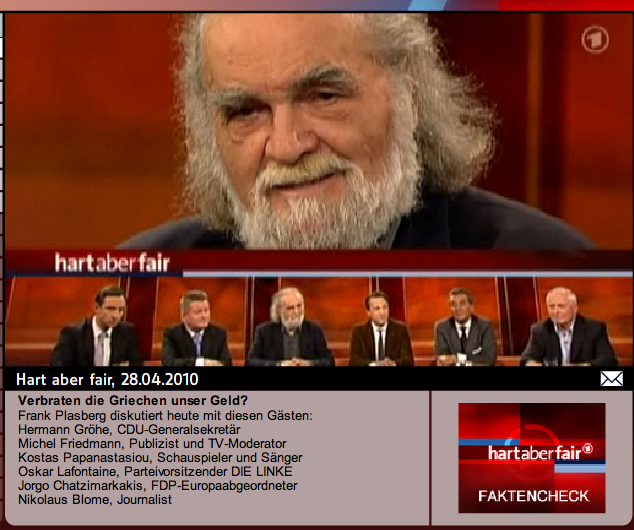
A TV talk show debate on the proposed Greek bailout mid-week had me rather engrossed (which is saying something as I feel there’re far too many talk shows on the national broadcaster). Politicians from across the spectrum thrashed out their views on how to help Greece on the appropriately named programme, Hard But Fair. Though a well known Greek-Berliner restaurateur-actor on the panel somewhat struggled to get a word in.
So, it was with little surprise the next morning when I popped into my local cafe, the headline of Bild screamed:
"Greeks want even more billions from us!"
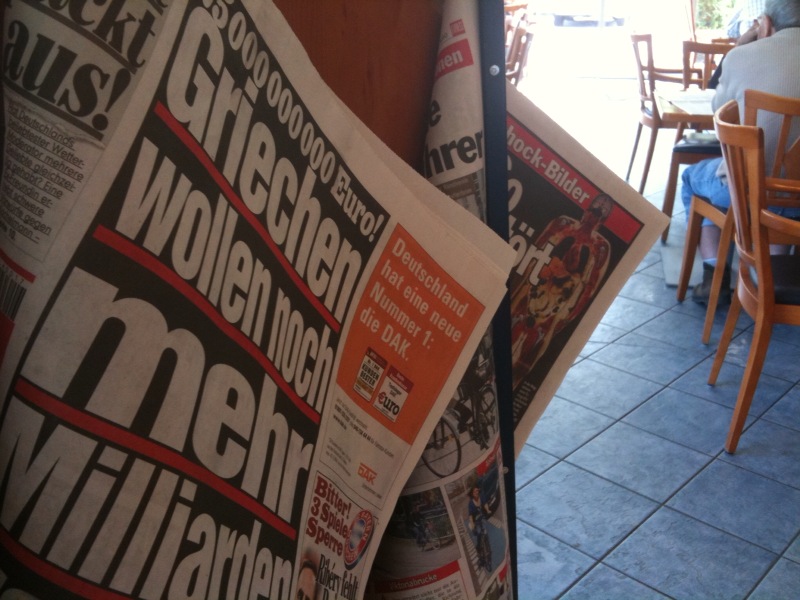 Regular Bild readers might have been dismayed that such a headline left hardly any room for the page 1 girl. The tabloid spelt out rather simply that while the coalition government considers billions of euros for helping Greece, there’s no money for tax cuts, repairing schools or maintaining streets and parks.
 Meanwhile, we have to keep things stable. That’s what Chancellor Merkel’s CDU party is campaigning for in the May 9 election in Germany’s largest state, North Rhine Westfalia (NRW). A state election which might end up signaling what Germans think about the federal government stepping in to help sort out the economic woes of Greece. The emergency Eurozone summit is scheduled the day after the NRW elections.
However while Germany, being the good EU member that it is will be seeking to do its (usual) part to maintain stability in the Eurozone, the German reaction to whole episode has me thinking back to what Timothy Garton Ash mentioned at a Frontline Club talk recently. TGA spoke about Germany’s change in attitude towards Europe. Germany is now much more sceptical and much more happier talking about national interests.
Anyway, getting back to what Germans and Greeks do well together, I wonder if on May 10 the German delegation at the Eurozone summit will emerge from the talks singing the classic Griechischer Wein? Take it away Üdo…
]]>