The Frontline Club will be hosting a series of screenings for the launch of a new virtual reality news documentary from the BBC. With headsets provided, we will be screening the immersive documentary followed by a Q&A with BBC Africa’s correspondent Alastair Leithead, executive producer and head of BBC’s VR Hub Zillah Watson and digital development director for BBC News James Montgomery on the potential this new technology holds for the future of news reporting.
DAMMING THE NILE
The Nile is the world’s longest river, and it’s where the world’s first war over water could be fought. For millennia Egypt has been the river’s great superpower, but now an ambitious and emerging Ethiopia has dammed the Blue Nile – where most of its water comes from. “Damming the Nile” is a virtual reality documentary series from BBC News, taking viewers on a deeply immersive journey down the Nile from its source to the sea through Ethiopia, Sudan and Egypt. On assignment with the BBC’s Africa correspondent and his team, you’ll explore the geopolitical struggles for regional power and influence along the Nile and investigate how these nations are navigating these choppy waters. Enjoy the ride.
Time Slots:
9:30 AM – 10:30 AM
11 AM – 12 PM
16:30 – 5:30 PM
Please email events@www.beta.frontlineclub.com to reserve your place specifying what time you will be attending.
]]>
This event is organised by the Overseas Development Institute (ODI).
On 23 October 1984, the BBC aired a landmark report on the famine in Ethiopia. Describing the crisis as a ‘biblical famine’, the report galvanised the public, spurred the UK government into action and prompted the creation of the infamous Live Aid concert.
Now 30 years on, is media reporting of today’s conflicts and disasters having the same effect on the public and has the nature of conflict and disaster reporting changed? How are journalists adapting to these changes?
How are humanitarian organisations working with media outlets to help generate interest and understanding of the crises affecting millions of civilians around the world?
Join the Overseas Development Institute (ODI) as they examine the current state of conflict and disaster reporting and how humanitarian agencies can work with the media to raise awareness and much-needed funds.
Chaired by Ben Parker who has worked in media and humanitarian response for over 20 years. He co-founded the IRIN humanitarian news service in 1995. As well as a reporter and editor, he has been an aid worker, most recently as head of UN’s humanitarian office in Syria in 2012, and as UN director of communications in Somalia.
The panel:
Juliana Ruhfus, senior reporter for the People and Power programme on Al Jazeera English, specialising in investigative work. Her journalistic work with Channel 4, BBC and now Al Jazeera has taken her to over 30 countries, including Somalia, Yemen, Haiti, Libya and Sri Lanka after the 2004 Indian Ocean Tsunami.
Marc DuBois was the head of Médecins Sans Frontières (MSF) UK from 2008–14. He has worked in the front lines of humanitarian crises for MSF in countries including Sudan and Angola.
Jon Snow, Channel 4 News anchor since 1989. During his career he has covered conflicts in countries including Iraq, Afghanistan, Eritrea, Ethiopia, Angola as well as the Haiti earthquake and the recent crisis in Gaza.
Eva Svoboda, research fellow in the Humanitarian Policy Group at the Overseas Development Institute. She has worked for various NGOs and the ICRC in emergencies in the Middle East, Africa and Asia.
If you are unable to attend you can watch the event live, to receive a reminder register here.
Photograph: isafmedia


The Frontline Club was treated to an explosion of colour, culture, festivity and debate as photojournalist Jeremy Hunter explored the “DNA of countries” through pictures.
Hunter described how he began travelling as part of his job as a foreign correspondent for NIR-TV in Tehran. Although not employed as a photographer he always carried his camera along.
Today his unique portfolio of photographs spans 35 years and 65 countries, and captures images of festivals and cultural ceremonies in some of the most remote regions of the planet.
As he introduced Hunter, moderator Paddy O’Connell of BBC Radio 4’s Broadcasting House warned:
“What he’s captured is dying… what we are going to see is endangered.”
Hunter added:
“I’ve now got an archive of material which I think is…historic because so many of the celebrations I’ve been to…will probably not continue in the near future.”
Hunter’s passion led him to North Korea, one of the world’s most inaccessible and secretive societies. He arrived just before the death of Kim Jong-il for the August Arirang festival.
The slide show unveiled the largest stadium in the world which, he says, has a seating capacity of 150,000. It also revealed “truly extraordinary mosaics” of flags, flowers and even the Pyongyang skyline – created by 50,000 teenagers holding up flipcharts.
The stark images that followed of Ethiopian tribal rituals, ceremonies and festivities – including those of women being whipped and mutilated – sparked a debate on the ethical considerations of paying natives to pose for these pictures.
Hunter admitted:
“The Mursi (tribe) are now become almost a sort of freak show… because people like me have been there, have photographed them and have their put their images on the website and as a result of that, tourism has absolutely grown to such a degree. When I first went there there were only about 2,000 tourists a year, there are now an estimated 30,000.”
Commenting on an image in Ethiopia showing the words “Jesus will never let you down” scrawled across a galvanised door, Hunter said:
“Jesus has definitely arrived…. The missionaries are there, baptisms are taking place… and I think that very soon they will no longer be animist and they will be brought into the church, and at that point I think that some of these practices -particularly the circumcision of the girls and indeed the scarification and the cutting of the lower lip – is all likely to change.”
This encouraged other questions about Hunter’s motives for documenting these remote practices.
O’Connell asked:
“Do you hate the fact that you spoil a culture by photographing it…?”
In Hunter’s conclusion he said:
]]>“The whole… archive of work is called ‘Let’s Celebrate: exploring the DNA of the world’s cultures through their festivals, rituals and celebrations’…. My role has been, in fact, to record these over a period of 35 years and I’m recording … what continues to happen. So actually it’s a…piece of historical and archival material that I think will have a place in the future.”
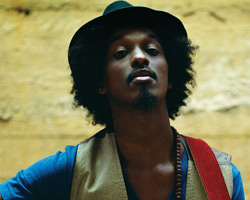
In recent years Somalia has often made the headlines for all the wrong reasons. Piracy, poverty and lawlessness have cast a long shadow over the Horn of Africa. Two generations of Somalis have been scattered forming a diasporas across the world. Many still live in refugee camps in Ethiopia, Yemen, Kenya and as far away as South Africa. In South Africa, those refugees found themselves on the receiving end of xenophobic attacks. This has made their plight in the country more difficult and uncertain.
Somalis have always eyed sports events closely and in the Beijing Olympics were just happy to be there and to wave a flag. There seems to be a need for recognition, seeking validation that the place still exists in the eyes of the international community.
The World Cup is coming to South Africa and it needed a unifying and inspiring anthem. A song written by a son of Somalia and a survivor of its troubles was most suited to feed that sense of hope. K’naan, a Somali born Canadian musician was approached by sponsors to do the anthem and he obliged. Interestingly he had already written the song Waving Flag, it was the last song he wrote on his Troubadoure album. The song is melancholic and speaks of troubles and loss but always had the potential for being tweaked to inspire. Coca Cola, the World Cup sponsors, approached him and told him they wanted someone who could represent the African continent and not shy away from being vocal on its behalf. This was before they even knew about the song.
I met K’naan and his manager Sol Guy when he was on tour in London last May. Back then the whispers of the Coca-Cola sponsorship anthem had just begun. K’naan was back in London in transit last month en-route to Mozambique when I met up with him again. On both occasions he was most generous with his time. We spoke of his recent trip to Somaliland and how it has been instrumental in inspiring his music. He described his trip as necessary and as a ‘key to an artistic lock’ that hehad come up against.
During his recent travels across 18 African countries, K’naan saw that Africans “no matter the scenario, the difficulty, the hope and the beauty, …always expressed it through love …and music”. He is determined to make music to that feeling [of hope] and not just produce a “soundtrack to difficulty”.
Some have criticised the choice and argued that a ‘real’ African pop song should have been written and recorded on the continent itself. It should make no difference where it was written. If the diary of genocide survivor was published in Europe or North America it would not detract from the authenticity and the credentials of that survivor’s story. By the same token music written by a Somali artist enriched by his own experiences is a real African pop anthem giving real hope to real people, not least South Africans of Somali origin.
K’naan has been nominated for 3 Juno Awards [Canada’s answer to the Grammy’s] and the ceremony takes place on April 18th 2010. I have a sneaky suspicion he will be waving not a flag but a Juno, or two, or maybe even three.
Picture Courtesy of KnaanMusic.com

Part of the fun of travel anywhere involves the matching of a preconceived image with a reality. The northern Horn of Africa is steeped in travelers mythology which dates back to Richard Burton’s famous, first footstep,in the mid 19th Century and stretches into popular modern imaginings of the, archetypical failed state, Somalia. Separating fact from fiction here isn’t always easy.
For a journey to Somaliland I’ve been in full tourist mode. I’m no Richard Burton – for one thing I’m pretty sure colonial-era explorers didn’t carry Lonely Planets. At the same time, as there are so few other foreign travelers in Eastern Ethiopia it is possible to pick up on that scent of adventure and sense of genuine wonder. The region has vast potential to develop as a location for independent travel and the beauty of the country would certainly warrant it. From cosmopolitan Addis Ababa the road stretches out through undulating green farmland and falls into a dusty interior populated by nomadic tribes people and their livestock. Beyond the savannah-like plains of Awash however, the road rises again into verdant highlands where the valleys sparkle with the reflected light of scattered tin-roofed settlements. This is chat country and the terraced hillsides are lined with this plant whose leaves when chewed (and they are, a lot) act as a mild narcotic. Chat is consumed throughout the Eastern Ethiopian and Somali Horn and the trade has developed into a massive and hugely influential regional industry – in many ways this little leaf ties these nations together. Afternoons in the ancient city of Harar are spent roasting coffee beans, downing multiple sugar laden cups of the rich brew and chewing the cud. Chat debris is strewn all over the floor and the cumulative stimulant effect is enough to set hearts palpitating to the same rhythm as the buses which bounce through in clouds of dust. Not that such intoxicants are really needed to get a kick out of a place like Harar where the nightly ritual involves the feeding of the local Hyenas. Skulking out of the darkened fields these magnificently scruffy animals howl and yap in deference to the old men who call them by name and hand over big chunks of meat.
From Harar I double back to the more modern town of Dire Dawa, the second largest urban centre in the country built up at the turn of the century for the new railway line running from Addis all the way to Djibouti and the
The tiny African country of Djibouti is definitely a Somali state, but is, at the same time, defined by a colonial history and modern geopolitics. Traditionally playing host to French legionnaires, Djibouti is now home to the Americans. It is from here that the Combined Joint Task Force Horn of Africa operates to conduct intelligence and military operations in the Horn. The G.Is on leave in downtown Djibouti city show off fierce crew cuts and a general lack of discernible necks, whilst the burly legionnaires sport their snazzy desert boots and short shorts combos. In the heart of the city the Somali market buzzes with the intensity of semi-organised chaos, whilst a five minute walk will take you to leafy colonial squares and air-conditioned supermarkets patronised by white families driving shiny SUVs.
Short of time, I elect to jump into Somaliland by plane and show up bright and early at the airport to catch my scheduled flight. After waiting around outside for an hour or so while all the airport staff arrive for work, I am duly informed that there will be no plane to Hargeisa today. Several ticket-holding passengers gather up their luggage and set off back into the city. I inquire at the airline office and find out that a, no plane today, can evolve into a, maybe later this morning, to finally a wonderful, oh look, there it is’. The best thing about the delay is getting some time in the departure lounge to drink overpriced cups of tea and watch the F-16s use the runway for takeoff.
So that’s the neighbours. It’s a superficial glance to be sure, but is one that might give you some sense of context for this de facto independent but diplomatically unrecognized modern nation state of Somaliland. Somaliland’s fledgling democracy, (excuse the phraseology) is apparently reeling in a protracted constitutional crisis. The most recent postponement of the presidential election, scheduled for September 27th, resulted in clashes on the streets, police shootings and several fatalities. Once again Somaliland’s hard won and oft-ignored stability was rocked by political violence. The previous instance occurred last year with Islamist-linked bombings in Hargeisa and Bossaso in largely autonomous Puntland, which targeted government buildings, the UN, and Ethiopian commercial and diplomatic interests.
To some, Somaliland is as a country on the brink. Democratic functioning (another of the Republic’s previous claims to fame) is faltering and the whirlwind forces of insurgency which plague Mogadishu and the South of the country, could conceivably expand into a vacuum brought by destabilisation Somaliland. The stakes are no doubt high though that in itself may be a moderating factor. Political crises come and go in this part of the world (as do the staff of some international organizations who are pulled out of the country as soon as any trouble is spotted on the horizon) and already political concessions have been made. Whilst not without controversy, Somaliland’s Guurti legislature has, in effect, confirmed an extension of President Rayaale’s term of office, and an election will be unlikely to take place this year. Does this represent a return to normality for a large proportion of the population who are more concerned about putting food on the table than elite political wrangling, or does it instead epitomise the perpetuation of an inherently vulnerable and potentially combustible status-quo? This is a question I hope to explore during my stay in this fascinating corner of the Horn of Africa.
For pictures visit my photojournal.
]]>
Last year, while trying to pick the sixth book for my African Reading Challenge, I explained how I wanted a book that wasn’t self-consciously a book about Africa. I wanted a story, a biography, a self-help guide, whatever, that just happened to be set in Africa. I failed. And as a result didn’t even manage to finish the six books that I was hoping to review.
Then along comes Bikila: Ethiopia’s Barefoot Olympian and I have my sixth book. This biography is most definitely a book that would be filed under sport rather than world affairs, but in telling the story of Abebe Bikila, who exploded on to the sporting scene at the 1960 Rome Olympics, Tim Judah has found a very human story that also reveals a huge amount about Ethiopian life through the 1960s and 1970s.
As he cruised to victory in the Marathon, Bikila was the first black athlete to win Olympic gold thus setting the tone for the rest of the century. That he did it barefoot pretty much in the shadow of the looted Axum Obelisk and only a couple of decades after Mussolini claimed Ethiopia for Italy, only added to the historical resonance.
Judah masterfully interweaves Ethiopia’s troubled political history with the story of Bikila’s triumph and ultimate decline. There are audiences with Haile Selassie, Bikila is detained during a failed coup and there are agonised discussions about whether it was appropriate for an Ethiopian to be seen running barefoot, such was Abyssinian pride.
Bikila’s is an incredible story. He and his coach, Onni Niskanen, revolutionised the way Africa was viewed by the rest of the world. But like many African runners Bikila succumbs to his celebrity lifestyle, drinking heavily and is eventually paralysed in a car crash. He died a year later.
Judah’s book is filled with some of the best sports journalism from the age, vivid accounts of Olympics past but at times it reads too much like a journalist’s book, heavy on sources and quotes. I would have liked him occasionally to put his notebook aside to fill in the gaps and round out the story. But then I guess the blurb wouldn’t have been able to say "for the first time, his true story is told". This is still a cracking read.
My previous reviews in the Africa Reading Challenge
]]>Numerous scenarios are being discussed for what happens next in the Horn of Africa’s most lawless country. For what it’s worth, I reckon the pull-out will eventually take the heat out of the insurgency.
Ethiopia’s withdrawal will lead to a massive power vacuum, which the feeble Transitional Federal Government and African Union mission will fail to fill. The result will be an immediate sort out of the clans and the settling of scores in a bloody period of fighting.
The question then is to what extent the Islamist forces can coalesce into an organisation as capable as the Union of Islamic Courts which controlled most of Somalia for six months in 2006. That requires some hatchets to be buried and cheeks to be turned – and Somalis don’t have a good record in that department (unless you include burying hatchets in cheeks). If the Asmara and Djibouti factions of the courts and the Shabaab can manage that (and if the reports that I’m hearing about a general moving to the centre are true) then it might be possible for a new administration, one that encompasses a representative portion of Somali society to come to the fore.
There are some big ifs here. Notably whether the Americans and Ethiopians could possibly let this happen.
Shashank at Somewhere in Africa touches on the key problem that underlies all our dealings with this shattered, broken shell of a country..
The main problem, one that few commentators grapple with convincingly, is whom to hitch your wagon to in Somalia?
But if there is a lesson to be learned over the past two years, it has to be that the outside world cannot pick sides and expect Somalis to accept it. Hitching our colours to the TFG at a time when the Islamists were bringing a degree of peace and stability to Mogadishu was a sure-fire way to ensure that the interim government would fail.
Far better to let Somalis decide who they want in charge and then come in with aid and support on the back of that. If they can’t decide, then we have a problem. We may not like everything the Islamists stand for, but to artificially support an institution that is despised by many Somalis is just a recipe for disaster and one that pushes moderates into the hands of West-hating extremists.
This is a more sophisticated analysis than that of a friend, who reckons bricking the whole place up and allowing the last man standing to be president is the only way to proceed, but I guess the point is the same.
- Robert Mugabe dies of cholera, forensic scientists discover he was infected by contaminated ice in his gin and tonic
- Meles Zenawi announces Ethiopian troops will be pulling out of Somalia
- Kenya blacked out as rains flood hydro-electric dams
- Kenya blacked out as drought empties hydro-electric dams
- US State Department finds link between Somali pirates and al Qaeda. Somalia bombed into the, erm, stone age
- President Bashir of Sudan kicks off peace talks alone as Darfur rebels stay away. Talks break down after 24hr
- Raila Odinga, Kenyan Prime Minister, swaps his Merc for a Toyota Corolla and begins governing as the People’s Prime Minister, paying tax and everything
- Somali pirates buy Djibouti, launch bid for 2020 Olympics
- Laurent Nkunda apologises for all the trouble he’s caused in the DRC, in a statement issued by the Rwandan government
- Omar Bongo, long-serving leader of Gabon, explodes – pieces of his liver are grilled and served to diners in Gabon amid foie gras shortage
Any others?
]]>
A few days ago I was compiling an 800wd review of 2008 in Africa for one of my papers. I asked for help in finding a good news story to include and was inundated by readers’ ideas for things I should include. I simply didn’t have room for more than one, so I thought we might have a crack at putting together an alternative “good news” review of 2008.
I’ll start you off with an intro, but after that feel free to leave a brief paragraph or two about anything that has happened in Africa this year that you feel is important and carries some sort of wider significance for the development of the continent. I’ll update the main story with each of the latest comments, and it would make my job a maybe lot easier if you could try to follow on from whatever the last one was.
In some ways 2008 brought business as usual in Africa. Somalia sank further into chaos. Darfur’s messy conflict rumbled on. And the biggest news stories of the past 12 months involved elections that were flawed at best – rigged at worst.
But in other ways, away from the glare of the mainstream media, the year brought fresh achievements in commerce, politics and technology.
Over to you…
In Ethiopia, for example, an anti-government pop singer who could have faced 15 years in prison on trumped up charges of causing death by dangerous driving was only jailed for six years. (Andrew)

Among many of the titbits of useful advice I picked up as I worked my way through Britain’s regional newspapers was one that has caused me no end of trouble. “Rob,” one of the old hands at The Herald (I should point out this is a Scottish national paper – not a British regional paper) said, “The stories that you don’t write are just as important as the stories you do write.”
The job of a journalist, he went on to explain, is to sift through the assorted rubbish that arrives each day and work out what is true, what is important and what is news. Everything else could be passed over with a dismissive, “The Scotsman might do this tomorrow but frankly it’s bullshit,” to the news editor.
Sound advice. But it has been causing me problems as a freelancer sitting several thousand miles away from the foreign desk. The issue is that a quiet word in the ear of my foreign editor that such and such a story is rubbish, doesn’t stop some hotshot writer from London bigfooting me or another freelancer offering said story to the desk. Often the first I’ll know about it is reading my own paper online.
I raise this now because I deliberately haven’t written about the “impending famine” in Ethiopia. Charities have been taking journalists on junkets to view stick-thin children and talking up the crisis in terms of global warming and natural disasters. This was not enough for me. If I was going to write about an Ethiopian hunger I wanted to discuss the country’s expensive wars in Somalia, Ogaden and Eritrea, its abuse of human rights in Ogaden and its denial of drought. That was the way the to do the story properly.
Meanwhile a steady stream of wannabe Michael Buerkes was filing stories such as this, in my own paper:
Surprisingly, when The Times visited the region, the fields were alive with maize and most afternoons a warm rain fell. “Here the problem is acute,†said Jean de Cambry, the emergency co-ordinator for Médecins Sans Frontières in southern Ethiopia. “It is very surprising and very strange, because everything is so green. But food stocks at household level are empty or close to empty.â€
Or this imaginative way of producing a famine story in the LA Times:
They call it the green hunger. Four-foot cornstalks sprout from rain-soaked earth, and wind billows fields of teff, the staple Ethiopian grain. Goats and cattle are getting fat on lush grasses — but the children are still dying.
Each time these stories appeared I would call colleagues to ask whether it was time to go to Ethiopia. Each time they said not yet – including one TV reporter who had just filed a harrowing account of children starving, but had to admit it wasn’t really as bad as all that. A day’s filming was canned because the area was too green.
So it wasn’t a massive surprise when I received the following press release from the Irish aid agency Goal:
Ann Bourke, one of the most experienced of GOALâ€
s field personnel, reported with optimistic news from Ethiopia today. Ann stated that the interventions of aid agencies such as GOAL, and fact that it has started to rain have had very beneficial effects on the famine in Ethiopia. Although it is too early to be sure, indications are that a major famine may have been adverted.
This is clearly great news for the people of Ethiopia. And it is still early days. And maybe it was the reporting and PR work by charities that averted a crisis. But at a time when fundraisers complain about compassion fatigue could it be another example of journalists putting their critical faculties to one side in favour of reporting a worst-case scenario peddled by NGOs with an interest in collecting cash? Did we jump when they cried wolf? I wasn’t the only Nairobi-based reporter who decided not to go to Ethiopia, only to see a colleague based on another continent file an “Ethiopia Starves” piece.
It all reminds me of another piece of advice I picked up at The Herald, where the editor was fond of shooting down stories in conference with a terse: “That might be what they say, but is it true?”