 Watch the video stream of Saving the News: Ethics And The Fight For The Future Of Journalism]]>
“SAVING THE NEWS: Ethics and the fight for the future of journalism”, features 20 articles by journalists reporting from Kenya to Honduras, Jordan to the Philippines, South Sudan to Mexico, as well as how journalists are adjusting to life being labelled “enemies of the people” in Trump’s America.
Alan Rusbridger, opens the Ethical Journalism Network’s annual magazine with a heartfelt plea for a return to ethics in journalism.
The former Guardian editor, who broke the story that convulsed the UK media industry when some national newspapers were shown to have a culture of illegally hacking mobile phones, writes in his foreword:
‘There has always been a strand of amorality in the attitudes of some journalists and editors. They are neither very moral, nor terribly immoral. They don’t necessarily believe in doing bad things. But newspapering is (they might say) “rough old craft” and in the end, it’s the story that counts.’
Join us on April 8th for the launch of the report and a discussion with some of the report’s authors. You will even be able to get your hands on a printed copy!
Chair
Dorothy Byrne is Chair of the Ethical Journalism Network and Head of News and Current Affairs at Channel 4. She was appointed in September 2003, having previously edited the award-winning Dispatches. During her tenure, the Channel’s news and current affairs programmes have won numerous BAFTA, RTS, Emmy Awards and others. In 2014, Dispatches won the RTS Journalism Awards for both best Home and best International Current Affairs, the first time one strand won both awards, and Channel Four News won the RTS Journalism Award for Best News Programme of the Year for the second year running.
Speakers
Hannah Storm becomes the new Director and CEO of the Ethical Journalism Network in April 2019. Storm joined the International News Safety Institute (INSI) in 2010, becoming its director in 2012. Before joining INSI, Storm spent more than a decade working as a journalist for television and radio, online and print for outlets including the BBC, The Times, Reuters and ITN, and Oxfam. She has also worked as a freelance media consultant for different UN agencies with a specific focus on gender and media. In her freelance capacity, she is currently developing a curriculum for the Poynter Institute in Florida in partnership with the Press Forward to counter sexual harassment in the newsroom.
Salim Amin is Chairman of Camerapix, Chairman of The Mohamed Amin Foundation and co-founder and former Chairman of Africa24 Media. Amin’s father was Mohamed Amin MBE, a Kenyan photojournalist noted for his pictures and videotapes of the Ethiopian famine that led to the Live Aid concert. He is a Fellow of the African Leadership Initiative and a member of the Aspen Global Leadership Network. In December 2012, Salim was named as one of the 100 Most Influential Africans by the New African magazine, which also named him in their ’50 Under 50’ Africans in May 2013. Amin is a trustee of the EJN.
Chris Elliott served as the readers editor at The Guardian having been appointed managing editor in February 2000. Elliott has worked as the home affairs correspondent for the Sunday Telegraph, chief reporter for the Sunday Correspondent and assistant news editor for the Times. He has also served on the board of the International News Safety Institute (INSI) and the Nomination Committee of the Reuters Founders Share Company until 2015. He chaired the UK’s major journalism training body, between 2010 and 2016. Elliott was the EJN’s interim CEO and Director from April 2018 to April 2019 and has now returned to his role as a trustee.
Aidan White is the Founder and President of the Ethical Journalism Network. White founded the EJN in 2012 after he left the International Federation of Journalists (IFJ) where he was General Secretary for 25 years. He has written extensively on human rights, ethics and journalism issues and played a leading role in establishing International Freedom of Expression Exchange (IFEX), a global network of free expression campaigners and the International News Safety Institute (INSI).
Watch the video stream of Saving the News: Ethics And The Fight For The Future Of Journalism
Join Filipino photojournalist Raffy Lerma, chair of the Ethical Journalists Network Dorothy Byrne (Head of Channel 4 News and Current Affairs) and founder of the Photo Ethics Centre Savannah Dodd to try and understand life behind the lens – and the ethical challenges of looking through it – while covering horrific stories of human rights abuses.
In May 2016, Rodrigo Duterte, then-mayor of Davao City, won a landslide victory in the Philippine presidential elections on a campaign centered on the eradication of drugs in the country; a goal which the President maintains must be achieved even if authorities resort to violence.
“Forget the laws on human rights,” he said at his final campaign rally. “If I make it to the presidential palace, I will do just what I did as mayor [of Davao]. You drug pushers, hold-up men and do-nothings, you better go out. Because I’d kill you. I’ll dump all of you into Manila Bay, and fatten all the fish there.” Since then, a wave of killings has engulfed the country.
By November 2018, government figures revealed that 5,050 drug personalities have been killed in anti-drug operations – mostly from poor families in urban centers across the country. 23,327 homicide cases are still under investigation, including those killed by unidentified gunmen and vigilantes.
During the discussion, we’ll be showcasing Raffy Lerma’s photographs humanising the victims of the violent anti-drug policy and calling for accountability. We will also hear from Olivier Sarbil and James Jones the makers of “On The President’s Orders“, a film which documents President Duterte’s bloody campaign against drug dealers and addicts in the Philippines, told with unprecedented and intimate access to both sides of the war – the Manila police, and an ordinary family from the slum.
On The President’s Orders – Official Trailer from Mongoose Pictures on Vimeo.
Chair:
Dorothy Byrne is Chair of the Ethical Journalism Network and Head of News and Current Affairs at Channel 4. She was appointed in September 2003, having previously edited the award-winning Dispatches. During her tenure, the Channel’s news and current affairs programmes have won numerous BAFTA, RTS, Emmy Awards and others. In 2014, Dispatches won the RTS Journalism Awards for both best Home and best International Current Affairs, the first time one strand won both awards, and Channel Four News won the RTS Journalism Award for Best News Programme of the Year for the second year running.
Speakers:
Raffy Lerma is a freelance photographer based in Manila, Philippines. He began his career in photojournalism as a student of the College of Fine Arts in the University of the Philippines Diliman. Raffy finished his Diploma in Photojournalism at the Konrad Adenauer Asian Center for Journalism at the Ateneo de Manila University. For 12 years, Raffy worked as a staff photographer for Philippine Daily Inquirer covering the daily news beat in Metro Manila. He has recently shifted into working independently to focus on his documentation of the Philippines’ “war on drugs.”. Raffy has been featured in The New York Times documentary “When a President Says, I’ll Kill You” and in the BBC World Series radio documentary “Trolls, ‘the Devil,’ and Death.” He has been giving talks in different parts of the Philippines and the world to help disseminate to a broader audience the realities of the drug war in the country.
Savannah Dodd is a photographer and anthropologist. She brought her two passions together in 2017 when she founded the Photography Ethics Centre, a social enterprise dedicated to raising awareness about ethics across the photography industry and around the world. Prior to founding the Centre, she completed her bachelor’s and master’s degrees in anthropology, and she worked in the development sector for NGOs and IGOs in Switzerland, Turkey, and Thailand. Alongside her work in the Photography Ethics Centre, she is pursuing her PhD in anthropology studying the politics of representation in photographs of conflict and post-conflict contexts at Queen’s University Belfast.
James Jones is an Emmy-winning British director who makes documentary films for international television and theatrical release. He has made films all over the world – from North Korea, Nigeria, Saudi Arabia, Iraq, Gaza, to the Philippines. He has just finished a feature documentary on Duterte’s drug war with Olivier Sarbil – On The President’s Orders – for FRONTLINE PBS, ARTE France, BBC Storyville and Bertha DOC SOCIETY. The film will have its festival premiere in March 2019.
Olivier Sarbil is an award-winning French documentary director and Emmy-winning cinematographer based in London. Olivier has covered conflicts and critical social issues across Asia, the Middle East, Africa, Europe and North America. He has just finished a feature documentary on Duterte’s drug war with James Jones, ‘On The President’s Orders’. The film will premiere in March 2019.
photograph courtesy of Raffy Lerma
]]>This event is part of the Brunel University London ‘Knowing Our Rights’ research project.
Chair – Roy Greenslade

Roy Greenslade is one of Britain’s foremost media teachers. He is a leading commentator and columnist on the media, and currently blogs for The Guardian. As a journalist he rose to the highest levels of management in a career taking in The Sun, the Sunday Times, and culminating in the editorship of the Daily Mirror.
Speakers
Professor Anthony Glees – Director at the Centre for Security and Intelligence Studies, University of Buckingham.

Anthony Glees is a Professor of Politics at the University of Buckingham and directs its Centre for Security and Intelligence Studies. He has a specialist concern with Security and Intelligence Issues and has written and lectured on a range of these issues, from the British Intelligence, the Stasi, to terrorism and counter-terrorism. He is a member of the international advisory boards of the Centre of Policing, Intelligence and Counter-Terrorism at Macquarie University, Australia the Asia-Pacific Foundation in London, the Research Institute for European and American Studies in Athens, Greece and the Oxford Intelligence Group. He is a member of the Editorial Board of Intelligence and National Security and The Journal for Policing, Intelligence and Counter-Terrorism and the Advisory Board of The Journal of Intelligence Ethics.
Pat Magee – a former IRA member.

Pat Magee was jailed for his part in the 1984 bombing of the Grand Hotel, Brighton, and released in 1999 under the Good Friday Agreement.
Professor Will Self – Writer. Brunel University London.

Will Self is the author of nine novels, six collections of short stories, three novellas and six non-fiction works; he is a prolific journalist and a frequent broadcaster. His fiction has won various awards – as has his journalism. His 2002 novel Dorian, an Imitation was longlisted for the Booker Prize, and his novel Umbrella was shortlisted for the Man Booker Prize. His fiction has been translated into over 22 languages, and he contributes to publications in Europe and the US as well as the UK.
Tasnime Akunjee – Lawyer

Tasnime is a solicitor working in the field of Complex Crime with a focus on Terrorism and Terrorism related offending. He has been engaged in the field of defence work from 1999 onwards. In addition to his normal activities as a lawyer, Tasnime also negotiates the release and resettlement of individuals caught up in the conflict in Syria. He has written papers and contributed to research and analysis academically on the subject of Isis as well as the government’s ‘Prevent’ policy.

How have cuts within the industry, the decline of newspapers and the turn to online news impacted the quality of reporting? What role have the news and social media played in recent political events? And how can journalism maintain its integrity in a time when unverified information circulates on social media under the guise of ‘news’?
Readers across the political spectrum are calling for new standards of accuracy and impartiality. In a new series of exclusive talks hosted by journalist Roy Greenslade, we are bringing together today’s leading news editors to discuss editorial policies and press freedom in an era of polarising politics.
Speakers:
Roy Greenslade is one of Britain’s foremost media teachers. He is a leading commentator and columnist on the media, and currently blogs for The Guardian. As a journalist he rose to the highest levels of management in a career taking in The Sun, the Sunday Times, and culminating in the editorship of the Daily Mirror.
Emma Tucker is Deputy Editor of The Times. Emma joined The Times from the Financial Times where she started her career as a graduate trainee eventually becoming Editor of the Weekend FT. During her career with the FT, Emma spent four years as UK Economics Reporter before moving to Brussels in order to cover the European Union.
]]>How have cuts within the industry and the turn to online readership impacted the phenomenon of ‘fake news’? And how can journalism maintain its integrity in a time when unverified information circulates on social media under the guise of fact?
Readers across the political spectrum are calling for new standards of accuracy and impartiality. In a monthly series of exclusive talks hosted by media analyst Roy Greenslade, we are bringing together today’s leading news editors to discuss the new challenges facing the online journalism industry. For the first of these talks, we will unpack the ‘fake news’ debate.
Host:
Roy Greenslade is one of Britain’s foremost media teachers. He is a leading commentator and columnist on the media, and currently blogs for The Guardian. As a journalist he rose to the highest levels of management in a career taking in The Sun, the Sunday Times, and culminating in the editorship of the Daily Mirror.
Speakers:
Ben de Pear is Editor of Channel 4 News. Previously Head of Foreign News, has led an award-winning team of foreign correspondents, including those that produced the BAFTA-winning coverage from the 2011 Japan earthquake. He also led the programme’s investigation into the end of Sri Lanka’s civil war which has prompted a UN investigation and global calls for a war crimes tribunal.
Rory Cellan-Jones has been a BBC reporter on business and economics for nearly 30 years. For the last decade he has been the BBC’s Technology Correspondent, charged with widening the Corporation’s coverage of the impact of technology on business and society. He has also presented a number of Radio 4 documentaries, including The Secret History of Social Networking and The Force of Google, an investigation into the power of Google’s search algorithm.
Madhumita Murgia is a prize-winning journalist and editor with expertise in the fields of technology and science. As the FT’s European tech correspondent, she reports on major news, trends and innovations in global technologies, and their impact on Europe. She was formerly head of the Telegraph’s technology section, where she wrote a weekly column on the business of technology, and has written features about data privacy, security and digital health for publications such as Wired, Newsweek and BBC Future.
Owen Bennett is Deputy Political Editor of The Huffington Post UK and a critically acclaimed author. His second book, ‘The Brexit Club: The Inside Story of The Leave Campaign’s Shock Victory’ was published in 2016, and was described as “a riveting inside account” of the referendum by The Observer. Bennett is a regular contributor to the BBC and Sky News and has also written for the New Statesman website and other political blogs.
]]>For decades, newsrooms around the world have relied on local journalists, fixers and translators to help journalists carry out on-the-ground reporting from unfamiliar and dangerous regions. Without their support and local knowledge, international news gathering would not be able to function and some of the world’s most important stories would never have made the news.
But who looks out for the fixers when the international news teams go home? And what happens when local fixers become victims of a media crackdown against journalists?
An expert panel reveals how international news gathering really works, considers the risks in getting the story out and assesses the role of international news organisations in safeguarding the unsung heroes of foreign reporting.
Panelists:
Mowaffaq Safadi is a freelance fixer, translator and journalist who works across broadcast and print media. He writes regularly for Arabic and Syria-opposition websites and was a presenter for Syrian radio station Hawa Smart. He has worked for the Guardian, the Observer, BBC Radio 4 and international NGOs.
Issa Awadat is a freelance Syrian video journalist and photographer working on the current conflict in Syria from 2011-2015. He has been employed as a reporter and field producer for a number of western media outlets including the BBC, CBS and CBS 60 Minutes. As well as his work with the media, he has also produced short video documentaries and still images for a number of NGOs, covering the refugee crisis across the Turkish/Syrian border.
In 2015, after receiving numerous threats from ISIS, he left Turkey and gained asylum in the UK.
Jo Glanville is director of English PEN. She was an award-winning editor of Index on Censorship and was previously a BBC current affairs producer and documentary maker. She edited Qissat (Telegram), an anthology of short stories by Palestinian women writers. She has written for the Guardian, the Daily Telegraph, the London Review of Books and the Observer, amongst other publications.
Kevin Sutcliffe, Head of News Programming, VICE Europe
Sarah Giaziri, Middle East North Africa Officer at Rory Peck
Evan Williams, Journalist and filmmaker specialising in international investigations
]]>An event at the Frontline Club on 25 September saw a discussion focused on the recently published book by Stewart Purvis and Jeff Hulbert, When Reporters Cross The Line, examining the ethics of reporting in high pressure situations.

L-R Frederick Forsyth, Jeff Hulbert, Martin Bell, Stewart Purvis, Penny Marshall. Photo: Greta Hofmann
Assembled for the discussion were Purvis, professor of television journalism at City University, Hulbert, a media historian, Penny Marshall of ITV News, former journalist and renowned novelist Frederick Forsyth and veteran journalist Martin Bell in the chair.
A wide-ranging talk took in Marshall’s defence of a story on Bosnian war atrocities, Forsyth’s experiences of reporting the Biafra massacres in Nigeria, and a variety of other issues associated with reporting under pressure.
The product of meticulous archive research, Purvis and Hulbert’s book covers a range of situations in which lines might be crossed.
“No one has ever defined what the line is,” said Purvis. “We found that there are lots of lines.”
“We felt that there was a need for certainty in regulations, but found that regulatory precision is unlikely and that there are grey areas all over the place. . . . The subtitle for the book was heroes, villains, hackers and spies. Some of the villains turned out to be heroes and some of the heroes turned out to be villains.”
Touching on the issue of protection of a journalist’s sources, Hulbert suggested that while this is important, there was also a responsibility for a journalist to be held accountable for their reporting:
“It’s a little debatable from the archives whether the stories actually held water. . . . At no point have lawyers said to journalists ‘you made it up mate’. They just allowed the innuendo to percolate.”
In 2000, ITN won a libel case against left-wing magazine Living Marxism that had claimed that Marshall, along with others at ITN, had fabricated a report about a Bosnian detention camp.
“The supposed motives were variously that we were in it to win it, were vain, wanted an award, or worse had an anti-Serb agenda and had gone out to see what we wanted to see and wasn’t there,” she explained. “What ensued some of the bravest defending of our journalism.”
Marshall admitted though that in the heat of a situation the lines are not always clear cut:
“In the field the lines are blurred,” she said. “It’s easy for regulators and for academics who are not in high stress situations. But in these situations you have to rely on the seasoned judgement of journalists. I held hands with a lost child. I showed I cared . . . we’re not robots. If you don’t care, don’t be a journalist.”
A more difficult line, said Marshall, was the extent to which sources of stories should be put at risk:
“I’ve always worried that some of the people who were in our report lost their lives because of our endeavours to show what was happening.”
Forsyth said that he had crossed “three lines” during the course of his career. The first was taking a job as the BBC’s assistant diplomatic correspondent at the age of 28 and realising he had not only “inadvertently joined the establishment”, but was also “expected to serve it”.
The coverage he was expected to produce of the Nigerian-Biafran war in 1967, he said, was “strongly biased”. The second line was his decision to walk out on his post without notice and board a plane to Biafra, where he witnessed what he described as “a deliberately concocted and organised famine.”
“It was the only time our government has assisted a foreign government killing its own citizens,” he said. “Why? Because of the massive vanity of senior civil servants who could not and would not be proved wrong.”
Others on the panel agreed that journalists are often under the pressure of editorial agendas.
“I’ve become more sceptical about impartiality,” said Purvis. “You have to ask whether the coverage of Libya [of the overthrow of the country’s leader, Colonel Gaddafi, in 2011] was really balanced. And yet the only channel that was criticised for bias was Russia Today, and that was for being pro-Gaddafi.”
Forsyth agreed:
“I don’t think there’s any major story where you can avoid bias. There’s almost always two sides to every story. The establishment is not the friend of dispassionate reporting because it wants its version to dominate and that may well be the wrong version.”
The issue of celebrity among broadcast journalists was also a source of concern.
“There are a number of celebrity journalists who have thrived through their celebrity,” says Hulbert. “Some I imagine would be able to gain entry to worlds that mere mortals such as I wouldn’t, so I think it helps. But whether it’s that celebrity emerges from the quality of your work or whether it emerges from a desire to be a celebrity depends on the individual.”
Marshall argued that one advantage of broadcast journalism is that many potential elements of bias are plain for all to see:
“You can see who I am and what I am. . . . You wear your history on your face, but I don’t think you can leave it behind.”
But the confines of the mainstream news agenda remain an issue, Marshall continued:
“The agenda is so narrow now which I regret. My children’s agenda is much wider than the news we’re feeding them. It’s part of a bigger disconnect between Westminster and the public and the media and the public.
The space for independent journalism, meanwhile, is shrinking. As Michela Wrong, a former Financial Times and Reuters journalist commented from the floor:
“It’s about how you see the world. If you go to an Angolan diamond mine with a diamond company, or with Oxfam, or on your own, you’re going to have three completely different experiences. There’s not really any room for independent journalists to cover a story now.”
In the end, says Marshall, it is down to the journalist to hold themselves accountable for their stories, and to be transparent about any lines they may have crossed.
“You want the sort of journalists who cross lines because the best journalists have the will to bring Biafra to account. But they also need to know that when they cross lines they can admit to doing it and are prepared to explain themselves.”
https://soundcloud.com/frontlineclub/when-reporters-cross-the-line
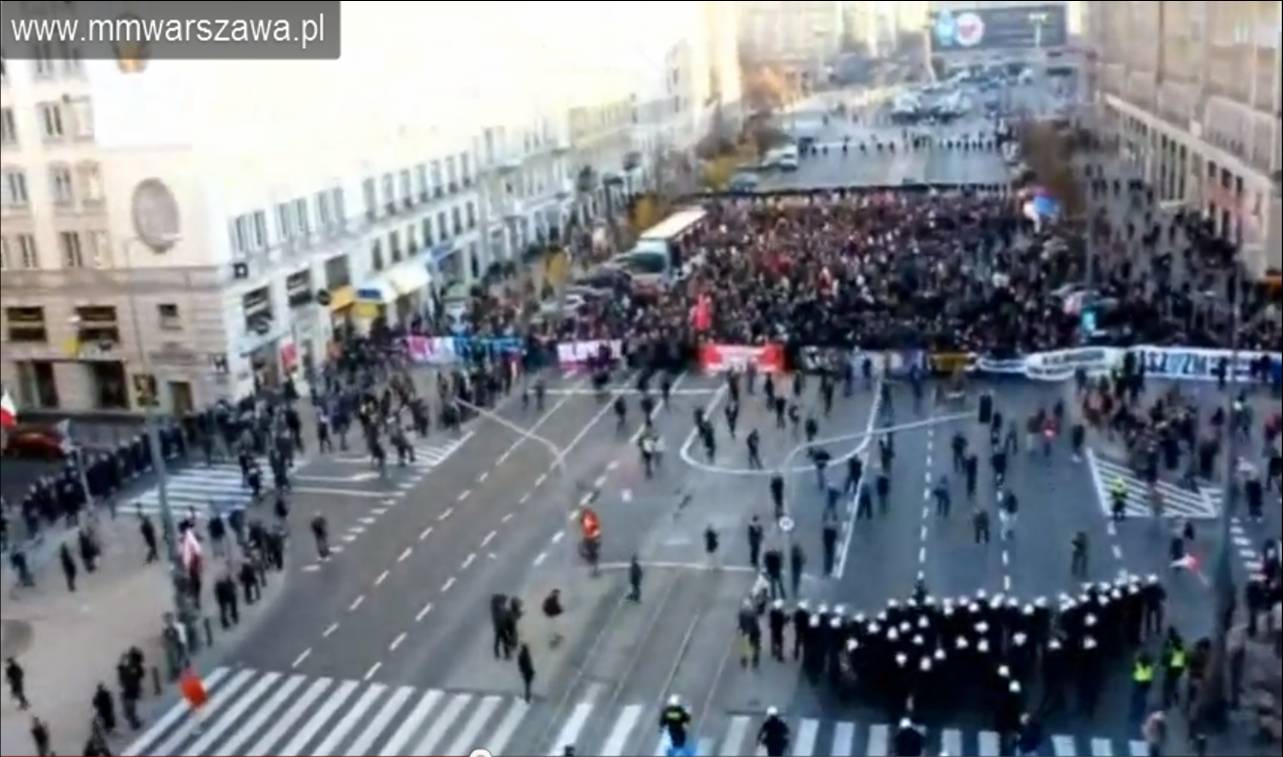
In November 2011, Polish firm RoboKopter filmed striking images of a political demonstration in Warsaw using a video camera attached to a drone or unmanned aerial vehicle (UAV).
The New York Times heralded the footage as signalling the arrival of ‘drone journalism’. Since then, we haven’t seen many newsgathering drones in UK skies, but we might well be seeing them some time soon.
Drones have been receiving more attention in recent months usually in the context of military operations. The Bureau of Investigative Journalism has been tracking the controversial use of drone strikes by the US military in Afghanistan, Pakistan and Africa. It has also emerged that the RAF were flying US drones during the conflict in Libya last year.
But much smaller UAVs – whether fixed wing or rotary – are now being used in civilian settings not for targeted killing but for image gathering. Last week, BBC Newsnight explored some of the issues around civilian drones and earlier in the year, Al Jazeera English filmed a training exercise with the German fire brigade which showed how UAVs could support firefighting.
I understand that several media organisations in the UK have already started to explore how they could use UAVs for newsgathering.
UAVs for Aerial Newsgathering
Aerial footage is not new of course, but UAVs are much smaller than helicopters allowing them to provide imagery from previously inaccessible locations.
The fact that they are unmanned also means there is no risk to a journalist or pilot. The latest models are being equipped with high definition technology allowing them to potentially provide stunning footage of national celebrations, political protest, natural disasters and conflict.
Safety, legality and ethics
The use of UAVs for newsgathering nevertheless raises a host of practical, legal and ethical issues. Question marks remain over safety concerns and the reliability of the technology, although the UAV industry is developing features such as an automatic ‘return to base’ function if the battery runs out or the operator loses control.
Legally, there is already a fairly well-established regulatory framework in place in the UK for flying UAVs which is outlined in guidance issued by the Civil Aviation Authority (CAA).
But this is an evolving area. The CAA’s chapter on ‘Civil Operations, Approval to Operate [UAVs]’ was completely rewritten in the latest guidance for August 2012. The requirements for ‘the licensing and training of United Kingdom civil Remote Pilots have not yet been fully developed’ and there is no European-wide standard to test UAV pilot competency.
It is likely that larger media organisations will look to fully licensed and CAA approved UAV operators to provide them with a newsgathering capability or apply for their own licenses to operate UAVs. But there is no particular reason why smaller organisations or individual ‘citizen’ ‘drone’ ‘journalists’ couldn’t do the latter and attempt to gather their own footage.
Gizmodo recently featured the (intriguingly named) Spy Hawk RC Glider which allows you to record video from the sky for a mere £250. With a battery life of 15 minutes it’s unlikely to have any heavyweight journalistic applications but we can expect the cost of more sophisticated equipment to come down.
Ethically, UAVs are likely to compound longstanding editorial dilemmas. It is not hard to imagine scenarios in which the deployment of UAVs for newsgathering is likely to directly invade individuals’ privacy or indirectly facilitate ‘collateral intrusion’.
These concerns might need to be balanced against a ‘public interest’ defence in a situation where it is deemed that the footage reveals serious wrongdoing.
News organisations might then face requests from other organisations for access to video footage. Only last year, the Metropolitan Police asked UK media organisations to handover footage of the London riots, but the police have already been exploring the deployment of their own UAVs and are likely to continue to do so in the future.
Indeed, in a rather strange – but perhaps not unrealistic vision of the future – it is possible to envisage a stand off between a fleet of media-operated UAVs and their police counterparts at the site of a protest or emergency. Newsgathering sorties might have to be coordinated or argued over with ‘rival’ UAV operators or interested parties.
Another possible scenario which raises some profound questions is the use of UAVs in the context of conflict. What would happen if a news organisation flew a UAV from Jordan over the border into Syria? Will opposition activists of the future be streaming live video footage to YouTube shot with UAVs?
Newsgathering UAVs coming soon?
Until now, these have been hypothetical debates set out in ‘future scenarios’ by interested thinkers and there has not been much visible evidence of UAVs being deployed by media organisations in the UK.
But recently I’ve been in contact with several people from the media and UAV industries. Behind the scenes discussions are taking place about UAVs for newsgathering and I think we can expect to see major developments in this area within a year and perhaps even by the end of 2012.
It would not be a surprise to see UAV footage being played out on air in the near future and maybe we’ll run into some of these other issues before too long as well. So watch this space – the one just above your head.
]]>On the one hand, Breivik is gaining another bout of publicity for his crimes.
On the other, the journalist’s role is to document a trial which inevitably has attracted significant public attention.
Although Twitter’s use in court is not new, this is a particularly high profile case which also presents a wealth of potential ethical issues for journalists using the microblogging tool to cover the trial.
I have a new article up at Index on Censorship which explores some of the issues.
Head over there to read more.
]]>After publishing the preliminary results, we invited non-members to participate. The final statistics, published in full below, reveal that there has been no dramatic shift in opinion.
This would suggest – if our survey is any measure – that there is a broad consensus on the key issues around the phone hacking debate. A clear majority not only believe phone hacking was a widespread practice used by more media groups than just News International, but also agree that:
• Illegal practices such as blagging and bribery were accepted as common practice in journalism.
• The Press Complaints Commission should not be scrapped, but instead restructured.
• Prime minister David Cameron’s reputation has been tarnished by the scandal.
• The introduction of new statutory powers over the press is not the best solution.
• The industry of journalism should implement a new code of ethics similar to a Hippocratic Oath.
The only notable change from the premilinary results is that a majority said they believed it was too early to tell whether the phone hacking scandal would fundamentally change the relationship between politics and journalism (in the preliminary survey a majority felt that the scandal would not change the relationship).
Along with the full statistics, we have included some outstanding written contributions that cover media regulation and thoughts on how the phone hacking scandal might end.
We have also collated a series of further written contributions on "the role of investigative journalism", which have been published a seperate page (see here).
Frontline Club would like to take this opportunity to sincerely thank all of those who took the time to participate.
Full results
Of those who responded*, a majority believe:
• It is too early to tell whether the phone hacking scandal will fundamentally change the relationship between politics and journalism (Yes 23%; No 35%; Too early to tell 42%)
• Phone hacking was a widespread practice used by more media groups than just News International (Yes 88%; No 2%; Don’t know 10%)
• Illegal practices such as blagging, bribery etc. were accepted as common practice in journalism (Yes 84%; No 7%; Don’t know 9%)
• That the Press Complaints Commission should not be scrapped, but instead be restructured (Yes 16%; No 9%; It shouldn’t be scrapped, but it should be restructured 65%; Don’t know 10%)
A majority also said they:
• Had confidence in the Media Ethics inquiry committee not to harm press freedoms (Yes 51%; No 19%; Don’t know 30%)
• Did not believe the introduction of new statutory powers over the press was the best solution (Yes 16%; No 63%; 21%)
• Felt David Cameron’s reputation and leadership has been harmed by the scandal (Yes 82%; No 9%; Don’t know 9%)
• Agreed that the industry of journalism should implement a new code of ethics, similar to a Hippocratic oath (Yes 79%; No 17%; Don’t know 4%)
Asked if the introduction of an independent body such as Ofcom be a good idea for print media, responses included:
• No. The more controls that are in place, the less responsibility the individual has for his own code of behaviour. As more controls have been introduced into all areas of society the more it seems that it is someone else’s job to check things. There used to be codes of behaviour, that were understood by the various professions, people used to resign when they abused these. When the story is the all-important thing without the ethical responsibility that goes with this other independent bodies such as Ofcom are only window dressing.
• Yes. It has been proven over and over again that self regulation doesn’t work. The PCC’s weakness has been detrimental to the profession of journalism and damaged its reputation over the past 20 years, culminating in the current crisis. An independent, credible, authoritative body would not only keep the press in line, but also keep politicians from abusing their position vis a vis the media, since they will know their conduct or collusion with the media would more likely come under scrutiny. Ofcom has broadly been successful in regulating broadcasting without bringing in censorship or tipping the balance towards politicians. A similar body could achieve the same success. It can’t do a worse job than the PCC.
• No. I cannot see what powers it could use to prevent the sort of abuses now under discussion. This is a fundamental failure of ethical behaviour – that is a societal problem that cannot be legislated against.
• Depends if it will have any teeth. Fine line between upholding standards and constricting the freedom of the press.
• No. There are already laws against invasion of privacy, bribery, etc. They just need to be enforced. And news outlets should all adopt their own ethics policies, with punishments, including sacking, for those who violate them.
Asked to propose a change to media regulation in the UK, contributions included:
• The NUJ’s Code of Conduct should be recognised by employers. Media workers should be protected from bullying employers so that they are not forced to work in ‘a culture of fear’ (NOTW) and can resist unethical practices. This also has implications for proper training. I work in a university that trains journalists – we could all do better on this. There’s not enough discussion about ethics, nor about media history, from which lessons can be learned.
• Give the PCC some teeth. In particular the right to take total control of the front page of any publication. The right to create editorial content in the name of any publication, and have that publication print that editorial, as its own, in a place in the publication of the PCC’s choosing. To refer to the courts any publication that does not comply, or has committed wrongs too great to be put right with the above remedies.
• I’d like to see something that regulates communication between the police and the papers. I was talking to a friend who was caught in a scandal and the police told her not to say a word about the case. By the time she left the police station and got back to her flat the tabloids were camped outside and had already tried to interview her father. Surely that must be stopped.
• I’d abolish the PCC, of course. I’d establish a regulator like the ASA [Advertising Standards Authority], with a very strong independent element. A majority of people making any decision should not be press or media figures, and no members should be appointed or recommended by the press, or currently working in it. It should not be in any sense optional for the press to submit to it – if you’re a registered newspaper, it should have jurisdiction over you. It should have very strong and flexible powers – to obtain documents, to have questions answered. Critical is the power to prohibit publication, and to impose an unlimited fine. I doubt it would need to use these powers – but the public could have no confidence in it unless it has them. It should certainly be backed by statute. If need be it should also be backed (like the ASA is by the OFT [Office of Fair Trading]) by Ofcom. This regulator would regulate content, and n
ewspapers and magazines.In addition, I’d establish a General Council of Journalism, like the Bar Standards Board (BSB) or General Medical Council (GMC) as a regulator of individual journalists, admonishing them or even striking them off for unacceptable professional conduct, just as the BSB or the GMC do for people in other professions. Professions that are subject to this kind of thing see them a s a guarantee of quality – so should journalists. They should grow up, and stop being afraid of these sorts of professional conduct controls. This "GCJ" should publish standards, and then should enforce them. This body (unlike the content/organisation regulator) should have a majority of working journalists on it. However, they should be appointed individually, and on merit, and they should reflect all levels of the profession, including trainees and even students. There should also be a strong independent component: it should not be possible for journalists alone to adopt standards without the agreement of lay members of the GCJ, and professional conduct committees should be chaired by a lay member, with a mixed membership (lay and journalist) making every decision. The GCJ should have to disclose the fact whenever a decision is made with only journalists in favour of it.
• I would change the libel laws, which currently prevent journalists from reporting important issues that are in the public interest (eg: Trafigura case). There needs to be a way of separating out the exposure of corruption/wrong-doing by a company such as Trafigura and the exposure of some footballer’s sexual habits. The latter is not necessarily in the public interest, unless he has a campaign to tell young people to be faithful to their spouses or somesuch. The former is.
• The fit and proper test applied to owners, editors and board members.
• Improve the right to privacy. France’s privacy laws are tougher than those in the UK but France remains a thriving democracy, even if we Brits don’t like to admit it.
• Hold the press accountable for incorrect or malicious reporting.
• Create an independent regulator that is neither for or against the press, but is genuinely independent.
• To have a [regulatory] body with more ability to act – more teeth.
Asked how the phone hacking scandal would end, answers included:
• People will go to jail, tabloid journalists will behave themselves for a little while, then bad practices will creep back in.
• We shouldn’t get too euphoric about the sudden outbreaks of nobility we’ve seen lately. The moral of the story thus far is still "don’t get caught" and "change your PIN". And other forms of illicit information gathering (emails etc) haven’t come under much scrutiny yet. But the death of the Screws and the postponement of Rupert Murdoch’s BskyB majority have changed the landscape pretty dramatically, whatever happens with inquiry.
• Corruptly. All this is water off a ducks’ back. Murdoch will carry on with oodles of power. Cameron will survive in the long term, pretend he’s clean and keep spouting off about The Big Society. The police will continue to support all of it. The public will move on to some horrifying atrocity. The Labour party will lose the next election. And then we’ll all buy some crap tabloid and love the celebrity scandal on the front page.
• With the weakening of News International, and diminution of Rupert Murdoch’s power in British politics. I also think the tabloids may be ‘tamed’ to some extent but the danger is that important investigative reporting in the public interest will be caught in the same net.
• Whitewash with a few scapegoats but no one higher up held accountable
• A series of mid-level resignations and (some) prosecutions at several newspapers, a significant lessening of the influence of the Murdoch press in particular on British politics, and (hopefully) a reining in of the tabloid press’ intrusions into the private lives of minor public servants and a comprehensive discussion about the definition and meaning of ‘the public interest’ in British journalism.
• There will be a lot of early retirement (on full pensions of course) of many older hacks, of many more papers than have been implicated right now. There will be some calls for an independent press. Give it two months and it will all be forgotten.
• The ultimate outcome of the scandal does not appear obvious at this early stage in the investigation, but I would not be surprised if employees and management at other News Corporation subsidiaries or other companies such as The Daily Star are found to have a similar track record of malfeasance. Once all the documents of legally or ethically questionable activity have been examined, a large share of the presently established news media will have been forced to close or restructure — nothing less than a sea change among the British press.
• In 24 months we will have forgotten all about it.
• Hopefully with all of those responsible – police, journalists, private investigators – being brought to court and pleading not guilty, so that the full facts of these cases come out in court. And then long, exemplary jail sentences for those found guilty.
• It will be old news at some point. Old scores will have been settled and new ones started. It will be referred by the sanctimonious to grab moral high ground when it is useful. Although it is extremely serious, it is being treated as a drama that devalues the important ethical implications.
We also asked respondents to tell us what they thought was the role of investigative journalism. We have published these responses separately on this page.
* The survey results are based on the contributions of 57 respondents, gathered between 25 July – 10 August 2011.